Narcissistic Dependency Workplace: Leaving Feels Impossible
How Employees Are Made to Feel They Can’t Leave

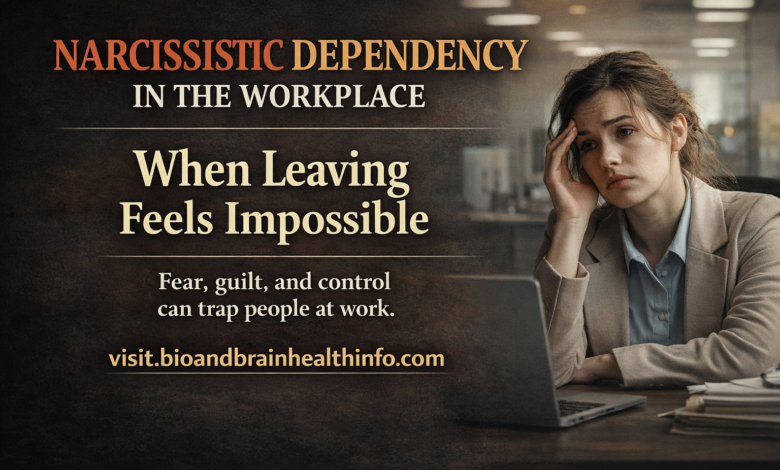
Narcissistic dependency workplace dynamics often form through dependency creation, fear of leaving, power imbalance, and emotional control that quietly limit choice and confidence at work.
Thank you for reading this post, don't forget to subscribe!“When staying feels safer than leaving, the body tightens around the familiar.
Even after leaving, the nervous system can stay on alert because it learned unpredictability as normal. Regulation returns through consistency, not force.”
Narcissistic Dependency in the Workplace
Narcissistic dependency workplace dynamics often create a quiet fear: “Why does leaving feel impossible, even when I’m unhappy?”
Many employees experience dependency creation that slowly narrows options, while fear of leaving grows louder than dissatisfaction.
A power imbalance can make stability feel conditional, and emotional control may be mistaken for loyalty or responsibility. The misunderstanding is painful—confusing trauma-based adaptation with personal identity.
Feeling unable to leave does not mean you are weak, incapable, or dependent by nature. It means your system adapted to uncertainty by clinging to predictability.
This response is not a flaw; it is a learned survival pattern shaped by environment, not character.
This article will help you understand what’s happening — without labels, blame, or self-attack.
REASON FOR THIS BLOG
To explain how dependency can be created in workplace relationships and to separate trauma-based responses from identity—without judgment, diagnosis, or pressure to act.
Please Explore This Detail recovery-after-narcissistic-workplace
INNER SEARCH MIRROR
Before naming anything, many people quietly wonder:
Why does leaving feel scarier than staying?
Why do I feel responsible for this place?
Why does stability feel conditional here?
Why do I doubt I’ll cope elsewhere?
Why does loyalty feel expected, not chosen?
Why does my confidence drop when I imagine leaving?
If these questions feel familiar, they describe a shared human response—not a lack of courage or competence.
PSYCHOLOGICAL EXPLANATION – Narcissistic Dependency Workplace: How the Mind Adapts
In narcissistic dependency workplace dynamics, the mind adapts to environments where security feels earned rather than stable.
Dependency creation works by pairing reassurance with uncertainty, teaching the psyche to equate staying with safety. Fear of leaving grows as options narrow, while power imbalance frames autonomy as risk.
Emotional control subtly rewards compliance, shaping thought patterns toward preservation rather than exploration.
This is not indecision by choice; it is adaptation to conditional stability.
Understanding this separates intent from reaction and removes self-blame—your mind learned how to keep you functioning when predictability felt scarce.
Personal note: Many people feel relief when they see adaptation, not weakness.
| Learned Pattern | Purpose |
|---|---|
| Staying | Preserve safety |
| Compliance | Reduce risk |
| Doubt | Avoid loss |
| Loyalty | Maintain access |
Please Explore This Detail exit-trauma-toxic-workplaces
NERVOUS SYSTEM EXPLANATION – Narcissistic Dependency Workplace and Automatic Responses
Within narcissistic dependency workplace environments, the nervous system reacts before thought.
Dependency creation heightens vigilance; fear of leaving activates fight, flight, or freeze depending on perceived consequences.
Power imbalance keeps the body alert to approval cues, while emotional control pairs relief with compliance.
These reactions are automatic, not conscious decisions.
Common warning signs include:
Tightness when imagining change
Relief after reassurance
Freezing when options appear
Overthinking exit scenarios
Fatigue linked to responsibility
Personal note: Understanding timing often softens harsh self-judgment.
CORE DISTINCTION – Identity vs Survival Responses
This distinction anchors the article.
Survival responses exist to protect stability when loss feels threatening. Identity reflects values, conscience, and capability.
In narcissistic dependency workplace settings, survival may look like staying, self-doubt, or over-loyalty. Identity does not disappear—it is temporarily overshadowed by protection.
Dependency creation pressures survival to lead, fear of leaving narrows choice, power imbalance amplifies risk, and emotional control rewards endurance.
Separating survival from identity restores self-trust. You are not your hesitation—you are the person whose system adapted to preserve safety.
Narcissistic Dependency in the Workplace: Trauma Response vs Self-Labeling
In narcissistic dependency workplace dynamics, a common fear is “What if this means something is wrong with me?”
Dependency creation can mimic personality traits, while fear of leaving resembles indecision. The distinction rests on motivation, not behavior.
A power imbalance pressures protection; emotional control narrows options.
Trauma responses retain conscience even when autonomy shrinks.
| Trauma-Based Response | Narcissistic Pattern |
|---|---|
| Experiences remorse | Lacks remorse |
| Reflects on impact | Avoids reflection |
| Accepts accountability | Deflects accountability |
| Seeks repair | Preserves dominance |
The presence of reflection already answers the fear.
Personal note: Many people feel relief when conscience is named as evidence.
Narcissistic Dependency in the Workplace and Gentle Re-Orientation
After narcissistic dependency workplace experiences, growth is about orientation, not fixing. Dependency creation loosens as inner permission returns.
Fear of leaving softens when stability is no longer conditional. A power imbalance loses its pull as choices widen, and emotional control fades when approval stops setting the pace.
Signs of healing are quiet: fewer spikes of guilt, slower decisions, and a preference for steadiness over reassurance.
Slowing down supports clarity; choosing peace restores agency. This is not withdrawal—it is recalibration. Agency returns through consistency and self-trust rather than urgency.
Personal note: I’ve seen steadiness arrive when pace finally slows.
Please Explore This Detail performance-pressure-narcissistic-workplace
HEALING COMPASS / ORIENTATION TABLE
This compass offers a calm map from confusion to stability after dependency patterns.
These stages describe common experiences, not tasks to complete.
| Stage | Inner Experience |
|---|---|
| Recognition | “Staying feels safer than leaving.” |
| Stabilization | “Predictability helps me think.” |
| Softening | “Guilt eases as choice returns.” |
| Reclaiming | “My confidence widens.” |
| Integration | “Autonomy feels normal again.” |
Each stage affirms capacity rather than demand. Healing unfolds through safety and time, not pressure.
Why Staying Starts to Feel Like the Only Safe Option
In narcissistic dependency workplace environments, staying can slowly feel safer than leaving.
Dependency creation works quietly by pairing reassurance with uncertainty, teaching the system that stability must be preserved.
Fear of leaving grows not because you lack courage, but because predictability has been made conditional. A power imbalance narrows perceived options, while emotional control rewards endurance over exploration.
The breakthrough is recognizing that your hesitation reflects learned safety, not weakness. When security is tied to presence, the mind prioritizes continuity.
Understanding this restores respect for your instincts without requiring confrontation or proof.
Why Confidence Shrinks Over Time
Within narcissistic dependency workplace patterns, confidence often erodes gradually.
Dependency creation shifts decision-making outward, while fear of leaving reframes uncertainty as danger.
Power imbalance teaches the system to minimize risk by staying aligned, and emotional control reinforces doubt when independence appears.
The breakthrough is realizing that confidence didn’t disappear—it was deferred. When choices are consistently filtered through approval, self-trust pauses.
Seeing this prevents harsh self-judgment and explains why capability can feel inaccessible in one environment yet intact elsewhere.
Why Responsibility Starts Feeling Heavy
Responsibility can feel overwhelming in narcissistic dependency workplace dynamics because dependency creation assigns emotional weight to presence.
Fear of leaving turns absence into threat, while power imbalance positions you as essential rather than replaceable.
Emotional control ties relief to staying engaged, making rest feel irresponsible. The breakthrough is recognizing that this heaviness is relational pressure, not moral duty.
When responsibility is inflated to secure continuity, the system carries more than its share.
Naming this allows responsibility to return to a realistic scale.
Why Imagining Exit Triggers Anxiety
In narcissistic dependency workplace contexts, imagining exit can activate anxiety immediately. Dependency creation conditioned safety to proximity, and fear of leaving signals loss before gain.
Power imbalance amplifies perceived consequences, while emotional control warns of instability without approval.
The breakthrough is understanding that anxiety here is predictive, not prophetic. It reflects how safety was learned, not what will happen.
Recognizing this prevents panic and separates anticipation from reality.
Why Freedom Returns Quietly, Not Dramatically
Freedom after narcissistic dependency workplace experiences rarely arrives with certainty.
Dependency creation loosens gradually, fear of leaving softens, power imbalance loses emotional weight, and emotional control fades into background noise.
The breakthrough is noticing quiet shifts—simpler decisions, less justification, more internal reference.
Freedom feels ordinary when it returns because it restores what was always yours.
Authority comes back through steadiness, not rebellion.
Closing Note
If these insights resonate, it does not mean you were dependent by nature. It means your system adapted to stability that felt conditional. With safety and understanding, what adapted can soften again—without force, urgency, or self-attack.
Please Explore This Detail narcissistic-leadership-burnout
Medical / Ethical Positioning — Narcissistic Dependency in the Workplace
In narcissistic dependency workplace contexts, ethical framing protects readers from self-blame and misdiagnosis.
This layer explains how the mind interprets threat, confusion, and meaning when stability feels conditional. Using fear of leaving language clarifies lived experience without labeling people.
Ethical positioning emphasizes education, consent, and stabilization—never confrontation.
The goal is orientation: helping readers understand patterns while preserving dignity and autonomy. Healing begins when experience is explained without pressure to prove harm or act prematurely.
Personal note: Ethical clarity often brings relief before emotional clarity.
| Anchor | Position |
|---|---|
| Role | Education |
| Lens | Non-pathologizing |
| Aim | Restore choice |
| Priority | Safety |
Psychological Layer — Meaning & Interpretation
Within narcissistic dependency workplace environments, the psyche organizes meaning around continuity.
Dependency creation pairs reassurance with uncertainty, teaching the mind to interpret staying as safety.
Confusion becomes internalized as responsibility, and doubt narrows options. This layer explains how interpretation adapts to mixed signals—not because of weakness, but to preserve coherence.
Naming this restores clarity and separates learned meaning from identity.
Personal note: Many feel steadier once confusion is understood as adaptive.
| Function | Shift |
|---|---|
| Interpretation | Safety-weighted |
| Meaning | Conditional |
| Doubt | Internalized |
| Coherence | Preserved |
Nervous System Layer — Automatic Protection
During narcissistic dependency workplace dynamics, the body reacts automatically to perceived risk.
Power imbalance keeps the nervous system alert to approval cues, tightening when change is imagined.
These responses—tension, scanning, freezing—are reflexive protections, not conscious choices.
This layer reframes bodily reactions as intelligence under constraint, restoring respect for the body’s timing.
Personal note: Understanding automaticity often softens self-judgment.
| Reaction | Purpose |
|---|---|
| Tension | Readiness |
| Scanning | Risk detection |
| Freeze | Loss prevention |
| Relief | Approval signal |
Mental Health Layer — Capacity & Endurance
In narcissistic dependency workplace experiences, mental health reflects capacity under sustained pressure. Emotional control can drain clarity and energy by tying relief to compliance.
Over time, self-trust thins—not from incapacity, but from deferred autonomy.
This layer reframes fatigue and indecision as depletion rather than personal failure, supporting realistic expectations for recovery.
Personal note: Naming depletion accurately often restores steadiness.
| Capacity | Effect |
|---|---|
| Clarity | Reduced |
| Energy | Limited |
| Confidence | Deferred |
| Trust | Externalized |
Identity Layer — Inner Continuity & Meaning
Beneath narcissistic dependency workplace patterns, identity remains continuous. Values, conscience, and capability persist even when expression is constrained.
Survival responses manage risk; they do not redefine character. This layer anchors self-trust by separating who you are from how you adapted to conditional stability.
Personal note: Identity often re-emerges when permission replaces performance.
| Element | Status |
|---|---|
| Values | Intact |
| Conscience | Present |
| Capability | Unchanged |
| Worth | Stable |
Reflective Support Layer (Including AI) — Gentle Mirroring
After narcissistic dependency workplace experiences, reflective supports help reorganize meaning without directing action.
Tools like journaling, conversation, or AI can mirror patterns neutrally, allowing insight to surface safely.
Mirroring restores internal reference and supports integration at a humane pace.
Personal note: Reflection feels safest when nothing is pushed.
| Tool | Function |
|---|---|
| Journaling | Externalize |
| Conversation | Normalize |
| AI | Pattern mirror |
| Silence | Integrate |
PERSONAL NOTE – Narcissistic Dependency in the Workplace — A Lived Insight
In narcissistic dependency workplace settings, what clarified things for me was noticing how often I postponed my own judgment.
Dependency creation felt like responsibility at first, while fear of leaving sounded like prudence.
Over time, a subtle power imbalance taught me to check for approval before trusting myself, and emotional control made relief feel earned rather than natural.
The insight wasn’t dramatic: my hesitation wasn’t failure—it was adaptation. When I stopped arguing with my instincts and allowed consistency to rebuild trust, confidence returned quietly.
Understanding the pattern did more than any confrontation ever could.
Please Explore This Detail trust-issues-after-toxic-job
COSMIC / PHILOSOPHICAL TAKEAWAY – Narcissistic Dependency in the Workplace and Human Meaning
“What binds us most tightly is not control, but the promise of safety.”
In narcissistic dependency workplace dynamics, dependency creation, fear of leaving, power imbalance, and emotional control echo a timeless human tradeoff: security versus freedom.
When safety feels conditional, people adapt by narrowing choice to preserve belonging. This narrowing is not loss—it is waiting.
Meaning returns when safety no longer requires permission. Identity does not dissolve under dependence; it rests beneath it.
As consistency replaces conditions, the inner compass reorients without drama.
Healing honors timing over force and clarity over urgency.
FINAL CLOSING – Narcissistic Dependency in the Workplace — Returning to Steadiness
If narcissistic dependency workplace patterns shaped your experience, nothing about your response means you are incapable or weak.
Dependency creation, fear of leaving, power imbalance, and emotional control describe environments that teach caution, not character flaws.
With safety and understanding, what adapted can soften again. You are not required to confront, justify, or rush clarity.
Let this be an invitation to notice small returns of agency—simpler decisions, less guilt, quieter confidence.
Healing grows where self-attack ends and consistency is allowed to restore trust.
FAQ SECTION
1. Why does leaving a workplace feel impossible?
Because stability may have been made conditional, training caution rather than choice.
2. Does dependency mean I’m weak?
No. Dependency can form as a survival adaptation under uncertainty.
3. Why do I feel guilty imagining exit?
Guilt often follows conditional security, not wrongdoing.
4. Is this the same as loyalty?
Loyalty is chosen; dependency often develops under pressure.
5. Can confidence return after leaving?
For many people, yes—gradually and quietly.
6. Why does fear linger even after distance?
Patterns unwind through consistency, not time alone.
7. Do I need proof to trust my discomfort?
No. Discomfort can be valid information by itself.
8. Is neutrality part of healing?
Often, yes. Neutrality can precede steadiness.
9. Can autonomy and belonging coexist?
Yes—when safety does not require permission.
Please Explore This Detail recovery-after-narcissistic-workplace
🌿 Final Blog Footer — Bio & Brain Health Info
Written by Lex, founder of Bio & Brain Health Info — exploring the intersections of psychology, spirituality, and emotional recovery through calm, trauma-aware understanding.
✨ Insight & Reflection
Healing does not begin when answers arrive — it begins when self-attack stops.
Clarity grows in spaces where safety is restored.
🧠 Learn
Narcissism • Emotional Healing • Spiritual Psychology
🌍 A Moment for You
💡 Pause for two minutes. Let your body settle before moving on.
🧭 If This Article Helped, Your Next Questions Might Be:
These questions are natural continuations — not obligations.
✨ Cosmic Family Invitation
You are not here by accident. If these words reached you, clarity was already beginning.
We rise together — different souls, one journey. 🕊️
📩 Connect with us
info@bioandbrainhealthinfo.com
Telegram: @bioandbrainhealthinfo
WhatsApp Channel: Punehealth
Lex | Bio & Brain Health Info
Cosmic Family — Different Souls, One Journey.
REFERENCES & CITATION
Trusted Sources on Dependency, Power, and Workplace Stress
American Psychological Association — Workplace Stress
https://www.apa.org/topics/workplace/stressWorld Health Organization — Mental Health at Work
https://www.who.int/teams/mental-health-and-substance-use/mental-health-at-workHarvard Business Review — Power and Influence
https://hbr.org/topic/powerNational Institute for Occupational Safety and Health (NIOSH) — Work Stress
https://www.cdc.gov/niosh/topics/stressCleveland Clinic — Emotional Manipulation
https://health.clevelandclinic.org/emotional-manipulation/Mind UK — Healthy Boundaries at Work
https://www.mind.org.uk/workplace/mental-health-at-work/Psychology Today — Dependency and Control
https://www.psychologytoday.com/us/basics/dependencyJudith Herman, MD — Trauma and Recovery
https://www.basicbooks.com/titles/judith-herman/trauma-and-recovery/9780465061716/Bessel van der Kolk, MD — The Body Keeps the Score
https://www.penguinrandomhouse.com/books/220128/the-body-keeps-the-score-by-bessel-van-der-kolk-md/