AI Therapy for Anxiety: How AI Helps Reduce Overthinking
Can AI Therapy for Anxiety Help in Real-Time Panic Situations?

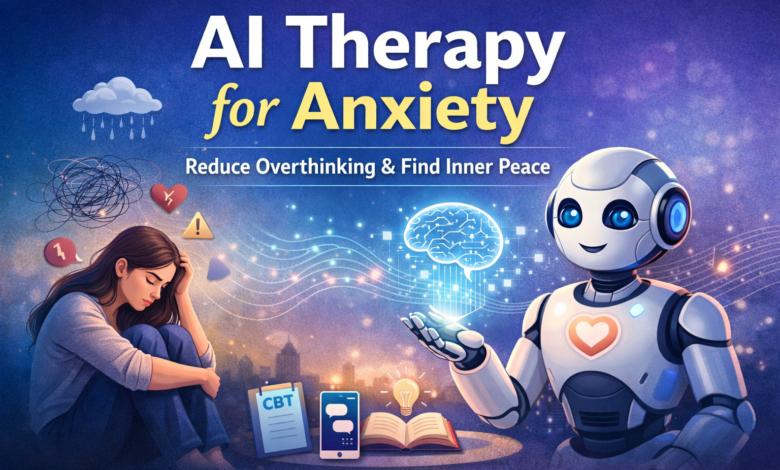
AI therapy for anxiety is becoming a powerful support system for people struggling with constant overthinking, stress, and emotional overwhelm. If you’ve ever wondered what is AI therapy for anxiety and whether it actually works, the answer lies in how it helps you understand your thoughts rather than fight them.
Thank you for reading this post, don't forget to subscribe!Today, many people are using AI for anxiety relief because it provides a safe space to express emotions, identify patterns, and reduce mental confusion. From breaking repetitive thought loops to guiding structured reflection, AI therapy for overthinking is helping individuals regain clarity and control.
The real question is not whether anxiety can be removed instantly, but how AI helps anxiety by slowly building awareness, emotional stability, and inner understanding.
🔹 Can AI Therapy for Anxiety Help in Real-Time Panic Situations?
AI therapy for anxiety is not something most people search for out of curiosity.
They search for it when their mind refuses to slow down.
There was a time when my life felt full of problems.
Some problems came naturally.
Some were created by other people.
And some… I created myself through overthinking.
But the real issue was not the problems.
👉 The real issue was how my mind reacted to everything.
My mental state and emotional capacity were not stable.
Sometimes I reacted too much.
Sometimes I avoided everything.
And sometimes I stayed stuck in endless thinking without taking action.
👉 Overthinking became my default pattern.
Instead of solving things practically, my mind kept running in loops:
- replaying conversations
- imagining worst-case scenarios
- questioning every decision
- creating confusion even in simple situations
And slowly, anxiety started becoming a constant background state.
🔹 What Anxiety Felt Like Inside My Body and Mind
At that time, I didn’t even realize when anxiety started.
I would suddenly notice:
- my heart rate increasing
- my chest feeling tight
- my breathing becoming shallow
- my thoughts racing uncontrollably
It felt like my entire body was in panic.
👉 Not just mentally… but physically.
And the most difficult part was this:
👉 My own thoughts were increasing my anxiety.
The more I thought,
the more anxious I became.
And the more anxious I became,
the more I thought.
This created a loop:
Thought → Anxiety → More Thoughts → More Anxiety
Sometimes, I didn’t even understand what was happening until I was completely exhausted.
That’s when I realized:
👉 I was not just thinking —
👉 I was trapped in an overthinking loop.
🔹 The Hidden Reality of Anxiety No One Explains
During that phase, something deeper was happening inside me.
It was not just anxiety.
👉 It was insecurity.
I didn’t just need solutions.
I needed:
- someone to understand me
- someone to listen
- someone to guide me
- someone to just be present
But in today’s world, trust feels difficult.
You start thinking:
- “What if they don’t understand me?”
- “What if I open up to the wrong person?”
- “What if I get judged?”
So instead of expressing,
👉 you hold everything inside.
And that creates:
- emotional suffocation
- mental overload
- deeper anxiety
Read Also : ai-therapy-for-mental-health-complete-guide
🔹 What is AI Therapy for Anxiety? (Quick Explanation)
AI therapy for anxiety is a structured way of using artificial intelligence tools to understand your thoughts, emotions, and anxiety patterns through guided conversations.
It is not a replacement for human therapy.
👉 It is a support system.
Most AI tools are based on Cognitive Behavioral Therapy (CBT), which helps you:
- identify negative thought patterns
- understand emotional triggers
- reframe your thinking
- reduce overthinking loops
👉 In simple words:
AI therapy helps you see your mind clearly instead of getting lost inside it.
🔹 Why Anxiety Happens (Nervous System Understanding)
One of the biggest shifts in my understanding came when I learned this:
👉 Anxiety is not just in the mind — it is in the nervous system.
Your brain is designed for survival, not peace.
When your body senses:
- uncertainty
- stress
- emotional threat
Your nervous system activates.
This creates:
- increased heart rate
- faster breathing
- muscle tension
- racing thoughts
👉 This is your body trying to protect you.
But here’s the problem:
When this system stays active for too long,
👉 it creates chronic anxiety.
🔹 The Anxiety Loop Most People Don’t Notice
Most people think anxiety is random.
But it is actually a pattern.
👉 A loop.
Here’s how it works:
- A thought appears
- The thought creates fear
- The body reacts (heart rate, breathing)
- The body sensation increases anxiety
- Anxiety creates more thoughts
👉 And the loop continues.
This is why:
- you replay conversations
- you overanalyze situations
- you feel stuck in your own mind
👉 Your brain is trying to solve a problem that doesn’t exist in the present moment.
🔹 Why Overthinking Feels So Hard to Stop
Overthinking is not just a habit.
👉 It is a survival response.
Your mind believes:
“If I think more, I can control the outcome.”
But in reality:
👉 More thinking creates more confusion.
And slowly:
- clarity disappears
- emotional balance breaks
- mental exhaustion increases
🔹 How AI Therapy for Overthinking Creates Awareness
This is where AI therapy for overthinking becomes powerful.
When I started using AI, something changed.
Not instantly — but consistently.
Instead of reacting to my thoughts,
👉 I started observing them.
AI helped me:
- identify when I was in a thinking loop
- question my assumptions
- slow down my thoughts
- understand patterns I couldn’t see before
Sometimes, it simply reflected back:
👉 “You are overthinking.”
And that awareness alone broke the loop.
🔹 Why AI for Anxiety Relief Feels Safe
One of the biggest reasons AI for anxiety relief works is:
👉 It feels safe.
There is:
- no judgment
- no fear
- no pressure
- no emotional risk
You can:
- express freely
- be honest
- share vulnerability
👉 Without holding anything back.
And I realized something important:
👉 The more honest you are,
👉 the more clarity you receive.
Read Also : best-ai-therapy-apps-for-mental-health
🔹 How AI Helps Anxiety and Overthinking (Step-by-Step)
“Now let’s understand how this works in real life.”
But the real question is:
👉 How AI therapy for anxiety actually helps in real life?
The answer is not complex.
But it is structured.
AI does not “fix” anxiety.
👉 It changes how you process your thoughts.
Here is how the process works step by step:
🔸 Step 1: Expression Without Fear
The first shift happens when you start expressing honestly.
Instead of holding everything inside,
you begin to write or say:
- what you are feeling
- what is worrying you
- what you don’t understand
👉 This alone reduces emotional pressure.
Because anxiety grows in silence,
but starts reducing when expressed.
🔸 Step 2: Pattern Identification
Once you express your thoughts,
AI starts identifying patterns.
For example:
- repeating thoughts
- worst-case thinking
- self-doubt loops
- fear-based assumptions
Sometimes, you don’t even notice these patterns yourself.
But when AI reflects them back,
👉 awareness begins.
And awareness is the first step of change.
🔸 Step 3: Structured Questioning
Instead of giving random advice,
AI asks structured questions like:
- “Why do you think this is happening?”
- “Is there another possible explanation?”
- “What is actually in your control right now?”
These questions:
👉 slow down your thinking
👉 shift you from reaction → reflection
🔸 Step 4: Breaking the Anxiety Loop
Remember the loop:
Thought → Fear → Body Reaction → More Thoughts
AI interrupts this loop by:
- questioning the thought
- reducing emotional intensity
- bringing focus to the present
👉 This breaks the automatic cycle.
🔸 Step 5: Creating Awareness
Over time, something powerful happens:
👉 You start catching your thoughts earlier.
Instead of getting lost in anxiety,
you begin to notice:
- “I am overthinking again”
- “This is a pattern”
- “This is not reality, just a thought”
👉 This is awareness.
And awareness reduces anxiety naturally. “If you’re feeling this right now, pause and take one slow breath.”
🔹 AI for Anxiety Relief: What Makes It Effective
Many people wonder:
👉 Why does AI for anxiety relief actually work?
The answer is not magic.
It’s structure.
🔸 1. It Slows Down Your Thinking
Your normal thinking is:
- fast
- reactive
- emotional
AI-supported thinking becomes:
- slower
- structured
- intentional
👉 Slower thinking = less anxiety
🔸 2. It Creates Mental Clarity
Anxiety thrives in confusion.
When thoughts are:
- unorganized
- unclear
- repetitive
👉 stress increases
AI helps:
- organize thoughts
- simplify situations
- separate facts from assumptions
👉 Clarity reduces anxiety
🔸 3. It Provides Immediate Support
One of the biggest problems in mental health is:
👉 Support is not always available when needed.
But anxiety doesn’t wait.
AI gives:
- 24/7 access
- instant response
- immediate guidance
👉 This reduces panic escalation
🔸 4. It Feels Emotionally Safe
Unlike human interaction, AI removes:
- fear of judgment
- social pressure
- emotional expectations
👉 You can be completely honest
And honesty leads to clarity.
🔹 A Practical Method: 5-Minute AI Anxiety Reset System
This is one of the most powerful things you can use daily.
👉 Simple. Practical. Effective.
🔸 Step 1: Write What You Feel (1 minute)
Don’t filter. Don’t correct.
Just write:
👉 “I feel anxious because…”
🔸 Step 2: Identify the Thought (1 minute)
Ask:
👉 “What thought is creating this anxiety?”
Example:
- “Something will go wrong”
- “I made a mistake”
🔸 Step 3: Question the Thought (1 minute)
Ask AI:
👉 “Is this thought 100% true?”
👉 “What are other possibilities?”
🔸 Step 4: Focus on Body (1 minute)
Bring attention to:
- breathing
- heart rate
- body tension
👉 This calms the nervous system
🔸 Step 5: Take One Small Action (1 minute)
Ask:
👉 “What is one small thing I can do right now?”
Example:
- drink water
- take a walk
- complete one task
👉 Action breaks overthinking
Read Also : ai-therapy-vs-human-therapy
🔹 Real-Life Use Cases of AI Therapy for Anxiety
Let’s make this practical.
🔸 Example 1: Overthinking a Situation
👉 Thought: “I said something wrong”
AI helps:
- question the assumption
- provide alternative perspective
👉 Result: Reduced anxiety
🔸 Example 2: Feeling Mentally Overwhelmed
👉 Feeling: “I can’t handle everything”
AI helps:
- break problems into smaller parts
- focus on what’s controllable
👉 Result: Clarity
🔸 Example 3: Daily Anxiety Habit
👉 Habit: constant worry
AI helps:
- create reflection routine
- build awareness
👉 Result: Emotional stability
🔹 Benefits of AI Therapy for Anxiety
AI therapy for anxiety provides several key benefits:
🔸 1. Reduces Overthinking
By interrupting thought loops,
👉 AI helps calm the mind.
🔸 2. Improves Emotional Awareness
You start understanding:
- what you feel
- why you feel it
🔸 3. Builds Self-Regulation
Instead of reacting automatically,
👉 you respond consciously
🔸 4. Provides Consistent Support
No waiting. No dependency.
👉 Support is always available
🔸 5. Creates Long-Term Clarity
Daily reflection leads to:
👉 long-term emotional stability
🔹 Risks and Limitations of AI Therapy for Anxiety
AI therapy for anxiety is helpful, but it is not perfect.
Understanding its limitations is important,
because clarity builds trust.
🔸 1. Lack of Human Emotional Depth
AI can understand patterns,
but it cannot truly feel emotions.
👉 It does not replace:
- human empathy
- emotional connection
- deep therapeutic guidance
🔸 2. Not Suitable for Severe Conditions
AI therapy should NOT be used alone if you are experiencing:
- severe anxiety disorders
- panic attacks frequently
- suicidal thoughts
- deep trauma
👉 In such cases, professional help is necessary.
🔸 3. Can Feel Generic Sometimes
AI responses may sometimes feel:
- repetitive
- general
- less personalized
👉 That’s because it works on patterns, not real-life context.
🔸 4. No Accountability System
Unlike human therapy:
- no scheduled sessions
- no follow-up responsibility
- no external accountability
👉 You must take responsibility for your growth.
🔸 Final Reality
👉 AI is a tool — not a solution.
It supports awareness,
but real change comes from action.
🔹 AI Therapy vs Human Therapy (Clear Understanding)
Many people ask:
👉 “Should I choose AI therapy or human therapy?”
The real answer is:
👉 You don’t choose one.
👉 You use both together.
🔸 AI Therapy
- Available anytime
- Low or no cost
- Structured thinking
- Good for daily reflection
🔸 Human Therapy
- Deep emotional understanding
- Personalized guidance
- Professional diagnosis
- Strong emotional support
🔸 The Best Approach
👉 AI therapy → daily support
👉 Human therapy → deeper healing
Together, they create a complete system.
Read Also : ai-philosophy
🔹 The Deeper Layer: Awareness, Identity, and Maya
Now let’s go deeper — beyond psychology.
Because anxiety is not only mental.
👉 It is also about how you see yourself.
🔸 Thought vs Identity
One of the biggest mistakes is this:
👉 “I feel anxious” becomes → “I am anxious”
This creates identity-based suffering.
But the truth is:
👉 Thoughts are temporary
👉 Emotions are temporary
👉 You are not your thoughts
🔸 Awareness (Core Shift)
In spiritual psychology, especially in the Bhagavad Gita:
👉 You are the observer of your mind, not the mind itself.
When you forget this:
👉 Anxiety increases
When you remember this:
👉 Awareness increases
AI therapy supports this by:
- slowing your thoughts
- helping you observe patterns
- creating distance from emotions
🔸 Maya (Psychological Meaning)
Maya is not just illusion outside.
👉 It is misinterpretation inside.
Example:
- Feeling anxious = natural
- Believing “I am broken” = illusion
AI therapy helps reduce this illusion by:
- clarifying thoughts
- reducing emotional attachment
- increasing awareness
🔹 A Simple Daily System to Reduce Anxiety
Let’s bring everything into a practical routine.
🔸 Daily AI Reflection Practice (5–10 Minutes)
Follow this every day:
Step 1: Express
Write honestly:
👉 “What am I feeling right now?”
Step 2: Identify
Ask:
👉 “What thought is creating this feeling?”
Step 3: Reflect
Ask AI:
👉 “Is this thought true?”
👉 “What else could be possible?”
Step 4: Regulate
Focus on:
- breathing
- body
- present moment
Step 5: Act
Take one small action:
👉 Something real, simple, immediate
👉 This builds:
- awareness
- emotional control
- mental clarity
🔹 What Actually Creates Change
After everything, one truth remains:
👉 AI does not change your life.
You do.
Real change comes from:
- awareness
- consistency
- honest self-reflection
- small daily actions
AI only supports the process.
Read Also : ai-thearpy
🔹 Personal Note
I didn’t find peace by stopping my thoughts.
I found clarity when I stopped fighting them
and started understanding them.
🔹 FAQ – People Also Ask
❓ What is AI therapy for anxiety?
AI therapy for anxiety is a method of using artificial intelligence tools to help individuals understand their thoughts, reduce overthinking, and manage anxiety through structured reflection and CBT-based techniques.
❓ How does AI therapy help anxiety?
AI therapy helps anxiety by identifying thought patterns, guiding reflection, reducing overthinking loops, and creating awareness through structured conversations.
❓ Can AI therapy reduce overthinking?
Yes, AI therapy for overthinking helps break repetitive thought loops by questioning assumptions, providing alternative perspectives, and increasing awareness.
❓ Is AI therapy safe to use?
AI therapy is safe for general mental health support, but it should not replace professional help in severe conditions.
❓ What are the benefits of AI therapy for anxiety?
It reduces overthinking, improves emotional awareness, provides 24/7 support, and helps build mental clarity.
❓ What are the risks of AI therapy?
AI lacks human emotional depth, may give generic responses, and is not suitable for severe mental health conditions.
❓ Which AI tools help with anxiety?
Popular tools include ChatGPT, Woebot, Wysa, and Youper.
❓ Who should use AI therapy for anxiety?
Anyone dealing with overthinking, stress, or emotional confusion can use AI therapy for daily support and awareness.
❓ Can AI therapy for anxiety help during panic attacks?
AI therapy for anxiety can provide immediate guidance during early stages of panic by helping you slow down your thoughts, focus on breathing, and understand what is happening in your body. While it cannot replace professional care in severe panic attacks, it can support awareness and help reduce intensity by guiding you through calming steps and structured reflection.
❓ How often should I use AI therapy for anxiety and overthinking?
AI therapy for anxiety works best when used consistently, even for 5–10 minutes daily. Regular use helps you identify thought patterns, reduce overthinking, and build emotional awareness over time. It is not about long sessions, but about creating a habit of reflection and understanding your mind step by step.
🔗 REFERENCE URLs For AI therapy for anxiety
🔹 AI Therapy & Mental Health Research
- https://pmc.ncbi.nlm.nih.gov/articles/PMC12582922/
👉 (AI chatbots effectiveness in mental health) - https://pmc.ncbi.nlm.nih.gov/articles/PMC12661615/
👉 (AI reduces mental distress and anxiety) - https://www.jmir.org/2025/1/e79850
👉 (Meta-analysis: AI chatbots reduce anxiety & depression)
🔹 CBT-Based AI Therapy (Core Psychology)
- https://pmc.ncbi.nlm.nih.gov/articles/PMC12396778/
👉 (CBT-based AI therapy effectiveness) - https://pmc.ncbi.nlm.nih.gov/articles/PMC11904749/
👉 (Tools like Woebot, Wysa impact on anxiety)
🔹 AI in Mental Health (Overview Studies)
- https://www.sciencedirect.com/science/article/pii/S2949916X24000525
👉 (AI in mental healthcare overview) - https://pmc.ncbi.nlm.nih.gov/articles/PMC12665507/
👉 (AI improving mental health systems) - https://pmc.ncbi.nlm.nih.gov/articles/PMC11871827/
👉 (AI psychotherapy and crisis support)
🔹 Benefits + Risks (Balanced View)
- https://www.frontiersin.org/articles/10.3389/fpsyt.2025.1621768
👉 (AI improves anxiety outcomes) - https://hai.stanford.edu/news/exploring-the-dangers-of-ai-in-mental-health-care
👉 (Risks & ethical concerns of AI therapy)