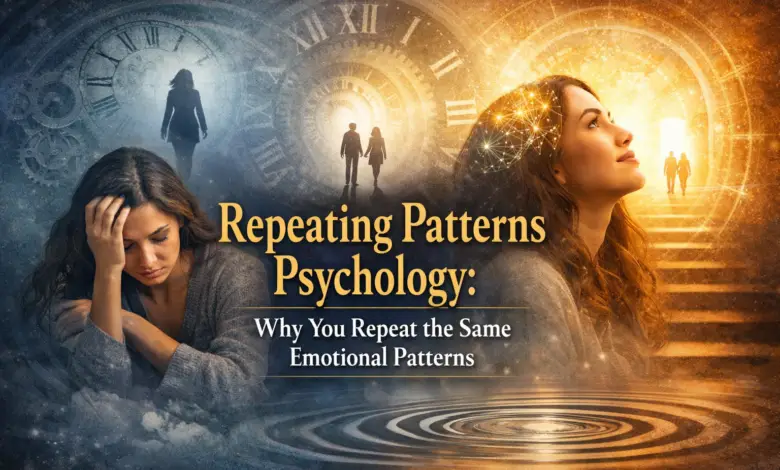
Repeating Patterns Psychology: Why You Repeat the Same Emotional Patterns
10 Reasons Your Thoughts Keep Repeating.

You are not stuck in life — you are stuck in a pattern your mind has learned to repeat. In repeating patterns psychology, this is not random thinking but a structured behavior loop psychology process driven by subconscious behavior patterns that keep bringing you back to the same emotional state.
Thank you for reading this post, don't forget to subscribe!Whether it shows up as overthinking, conflict, or attachment, this emotional pattern repetition is often a form of trauma repetition psychology, where the mind tries to resolve what was never fully understood.
What feels like confusion is actually a loop — and until you see how it works, your thoughts will continue to repeat, no matter how much you try to move forward.
Why You Repeat the Same Emotional Patterns (The Hidden Maya Cycle)
You are not repeating life.
You are repeating unresolved meaning.
In repeating patterns psychology, this is one of the most important truths most people fail to understand. We often believe that life keeps putting us in the same situations, with the same type of people, and the same emotional pain. But when you observe closely, it is not life that is repeating — it is your subconscious behavior patterns that are recreating the same emotional experience again and again.
The situation may look different.
The person may be different.
The timing may be different.
But the feeling remains the same.
That is not coincidence.
That is a behavior loop psychology pattern running silently inside you.
Read Also: Maya Meaning in Psychology: The Illusion of Perception
Why the Pattern You See Is Only the Surface (Repeating Patterns Psychology Explained)
Most people think their pattern is visible.
- conflict with parents
- repeated emotional reactions
- feeling ignored or misunderstood
- stress and pressure in relationships
But in emotional pattern repetition, the visible reaction is never the real pattern. It is only the surface expression of something deeper that has not been understood yet.
The real pattern is not what is happening outside.
👉 The real pattern is what continues to repeat inside you.
This is the foundation of repeating patterns psychology — the mind does not repeat events, it repeats emotional meanings attached to those events.
My Personal Story (The Hidden Layer Behind My Pattern)
For a long time, I believed my biggest pattern was conflict with my parents.
I felt anger.
I felt frustration.
I felt misunderstood.
And many times, I thought:
“Why does this keep happening again and again?”
But when I started observing deeply, I realized something unexpected.
This was not just conflict.
This was a behavior loop psychology pattern built on something much older.
There was a time when my parents were not my conflict.
They were my direction.
When I started my business, my entire motivation came from one place — I wanted to make them happy.
That was not pressure.
That was purpose.
I worked hard.
I pushed myself.
I tolerated stress.
I kept moving forward even when things were not easy.
Because somewhere inside, I believed:
👉 “If I succeed, they will see me.
👉 If I succeed, they will value me.
👉 If I succeed, they will love me more.”
At that time, this belief gave me energy.
It gave me identity.
It gave me a reason to keep going.
When Reality Changes but Meaning Does Not
But life does not always move in the direction we expect.
Slowly, things changed.
The same people who once felt like my source of inspiration…
started becoming the source of emotional pain.
There were moments of rejection.
Moments where I felt used.
Moments where I felt like they did not really care.
And that is where confusion began.
Because in repeating patterns psychology, the mind does not update emotional meaning automatically.
Even when reality changes…
👉 your internal system keeps running the same old definition.
So what happened inside me?
- I still wanted their validation
- I still wanted their approval
- I still felt connected to them as my emotional source
But at the same time…
- I felt anger
- I felt distance
- I felt hurt
This is where emotional pattern repetition begins to intensify.
The Origin of Behavior Loops in Repeating Patterns Psychology
This internal contradiction creates a loop.
A behavior loop psychology pattern forms when:
- emotional investment is high
- expectation is strong
- but emotional return does not match
The mind cannot close that experience.
So instead of letting it go…
👉 it keeps repeating it.
Again and again.
Through thoughts.
Through memories.
Through emotional reactions.
This is exactly how subconscious behavior patterns are created.
Why the Same Thoughts Keep Coming Back
There were moments when I felt:
“They used me.”
“They don’t love me.”
“They don’t even bother about me.”
And these feelings were real.
But in trauma repetition psychology, feelings are not only about the present moment. They are connected to:
- past emotional investment
- expectations that were never fulfilled
- identity built around someone
When that identity gets disturbed…
👉 the system does not stop.
It starts repeating.
Not because you want to suffer.
But because your mind is trying to resolve something that never got completed.
Read Also : Attachment and Suffering: 10 Reasons Your Mind Can’t Let Go
The Real Reason Behind Your Conflict: Meaning Attachment, Not the Situation
At one point, I realized something that changed how I see everything.
My pattern was not conflict with my parents.
👉 My pattern was meaning attachment.
I had attached my growth, my identity, and my emotional drive to them.
So when they changed…
👉 my internal system did not know what to do.
In repeating patterns psychology, this is a critical point — when your meaning is attached to a person, your mind keeps returning to that person, even if the experience becomes painful.
Why You Still Feel Pulled Back
This was the most confusing part for me.
Even when I felt anger…
even when I wanted distance…
👉 I still felt pulled toward them.
And this is where I understood something deeper about behavior loop psychology.
You are not going back to the person.
👉 You are going back to the meaning you created with that person.
- the inspiration
- the direction
- the emotional energy
Your system remembers what that connection once gave you.
And it keeps trying to return to it.
Even if reality has changed completely.
Why You Feel Pulled in Two Directions (The Emotional Conflict No One Talks About)
This creates a very painful internal state:
- you want connection
- but you also want distance
- you feel attachment
- but you also feel anger
- you want to move forward
- but your mind keeps going back
This is not confusion.
👉 This is emotional pattern repetition combined with trauma repetition psychology.
Your system is running two realities at the same time:
- past meaning
- present experience
And both are clashing inside you.
Final Insight
You are not repeating the same situation.
You are repeating the same emotional meaning attached to it.
This is the core of repeating patterns psychology.
Until that meaning is understood…
- the behavior loop psychology will continue
- the subconscious behavior patterns will continue
- the trauma repetition psychology cycle will continue
Not because life is against you.
👉 But because your mind is still trying to complete a story that once gave you identity… but no longer fits who you are becoming.
Why Your Mind Keeps Repeating the Same Thought Loop
If Part 1 helped you see what is happening, this part will help you understand how it is happening inside you.
In repeating patterns psychology, the mind does not randomly replay thoughts, emotions, or memories. It follows a structured internal system built on subconscious behavior patterns, brain chemistry, and emotional conditioning over time.
What you call “overthinking” is not just thinking.
👉 It is a behavior loop psychology system running automatically.
Behavior Loop Psychology: Why Your Mind Runs on a Repeating System
Most people believe:
“I just think too much.”
But that is not the full truth.
Your system is running a loop that looks like this:
Trigger → Thought → Emotion → Reaction → Reinforcement → Repeat
A small trigger activates an old memory.
That memory creates a thought.
That thought creates an emotion.
That emotion pushes you to react.
And that reaction…
👉 strengthens the same subconscious behavior pattern again.
This is how repeating patterns psychology works — not as random thoughts, but as a structured loop.
Read Also : When Love Becomes Emotional Drain: Relationship Psychology
Why Behavior Loops Feel So Strong: The Psychology Behind Repeating Patterns
The reason this loop feels uncontrollable is because it is not only mental.
It is:
- emotional
- chemical
- and physical
Your brain, your body, and your identity are all involved in keeping this loop active.
That is why simply “deciding to stop thinking” never works.
Because in behavior loop psychology, the loop is not created by decision.
👉 It is created by conditioning.
10 Reasons Your Thoughts Keep Repeating (The Emotional Unawareness Loop)
Before trying to stop the loop, you need to understand what is actually driving it. In repeating patterns psychology, there are specific internal reasons why your thoughts keep coming back, even when you want to move forward.
1. Emotional Attachment Keeps the Loop Alive
The strongest force behind emotional pattern repetition is attachment.
When you emotionally invest in:
- a person
- a relationship
- an expectation
your mind does not easily release it.
It keeps going back to the same thought because something inside still feels connected.
👉 Not logically… but emotionally.
2. Brain Chemistry Reinforces the Behavior Loop
Your brain is not neutral.
It is constantly releasing chemicals based on your thoughts.
- Dopamine creates anticipation
- Adrenaline creates intensity
Even painful thoughts can feel engaging because they activate your system.
In behavior loop psychology, this creates a cycle where your mind becomes used to a certain emotional intensity.
👉 And then keeps returning to it.
3. The “Restart” Illusion Makes You Replay the Same Situation
There is a silent belief inside:
“If I think about it again, I can fix it.”
So your mind replays:
- conversations
- arguments
- situations
Again and again.
This is a core part of trauma repetition psychology — the mind tries to recreate the same situation, hoping for a different outcome.
But instead of resolution…
👉 it creates deeper repetition.
4. Identity Attachment Strengthens the Pattern
Sometimes the loop is not about the event.
It is about who you became because of it.
- “I am the one who was not understood”
- “I am the one who tried the most”
- “I am the one who got hurt”
In repeating patterns psychology, identity becomes part of the loop.
👉 And the mind protects identity… even painful ones.
5. Lack of Emotional Closure Keeps the Mind Active
Your brain does not like incomplete experiences.
So it keeps returning to:
- unfinished conversations
- unanswered questions
- emotional confusion
In subconscious behavior patterns, this creates a continuous loop.
👉 The mind is trying to create closure internally.
6. Familiar Pain Feels Safer Than Unknown Peace
This is uncomfortable, but true.
The brain prefers:
- known pain
over - unknown calm
Because familiar emotions feel predictable.
In emotional pattern repetition, even painful experiences can feel “safe” because they are known.
👉 So the mind returns to them.
7. Nervous System Conditioning Creates Automatic Reactions
Your body remembers patterns faster than your mind.
When something repeats:
- your nervous system starts predicting it
- your reactions become automatic
So even before you consciously think…
👉 your body reacts.
This is where behavior loop psychology becomes physical.
8. External Dependency Keeps Pulling You Back
If your emotional energy or motivation depends on someone:
- parents
- partner
- approval
👉 your system will keep returning to that source.
Even when it hurts.
Because in repeating patterns psychology, the brain prioritizes emotional sources over logical decisions.
9. Meaning Attachment (Your Maya Layer)
This is the deepest layer.
Not just attachment.
👉 Meaning.
If you once defined:
- “they are my reason”
- “they are my motivation”
Then your system keeps returning to that meaning.
Even when reality changes.
This creates a powerful subconscious behavior pattern that is very difficult to break without awareness.
10. Lack of New Direction Keeps the Old Loop Active
The mind needs direction.
If you don’t create a new one…
👉 it defaults to the old.
- same thoughts
- same emotions
- same reactions
In repeating patterns psychology, absence of a new path automatically strengthens the old pattern.
The Shift Most People Miss
At this point, most people try to:
- stop thinking
- distract themselves
- force positivity
But that does not work.
Because the loop is not the problem.
👉 The lack of understanding is the problem.
When you see:
- what is driving the loop
- what meaning is attached
- what is still unresolved
👉 the system starts weakening naturally.
Why Your Mind Feels Against You (But It’s Actually a Behavior Loop System)
Your mind is not trying to hurt you.
It is trying to complete something.
- a broken expectation
- an unfinished emotional experience
- a lost sense of identity
The loop exists because something inside you still feels incomplete.
Closing Insight (End of Part 2)
You don’t repeat thoughts because you are weak.
You repeat them because your system is still running a pattern
that once made sense…
but no longer fits your current reality.
And until you understand that pattern…
- repeating patterns psychology will continue
- behavior loop psychology will continue
- trauma repetition psychology will continue
The Hidden Maya Cycle Behind Repeating Patterns
By now, you understand that in repeating patterns psychology, the mind does not repeat thoughts randomly. It repeats what still holds meaning.
But there is one deeper layer most people miss.
That layer is what we call Maya.
Not as illusion in a simple sense…
but as a misalignment between reality and the meaning you continue to hold.
Maya is not fake.
👉 Maya is when something real from your past continues to control your present even after its role in your life has changed.
How the Maya Cycle Actually Forms
Every subconscious behavior pattern that keeps repeating follows a hidden structure:
- A real experience happens
- You create meaning from it (“this is my source”)
- Your identity attaches to that meaning
- Time passes, reality changes
- But the meaning inside you does not update
So your system continues to behave as if nothing has changed.
👉 This is the Maya cycle inside repeating patterns psychology.
Seeing Your Story Clearly: The Truth Behind Your Emotional Patterns
When you look at your own experience without judgment, the pattern becomes simple.
Your parents were not just people in your life.
They became:
- your inspiration
- your emotional center
- your reason to move forward
That was real.
That gave you energy.
That shaped your identity.
But when reality changed — when distance, rejection, or emotional disconnection entered — your internal meaning did not change at the same speed.
So now you are living in two layers at once:
- a past where they were your source
- a present where they are your pain
And your system is trying to reconcile both.
Read Also: Start Here – Your Journey to Mental Clarity & Emotional Healing
Why Love and Resistance Exist Together (Emotional Pattern Repetition Explained)
This is where confusion becomes intense.
You feel:
- attachment and anger
- connection and rejection
- need and resistance
At the same time.
This is not emotional weakness.
👉 This is a direct result of emotional pattern repetition and trauma repetition psychology working together under the Maya cycle.
Your mind is not confused.
It is trying to protect both:
- the old meaning
- and the new reality
And that creates internal friction.
The Insight from the Gita (Practical, Not Theoretical)
The Bhagavad Gita does not ask you to reject relationships.
It asks you to understand attachment.
One of its core teachings is simple:
👉 You suffer not because of action…
👉 but because of attachment to outcome and identity.
In your case:
- your action was growth
- your intention was genuine
- your effort was real
But your attachment was:
👉 “They must remain my source of meaning”
And when that did not happen…
👉 the system started collapsing.
What Detachment Actually Means (Clear, Practical)
Detachment does not mean:
- ignoring people
- suppressing emotions
- disconnecting from relationships
Detachment means:
👉 separating your identity from your source
It means understanding:
- they were part of your journey
- but they are not your foundation
This is where repeating patterns psychology begins to change.
Because once identity shifts…
👉 the loop weakens.
The Real Cause of Repeating Patterns (A Blame-Free Psychological View)
Your problem is not your parents.
Your problem is not your past.
Your real problem is:
👉 your meaning is still attached to a source that is no longer stable.
When your internal system depends on something external…
👉 your stability becomes dependent too.
And this is where behavior loop psychology continues.
The Turning Point (Clarity Over Emotion)
This is the moment where the shift begins.
Not by forcing yourself to feel better.
Not by trying to fix everything immediately.
But by seeing one truth clearly:
👉 You are not trying to go back to them.
👉 You are trying to go back to the version of yourself that felt driven and complete.
That version felt alive because:
- it had direction
- it had purpose
- it had emotional energy
Now the task is not to recreate the past.
👉 The task is to rebuild that state… without dependency.
How to Break the Repeating Emotional Pattern
Now we move from understanding to rebuilding — calmly, without pressure.
1. See the Pattern Without Judging Yourself
Observe:
- what triggers you
- what thought repeats
- what emotion follows
In repeating patterns psychology, awareness alone begins to weaken the loop.
2.Separate the Person from the Meaning
This is the most powerful step.
They were not your meaning.
👉 They were the trigger through which your meaning was activated.
Your drive did not come from them.
👉 It came from your response to them.
3.Update the Meaning of Your Past
Instead of:
- “they changed everything”
Shift to:
👉 “that phase gave me direction, and now I need to build that direction consciously”
This reduces the intensity of trauma repetition psychology.
4.Rebuild Internal Direction
Earlier:
👉 “I grow for them”
Now:
👉 “I grow because I understand my path”
Start small.
- one action
- one decision
- one commitment
Consistency builds identity.
5.Create a New Emotional Anchor
Your system needs stability.
Not from people.
Not from approval.
👉 From clarity, self-respect, and direction
Without a new anchor…
👉 subconscious behavior patterns will pull you back again.
Read Also: Maya & Illusion
What Healing Actually Looks Like (Breaking Repeating Patterns Psychology)
Healing is not dramatic.
It is not instant.
It is not emotional relief in one moment.
Healing is:
👉 when the same trigger comes…
👉 but the meaning inside you has changed
And because the meaning has changed…
👉 the pattern does not repeat the same way
Final Integration (Your Core Truth)
You are not stuck in your life.
You are stuck in a meaning that once helped you grow
but is no longer aligned with who you are becoming.
This is the deepest layer of repeating patterns psychology.
Final Closing
You don’t need to go back to your past
to feel motivated again.
You don’t need to fix every relationship
to feel stable again.
You only need to understand:
👉 what that past gave you
👉 what you attached to it
👉 and how to build that within yourself
Because patterns don’t stop when life changes.
👉 Patterns stop when meaning changes.
People Also Ask: Repeating Patterns Psychology & Emotional Loops
1. Why do I keep repeating the same emotional patterns?
In repeating patterns psychology, the mind repeats emotional experiences that were never fully understood or resolved. These patterns are driven by subconscious behavior patterns and emotional attachment.
2. What is a behavior loop in psychology?
A behavior loop psychology pattern is a cycle where triggers create thoughts, thoughts create emotions, and emotions lead to repeated reactions, reinforcing the same pattern over time.
3. Is repeating patterns related to trauma?
Yes, this is called trauma repetition psychology, where the mind unconsciously recreates similar emotional situations to try to resolve past experiences.
4. Why do my thoughts keep looping even when I try to stop them?
Thought loops continue because of emotional pattern repetition and brain conditioning. The mind is trying to process unresolved meaning, not just random thoughts.
5. Can repeating emotional patterns be changed?
Yes, by understanding repeating patterns psychology, increasing awareness, and creating new internal meaning, these patterns can gradually weaken and change.
6. Why do I feel attached and angry at the same time?
This happens due to emotional pattern repetition, where past attachment and present pain exist together, creating internal conflict.
7. What causes subconscious behavior patterns?
Subconscious behavior patterns form through repeated emotional experiences, conditioning, and identity attachment over time.
8. Why do I keep thinking about the same person?
Your mind is attached to the meaning associated with that person, which keeps the loop active in repeating patterns psychology.
9. How does the nervous system affect emotional patterns?
The nervous system stores repeated reactions, making responses automatic, which strengthens behavior loop psychology patterns.
10. How can I break a repeating thought loop?
Breaking the loop requires awareness, separating meaning from people, and building a new internal direction to replace old subconscious behavior patterns.
🌑 FAQ: Repeating Patterns Psychology, Behavior Loops, and Emotional Repetition
1. What is repeating patterns psychology?
Repeating patterns psychology explains why individuals experience the same emotional reactions or situations due to unresolved internal meaning and subconscious conditioning.
2. Why do emotional patterns repeat in relationships?
Emotional pattern repetition occurs when unresolved attachment and expectations continue to influence behavior in new relationships.
3. What is trauma repetition psychology?
Trauma repetition psychology is when the mind unconsciously recreates similar emotional experiences to process unresolved past trauma.
4. How does behavior loop psychology work?
In behavior loop psychology, triggers activate thoughts, which create emotions and reactions, reinforcing the same loop repeatedly.
5. Are subconscious behavior patterns permanent?
No, subconscious behavior patterns can change through awareness, emotional understanding, and consistent new actions.
6. Why do I feel stuck in the same life situations?
Feeling stuck is often due to repeating patterns psychology, where internal meaning and emotional loops recreate similar experiences.
7. Can awareness alone break emotional patterns?
Awareness is the first step, but breaking emotional pattern repetition also requires rebuilding new meaning and direction.
8. Why do I go back to the same emotional triggers?
Your system is conditioned to return to familiar emotional states due to behavior loop psychology and nervous system memory.
9. How do I stop overthinking the same situation?
Understanding the loop, reducing emotional attachment, and creating new focus areas can reduce trauma repetition psychology patterns.
10. What is the role of meaning in repeating patterns?
Meaning is central — in repeating patterns psychology, the mind repeats what it still considers important or unresolved.
🔗 REFERENCE
👉 https://www.apa.org/monitor/2015/03/cover-trauma-repetition
Title: Trauma Repetition and Emotional Patterns – American Psychological Association
👉 https://www.ncbi.nlm.nih.gov/pmc/articles/PMC3181836/
Title: Neural Mechanisms of Repetitive Thought Patterns
👉 https://www.psychologytoday.com/us/blog/theory-knowledge/201902/why-do-we-repeat-emotional-patterns
Title: Why Do We Repeat Emotional Patterns? – Psychology Today
👉 https://www.frontiersin.org/articles/10.3389/fpsyg.2017.01673/full
Title: Emotional Conditioning and Behavioral Patterns in Psychology