Why Does No Reply Hurt? Texting Anxiety Explained
Why Delayed Replies Trigger Attachment Anxiety

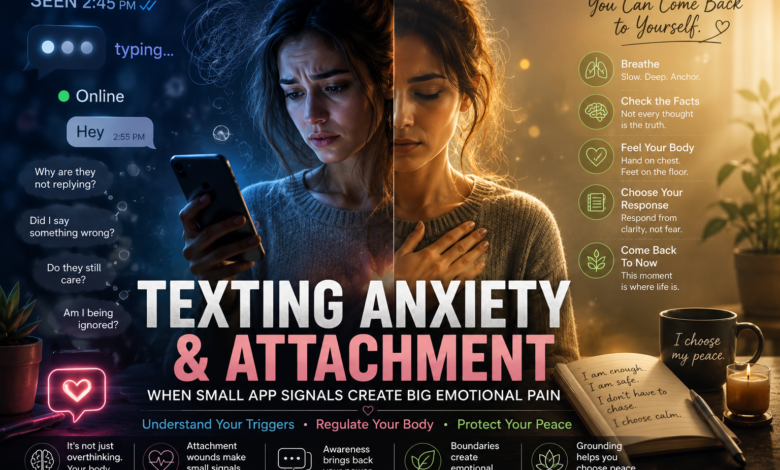
You send a message, put your phone down, and try to continue with your day. But when no reply comes, your attention returns to the conversation again and again. You reread your words, check whether the person is online, and begin asking, “Do they still care?” or “Am I no longer important to them?”
Thank you for reading this post, don't forget to subscribe!This pattern is often called texting anxiety. It may appear as delayed reply anxiety, anxious attachment texting, overthinking text messages, or feeling ignored texting when silence begins to feel like rejection.
For some people, the distress does not stay inside one conversation. It can affect food, sleep, self-care, concentration, body tension, anger, and even other relationships.
This blog explains why unanswered messages feel so painful, how the nervous system reacts to uncertainty, when silence may reflect an unhealthy communication pattern, and how to regain emotional balance without losing dignity, clarity, or peace.
Why Texting Anxiety Can Make Silence Feel Like Rejection
Texting anxiety is not simply impatience about receiving a message. The deeper pain comes from what the delay appears to mean.
When another person replies quickly and warmly, you may feel connected, remembered, and emotionally secure. When the reply suddenly slows down—or does not come—the mind may interpret that change as evidence that the relationship is also changing.
The silence may begin to say things the other person has not actually said:
- “You are no longer important.”
- “They have lost interest.”
- “You said something wrong.”
- “They are deliberately avoiding you.”
- “The relationship is ending.”
- “Someone else matters more.”
This is how an empty space in communication becomes emotionally full.
The delayed message is one fact. The meanings attached to it may be many.
Your distress may become stronger depending on the emotional importance of the relationship, what was discussed, how vulnerable your message was, and whether the other person has behaved inconsistently before. A delayed response from a casual acquaintance may feel manageable. Silence from someone whose care deeply matters to you may feel almost impossible to ignore.
That difference is important. It shows that texting anxiety is usually connected to emotional meaning, not only screen habits.
Read Also: “fear before dating or texting”
Why Do I Keep Checking My Phone for a Reply?
You may keep checking because your brain expects the next message to bring relief.
The phone is no longer only a device. It has temporarily become the place where you expect to receive reassurance, explanation, affection, apology, or proof that the connection is still safe.
Each time you check, part of you is asking:
“Has the uncertainty ended yet?”
When no message appears, the body may remain activated. You check again because the last check did not provide closure.
This can create a repeating loop:
Send message → wait → feel uncertainty → check phone → receive no relief → imagine rejection → check again
The checking is not proof that you are weak or obsessed. It may be an attempt to regulate emotional discomfort. However, repeated checking rarely creates lasting calm because it keeps your attention tied to the source of uncertainty.
Understand how your body can react before your mind fully processes an emotional situation: nervous-system-and-emotions
Delayed Reply Anxiety Is Often a Reaction to Uncertainty
Delayed reply anxiety often becomes intense because the mind does not have enough information.
Face-to-face communication provides tone, eye contact, facial expression, body language, and the possibility of immediate clarification. Texting removes many of those signals.
A short delay might mean:
- the person is working;
- they are emotionally tired;
- they need time to think;
- they saw the message at an inconvenient moment;
- they do not know what to say;
- they are avoiding conflict;
- they have different texting habits;
- they are withdrawing from the relationship.
The problem is that several explanations are possible, but the anxious mind wants one certain answer immediately.
When certainty is unavailable, it may select the explanation that feels most emotionally familiar—not necessarily the one best supported by evidence.
This is why delayed reply anxiety can become stronger in people who have previously experienced inconsistent care, sudden withdrawal, betrayal, emotional neglect, abandonment, or relationships that ended without honest closure.
The present silence may activate an older emotional memory:
“I have felt this uncertainty before, and it did not end safely.”
The current message may be small, but the emotional history attached to waiting may be much larger.
Why More Thinking Does Not Always Create More Clarity
When something feels unresolved, the mind often believes that additional analysis will produce safety.
You may review:
- your exact wording;
- the time the message was sent;
- the other person’s last response;
- whether your tone seemed demanding;
- whether they were recently online;
- what they posted on social media;
- when their communication pattern changed.
Some reflection may be useful. But once you have reviewed the same limited evidence repeatedly, more thinking usually creates more interpretations—not more facts.
Delayed reply anxiety grows when the mind treats every possibility as a problem that must be solved immediately.
A more stabilising sentence is:
“I do not have enough information yet. I can wait without deciding what the silence means.”
This does not deny your emotions. It prevents uncertainty from becoming an automatic verdict.
What Texting Anxiety Can Do to the Body and Daily Life
Texting anxiety can affect far more than thoughts.
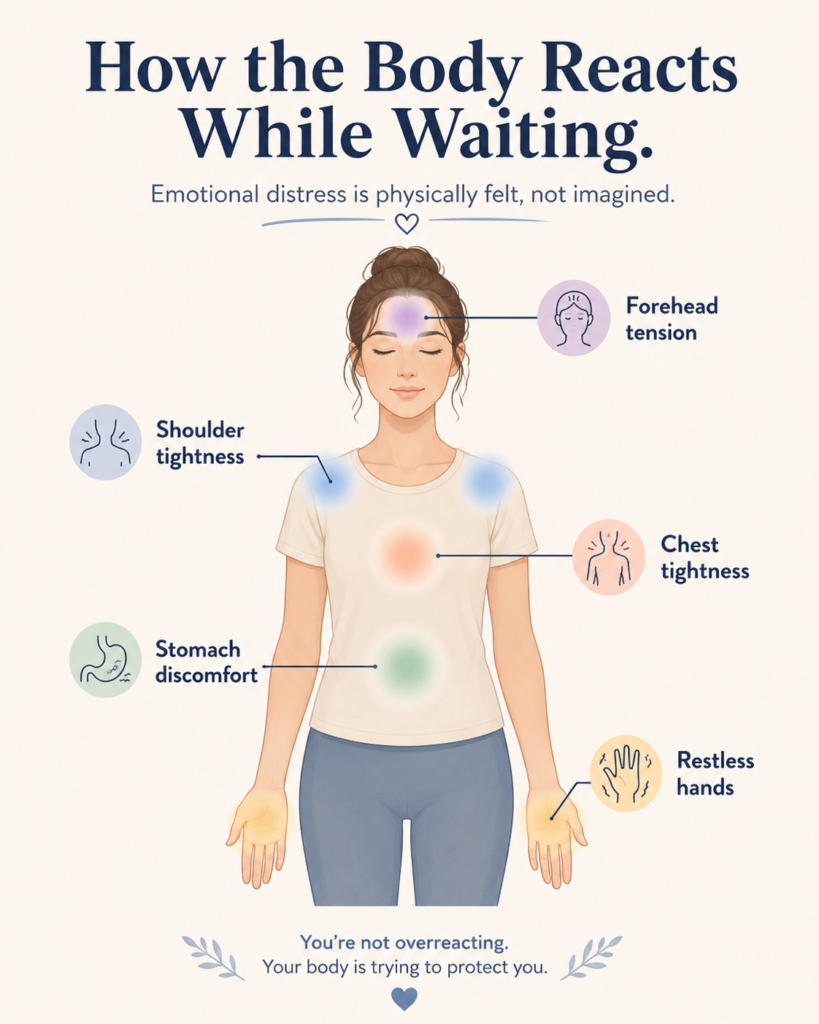
When emotional uncertainty feels threatening, the body may react as if something important must be solved urgently. You may experience:
- tightness in the chest;
- heaviness around the head or eyes;
- an unsettled stomach;
- changes in appetite;
- muscle tension;
- restlessness;
- difficulty sleeping;
- repeated phone checking;
- anger or irritability;
- inability to concentrate;
- difficulty completing basic self-care.
For some people, the distress spreads into unrelated parts of life.
You may become less patient at work. You may react sharply to another family member. You may avoid eating properly, delay bathing, stop exercising, or lose interest in tasks that normally matter to you.
This emotional spillover is one of the most painful parts of texting anxiety. One person’s silence begins influencing relationships and responsibilities that have nothing to do with the original conversation.
It may feel as if your whole emotional system is waiting for permission to continue living normally.
But your food, health, work, sleep, and other relationships should not have to wait for another person’s message.
The Nervous System Wants Resolution, Not Drama
When the body remains activated, people often judge themselves:
- “Why am I making this so serious?”
- “Why can’t I just ignore it?”
- “Why am I so sensitive?”
- “Why does one message control my mood?”
A more compassionate explanation is that your system is looking for resolution.
It wants to know whether the connection is safe, whether the conflict can be repaired, and whether you still matter to the other person. The urgency is not necessarily a desire for drama. It may be an attempt to restore emotional order.
Yet urgency can produce actions that create more distress:
- sending repeated messages;
- apologising without knowing whether you did anything wrong;
- demanding an immediate explanation;
- checking online activity repeatedly;
- withdrawing from other people;
- speaking from anger;
- deciding the relationship is over before having enough information.
The body may be seeking peace, but an activated reaction can move the situation further away from peace.
Read the practical guide to understanding stress activation and returning the body to balance: nervous-system-regulation-guide
Anxious Attachment Texting and the Fear of Emotional Loss
Anxious attachment texting may develop when communication becomes closely connected to emotional security.
A person may be highly sensitive to:
- changes in reply speed;
- shorter messages;
- missing affectionate words;
- punctuation or tone;
- seen status;
- online activity;
- cancelled conversations;
- sudden distance after closeness.
The person is not necessarily seeking constant attention for its own sake. Underneath the behaviour may be a fear that love, interest, or connection can disappear without warning.
The hidden question is often:
“Are you still here with me emotionally?”
When the answer does not arrive, the mind may search for reassurance through more texting. But when reassurance becomes entirely dependent on another person’s availability, the nervous system remains vulnerable to every communication gap.
Anxious attachment texting can create a painful cycle:
- A delay feels threatening.
- Anxiety increases.
- The person sends another message.
- The other person feels pressure or withdraws.
- The withdrawal confirms the original fear.
- More reassurance is sought.
This cycle does not mean either person is automatically bad. One may fear abandonment while the other feels overwhelmed by emotional urgency.
However, understanding attachment must never become an excuse for disrespectful behaviour. A person’s need for space does not justify prolonged punishment, manipulation, deliberate confusion, or disappearing whenever accountability is required.
The Difference Between Needing Space and Creating Emotional Punishment
Healthy space is usually communicated.
It may sound like:
“I need time to think. I care about resolving this, and I will contact you tomorrow.”
Emotional punishment often involves silence without clarity, especially after conflict, while the other person is left guessing whether the relationship still exists.
The difference is not always the length of the delay. It is the pattern, intention, and willingness to repair.
A person may genuinely need several hours or even a day to regulate. That can be healthy. But repeated silent withdrawal, refusing all communication, and returning only when it suits them may create an emotionally unsafe pattern.
Explore how attachment wounds can affect self-worth and make emotional distance feel more threatening: how-to-build-self-esteem-after-attachment-wounds
Overthinking Text Messages: How the Mind Fills Missing Information
Overthinking text messages often begins with a reasonable question and then becomes a mental investigation.
You may ask:
- “Was my message too emotional?”
- “Did I sound desperate?”
- “Should I have used a different word?”
- “Why did they view my story but not reply?”
- “Are they talking to someone else?”
- “Should I delete the message?”
- “Will another text make things worse?”
The mind keeps returning to the conversation because it believes there must be one detail that explains everything.
But written messages are easy to overanalyse because they contain limited emotional context. A full stop may look cold. A short response may appear angry. A late reply may feel deliberate.
Sometimes your interpretation is accurate. Sometimes it reflects the emotional state from which you are reading.
A calm mind and an activated mind can read the same sentence very differently.
Activated Interpretation Versus Evidence-Based Interpretation
| Digital event | Activated interpretation | Evidence-based interpretation |
|---|---|---|
| Reply is late | “They no longer care.” | “I do not yet know why they are late.” |
| Message is short | “They are angry with me.” | “The tone is unclear without more context.” |
| Seen but unanswered | “They deliberately rejected me.” | “They opened it, but I do not know their situation.” |
| They are online elsewhere | “Everyone matters except me.” | “Being online does not always mean being ready for this conversation.” |
| Communication changed | “The relationship is over.” | “A change deserves observation and possibly one calm conversation.” |
This table is not meant to excuse every behaviour. It helps prevent one incomplete signal from becoming absolute proof.
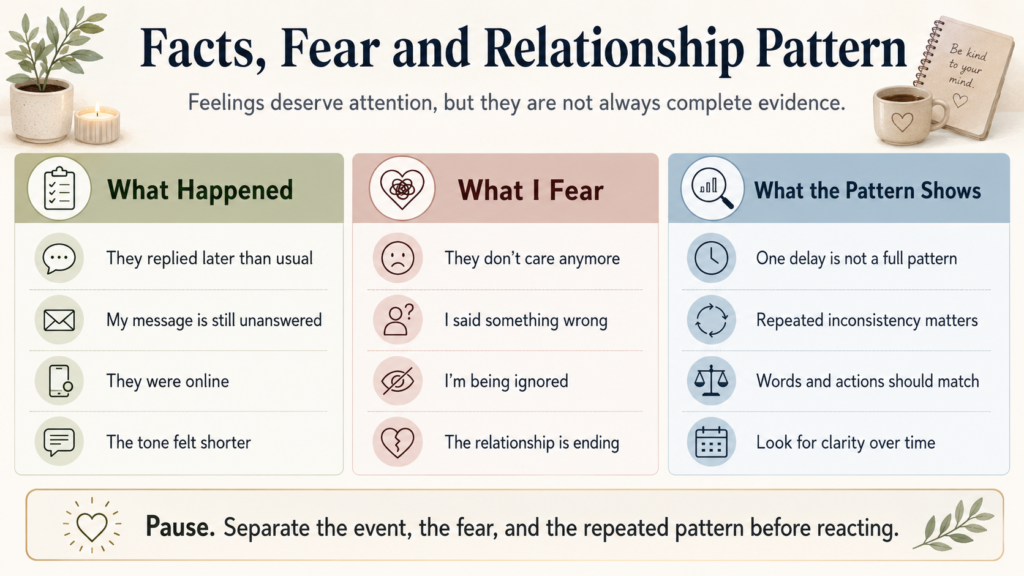
Overthinking text messages becomes less powerful when you separate three layers:
Fact: What objectively happened?
Fear: What am I predicting?
Pattern: What has this person repeatedly shown over time?
That third layer matters. One delayed reply is not the same as a long pattern of emotional disappearance.
Learn how to interrupt repetitive thinking without attacking or suppressing yourself: overthinking-emotional-attachment-mental-chaos
Feeling Ignored Texting: When the Pain Is Not Only in Your Mind
The phrase feeling ignored texting describes a real emotional experience, even though it sounds grammatically unusual in ordinary conversation. People often search this way because they are trying to name what happens when a message is visible but unanswered.
It is important not to reduce every painful experience to anxiety.
- Sometimes the person truly is inconsistent.
- Sometimes they communicate only when they need attention.
- Sometimes they disappear after emotional closeness.
- Sometimes they use silence to avoid responsibility.
- Sometimes they expect you to remain available while offering no predictable care in return.
- Sometimes the silence is part of a larger push-pull pattern that keeps you emotionally invested but never secure.
Your nervous system may be activated, and the relationship may also be unhealthy. Both can be true.
Is It Anxiety or an Unhealthy Communication Pattern?
Ask these questions:
- Is this a single delay or a repeated pattern?
- Do they usually return with a reasonable explanation?
- Can they discuss communication differences respectfully?
- Do they disappear specifically after conflict or accountability?
- Do their words and actions match?
- Do they expect instant access to you but ignore your needs?
- Do you feel calmer over time, or increasingly confused?
- Does asking for basic clarity lead to blame, ridicule, or punishment?
Healthy communication does not require constant texting. It does require enough honesty and predictability for both people to understand the connection.
A relationship cannot be repaired by one person repeatedly searching for closure while the other refuses to participate.
Why Ego and Silence Can Damage a Relationship
When two people care about each other, repair should matter more than winning.
But ego can make people delay necessary conversations. They may wait for the other person to contact them first, refuse to acknowledge hurt, or treat silence as power.
As time passes, the original issue may become less important than the damage created by prolonged emotional distance.
Silence can gradually produce:
- mistrust;
- resentment;
- defensive reactions;
- imagined meanings;
- emotional exhaustion;
- loss of affection;
- a relationship ending without real closure.
Not every disagreement must be resolved instantly. People sometimes need time to calm down. But silence should not become a substitute for emotional maturity.
A respectful pause protects the relationship. Unexplained withdrawal may slowly destroy it.
The 48-Hour Pause for Delayed Reply Anxiety
When emotions are intense, immediate interpretation is rarely your clearest interpretation.
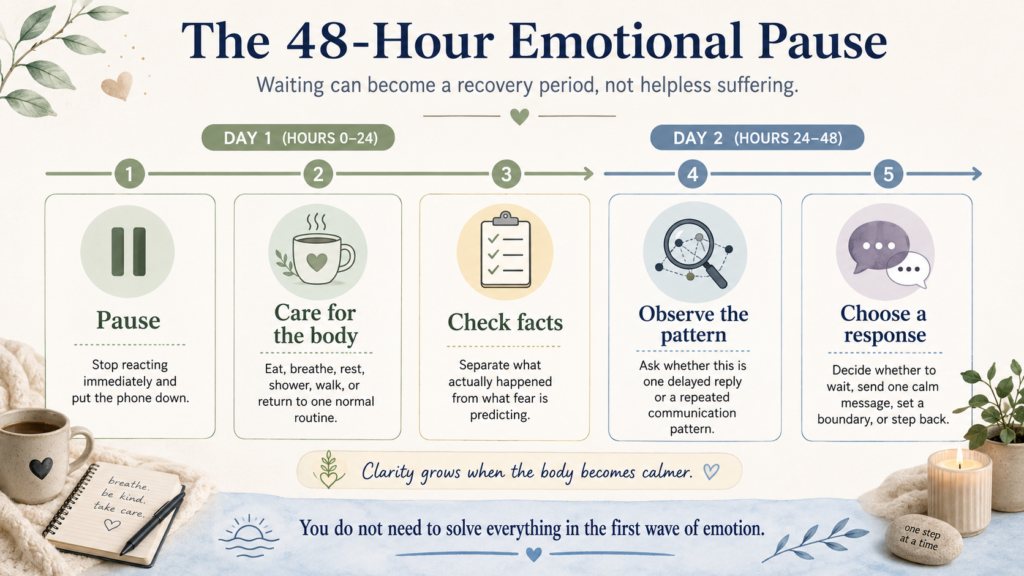
One practical response to delayed reply anxiety is to create a deliberate pause before deciding what the silence means or sending another emotionally charged message.
For some situations, allowing approximately 24 to 48 hours can reduce the first wave of urgency. This is not a rigid rule for every relationship. Urgent practical matters, safety concerns, work deadlines, and established communication agreements may require a different response.
The purpose of the pause is not to play games. It is to give your body and mind enough space to move from reaction toward observation.
During this period:
- Avoid repeatedly checking online status.
- Do not reread the same conversation every few minutes.
- Continue eating, bathing, working, resting, and caring for your body.
- Write down what you know and what you are assuming.
- Decide whether the issue truly requires a follow-up.
- Observe whether the person returns with care, clarity, or continued avoidance.
Time can reveal information that panic cannot.
After 48 hours, the situation may still hurt, but your emotional intensity may be lower. You may see that the delay had an ordinary explanation. You may also recognise that the communication pattern is not acceptable to you.
Both forms of clarity are useful.
What to Tell Yourself During the Pause
Try saying:
“I want an answer, but I do not need to injure myself emotionally while I wait.”
“The silence is uncomfortable, but it does not have to control my food, work, body, or other relationships.”
“I can seek clarity without abandoning my dignity.”
“I will respond to the pattern, not only to the panic.”
These statements do not force false positivity. They protect your ability to think.
How to Calm Texting Anxiety Before You Reply
The goal is not to become emotionally cold. It is to create enough steadiness that fear does not write the next message for you.
1. Put the Phone Beyond Immediate Reach
Place the phone face down or in another room for ten minutes.
This is not punishment or avoidance. It interrupts the automatic checking loop long enough for your attention to return to your body.
2. Name the Exact Body Sensation
Instead of saying, “Everything is wrong,” become specific:
- “My chest feels tight.”
- “My stomach feels unsettled.”
- “My jaw is tense.”
- “My hands want to check the phone.”
- “My body feels afraid of rejection.”
Naming the sensation can create a small distance between the physical feeling and the meaning your mind is assigning to it.
3. Use a Five-Senses Grounding Exercise
Notice:
- five things you can see;
- four things you can physically feel;
- three things you can hear;
- two things you can smell;
- one thing you can taste.
The message may remain unanswered, but your attention returns to the present environment instead of living entirely inside a feared future.
4. Restore One Part of Your Daily Routine
Do one normal action before checking again:
- eat a proper meal;
- shower;
- complete one work task;
- walk for ten minutes;
- call a trusted person;
- feed or sit with your pets;
- read something calming;
- clean one small area.
This sends an important internal message:
“My life is continuing even while this question remains unresolved.”
5. Separate the Need From the Strategy
Your need may be:
- reassurance;
- respect;
- clarity;
- repair;
- consistency;
- closure.
Repeated texting is only one possible strategy for meeting that need—and often not the most effective one.
Once you identify the need, you can choose a healthier strategy: wait, communicate once, set a boundary, seek support, or step away from a repeated harmful pattern.
Using AI Carefully When Overthinking Text Messages
Talking to a reflective AI tool may help when your emotions are intense and you need somewhere to organise your thoughts before responding.
AI can help you:
- name what you are feeling;
- separate facts from assumptions;
- understand why the situation feels so personal;
- create a calmer reply;
- identify whether you are seeking reassurance or clarity;
- consider an alternative interpretation;
- prepare points to discuss with a therapist.
A helpful prompt is:
“Someone has not replied to my message, and I feel rejected. Help me separate confirmed facts from fearful assumptions. Ask me one question at a time, and do not automatically blame me or the other person.”
Another prompt is:
“Help me write one calm message asking for clarity. Do not make it demanding, cold, or overly apologetic.”
AI should support reflection, not become the final authority on your relationship. It cannot see the full context, verify another person’s intentions, diagnose attachment styles, or replace professional mental-health care.
It should also not become another form of compulsive reassurance-seeking. Asking the same question repeatedly until you receive the answer you hope for can keep the anxiety loop active.
Use it to improve clarity—not to eliminate every uncertainty.
Explore practical AI prompts for emotion naming, fact checking, grounding, and mature communication: emotional-growth-ai-self-leadership-tools
What Can You Say When Someone Keeps Replying Late?
You do not need to accuse, beg, or pretend you are unaffected.
A calm message might be:
“I understand that you may not always be available. When communication stops without clarity, I find it difficult to understand where we stand. Could we discuss what response expectations feel realistic for both of us?”
After conflict, you might say:
“I respect that you may need space. I would appreciate knowing whether you want to continue this conversation and when we can return to it.”
If the pattern repeatedly harms you:
“I do not need immediate replies, but I do need consistent and respectful communication. This pattern is affecting my wellbeing, so I need to step back if we cannot address it.”
Send one clear message. Then observe what the person does.
Do not send twenty versions of the same need.
A healthy person may not agree with every expectation, but they should be capable of discussing it without making you feel ashamed for needing clarity.
When Online Communication Requires Extra Caution
Texting anxiety can become especially intense in online dating or long-distance connections because emotional closeness may develop before enough real-world evidence exists.
Words, daily messages, praise, promises, and future plans can feel deeply meaningful. The emotions may be real even when the relationship has not yet been tested through consistent actions.
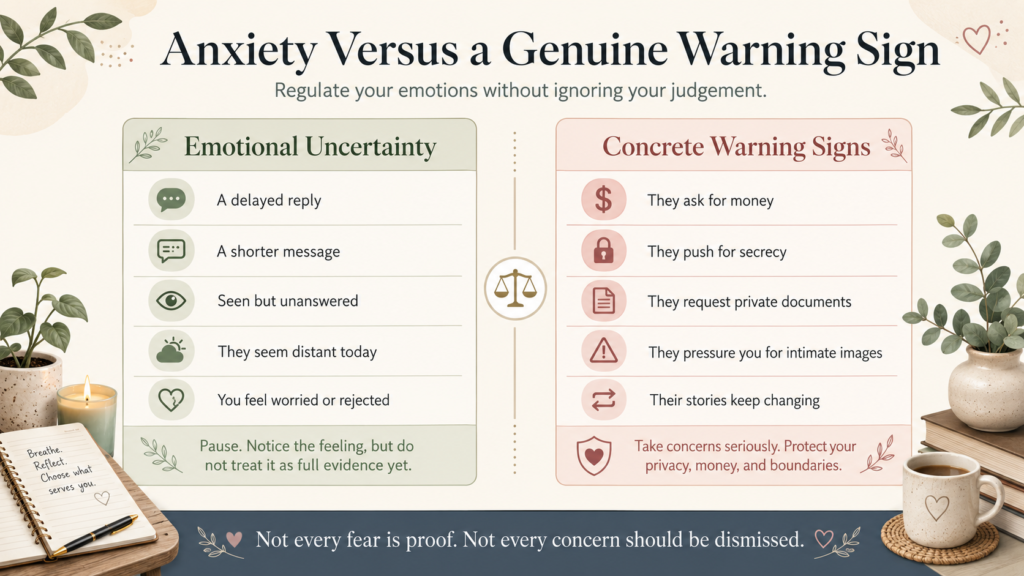
Slow down when someone:
- makes large romantic promises very quickly;
- refuses video calls or realistic meetings;
- repeatedly changes personal details;
- disappears and returns with dramatic explanations;
- pressures you to keep the relationship secret;
- asks for money, investments, financial help, or private documents;
- requests intimate images;
- becomes controlling about your online activity;
- uses affection to create urgency.
Regulation does not mean ignoring red flags.
You can calm your nervous system and still protect yourself.
Do not send money to an online love interest. Avoid sharing financial details, identification documents, passwords, or intimate material. Speak to someone grounded if the relationship is moving quickly or making you feel pressured.
Real care can tolerate reasonable questions and verification.
People Also Ask
Why do I panic when someone doesn’t text back?
You may panic because the silence creates uncertainty about connection, rejection, or emotional safety. Previous experiences of inconsistent care, abandonment, betrayal, or sudden withdrawal can make the present delay feel more dangerous. The body may react before you have enough facts.
Why does being left on read hurt so much?
Being left on read can look intentional because the message appears to have been seen. The mind may interpret this as a conscious decision to ignore you. However, a read receipt does not reveal the person’s emotional state, circumstances, or intention. Consider the full pattern rather than one digital signal.
Is texting anxiety a mental-health diagnosis?
Texting anxiety is not a formal diagnosis by itself. It is an informal term for anxiety, overthinking, physical activation, or attachment-related distress connected to digital communication. Persistent anxiety that interferes with daily functioning may deserve professional assessment.
How long should I wait before texting again?
There is no universal time rule. Consider the urgency of the message, your established communication pattern, and whether a response is practically required. For non-urgent emotional conversations, waiting until you feel calmer—and sometimes allowing 24 to 48 hours—may help you respond more clearly.
Can delayed replies mean someone has lost interest?
They can, but a single delayed reply does not prove loss of interest. Look for a broader pattern: reduced effort, repeated avoidance, inconsistent promises, lack of repair, and unwillingness to discuss the change.
Can anxious attachment affect texting?
Yes. Anxious attachment texting may increase sensitivity to delays, tone, punctuation, read receipts, online activity, and changes in communication. The person may seek repeated reassurance because silence feels connected to possible emotional loss.
Frequently Asked Questions
How do I stop overthinking text messages?
Begin by separating facts, fears, and repeated patterns. Limit status checking, return to one ordinary activity, allow time to pass, and avoid sending another message while highly activated. If necessary, communicate your need once in calm language.
Why does texting anxiety affect my appetite and self-care?
Strong anxiety can produce physical tension, restlessness, stomach discomfort, and difficulty concentrating. Attention becomes focused on resolving the perceived threat, making ordinary routines feel harder. Restoring one small self-care action can help interrupt the cycle.
Is feeling ignored texting always an overreaction?
No. Your emotional response may be intensified by anxiety, but repeated dismissive or avoidant communication can also be genuinely painful. Evaluate both your internal activation and the other person’s consistent behaviour.
Should I turn off read receipts and online status?
Turning them off may help if these features repeatedly pull you into monitoring and interpretation. This is a personal digital boundary, not a cure. The deeper work involves tolerating some uncertainty and evaluating relationships through consistent behaviour.
When should I seek professional support?
Consider speaking with a qualified mental-health professional when anxiety repeatedly disrupts sleep, eating, work, self-care, physical wellbeing, or several relationships. Seek urgent local help if you feel unable to keep yourself safe.
Personal Note: What I Learned From Waiting for Closure
There were times when a delayed reply did not affect only one conversation. It affected my food, self-care, body tension, reactions, and even how I communicated in other relationships.
My mind would ask whether the person still cared or whether I was no longer important to them. I also struggled to understand why people sometimes allow ego and silence to cause so much damage instead of trying to repair the relationship before it becomes too late.
I now understand something important:
“My mind was not trying to destroy me. It was trying to find a positive closure and a peaceful result as quickly as possible, because it believed that certainty would immediately relax me and restore my mood.”
What helped me was allowing more time to pass.
After approximately 48 hours, the emotional intensity often became lower, and I could see the situation more clearly. Talking through my thoughts with ChatGPT or another supportive AI tool also helped me hold the emotion, understand why it affected me so deeply, and consider another perspective before reacting.
I did not always become ready to move on immediately. But I could begin understanding why moving forward might protect me, even when my emotions were still asking the other person for closure.
The deepest lesson was this:
Closure does not always arrive through another person’s reply.
Sometimes closure begins when I stop allowing their silence to control my food, body, work, peace, and other relationships.
Final Takeaway: Texting Anxiety Needs Calm and Honest Reality Checking
Texting anxiety is not proof that you are needy, weak, or incapable of healthy love.
It may mean that digital silence has activated a deeper fear of rejection, inconsistency, abandonment, or unfinished conflict.
- Delayed reply anxiety can make the nervous system demand immediate resolution.
- Anxious attachment texting can turn communication changes into signs of emotional loss.
- Overthinking text messages can fill missing information with painful predictions.
- Feeling ignored texting can also reflect a genuine pattern that deserves attention.
The answer is not to blame yourself or automatically blame the other person.
First, regulate your body.
Then separate facts from fear.
Allow enough time for the first emotional wave to reduce.
Communicate your need once, clearly and respectfully.
Finally, observe the pattern.
Do their actions create growing trust, or growing confusion?
You do not need instant replies from everyone. But you are allowed to value communication that is honest, respectful, and emotionally responsible.
Your feelings matter. Your dignity matters too.
The goal is not to stop caring.
The goal is to care without allowing another person’s silence to take control of your entire inner life.
YMYL Mental-Health Safety Note
This article provides general education and self-reflection support. It does not diagnose anxiety disorders, attachment styles, trauma, or relationship abuse and does not replace advice from a licensed mental-health professional.
Occasional worry while waiting for a reply is common. Seek qualified support when anxiety becomes persistent, difficult to control, or repeatedly interferes with sleep, eating, work, self-care, physical health, or relationships.
If you are in immediate danger or believe you may harm yourself, contact your local emergency service or crisis support service immediately.
Internal Resources For More Reading
Understand emotional reactions in the body: nervous-system-and-emotions
Learn practical nervous-system regulation: nervous-system-regulation-guide
Calm a repetitive thought loop: overthinking-emotional-attachment-mental-chaos
Rebuild self-worth after attachment wounds: how-to-build-self-esteem-after-attachment-wounds
Use AI tools for structured emotional reflection: emotional-growth-ai-self-leadership-tools
Understand why emotional triggers feel larger than the moment: emotional-triggers-explained-why-small-things-hurt-so-much
External References
- National Institute of Mental Health — Anxiety Disorders
https://www.nimh.nih.gov/health/topics/anxiety-disorders - World Health Organization — Anxiety Disorders
https://www.who.int/news-room/fact-sheets/detail/anxiety-disorders - PubMed Central — Attachment Anxiety and Relationship Satisfaction in the Digital Era
https://pmc.ncbi.nlm.nih.gov/articles/PMC12445260/ - NHS Every Mind Matters — Tackling Your Worries
https://www.nhs.uk/every-mind-matters/mental-wellbeing-tips/self-help-cbt-techniques/tackling-your-worries/ - Federal Trade Commission — What to Know About Romance Scams
https://consumer.ftc.gov/articles/what-know-about-romance-scams