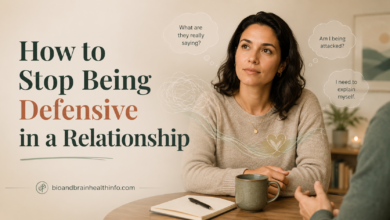
Why Do I Get Defensive in Relationships?
How to Pause Before Reacting and Communicate Safely

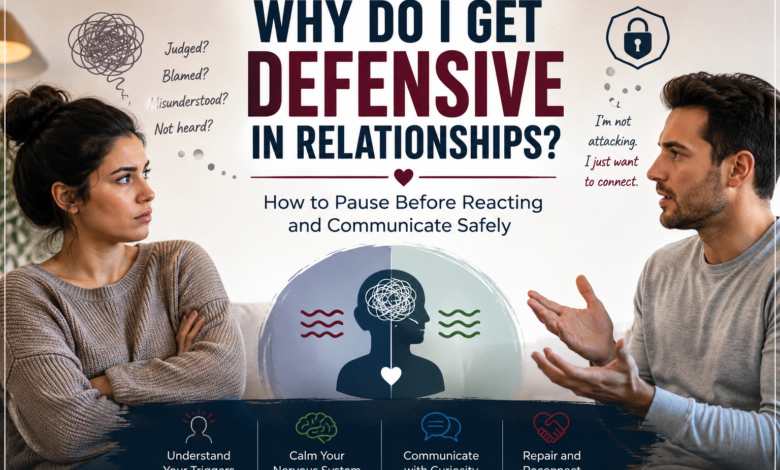
If you keep asking, “why do I get defensive in relationships?”, this blog will help you understand what may be happening beneath the reaction. Being defensive in relationships often starts when you feel judged, blamed, corrected, misunderstood, or emotionally unsafe.
Thank you for reading this post, don't forget to subscribe!Your body may react before your mind can respond calmly, leading to over-explaining, shutting down, arguing, or withdrawing.
This article explains how feeling judged can trigger emotional defensiveness, why your nervous system moves into protection, and how secure communication can help you pause before reacting, ask better questions, and repair conflict without abandoning yourself.
Why Do I Get Defensive in Relationships?
You may enter a conversation wanting to stay calm, but the moment someone sounds critical, corrects you, delays a reply, questions your intention, or says, “You always do this,” something inside your body reacts before you can think clearly.
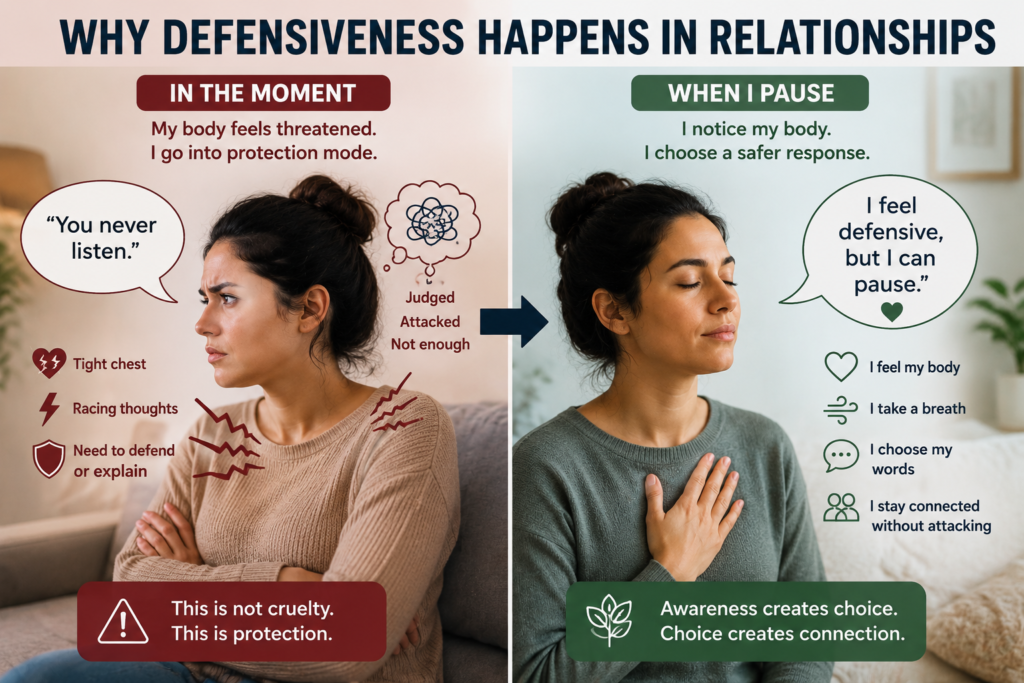
Your chest may tighten. Your voice may become faster. You may start over-explaining, proving your point, blaming back, shutting down, or silently withdrawing because the conversation suddenly feels unsafe.
Later, when the emotional wave settles, you may ask yourself, “why do I get defensive in relationships when I only wanted to be understood?”
The answer is not always simple, and it should not be used to shame you. You may become defensive because your nervous system reads criticism, correction, silence, or disagreement as emotional danger. In that moment, your body may prepare to protect you before your mind has time to choose a calmer response.
Defensiveness can look like explaining too much, interrupting, shutting down, attacking back, becoming cold, or trying to prove that you are not wrong. This does not mean you are a bad person. It may mean something inside you is trying to protect you from feeling judged, rejected, blamed, misunderstood, or emotionally unsafe.
In attachment repair, the goal is not to hate yourself for reacting. The goal is to understand the reaction, pause before it takes over, and learn safer ways to communicate.
This article explains why do I get defensive in relationships, how feeling judged can activate emotional defensiveness, and how secure communication can help you pause before reacting without abandoning your own truth.
Direct Answer: Why Defensiveness Happens
You may become defensive in relationships when your body believes you are under emotional attack. This can happen even when the other person is not trying to attack you.
A partner may ask a question, a friend may give feedback, a family member may correct you, or a coworker may point out a mistake. But if your nervous system hears the message as blame or rejection, your body may protect you quickly.
Defensiveness often comes from four emotional triggers:
| Trigger | What It Can Feel Like Inside |
|---|---|
| Feeling judged | “They think I am wrong or not good enough.” |
| Feeling attacked | “I need to protect myself right now.” |
| Feeling misunderstood | “They are not seeing my real intention.” |
| Feeling blamed | “I must explain before they decide I am the problem.” |
This is why the question “why do I get defensive in relationships” is not only about communication. It is also about emotional safety, nervous system protection, and attachment patterns.
When the body feels threatened, it may move into protection before the mind can respond with calm logic. That protective movement may be fast, sharp, silent, or confusing. Sometimes you may not even realize you are being defensive until the conversation has already become tense.
If this pattern often appears during difficult conversations, you may also find it helpful to understand how conversations can trigger defensiveness so you can notice the pattern earlier instead of only regretting it later.
You May Not Be Trying to Fight — You May Be Trying to Protect Yourself
Many people who struggle with emotional defensiveness are not trying to hurt anyone. They are trying not to feel exposed, ashamed, rejected, controlled, or unseen.
From the outside, defensiveness may look like resistance. From the inside, it can feel like panic.
You may feel:
- Heat in your face
- Tightness in your chest
- Pressure to explain everything
- A stomach drop after a cold reply
- Racing thoughts during conflict
- Fear that you are being blamed
- A strong need to prove your intention
- Sudden silence because words feel unsafe
This is why feeling judged can feel so powerful. Judgment does not only touch the mind. It touches the body. If past experiences taught you that being wrong leads to rejection, shame, punishment, abandonment, or emotional distance, then present-day criticism may feel much bigger than the actual moment.
A partner saying, “You did not listen to me,” may not only sound like feedback. It may feel like, “You are failing me.” A delayed reply may not only feel like a message delay. It may feel like distance, rejection, or emotional threat. A correction at work may not only feel like a small mistake. It may feel like your value is being questioned.
This is how defensiveness begins inside the body.
Read Also: “stop being defensive without shame”
The Nervous System Behind Defensiveness
When you ask, “why do I get defensive in relationships,” one answer is that your nervous system may be reacting faster than your conscious mind.
The nervous system is always scanning for safety and danger. In relationships, danger is not only physical. Emotional danger can also feel powerful. Being criticized, ignored, corrected, blamed, misunderstood, or rejected can activate protection.
This protection may show up as:
| Nervous System Signal | Defensive Pattern |
|---|---|
| Fight response | Arguing, blaming back, raising your voice |
| Flight response | Leaving the conversation, changing the topic |
| Freeze response | Shutting down, going blank, becoming silent |
| Fawn response | Over-apologizing, people-pleasing, giving up your truth |
This is why emotional defensiveness is not only a mindset. It can be a body response.
You may know logically that you want to listen. But your body may already be preparing to survive the emotional moment. That is why telling yourself, “Just stop being defensive,” often does not work. The body needs a safer path, not only a command.
A helpful first step is to name what is happening:
“I feel defensive right now.”
“My body feels activated.”
“I am afraid I am being blamed.”
“I need a moment before I answer.”
This small act of naming helps you move from automatic reaction into awareness. If your body becomes afraid during conflict, the article on how the body holds fear during conflict can help you understand why emotional reactions often feel physical before they feel logical.
How Attachment Patterns Can Make Conflict Feel Bigger
Attachment patterns shape how safe or unsafe connection feels. If you have learned that conflict leads to rejection, abandonment, punishment, silence, criticism, or emotional distance, then disagreement may feel threatening even before anything serious happens.
This does not mean you should label yourself as damaged or diagnose your relationship. It simply means your body may have learned to protect you in certain ways.
If you fear rejection, you may over-explain.
If you fear being controlled, you may push back.
If you fear conflict, you may shut down.
If you fear being misunderstood, you may repeat your point again and again.
If you fear emotional distance, you may react strongly to delayed replies or cold messages.
This is where secure communication becomes important. Secure communication does not mean you never feel hurt. It means you learn to express hurt without immediately attacking, defending, disappearing, or surrendering yourself.
A secure response may sound like:
“I want to understand, but I feel defensive right now.”
“I need a moment so I do not react from fear.”
“I hear that you felt hurt. I also want to explain my intention calmly.”
“Can we slow this conversation down?”
This is not weakness. This is relationship repair with awareness.
When defensiveness is connected to attachment wounds, rebuilding self-trust after attachment wounds becomes important because you need to believe your feelings matter without letting every fear control the conversation.
The Defensiveness Cycle
Defensiveness often becomes a cycle because one person’s protection can trigger the other person’s protection.
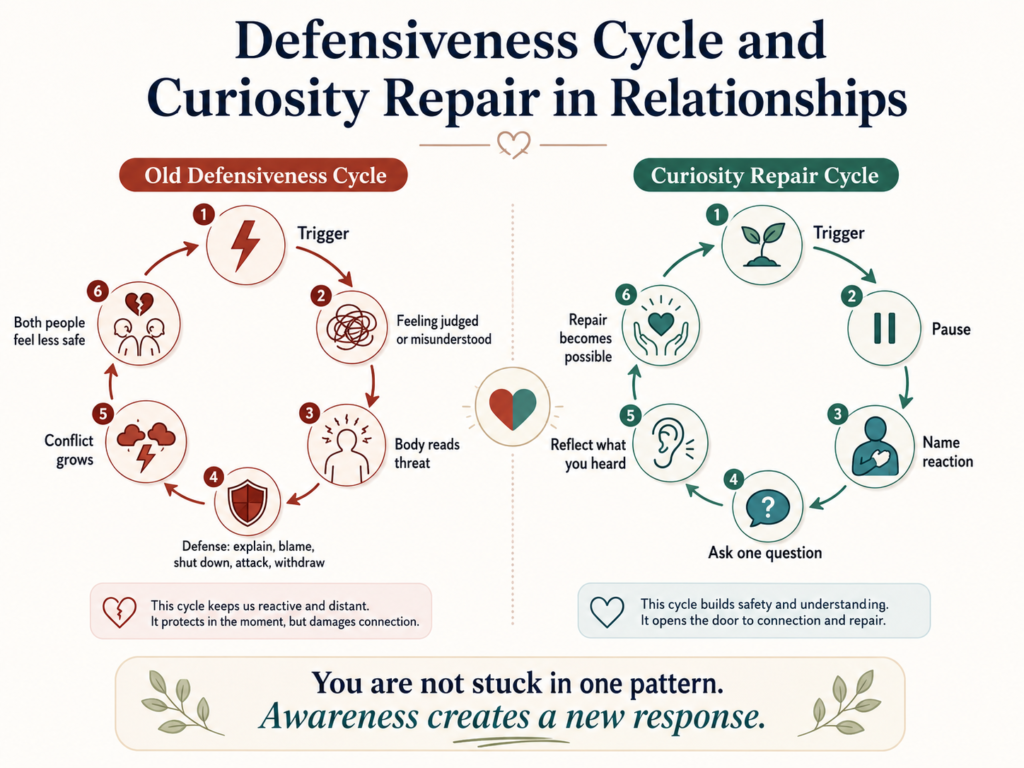
The old cycle may look like this:
Trigger
↓
Feeling judged or misunderstood
↓
Nervous system reads danger
↓
Defense: explain, blame, shut down, attack, withdraw
↓
Other person feels unheard
↓
Conflict increases
↓
Both people feel less safe
When this cycle repeats, both people may start believing the other person is the problem. But often, underneath the argument, both people are trying to protect something: dignity, safety, love, respect, control, connection, or emotional space.
The repair cycle can look like this:
Trigger
↓
Pause
↓
Name the reaction: “I feel defensive”
↓
Ask one clarifying question
↓
Reflect what you heard
↓
Share your truth without attack
↓
Repair becomes possible
This is why why do I get defensive in relationships is such an important question. It is not only asking, “How do I stop reacting?” It is asking, “What is my body trying to protect, and how can I respond more consciously?”
Real Solution Table: From Defense to Secure Curiosity
The goal is not to become perfect. The goal is to create one small pause before the old reaction controls the conversation.
| When This Happens | Your Body May Feel | Defensive Reaction | Secure Curiosity Response |
|---|---|---|---|
| Partner says, “You never listen.” | Tight chest, heat, pressure | “That’s not true. You always blame me.” | “I feel defensive hearing that. Can you tell me one specific moment you mean?” |
| Someone corrects you | Shame, anger, panic | Explaining too much | “I want to understand. Are you saying I made a mistake, or that you felt unsupported?” |
| Text reply feels cold | Anxiety, stomach drop | Accusing or withdrawing | “I noticed I felt worried after your reply. Is everything okay between us?” |
| You feel misunderstood | Racing thoughts | Interrupting, proving | “Can I first repeat what I meant, then hear how it landed for you?” |
| Conflict becomes intense | Numbness, shutdown | Silence or escape | “I need a pause so I do not react from defense. Can we come back to this in 20 minutes?” |
This table matters because defensive in relationships patterns often do not improve through shame. They improve through practice. The body needs new words, new pauses, and new signals of safety.
If you often feel exhausted after explaining, defending, or trying to make someone understand you, the article on why relationships can feel emotionally draining can help you connect defensiveness with emotional exhaustion.
What to Say When You Feel Defensive
When your body is activated, long explanations usually make the conversation worse. Short, honest sentences are better.
| Instead of Saying | Try Saying |
|---|---|
| “That’s not true.” | “I feel defensive, but I want to understand what you mean.” |
| “You always blame me.” | “Can you tell me the specific moment that hurt you?” |
| “I don’t want to talk.” | “I need 20 minutes to calm down, then I want to return.” |
| “You’re wrong.” | “Can I explain how I experienced it too?” |
| “I can’t do anything right.” | “I am hearing this as criticism. Can we slow down?” |
| “Fine, whatever.” | “I am shutting down. I need a pause so I do not disconnect.” |
These phrases help because they do three things:
- They name the reaction.
- They slow the conflict.
- They keep connection open without self-abandonment.
This is one of the most practical ways to answer why do I get defensive in relationships. You are not only learning why it happens. You are learning what to do in the moment when it begins.
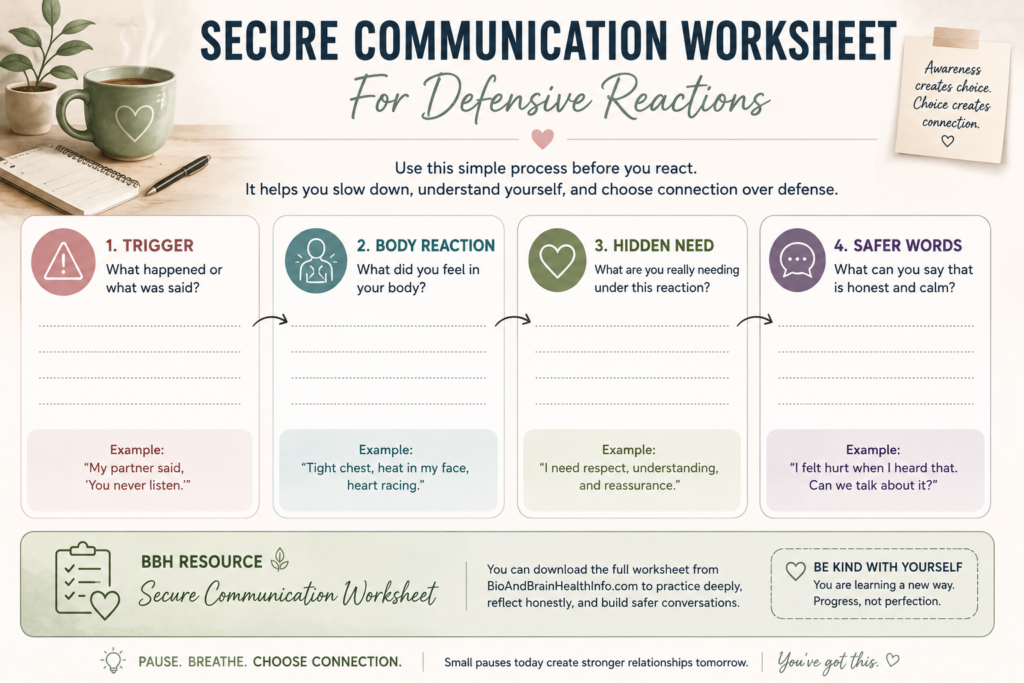
BBH Support Resource
Want a simple tool to practice this?
Download the BBH Secure Communication Worksheet to reflect on your trigger, body reaction, hidden need, and safer words for next time.
This worksheet can help you slow down after a defensive reaction and understand what was happening inside your body before choosing a calmer response.
Email Request Note:
Email info@bioandbrainhealthinfo.com and write:
“Send me the Secure Communication Worksheet.”
If you want to understand your emotional patterns more deeply, you may also explore emotional pain mapping with AI as a support tool for reflection, not as a replacement for therapy or professional care.
Curiosity Is the Pause Between Trigger and Reaction
Curiosity does not mean you accept blame. It does not mean you agree with everything. It does not mean you ignore your pain.
Curiosity simply means you pause before deciding the full story.
Instead of thinking, “They are attacking me,” curiosity asks:
“What did they actually say?”
“What am I afraid this means?”
“What is my body reacting to?”
“What else could be true here?”
“What question can I ask before I defend?”
This is the heart of secure communication. Curiosity gives the nervous system a small bridge between protection and understanding.
When you feel judged, curiosity may sound like:
“Can you help me understand what you meant?”
“Are you upset with me, or are you trying to share something important?”
“What part hurt you the most?”
“Can we talk about this without blaming each other?”
Curiosity is not passive. It is active emotional discipline. It helps you stay present when your body wants to protect you through attack, explanation, shutdown, or escape.
Curiosity Without Self-Abandonment
This part is very important.
Secure communication can support healthier repair, but it cannot replace safety, boundaries, or professional help when abuse, coercion, humiliation, or fear is present.
Curiosity should never become a reason to tolerate repeated disrespect. You can try to understand someone and still say:
“This hurt me.”
“This is not okay for me.”
“I need this conversation to be respectful.”
“I cannot continue if I am being mocked or threatened.”
“I need support outside this conversation.”
Understanding is not the same as excusing. You can understand why someone became angry and still know that cruel words were not acceptable. You can understand why someone withdrew and still ask for honest communication. You can understand why someone felt hurt and still protect yourself from blame.
If your defensiveness appears mostly around a relationship where you feel afraid, confused, emotionally pulled back, or repeatedly hurt, the issue may not be only communication. In that case, it may help to understand why you may miss someone who hurt you so you can separate attachment pain from emotional safety.
This is why the deeper answer to why do I get defensive in relationships is not “because something is wrong with me.” A better answer may be: “My body is protecting something, and now I can learn how to protect myself with awareness instead of automatic defense.”
Curiosity works best when respect is possible. If respect is not possible, boundaries may matter more than deeper inquiry.
Read Also : trauma-recovery-start-your-healing-journey-today
Ask Yourself Before You React
Before you answer, defend, explain, or shut down, try asking yourself:
| Question | Why It Helps |
|---|---|
| Am I responding to what was said, or what I fear it means? | Separates present conflict from attachment fear. |
| Do I feel judged, rejected, controlled, or misunderstood? | Helps name the real trigger. |
| What is my body doing right now? | Brings awareness to nervous system activation. |
| What question can I ask before I defend? | Creates space for curiosity. |
| What boundary do I need if this conversation is not safe? | Prevents self-abandonment. |
These questions are simple, but they are not always easy. When your body is activated, even a three-second pause can feel difficult. Still, small pauses matter. One calmer sentence can prevent an argument from becoming a painful pattern.
Read Also: Relationship → Attachment & Connection, Mental Health → Anxiety & Overthinking, Trauma → Relationship Trauma
People Also Ask
1. Why do I get defensive in relationships?
You may get defensive in relationships because your body reads criticism, correction, silence, or disagreement as emotional danger. In that moment, the nervous system may protect you through explaining, blaming, shutting down, or proving your point. Defensiveness is not always a personality flaw; it can be a protection response when you feel judged, rejected, or misunderstood.
2. How do I stop being defensive in a relationship?
To stop being defensive in a relationship, pause before answering, notice what your body is feeling, and name the reaction calmly. You can say, “I feel defensive right now, but I want to understand.” Then ask one clear question instead of immediately explaining or blaming. This creates space for repair without ignoring your feelings.
3. Why do I feel attacked when my partner criticizes me?
You may feel attacked when your partner criticizes you because criticism can activate shame, fear, or attachment insecurity. Even if the other person is trying to express a concern, your nervous system may hear it as rejection or blame. Learning to separate the present conversation from old emotional fear can help you respond more calmly.
4. What should I say instead of being defensive?
Instead of reacting defensively, try saying, “Can you help me understand what you mean?” or “I feel hurt hearing this, but I want to listen.” You can also say, “I need a short pause so I can respond calmly.” These phrases protect connection while still allowing you to keep self-respect.
5. Can curiosity help repair relationship conflict?
Yes, curiosity can help repair relationship conflict when both people are willing to communicate respectfully. Curiosity helps you slow down assumptions, ask better questions, and understand the emotion beneath the reaction. But curiosity should not replace boundaries if the relationship includes fear, control, humiliation, threats, or repeated harm.
Read Also:- Relationship → Attachment & Connection, Mental Health → Anxiety & Overthinking, Trauma → Relationship Trauma
FAQ
1. Is defensiveness always bad in relationships?
No, defensiveness is not always bad. It is often a protective response when someone feels judged, blamed, or emotionally unsafe. However, if defensiveness becomes the main communication pattern, it can block listening, accountability, and repair.
2. Is defensiveness connected to attachment wounds?
Defensiveness can be connected to attachment wounds, especially when conflict feels like rejection, abandonment, criticism, or emotional danger. This does not mean you are broken. It means your attachment system may be trying to protect you from pain.
3. What is the first step to becoming less defensive?
The first step is noticing the moment your body becomes activated. Before defending, ask yourself, “Am I responding to what was said, or what I fear this means?” This small pause helps you move from automatic protection into conscious communication.
4. Does being less defensive mean accepting blame?
No. Being less defensive does not mean accepting unfair blame. It means staying open enough to hear the other person while also speaking your truth clearly. Healthy repair includes listening, accountability, and boundaries.
5. When is curiosity not enough?
Curiosity is not enough when a relationship involves fear, coercion, humiliation, threats, control, intimidation, or repeated emotional harm. In those situations, emotional safety, boundaries, trusted support, or professional guidance may be more important than trying to understand the other person more deeply.
Personal Note
My healing became easier when I learned to accept that human emotions are not perfect. Everyone has issues, and I do too. I only need to see what hurts, what it is trying to teach me, and how I can respond with more awareness. Spirituality did not only help me calm down; it helped me understand how karma, reaction, illusion, and suffering work inside human behavior.
This does not mean I accept everything as right. It means I no longer treat every reaction as the final truth. Sometimes a reaction is pain. Sometimes it is protection. Sometimes it is old fear speaking loudly in a present moment.
The work is not to become perfect. The work is to pause, see clearly, and choose the next response with more awareness.
Conclusion
If you keep asking, “why do I get defensive in relationships,” the answer may not be that you are too sensitive, too difficult, or too broken. The answer may be that your body learned to protect you when you feel judged, blamed, corrected, misunderstood, or emotionally unsafe.
Defensiveness is often a signal. It tells you something inside feels exposed. Something feels at risk. Something wants protection.
But protection can grow. It does not always have to look like arguing, over-explaining, shutting down, or blaming back. With practice, protection can look like pausing. It can look like naming your body reaction. It can look like asking one clear question. It can look like saying, “I want to understand, but I need this conversation to stay respectful.”
Secure communication is not about becoming emotionless. It is about becoming aware enough to respond without losing yourself.
You can protect yourself without defending every moment.
You can listen without accepting unfair blame.
You can repair without self-abandonment.
You can be human and still grow.