25 Free AI ChatGPT Prompts for Anxiety
Anxious and Confused? Use These Free AI Prompts

You know that something feels wrong, but you may not understand what is happening or why.
Thank you for reading this post, don't forget to subscribe!Your thoughts may be racing. Your chest, stomach, shoulders or jaw may feel tense. You may be caught between anxiety and overthinking, repeatedly searching for an answer that will finally make you feel certain. Yet when you open an AI chat, another problem appears: you do not know what to type.
These ChatGPT prompts for anxiety are designed for moments when anxious thoughts, racing thoughts or emotional overwhelm make clear thinking difficult. The guide includes free AI prompts for anxiety, overthinking, nighttime worry, physical uneasiness, reassurance-seeking and anxiety journaling.
The prompts can help you organise what you are experiencing, separate confirmed facts from fearful predictions, identify possible anxiety triggers and choose one practical next step. They can be used with ChatGPT or adapted for another general AI tool.
They are not intended to diagnose anxiety, assess physical symptoms or guarantee that nothing bad will happen.
“Anxiety can leave you confused about what is happening and why. You may feel pain, uneasiness or emotional suffering, but still not understand where it is coming from or how to bring it under control.” — Shubhangi Halande, Founder of Bio and Brain Health
The BBH principle throughout this guide is simple:
Use AI to organise anxiety—not to diagnose, repeatedly reassure or replace human care.
How ChatGPT Prompts for Anxiety Can Help Organise Your Thoughts
You know that something does not feel right, but you cannot always explain what is happening.
Your thoughts may be moving too quickly. Your chest, stomach, shoulders or jaw may feel tense. You may feel uneasy without understanding why. One fear turns into another, and suddenly every question feels urgent.
You open an AI chat hoping it will help, but then another difficulty appears:
- What should you type?
- Should you explain every thought?
- Ask whether something bad will happen?
- Request reassurance?
- Search for a diagnosis?
- Ask the same question again in a slightly different way?
That confusion is one reason these ChatGPT prompts for anxiety have been created. They are not designed to tell you what is wrong with you. They are designed to help you slow the moment down, organise what you are experiencing and identify one practical next step.
“Anxiety can leave you confused about what is happening and why. You may feel pain, uneasiness or emotional suffering, but still not understand where it is coming from or how to bring it under control.” — Shubhangi Halande, Founder of Bio and Brain Health
The free prompts below can be used with ChatGPT or adapted for another general AI assistant. They cover racing thoughts, overthinking, emotional overwhelm, nighttime worry, uncertainty, health anxiety, reassurance-seeking and preparation for professional support.
The central BBH principle is simple:
Use AI to organise anxiety—not to diagnose, repeatedly reassure or replace human care.
YMYL safety note: AI prompts can support reflection and thought organisation, but they cannot diagnose anxiety, assess medical symptoms, replace professional care or provide emergency support.
ChatGPT Prompts for Anxiety When Thoughts Will Not Stop
AI prompts may help you:
- put scattered thoughts into words;
- separate known facts from feared possibilities;
- identify triggers and repeated patterns;
- create questions for a therapist or doctor;
- break a difficult situation into manageable steps;
- choose a grounding or journaling exercise;
- create a short plan for what to do away from the screen.
However, an AI response should not be treated as a diagnosis, medical assessment, crisis service or final authority on a major life decision.
A helpful prompt does not demand perfect certainty. It asks AI to help you observe, organise, reflect and prepare.
Quick-Use Anxiety Prompt Table
| What you are experiencing | Ask AI to help with | Avoid asking AI to do | Real-world next step |
|---|---|---|---|
| Racing thoughts | Separate thoughts into facts, fears and actions | Predict exactly what will happen | Write down one confirmed fact |
| Overthinking | Identify the decision that actually needs attention | Guarantee the perfect choice | Choose one reversible next step |
| Physical anxiety | Organise observations and questions | Diagnose the symptom | Seek medical advice when appropriate |
| Reassurance-seeking | Identify the repeated question and underlying fear | Reassure you again and again | Pause checking for a defined period |
| Nighttime anxiety | Create a worry-parking list | Solve your entire life at night | Revisit nonurgent concerns tomorrow |
| Emotional overwhelm | Reduce the situation to one immediate need | Make a major decision for you | Complete one safe offline action |
| Appointment preparation | Summarise symptoms, patterns and questions | Decide your treatment | Take the summary to a professional |
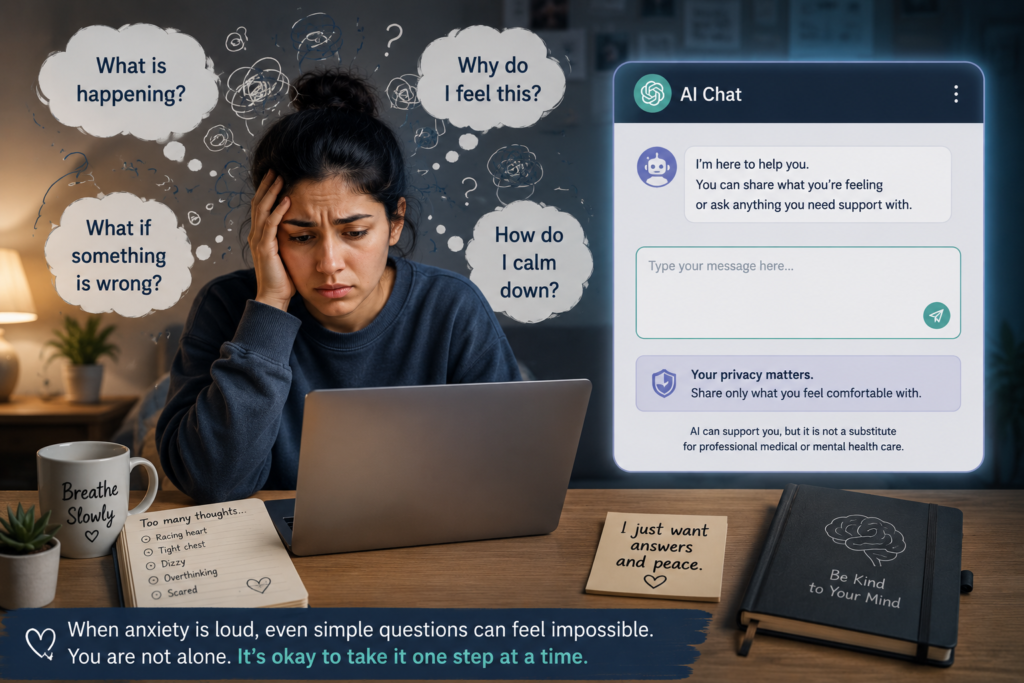
Why Anxiety Can Make Clear Thinking So Difficult
Anxiety is not limited to “thinking too much.” It may affect attention, decision-making, sleep, physical comfort and the way the brain interprets uncertainty.
When the nervous system detects possible danger, attention may narrow. The mind starts scanning for information that could explain the threat.
Questions become urgent:
- What caused this feeling?
- What if I made the wrong decision?
- What if something bad happens?
- What if this symptom means something serious?
- What if I cannot cope?
This reaction has a protective purpose. Your mind is trying to identify danger quickly. The problem is that modern anxiety often involves uncertainty rather than one visible threat.
There may be no immediate answer.
The mind then searches harder. You may revisit conversations, search symptoms, reread messages, imagine future outcomes or ask an AI assistant the same question repeatedly. Each new answer may briefly reduce anxiety, but the relief can disappear when another doubt appears.
This is why simply telling someone to “stop worrying” is rarely useful.
A more practical approach is to reduce the number of tasks the anxious mind is trying to complete. Instead of asking it to solve everything, you can ask:
- What am I noticing?
- What do I know?
- What is my fear predicting?
- What needs action now?
- What can wait?
- Who can help with what AI cannot assess?
To understand this body–emotion connection in more depth, read how your nervous system and emotions influence each other.
How to Use Free AI Prompts for Anxiety Safely
Reflection usually moves toward clarity, acceptance, a decision or an appropriate request for support.
Rumination circles around the same material without creating a meaningful next step.
For example:
Reflection:
“I notice that I become anxious after receiving unclear work instructions. I need to write down what I know and ask one clarifying question.”
Rumination:
“Why did they write it that way? Are they unhappy with me? What if I lose the client? What if they are hiding something? Let me analyse the message again.”
An AI assistant can accidentally support either process.
A well-designed prompt may help organise a situation. A reassurance-seeking prompt may prolong the loop.
That distinction is central to using free AI prompts for anxiety safely.
The Psychology Layer: Why We Seek Certainty and Reassurance
Anxiety frequently creates a strong desire for certainty.
The mind may believe:
- If I understand every cause, I will feel safe.
- If someone confirms that nothing bad will happen, I can relax.
- If I find the perfect answer, I will stop thinking.
- If I review the situation one more time, I will finally know.
But many emotional, relational and health situations contain uncertainty.
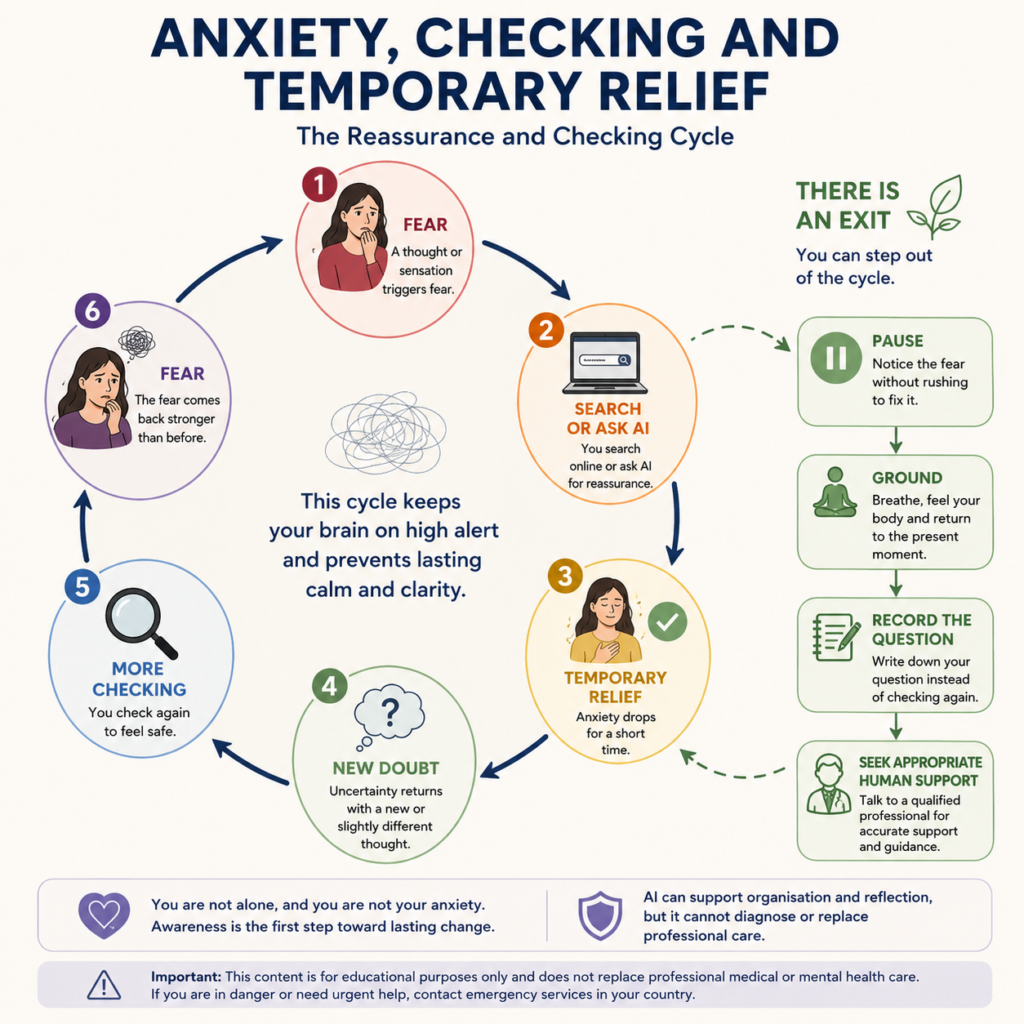
Repeated reassurance may therefore create a cycle:
Fear → question → reassurance → temporary relief → new doubt → another question
AI can make this cycle especially easy because it is available at any time and can generate another answer instantly.
This does not mean you must avoid AI completely. It means the goal of the interaction matters.
Ask AI to:
- identify the repeated pattern;
- organise evidence;
- name what remains unknown;
- help prepare a real-world conversation;
- suggest a bounded reflection exercise;
- return you to an offline action.
Do not use it endlessly to confirm that you are safe, loved, correct, healthy or certain about the future.
When persistent thought loops are the main struggle, these practical ways to calm overthinking can support the work you begin with an AI prompt.
How to Use Free AI Prompts for Anxiety Safely
Before copying any prompt, follow these boundaries.
1. Protect identifying information
Avoid entering:
- full medical record numbers;
- passwords;
- financial account information;
- private information belonging to another person;
- home addresses;
- highly identifying workplace or legal details that are not necessary.
You can replace names with labels such as “my manager,” “my partner” or “a family member.”
2. Ask for organisation, not diagnosis
A safer request is:
“Help me organise what I noticed and prepare questions for a professional. Do not diagnose me.”
An unsafe request is:
“Tell me what disorder or medical condition I have.”
3. Do not ask for absolute reassurance
Avoid:
“Promise me this symptom is harmless.”
Use:
“Help me separate what I observed from what my anxiety is predicting, and list questions I can take to an appropriate healthcare professional.”
4. Treat suggestions as options
AI-generated coping ideas may not be appropriate for everyone. Consider your health, circumstances, professional guidance and personal boundaries.
5. Stop when the conversation increases distress
Close the chat if the response becomes frightening, overwhelming, repetitive or emotionally destabilising.
You do not have to continue merely because you started.
6. Move from the screen to real life
Every useful AI interaction should end with an offline step, even if it is small:
- drink water;
- place both feet on the floor;
- write one sentence;
- step outside;
- call someone;
- prepare an appointment note;
- rest;
- complete one necessary task.
7. Use human care for human-level needs
AI cannot examine you, observe your environment, establish a therapeutic relationship or take responsibility for treatment.
You can explore the difference between AI support and human therapy before deciding what role AI should have in your emotional-health routine.
25 Free AI and ChatGPT Prompts for Anxiety
You do not need to use every prompt.
Choose the category that sounds closest to what your mind or body is experiencing now. Copy the prompt and edit any wording that does not fit your situation.
Free AI Prompts for Anxiety and Overthinking
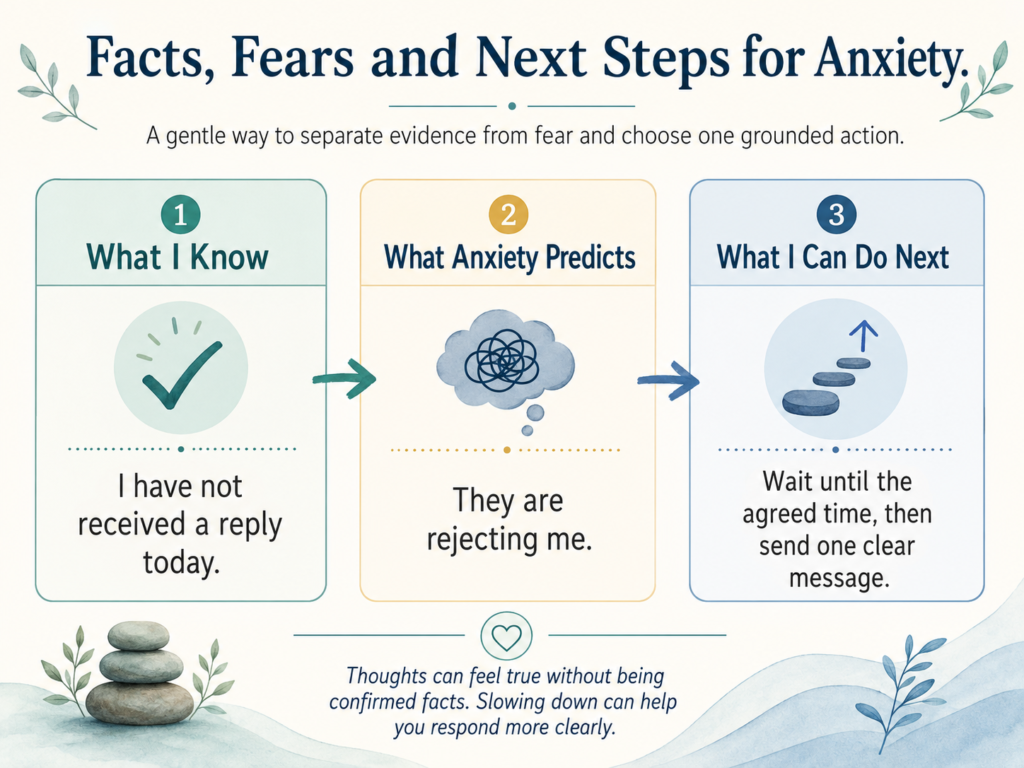
1. Facts, fears and next steps
Use this when: Several fears are blending together.
Copy this prompt:
“I am going to describe what is making me anxious. Organise it into three sections: confirmed facts, fearful predictions and actions that are within my control. Do not diagnose me or promise that everything will be fine. End with one small next step.”
Why it may help: It separates information from prediction.
Offline next step: Write the one confirmed fact on paper.
2. Mental-overload prompt
Use this when: Everything feels urgent.
“Help me reduce this situation into three levels: what needs attention now, what can wait until later and what may not require action. Ask no more than three clarifying questions.”
Why it may help: Anxiety often labels every concern as immediate.
Offline next step: Complete only the first safe task.
3. Repeating-thought prompt
Use this when: The same thought keeps returning.
“This thought keeps repeating: [insert thought]. Help me identify the underlying fear, what remains uncertain and whether there is a real problem I can act on today. Do not repeatedly reassure me.”
Why it may help: It directs attention toward the function of the thought.
Offline next step: Set a ten-minute pause before checking again.
4. Thought-summary prompt
Use this when: You cannot explain the problem clearly.
“I will write freely for two minutes. Summarise what I say into: the situation, my emotions, physical sensations, feared outcome, hidden need and one useful question.”
Why it may help: The AI performs organisation rather than interpretation.
Offline next step: Read only the summary, not the full emotional dump.
5. Slow-the-question prompt
Use this when: You feel pressure to find an answer immediately.
“Help me rewrite my urgent anxiety question into a slower and safer question focused on observation, uncertainty and the next manageable action.”
Why it may help: A safer question can reduce the demand for perfect certainty.
Offline next step: Take three slow exhalations before reading the response.
AI Prompts for Racing Thoughts and Mental Overwhelm
6. Decision versus rumination prompt
“Help me determine whether I am solving a real decision or repeating a worry. If there is a decision, show me the smallest reversible option. If there is no action required now, create a sentence that allows me to pause.”
Offline next step: Write a time when you will review the issue again.
7. Worst-case thinking prompt
“My mind is predicting this outcome: [insert fear]. Help me list the evidence I have, information I do not have, alternative possibilities and one preparation step that does not assume the worst outcome is certain.”
Offline next step: Remove one unnecessary checking behaviour.
8. Perfect-answer prompt
“I feel that I must make the perfect decision. Help me compare a good-enough choice with a perfect but unrealistic choice. Include what could be adjusted later.”
Offline next step: Choose one reversible action.
9. Control-circle prompt
“Divide my concern into what I control, what I can influence and what I cannot control. Give me one action only from the first category.”
Offline next step: Do that action before asking another question.
10. Overthinking boundary prompt
“Give me a five-minute structured reflection on this issue. Ask me three questions, summarise my answers and then tell me to stop analysing for now. Do not continue generating new possibilities.”
Offline next step: Close the AI chat when the exercise ends.
Prompts for Racing Thoughts and Emotional Overwhelm
11. Name the immediate need
“Based only on what I describe, help me identify whether I may need information, rest, reassurance from a real person, a boundary, food, movement, medical attention or time. Do not diagnose me.”
Offline next step: Meet one basic need.
12. One-sentence focus prompt
“Turn everything I write into one sentence beginning with: ‘The main thing I need to address now is…’ Then provide one next step that can be completed in under fifteen minutes.”
Offline next step: Start the task before requesting more suggestions.
13. Body-and-thought separation prompt
“Create two columns from my description: what my body is experiencing and what my mind is saying. Add a third column for what I can verify.”
Offline next step: Use a simple grounding practice. You may also try these grounding strategies when anxiety feels physically overwhelming.
14. Emotional-language prompt
“I know I feel anxious, but I cannot identify the other emotions. Offer a short list of possible emotions and needs for reflection. Do not tell me which one is definitely true.”
Offline next step: Select only one emotion and one need.
15. Reduce the response prompt
“Respond in fewer than 120 words. Help me understand the central problem and one safe next step. Do not give me a long list.”
Offline next step: Leave the screen for five minutes.
AI Prompts for Nighttime Anxiety
16. Worry-parking prompt
“Help me create a nighttime worry-parking note with four headings: concern, what can wait, when I will review it and what I need for rest now. Do not try to solve the entire concern tonight.”
Offline next step: Place the note away from the bed.
17. Night-versus-day prompt
“Help me identify which parts of this problem require daytime information, communication or professional support. Create a short note for tomorrow and a separate sentence giving me permission to pause tonight.”
Offline next step: Reduce stimulation and return to your sleep routine.
18. Racing-thought bedtime prompt
“My thoughts are racing at night. Turn them into a maximum of three tomorrow tasks and one calming statement that does not promise certainty.”
Offline next step: Do not add more tasks after the list is complete.
Anxiety Journaling Prompts for Reflection and Clarity
19. Trigger-pattern journal prompt
“Guide me through a short anxiety journal with these headings: what happened, what I noticed in my body, what I feared, what I needed, what I did and what might help next time.”
Offline next step: Save the entry without analysing it again.
20. Compassionate observer prompt
“Help me rewrite my anxious self-criticism from the perspective of a compassionate but honest observer. Do not deny the difficulty or use exaggerated positivity.”
Offline next step: Read the revised paragraph aloud once.
21. Pattern-review prompt
“I will share three recent anxiety situations. Help me identify repeated triggers, body signals, behaviours and unmet needs. Present patterns as possibilities, not diagnoses.”
Offline next step: Choose one pattern to discuss with a qualified professional.
Some readers process anxiety more clearly through structured writing. These guided journal prompts for anxious thoughts may help you continue that reflection away from the AI chat.
Prompts for Health Anxiety and Physical Sensations
AI cannot determine whether a physical sensation is caused by anxiety, a medical condition or another factor. Use the next prompts to organise information—not to request diagnosis or reassurance.
22. Symptom-organisation prompt
“Help me organise this physical concern into: what I noticed, when it began, changes over time, relevant context and questions for a healthcare professional. Do not diagnose the symptom or tell me whether it is harmless.”
Offline next step: Follow appropriate medical guidance, particularly for new, severe, worsening or concerning symptoms.
23. Checking-loop prompt
“I have checked or searched this concern [number] times. Help me identify what reassurance I am seeking, how long relief usually lasts and one safe way to pause repeated checking. Do not reassure me medically.”
Offline next step: Choose a defined pause period and follow your existing professional care plan.
24. Doctor-preparation prompt
“Turn my notes into a concise appointment summary with symptoms, timeline, relevant history, questions and concerns. Do not suggest a diagnosis or treatment.”
Offline next step: Review the summary for accuracy before sharing it.
Prompt for Professional Support
25. Therapist or doctor conversation prompt
“Help me prepare to discuss my anxiety with a qualified professional. Organise my concerns into symptoms, triggers, frequency, impact on daily life, coping methods tried and questions I want to ask. Keep the tone clear and non-diagnostic.”
Offline next step: Book or attend the appropriate appointment.
The Anxiety Reassurance Loop
One of the most important digital boundaries is knowing when a useful question has become repetitive reassurance-seeking.
The loop may look like this:
- A thought, sensation or situation creates fear.
- You ask AI for an explanation.
- The response gives temporary relief.
- A new possibility appears.
- You ask again.
- Relief becomes shorter.
- The mind learns that every doubt requires checking.
The solution is not to shame yourself.
Instead, change the task.
Ask:
- Am I gathering necessary information?
- Am I preparing for appropriate action?
- Or am I asking the same fear to disappear through another answer?
When the interaction no longer produces a real-world next step, it may be time to stop.
When an AI Response Makes Anxiety Worse
Stop and reassess if the response:
- introduces frightening possibilities without context;
- sounds as though it is diagnosing you;
- gives a long list that increases overwhelm;
- tells you to ignore professional advice;
- encourages repeated checking;
- presents uncertain information as fact;
- makes you feel dependent on continuing the conversation;
- pressures you toward a major decision.
You can type:
“This response is increasing my anxiety. Reduce it to one neutral summary and one suggestion for seeking appropriate real-world support. Do not provide further medical possibilities.”
You can also close the conversation completely.
Not every interaction has to be repaired. Sometimes the safest digital boundary is to stop reading.
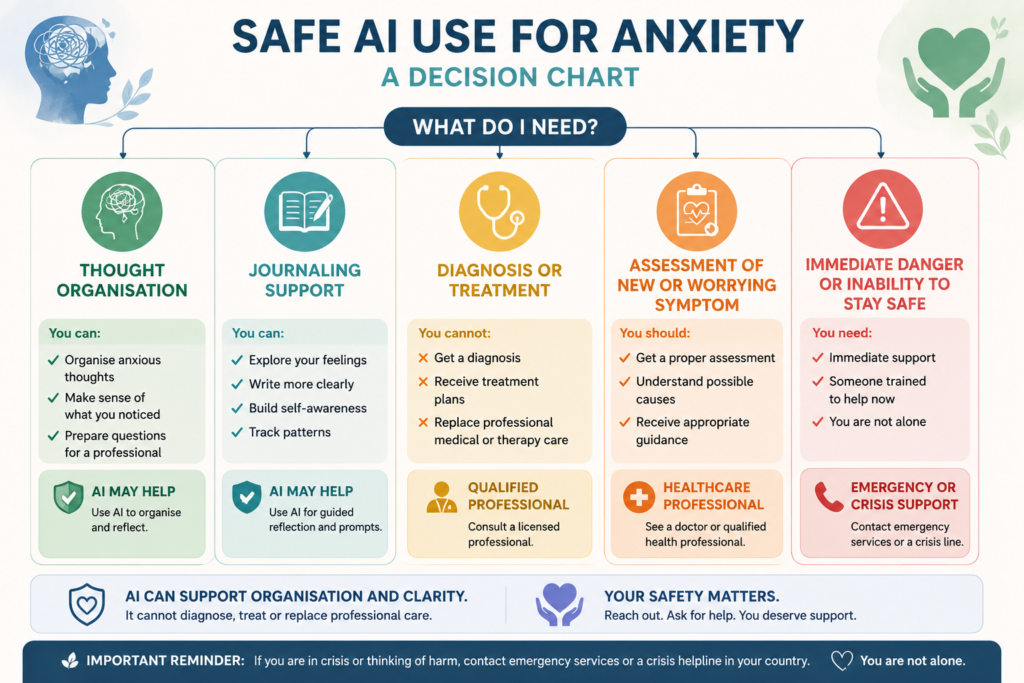
Decision Chart: AI, Professional Support or Urgent Help?
Use AI as an organisation tool when:
- you want to structure a journal entry;
- you need to separate facts from fears;
- you want to prepare questions;
- you need a short list of manageable tasks;
- you want to summarise information you already have.
Contact a qualified professional when:
- anxiety repeatedly interferes with sleep, work, relationships or daily functioning;
- symptoms are persistent, worsening or difficult to manage;
- you need diagnosis, treatment or medication guidance;
- you are changing or stopping prescribed treatment;
- a physical symptom needs assessment;
- you need personalised psychological care.
Seek urgent or emergency help when:
- you may harm yourself or someone else;
- you cannot keep yourself safe;
- you are experiencing a possible medical emergency;
- you are severely disoriented or unable to function safely;
- abuse, coercion or immediate danger is present.
Do not wait for an AI response in an emergency.
People Also Ask
1. Can ChatGPT help with anxiety?
ChatGPT may help organise thoughts, structure journaling, prepare questions and identify practical next steps. It cannot diagnose an anxiety disorder or replace treatment. The safest use is to ask for reflection, organisation or preparation—not certainty, medical reassurance or emergency guidance.
2. What should I ask ChatGPT when I feel anxious?
Begin with a bounded request such as: “Help me separate what I know, what I fear and what I can do next.” This limits overwhelm and directs the response toward clarity. Avoid asking AI to guarantee that nothing bad will happen.
3. Are ChatGPT prompts for anxiety safe?
They may be useful when written with clear boundaries. Do not share unnecessary identifying information, request diagnosis or treat the response as professional care. Stop using the tool if the conversation intensifies fear or encourages repeated reassurance-seeking.
4. Can AI help with racing thoughts?
AI may help turn racing thoughts into a short summary, priority list or facts-versus-fears table. The purpose is not to eliminate every thought. It is to reduce mental overload and direct attention toward one manageable offline action.
5. Can ChatGPT replace a therapist?
No. AI cannot form a professional therapeutic relationship, perform a clinical assessment, monitor treatment or respond as a responsible care provider. It may support preparation or reflection between appointments, but diagnosis and treatment belong with qualified professionals.
Download the Free BBH Anxiety Prompt Guide
When anxiety makes thinking difficult, you should not have to search through a long article to find the prompt you need.
5 Safe AI Prompts for Anxiety When Your Thoughts Will Not Stop
The PDF includes ready-to-copy prompts for:
- racing thoughts;
- worst-case thinking;
- physical anxiety;
- nighttime worry;
- preparing to speak with a doctor or therapist.
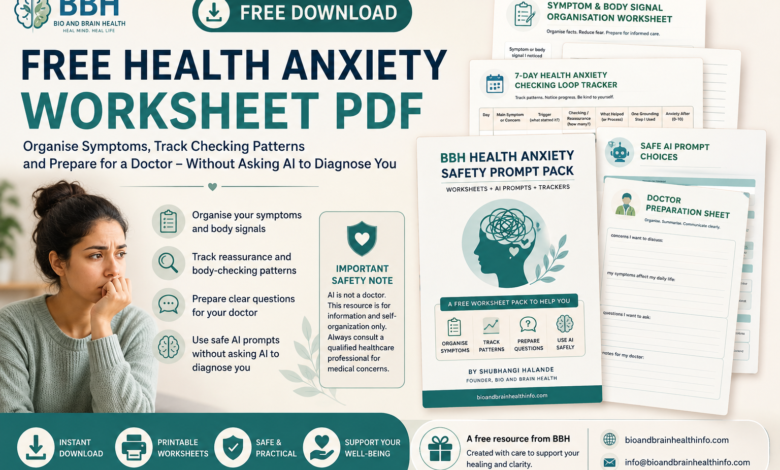
free AI Tool For health anxiety worksheet PDF
This free guide is a short starting resource. It does not contain the full anxiety profile system, scoring tools, seven-day trackers, detailed health-anxiety package or complete workbook prompt library.
BBH Anxiety Support Resource
The complete BBH AI Prompts for Anxiety and Panic Workbook is designed to help readers move beyond isolated prompts and explore anxiety in a more structured way.
The workbook includes guided tools for:
- recognising anxiety patterns;
- exploring triggers and root concerns;
- mapping thoughts, emotions, body responses and behaviours;
- selecting safer AI prompts;
- tracking reassurance and checking loops;
- preparing for professional conversations;
- reviewing AI answers responsibly;
- identifying practical next steps.
Get the Complete Anxiety Workbook
The Amazon purchase link will be added when the book becomes available.
Until then, email:
info@bioandbrainhealthinfo.com
Write:
“Send me the BBH Anxiety Workbook purchase details.”
AI tools and worksheets can support reflection and organisation, but they cannot diagnose anxiety, assess medical symptoms, replace professional care or provide emergency support.
Frequently Asked Questions
1. Which prompt should I use first?
Start with the facts, fears and next-steps prompt. It works across many anxiety situations because it does not assume a diagnosis or demand certainty. It simply separates what is known from what the mind is predicting and identifies one action within your control.
2. Can I use these prompts during a panic attack?
A short grounding prompt may help some people, but an active panic episode is not always the best time to read a detailed AI response. Prioritise immediate safety, a familiar grounding plan and appropriate human or medical support. Do not use AI to determine whether intense physical symptoms are harmless.
3. What should I do if AI gives frightening medical information?
Stop reading, close the conversation and avoid asking for additional possibilities. AI cannot examine you or interpret symptoms reliably enough to replace medical assessment. Record the relevant facts and seek guidance from an appropriate healthcare professional, especially for new, severe or worsening symptoms.
4. How often should I use AI prompts for anxiety?
There is no universal frequency. Use them when they lead to clarity or a practical action. Reduce or pause use when you repeatedly ask the same question, feel unable to act without AI, or notice that each answer creates more checking. A prompt should support your life, not become another anxiety ritual.
5. Can I share the AI summary with my therapist or doctor?
Yes, you may use a carefully reviewed summary to support a professional conversation. Check it for accuracy and remove any AI assumptions or invented details. The summary can help you remember patterns and questions, but it should not be presented as a diagnosis or professional assessment.
YMYL Safety and Professional-Care Note
This article is educational and does not provide diagnosis, psychotherapy, medical assessment or personalised treatment.
Anxiety may involve emotional, cognitive, behavioural and physical symptoms. Similar symptoms may also have other causes. Do not assume that a physical symptom is “only anxiety,” and do not use AI to decide whether a symptom is medically serious.
Contact an appropriate qualified professional when anxiety is persistent, difficult to control or affecting daily life.
Seek urgent local assistance when you may be in danger, cannot remain safe or believe you are experiencing a medical emergency.
External References
- National Institute of Mental Health — Anxiety Disorders
https://www.nimh.nih.gov/health/topics/anxiety-disorders - National Institute of Mental Health — Generalized Anxiety Disorder: What You Need to Know
https://www.nimh.nih.gov/health/publications/generalized-anxiety-disorder-gad - NHS — Get Help With Anxiety, Fear or Panic
https://www.nhs.uk/mental-health/feelings-symptoms-behaviours/feelings-and-symptoms/anxiety-fear-panic/ - Healthdirect Australia — Anxiety
https://www.healthdirect.gov.au/anxiety - Government of Canada — Anxiety Disorders
https://www.canada.ca/en/health-canada/services/healthy-living/your-health/diseases/mental-health-anxiety-disorders.html - OpenAI — Strengthening ChatGPT’s Responses in Sensitive Conversations
https://openai.com/index/strengthening-chatgpt-responses-in-sensitive-conversations/
A Personal Note From BBH
Anxiety can create the feeling that you must understand everything immediately.
You may want the complete explanation, the guaranteed outcome and the perfect solution before you allow yourself to rest.
But clarity does not always arrive all at once.
Sometimes the next useful step is smaller:
- name what you feel;
- separate a fact from a fear;
- pause one checking behaviour;
- prepare one question;
- contact one person;
- take one action away from the screen.
These ChatGPT prompts for anxiety are not here to think for you or decide what is true. They are here to help you create enough space between fear and action to respond more safely.
You do not have to solve every anxious thought today.
Choose one prompt. Read the answer slowly. Keep what is useful. Question what is uncertain. Then return to your body, your environment and the real people and resources that can support you.