How to Stop Being Defensive in a Relationship
Why You Get Defensive and How to Repair With Calm

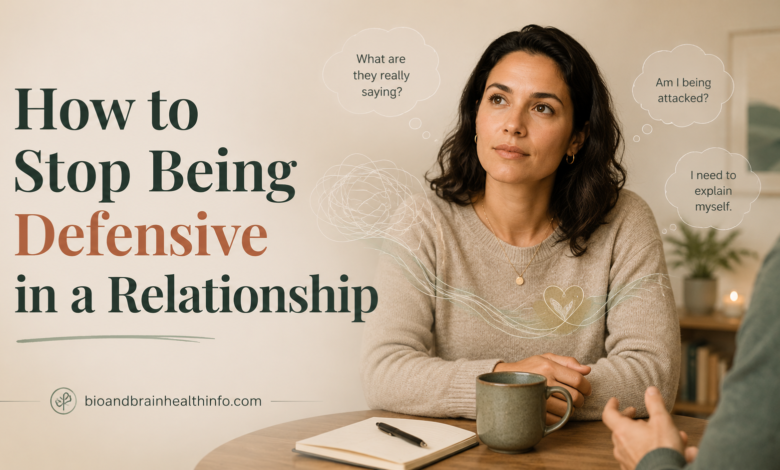
If you keep asking yourself how to stop being defensive in a relationship, you are probably not trying to be difficult. You may be trying to protect yourself from feeling blamed, rejected, misunderstood, or emotionally unsafe. Defensiveness often shows up during conflict when your body reacts faster than your calm mind can respond.
Thank you for reading this post, don't forget to subscribe!This blog explains why you get defensive, what happens inside the nervous system during a defensive reaction, and how defensive communication in relationships can slowly damage trust when it becomes a repeated pattern. You will also learn how to communicate without getting defensive by using safer words, emotional pauses, and a simple secure communication worksheet.
The goal is not to shame you or label you as the problem. The goal is to help you understand the difference between self-protection and relationship repair.
When you can notice your trigger, body reaction, hidden need, and next calmer sentence, conflict becomes less about winning and more about emotional safety.
What Defensiveness Really Means in a Relationship
Defensiveness is a self-protection response that shows up when feedback feels like attack. In a relationship, it can sound like explaining, blaming, correcting, denying, minimizing, justifying, or emotionally shutting down.
The Gottman Institute describes defensiveness as one of the “Four Horsemen” patterns that can harm relationships, and its antidote is accepting responsibility, even for one part of the conflict.
That does not mean you must accept false blame. It means you learn to separate your identity from the moment.
You are not being asked to say, “Everything is my fault.”
You are being asked to say, “Let me understand what part of this affected you.”
That difference matters.
A defensive reaction often says:
“I need to prove I am not bad.”
A secure response says:
“I can stay present while we understand what happened.”
This is why how to stop being defensive in a relationship is not only a communication question. It is also a nervous system question, a shame question, an attachment question, and sometimes a safety question.
Why Do I Get Defensive So Quickly?
Many people ask, why do I get defensive even when I love my partner? The answer is usually not one simple thing.
Defensiveness can come from old criticism, childhood emotional neglect, repeated invalidation, previous betrayal, fear of abandonment, low self-worth, perfectionism, or living with someone who uses blame as control.
- Sometimes you become defensive because you are avoiding responsibility.
- Sometimes you become defensive because your body has learned that being “wrong” is dangerous.
- Sometimes you become defensive because the other person is not communicating safely.
This is important. Not every conflict is healthy conflict. If someone humiliates you, threatens you, monitors you, controls you, frightens you, or repeatedly turns your feelings against you, the issue is not only communication skill. Mayo Clinic advises looking at larger relationship patterns when identifying abuse, not only isolated incidents.
Secure communication can support healthier repair, but it cannot replace safety, boundaries, or professional help when abuse, coercion, humiliation, or fear is present.
If the relationship is safe enough for honest repair, defensiveness can become a signal. It tells you, “Something in me feels under threat.” Then you can pause and ask, “Is this a real attack, or is my body reacting to old pain?”
How to Stop Being Defensive in a Relationship Without Shaming Yourself
The first step in how to stop being defensive in a relationship is to stop treating defensiveness as proof that you are a bad person.
Shame makes defensiveness worse.
When you tell yourself, “I am toxic,” “I always ruin things,” or “I am impossible to love,” your nervous system becomes even more threatened. Then it tries harder to protect you. This creates a loop: shame creates defense, defense blocks repair, blocked repair creates more shame.
A better starting point is:
“I am having a protective reaction. I can slow it down.”
This gives you space.
You do not need to become perfect in one conversation. You need one small interruption between trigger and reaction.
That interruption may be:
“I need a moment.”
“I am getting defensive, but I want to understand.”
“I feel blamed, so I may not be hearing you clearly.”
“I want to respond better than my first reaction.”
“Can we slow this down?”
These sentences are simple, but they are powerful because they tell the nervous system, “We are not under attack. We are trying to repair.”
Defensive Communication in Relationships Is Often a Body Reaction
Defensive communication in relationships is often discussed as a bad habit, but inside the body it can feel like survival. Your brain does not only process words. It processes tone, facial expression, timing, history, emotional memory, and perceived threat.
When your partner says, “You did not listen to me,” your thinking mind may hear feedback. But your body may hear, “You failed. You are unsafe. You are going to be rejected.”
This is why the reaction can feel instant.
The body may move into fight, flight, freeze, or fawn:
Fight: “You always blame me.”
Flight: “I don’t want to talk about this.”
Freeze: silence, numbness, blank mind.
Fawn: “Fine, I’m sorry,” while feeling resentful inside.
Anxiety can also intensify this pattern. NIMH notes that anxiety disorders can involve excessive worry, difficulty controlling worry, feeling on edge, trouble relaxing, sleep problems, fatigue, muscle tension, and concentration difficulty. When your nervous system is already overloaded, even a small relationship conversation may feel like too much.
This does not excuse harmful behavior. But it explains why “just listen” may not work until the body feels safe enough to listen.
The Difference Between Self-Protection and Relationship Repair
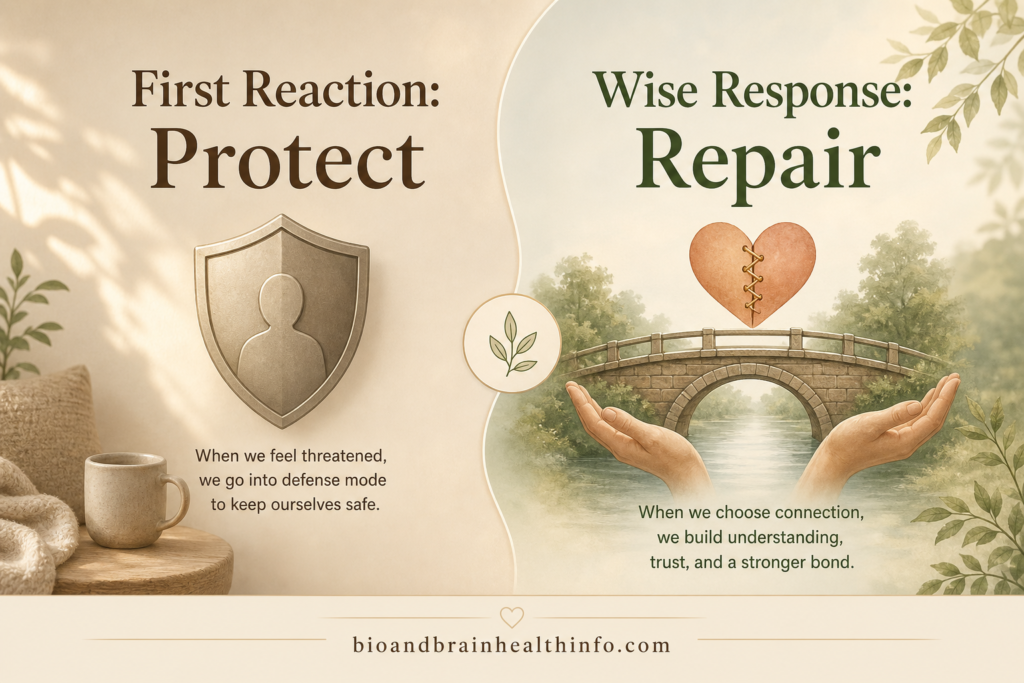
Self-protection asks, “How do I make this feeling stop?”
Repair asks, “How do we understand what happened and reconnect safely?”
Both matter. You are allowed to protect yourself. You are also responsible for how your protection affects someone else.
Here is the core distinction:
| Moment | Protective Reaction | Repair-Oriented Response |
|---|---|---|
| Partner says they felt hurt | “You’re exaggerating.” | “I did not realize it hurt you that way.” |
| You feel blamed | “That’s not my fault.” | “I feel blamed, but I can still listen.” |
| You feel ashamed | “You always make me the problem.” | “This is hard to hear, but I want to understand.” |
| You feel overwhelmed | Silent withdrawal | “I need 20 minutes, then I will return.” |
| You disagree | Counterattack | “I see it differently, but your feeling still matters.” |
This table is not about becoming weak. It is about becoming emotionally stronger.
Real strength is not winning every argument. Real strength is being able to stay present without destroying the bridge.
How to Communicate Without Getting Defensive During Conflict
Learning how to communicate without getting defensive begins before the perfect sentence. It begins with body awareness.
Before you answer, ask:
What is happening in my body?
Am I trying to understand or win?
Am I defending my intention instead of hearing their impact?
Am I afraid of being seen as bad?
Can I take responsibility for one small part?
This is where many people get stuck. They think responsibility means surrender. It does not.
You can say:
“My intention was not to hurt you, but I hear that it affected you.”
“I disagree with part of this, but I can understand why you felt alone.”
“I want to explain, but first I want to make sure I understand you.”
“I am noticing I want to defend myself. Let me slow down.”
“I can own my tone, even if I still want to explain my side.”
These phrases help because they do not erase you. They make space for both people.

A Practical Repair Table for Defensive Moments
When defensiveness rises, you need replacement language. Without replacement words, your nervous system will use old words.
Use this table as a practical guide:
| Defensive Sentence | What May Be Happening Inside | Safer Replacement |
| “You always blame me.” | Shame, fear, feeling attacked | “I feel blamed right now, but I want to understand what hurt you.” |
| “That is not my fault.” | Fear of being judged | “I may not agree with everything, but I can look at my part.” |
| “You are too sensitive.” | Avoiding emotional responsibility | “I did not realize it landed that way. Tell me more.” |
| “I never do anything right.” | Collapse into shame | “I am feeling ashamed, but I want to stay in the conversation.” |
| “I don’t care.” | Emotional shutdown | “I do care, but I am overwhelmed and need a short pause.” |
| “You do the same thing.” | Counterattack | “I want to talk about my concern too, but first I will hear this one.” |
| Silence without return | Freeze response | “I need time to calm down. I will come back at 7 pm.” |
This is one of the most important parts of how to stop being defensive in a relationship: do not only remove the defensive sentence. Replace it with a repair sentence.
The Attachment Layer: Why Feedback Can Feel Like Rejection
For some people, feedback does not feel like information. It feels like a threat to love.
If you have an anxious attachment pattern, your body may hear criticism as possible abandonment. You may panic, explain too much, apologize too fast, or beg for reassurance.
If you have an avoidant pattern, feedback may feel like invasion. You may detach, intellectualize, minimize, or leave the conversation.
If you grew up around harsh criticism, emotional unpredictability, or silent punishment, your body may have learned that conflict is not safe. So now, even in an adult relationship, your nervous system may respond to a small concern as if it is a big danger.
This is why defensive communication in relationships can feel so confusing. On the surface, the conversation may be about dishes, messages, tone, money, timing, intimacy, or attention. Underneath, the body may be asking:
Am I safe?
Will I be rejected?
Am I failing?
Will I be controlled?
Will my truth matter?
Will I be punished for being honest?
When these deeper fears are not named, the surface argument keeps repeating.
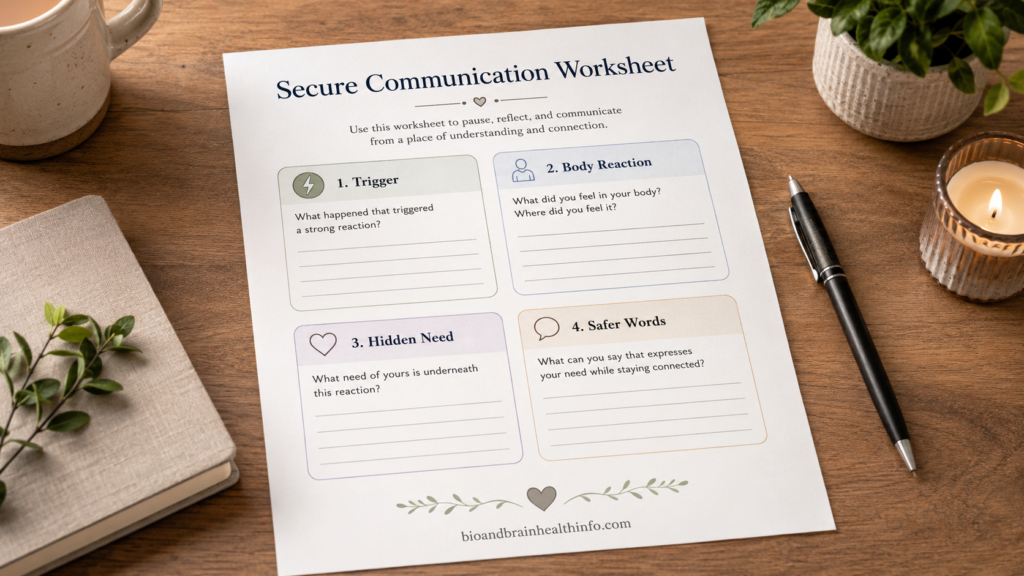
The Secure Communication Worksheet
A secure communication worksheet gives your mind a structure when emotions are too loud. It helps you move from reaction to reflection.
Use these four sections:
1. Trigger
What exactly activated me?
Example: “My partner said I never listen.”
2. Body Reaction
What happened in my body?
Example: “Chest tight, jaw tense, hot face, urge to explain.”
3. Hidden Need
What did I need in that moment?
Example: “I needed to feel that I was not being called a bad person.”
4. Safer Words
What could I say next time?
Example: “I feel defensive because I care how you see me. I want to understand what felt hurtful.”
This worksheet is not meant to make you overthink. It is meant to slow down the emotional traffic inside the mind.
A secure relationship is not one where no one gets triggered. A secure relationship is one where both people learn how to return.
BBH Support Resource
Want a simple tool to practice this?
Download the BBH Secure Communication Worksheet to reflect on your trigger, body reaction, hidden need, and safer words for next time.
Email Request Note:
Email info@bioandbrainhealthinfo.com and write: “Send me the Secure Communication Worksheet.”
When your Amazon resource or anxiety book purchase link is ready, you can add it gently here:
Optional Soft Book Note:
If defensiveness, anxiety, overthinking, or emotional shutdown are repeated patterns in your relationships, you may also explore the BBH anxiety and emotional regulation resources. Book link coming soon.
Keep the sales push soft. In emotional health content, help must come before selling.
Internal BBH Reading Path
If this topic feels connected to anxiety, overthinking, or emotional triggers, continue with these BBH guides:
Read this BBH guide on emotional triggers and anxiety:
https://bioandbrainhealthinfo.com/relationship-anxiety-and-emotional-triggers/
Explore this article on how anxiety affects conversations:
https://bioandbrainhealthinfo.com/how-anxiety-affects-communication/
Use this calming resource for body-based regulation:
https://bioandbrainhealthinfo.com/nervous-system-regulation-tools/
Read this deeper guide on protective patterns after emotional pain:
https://bioandbrainhealthinfo.com/trauma-responses-in-relationships/
Strengthen your limits with this boundary guide:
https://bioandbrainhealthinfo.com/healthy-emotional-boundaries/
Main Menu URL:
https://bioandbrainhealthinfo.com/relationship/
Submenu URL:
https://bioandbrainhealthinfo.com/relationship/communication-conflict/
Note: Adjust these slugs if your final live URLs are different.
How to Stop Being Defensive in a Relationship When You Feel Blamed
One of the hardest moments in how to stop being defensive in a relationship is when you genuinely feel blamed.
- Maybe your partner’s tone is sharp.
- Maybe they use words like “always” or “never.”
- Maybe they bring up five past issues at once.
- Maybe you already feel tired, anxious, or emotionally cornered.
In that moment, your first job is not to give the perfect answer. Your first job is to create enough inner space to avoid making the conflict worse.
Try this three-step response:
Step 1: Name the body reaction silently
“I am getting activated.”
This keeps you from becoming the reaction.
Step 2: Ask for one clear concern
“I want to understand, but I need one issue at a time.”
This protects the conversation from becoming overwhelming.
Step 3: Reflect before explaining
“What I hear is that you felt ignored when I looked at my phone.”
This does not mean you agree with everything. It means you are listening before defending.
Defensiveness often reduces when the nervous system feels there is a process. A process gives the mind somewhere to go.
What If the Other Person Is Actually Attacking You?
This matters deeply.
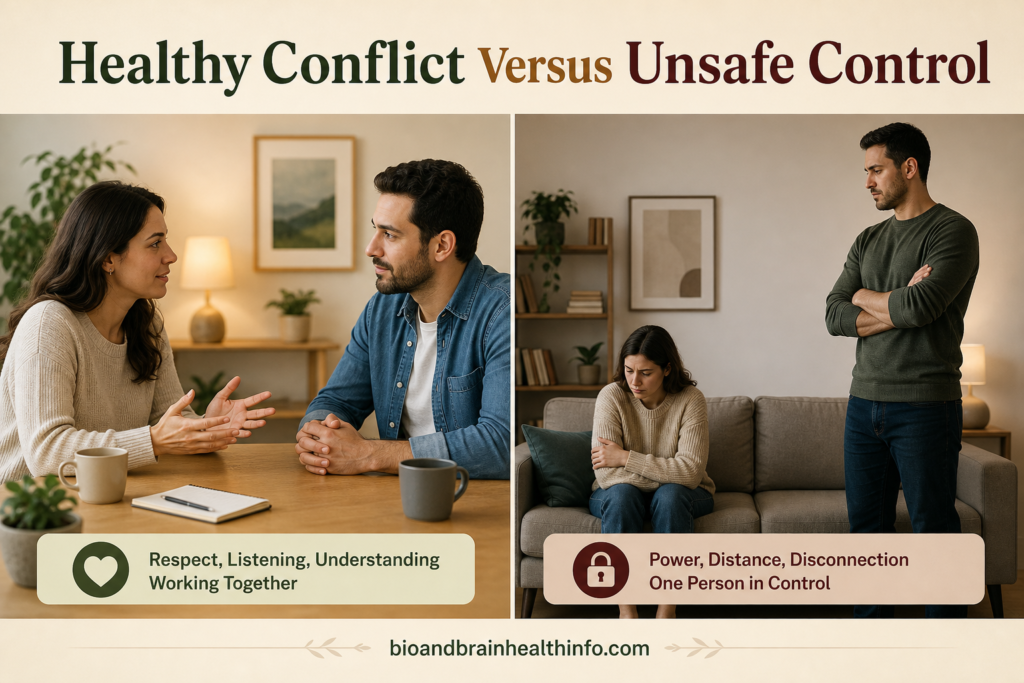
Not all “feedback” is healthy. Some people use the language of communication to control, shame, punish, or dominate.
The National Domestic Violence Hotline says abuse can involve patterns used to maintain power and control, and its Power and Control Wheel explains tactics that may keep someone trapped in an unsafe relationship.
The United Nations also describes domestic abuse as a pattern of behavior used to gain or maintain power and control, including emotional, economic, psychological, and threatening behaviors.
So ask yourself:
Do I feel safe to disagree?
Can I ask for a pause without punishment?
Does this person respect boundaries?
Do they use my vulnerability against me later?
Do I feel smaller, afraid, or monitored after conversations?
Is repair mutual, or am I always the only one changing?
If there is fear, coercion, humiliation, intimidation, threats, isolation, or repeated emotional harm, do not treat the problem as only defensiveness. Safety comes first.
Healthy communication requires two people who are willing to repair. One person cannot worksheet their way into safety with someone committed to control.
A 10-Minute Practice Before a Difficult Conversation
Use this short practice before speaking about a sensitive issue.
Minute 1: Breathe and notice your body
Do not force calm. Just notice.
Minute 2: Name the fear
“I am afraid of being blamed.”
“I am afraid of being rejected.”
“I am afraid I will be misunderstood.”
Minute 3: Separate past from present
Ask: “Is this conversation reminding me of something older?”
Minute 4: Choose your repair intention
“My intention is to understand, not win.”
Minute 5: Write one sentence
“I want to talk about this without attacking or defending.”
Minute 6: Choose one boundary
“If voices rise, I will ask for a pause.”
Minute 7: Choose one responsibility
“I can own my tone.”
“I can own my delay.”
“I can own that I did not listen fully.”
Minute 8: Choose one request
“I need us to speak slowly.”
“I need one topic at a time.”
Minute 9: Prepare for imperfection
“I may still feel defensive, but I can repair faster.”
Minute 10: Begin gently
Start with: “I care about us, and I want to handle this better.”
This small ritual teaches how to communicate without getting defensive in a practical way. You are not trying to become emotionless. You are trying to become conscious before the old pattern takes over.
Personal Note From BBH
My lived insight is this:
“Sometimes the first reaction is not the truth of the heart. It is only the body trying to protect an old wound.”
This matters because many people confuse their first reaction with their real self. But your first reaction may be fear. Your second response can be wisdom.
When you are defensive, pause before you hate yourself.
- Ask what your body is protecting.
- Ask what your relationship needs.
- Ask what sentence would help repair without self-betrayal.
That is the deeper path of how to stop being defensive in a relationship. Not self-attack. Not blame. Not silence. A slower, safer return to truth.
People Also Ask
1. Why do I get defensive so easily in my relationship?
You may get defensive because your nervous system reads feedback as blame, rejection, shame, or danger. Sometimes it is connected to old criticism or unsafe communication patterns. Sometimes it is a habit of avoiding responsibility. The key is to pause and ask what your body is protecting.
2. How do I stop being defensive when my partner talks to me?
Slow down before answering. Notice your body reaction, repeat what you heard, and take responsibility for one small part. You can say, “I feel defensive, but I want to understand you.”
3. Is defensiveness a trauma response?
It can be. Defensiveness may be connected to past emotional neglect, criticism, betrayal, or fear of punishment. But it can also be a learned communication habit. Either way, awareness and repair skills can help.
4. What is defensive communication in relationships?
It is a pattern where someone protects themselves from feeling blamed instead of listening to the concern being shared. It may look like denying, explaining, counterattacking, minimizing, withdrawing, or blaming back.
5. Can a worksheet help me communicate better?
Yes. A worksheet can help you identify your trigger, body reaction, hidden need, and safer words. It gives your mind a structure when emotions feel too fast.
FAQ
1. What is the secure communication worksheet?
The secure communication worksheet is a BBH reflection tool that helps you write down your trigger, body reaction, hidden need, and calmer sentence for a difficult conversation.
2. Is this worksheet a replacement for therapy?
No. It is a self-reflection tool, not therapy, diagnosis, crisis support, or professional treatment. If anxiety, fear, abuse, or emotional harm is present, professional support is important.
3. How many times should I use the worksheet?
Use it after repeated conflicts or before sensitive conversations. Over time, patterns become easier to see.
4. What if my partner is always defensive?
Use calm language, name one issue at a time, and set boundaries. But if your concerns are constantly dismissed, mocked, punished, or turned against you, the issue may be more than communication.
5. What is the fastest way to stop reacting defensively?
The fastest practical step is to pause and say, “I am getting defensive, but I want to understand.” This interrupts the old pattern and opens a door to repair.
Closing: Defensiveness Is a Signal, Not Your Whole Identity
Learning how to stop being defensive in a relationship does not mean you become silent, passive, or always wrong. It means you learn to stay connected to yourself while hearing another person’s pain.
You can protect your dignity and still listen.
You can explain your side and still validate impact.
You can disagree and still repair.
You can feel triggered and still choose a better sentence.
Defensiveness says, “I must protect myself from being bad.”
Secure communication says, “I can stay present, understand my part, and return with honesty.”
That is not weakness. That is emotional maturity.
External References
- The Gottman Institute
Title: The Four Horsemen: Defensiveness
URL: https://www.gottman.com/blog/the-four-horsemen-defensiveness/ - The Gottman Institute
Title: The Four Horsemen: The Antidotes
URL: https://www.gottman.com/blog/the-four-horsemen-the-antidotes/ - Mayo Clinic
Title: Domestic Violence Against Women: Recognize Patterns, Seek Help
URL: https://www.mayoclinic.org/healthy-lifestyle/adult-health/in-depth/domestic-violence/art-20048397 - National Domestic Violence Hotline
Title: Identify Abuse
URL: https://www.thehotline.org/identify-abuse/ - National Institute of Mental Health
Title: Generalized Anxiety Disorder: What You Need to Know
URL: https://www.nimh.nih.gov/health/publications/generalized-anxiety-disorder-gad