Anxiety Retreats in USA: When Rest Is Not Enough
Your Mind Is Exhausted: Could a Retreat Help?

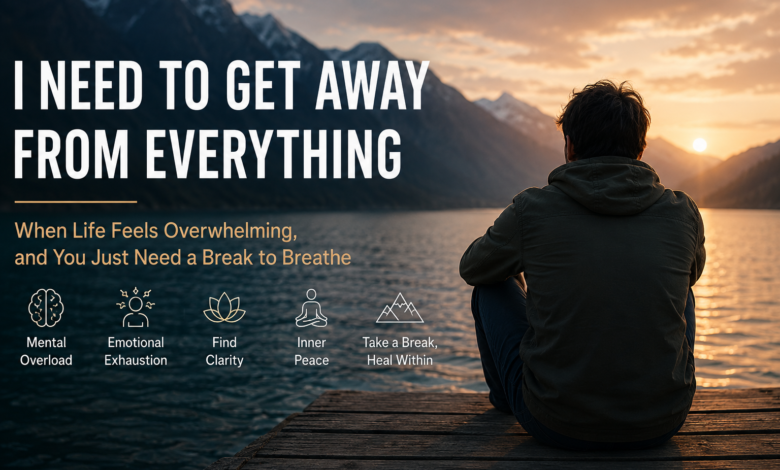
If you are searching for anxiety retreats in USA, you may not be looking for luxury—you may be looking for relief from a mind that never feels quiet.
Thank you for reading this post, don't forget to subscribe!This guide explains how a mental health retreat for anxiety differs from a wellness break, when an anxiety treatment retreat may offer structured support, and what to expect from a stress and anxiety retreat when daily pressure becomes overwhelming.
It also examines whether an anxiety and depression retreat is appropriate when low mood, exhaustion, fear, and emotional conflict appear together.
You will learn how to compare programmes, verify staff qualifications, recognise red flags, understand costs and aftercare, and decide whether retreat support, therapy, residential treatment, or professional care better matches your needs.
Anxiety Retreats in USA: When Rest Is Not Enough
You may not be searching for anxiety retreats in USA because you want luxury, yoga or a beautiful mountain view. You may be searching because your thoughts, emotions, responsibilities and uncertainty have become so tangled that you can no longer hear what your own mind and heart are trying to tell you.
Perhaps you have already tried sleeping longer, taking a weekend off, spending time alone or telling yourself to stop overthinking. Your body may be resting, but your mind remains watchful. You know that something needs to change, yet you cannot think clearly enough to understand what that change should be.
A carefully chosen retreat may provide distance from daily pressure, structured support and time to reflect. However, a retreat is not a guaranteed cure for anxiety, and not every programme offers mental-health treatment. Some are wellness breaks, some are professionally supported programmes, and others provide residential clinical care.
This guide will help you understand what different retreats offer, what questions to ask, how to recognise unsafe promises and whether a retreat matches the level of support you genuinely need.
Important safety note: This article provides general education and decision support. It does not diagnose anxiety or replace care from a licensed medical or mental-health professional. Seek urgent help if you cannot remain safe, have thoughts of harming yourself, experience severe confusion, or develop new or concerning physical symptoms.
Can Anxiety Retreats in USA Help When Rest Is Not Enough?
Anxiety retreats in USA may help some people step away from overwhelming routines, reduce environmental pressure and practise coping skills in a structured setting. Their usefulness depends on the type of programme, staff qualifications, safety procedures and the person’s emotional and clinical needs.
A retreat may give you space, but space alone does not always resolve anxiety.
If your internal conflict has been building for months or years, a short break cannot automatically settle everything. You may return to the same relationship, job, financial pressure, grief, family conflict or uncertain decision that was troubling you before you left.
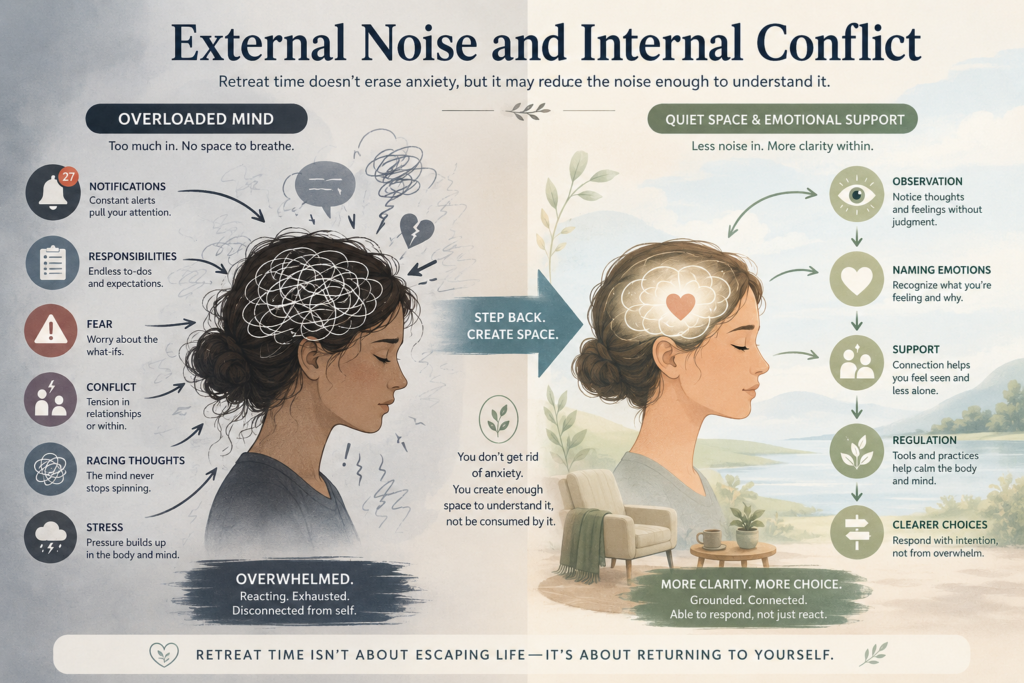
The deeper benefit of a retreat may be smaller but still meaningful: reduced noise.
When the external pressure becomes quieter, you may begin to notice:
- what has been exhausting you;
- which fears are realistic and which are driven by uncertainty;
- what your body has been communicating;
- what you have been avoiding;
- which boundaries or decisions need attention;
- and whether you require ongoing professional support.
A retreat should therefore be understood as a possible pause for observation and support, not as an escape that permanently solves life.
“I Need to Get Away From Everything”: What This Feeling May Mean
When someone says, “I need to get away from everything,” they may not simply be asking for a holiday.
They may be trying to run from a current condition that has become too complicated to process. Their heart may be saying one thing, their mind another, while events around them keep demanding attention. Fear, responsibility, emotional pain and uncertainty begin merging into one heavy experience.
At this stage, the mind, nervous system, emotions and inner self may feel as though they are in conflict.
- You may already know the answer to an important question but feel unable to accept it.
- You may understand that a situation is unhealthy yet still feel emotionally connected to it.
- You may know that rest is necessary but feel guilty when you stop working.
- You may recognise that a boundary is required but fear what will happen after you set it.
The brain remains alert because it is attempting to solve uncertainty. It repeatedly reviews conversations, predicts future problems and searches for a perfect solution that may not exist.
This is why a normal break sometimes fails to feel restorative. Your surroundings may become quiet while the argument inside you continues.
Understanding how anxiety affects the nervous system can help explain why your body may remain tense even when no immediate demand is present.
What Happens at Anxiety Retreats in USA?
Programmes described as anxiety retreats in USA vary widely. Two retreats using similar language may provide completely different levels of support.
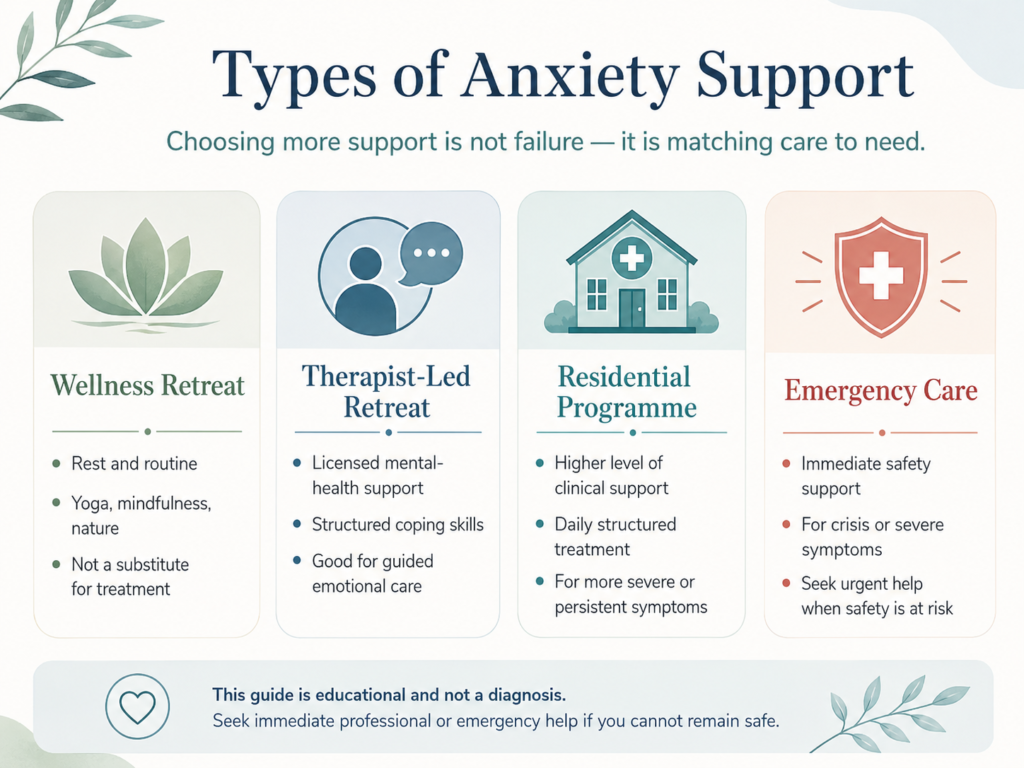
A wellness retreat might focus on yoga, breathing practices, healthy meals, nature and digital disconnection. A professionally led programme may include individual therapy, group sessions, psychoeducation and coping-skills training. A residential treatment centre may provide clinical assessment, psychiatric services and structured care.
Before booking anything, identify what the programme actually is—not only what it calls itself.
Common activities may include:
- guided breathing or meditation;
- yoga or gentle movement;
- individual or group therapy;
- education about anxiety and stress;
- sleep and routine support;
- journaling and reflective exercises;
- time in nature;
- digital boundaries;
- nutrition or wellness sessions;
- planning for life after the retreat.
None of these activities is automatically effective or appropriate for every person.
For example, meditation may feel calming to one person but emotionally uncomfortable to someone who becomes more aware of intrusive thoughts when sitting silently.
Group sharing may feel supportive to some guests and unsafe to others.
Intensive emotional exercises may be unsuitable for people with unresolved trauma unless properly qualified professionals are present.
The programme should explain how activities are adapted to individual needs.
Wellness Break, Mental Health Retreat or Residential Treatment?
One of the biggest content gaps in online retreat pages is the failure to explain the difference between wellness and treatment.
A beautiful website may use words such as “healing,” “transformation,” “reset” or “recovery” without telling you whether licensed clinicians are involved.
Retreat comparison table
| Type of programme | What it may provide | What it may not provide |
|---|---|---|
| Wellness retreat | Rest, yoga, meditation, nature, healthy routines | Diagnosis, medication management or crisis treatment |
| Stress-focused retreat | Relaxation, burnout education, coping exercises | Individualised mental-health treatment |
| Therapist-led programme | Structured sessions, emotional education, coping skills | Full psychiatric or medical care |
| Residential treatment | Clinical assessment, therapy and structured supervision | A vacation-style experience |
| Emergency or hospital care | Immediate medical and psychiatric safety support | Retreat-style rest or long-term recovery planning |
This distinction matters because a mental health retreat for anxiety should not be assumed to provide the same care as a licensed residential treatment programme.
A mental health retreat for anxiety may be appropriate when the programme is transparent about its scope, staff and limitations.
However, if you need medication monitoring, intensive trauma treatment, substance-withdrawal care or immediate safety support, a general retreat may not meet those needs.
Mental Health Retreat for Anxiety: What Should It Include?
The phrase mental health retreat for anxiety can sound reassuring, but the words alone do not confirm quality or safety.
A responsible programme should clearly state:
- who leads the sessions;
- what qualifications they hold;
- whether the programme is wellness-based or clinical;
- how anxiety symptoms are assessed;
- how panic or emotional distress is managed;
- whether medication can be continued;
- what emergency procedures exist;
- and what happens after the programme ends.
A credible mental health retreat for anxiety should avoid claiming that every participant will heal, transform or eliminate anxiety within a fixed period.
Mental-health progress is rarely predictable. Some people feel immediate relief when environmental pressure decreases. Others feel more emotional once they finally stop and become aware of everything they have been suppressing.
This does not necessarily mean the retreat is failing. It means adequate support matters.
Ask who is providing care
Terms such as “coach,” “healer,” “facilitator,” “mentor” and “wellness expert” do not necessarily mean the person is licensed to provide mental-health treatment.
Ask directly:
- Is a licensed psychologist, psychiatrist, therapist or clinical social worker involved?
- Which sessions are clinical?
- Which sessions are wellness-based?
- What experience does the team have with panic, trauma and depression?
- Is professional support available outside scheduled sessions?
The answers should be direct and easy to verify.
Anxiety Treatment Retreat: When More Structure May Be Needed
An anxiety treatment retreat generally suggests more structured, professionally supported care than a standard wellness holiday. But the term is not always used consistently.
Some programmes may offer genuine clinical treatment. Others may use treatment-oriented language while providing general relaxation activities.
A professionally organised anxiety treatment retreat may include:
- a clinical assessment;
- an individual treatment plan;
- regular therapy sessions;
- cognitive or behavioural strategies;
- support for sleep and daily routines;
- supervised group work;
- psychiatric consultation where appropriate;
- and planning for continued care.
An anxiety treatment retreat may be more suitable when anxiety is repeatedly interfering with work, sleep, relationships or normal daily responsibilities.
However, even a well-designed programme may not be appropriate during an acute crisis. If symptoms are rapidly worsening or you cannot function safely, seek an assessment before travelling.
When structured care deserves consideration
You may need more than a general wellness break when:
- anxiety is persistent and difficult to control;
- panic attacks are becoming more frequent;
- sleep has been severely disrupted;
- you are avoiding work, travel or social contact;
- physical symptoms repeatedly frighten you;
- depression or hopelessness is also present;
- previous self-help attempts have not been enough;
- or you feel unable to manage normal responsibilities.
A licensed professional can help determine whether outpatient therapy, an anxiety treatment retreat, residential care or another form of support is most appropriate.
Read Also: nervous-system-reset-program-for-anxiety-stress
Stress and Anxiety Retreat: Can Reducing Noise Create Clarity?
A stress and anxiety retreat may be useful when daily demands are keeping the body and mind in a constant state of activation.
Imagine trying to understand a quiet voice while several televisions are playing at once. This is similar to what happens when work pressure, relationship conflict, financial worry, online stimulation and inner self-criticism all compete for attention.
A temporary break can reduce some of that noise.
A stress and anxiety retreat may create space by removing:
- constant notifications;
- routine demands;
- repeated interpersonal tension;
- pressure to perform;
- environmental overstimulation;
- and the habit of reacting immediately to every concern.
But the goal should not be silence alone. The programme should help you use that silence productively.
A helpful stress and anxiety retreat should support questions such as:
- What is actually causing my stress?
- Which responsibilities are necessary?
- Which pressures have I accepted without questioning?
- What can I change after returning home?
- Which feelings require acceptance rather than immediate action?
- What ongoing support will I need?
Without these questions, temporary calm may disappear soon after you return.
You can also explore practical ways to regulate emotional overload before deciding whether travelling is necessary.
Why the Mind Can Stay Anxious Even in a Peaceful Place
A retreat can change your environment, but it cannot instantly teach your nervous system that everything is safe.
Your brain may continue scanning for danger because it has learned to remain prepared. You may wake early with a racing mind, replay old situations during meditation or feel guilty for not being productive.
This is especially common when anxiety is connected to:
- chronic uncertainty;
- prolonged relationship stress;
- emotional neglect;
- workplace instability;
- grief;
- caregiving pressure;
- health fears;
- or past experiences that made relaxation feel unsafe.
The peaceful setting may reduce triggers, but internal patterns can travel with you.
This is why the goal should not be “I must feel completely calm.” A more realistic goal is:
“I want enough space to notice what happens inside me without being overwhelmed by every signal.”
A retreat is more likely to help when it teaches skills you can use after returning home.
Anxiety and Depression Retreat: Is Combined Support Necessary?
Anxiety and depression can occur together, but they are not the same experience.
Anxiety may bring fear, tension, restlessness, racing thoughts and a feeling that something bad is about to happen. Depression may involve low mood, reduced interest, hopelessness, withdrawal, fatigue or difficulty finding meaning.
An anxiety and depression retreat should therefore provide more than relaxation.
Before attending an anxiety and depression retreat, ask whether the staff can assess and support both conditions. A programme designed only for mild stress may not be equipped for severe depression, significant functional decline or safety concerns.
A responsible anxiety and depression retreat should have:
- qualified mental-health staff;
- procedures for assessing risk;
- clear emergency support;
- appropriate levels of supervision;
- individualised care;
- and a plan for follow-up treatment.
Do not rely on testimonials as proof that an anxiety and depression retreat is suitable for your situation. Testimonials tell you how selected guests describe their experience; they do not establish clinical safety or effectiveness for everyone.
A retreat may provide supportive distance, but ongoing therapy or medical care may still be needed.
Read Also: healing-resources-hub
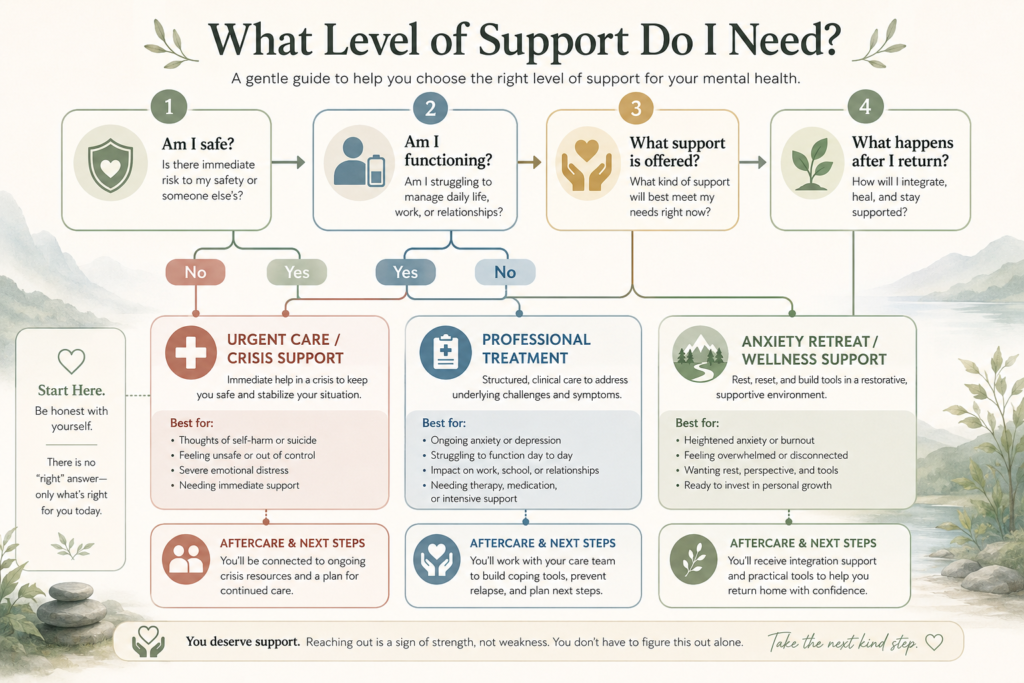
What Kind of Support Do You Actually Need?
Use this table as a starting point rather than a diagnosis.
| Your current experience | A retreat may be worth exploring when… | Seek clinical assessment first when… |
|---|---|---|
| Work-related burnout | You are functioning but depleted and need structured recovery time | You can no longer work or complete essential tasks |
| Repeated worry | You need coping skills and distance from constant triggers | Worry is severe, uncontrollable or rapidly worsening |
| Panic symptoms | The programme has qualified staff and a clear panic protocol | Symptoms are new, medically unexplained or feel dangerous |
| Relationship stress | You need space to reflect and plan healthy boundaries | Abuse, coercion or immediate safety risks are present |
| Trauma history | The programme is trauma-informed and clinically supported | Intensive exercises may destabilise you |
| Anxiety with depression | The programme can support both conditions safely | Hopelessness, self-harm thoughts or major functional decline are present |
| General exhaustion | You need rest plus a realistic return-home plan | A medical condition may be contributing to fatigue |
Simple decision path
Step 1: Are you medically stable and able to remain safe?
- If no, seek appropriate medical or emergency help.
- If yes, continue.
Step 2: Are you functioning but emotionally exhausted?
- If yes, compare wellness and professionally supported retreat options.
- If no, request a clinical assessment before booking.
Step 3: Does the programme match your actual needs?
- If no, do not book because the setting looks beautiful.
- If yes, evaluate qualifications, safety, cost and aftercare.
Step 4: Is there a return-home plan?
- If no, ask how progress will be supported after the programme.
- If yes, decide whether the plan is realistic in your daily life.
How to Choose Safe Anxiety Retreats in USA
When comparing anxiety retreats in USA, do not begin with scenery, food or accommodation. Begin with safety and programme transparency.
1. Verify professional qualifications
Look for full names, credentials and licensing information. Verify licences through the appropriate professional or state board where possible.
2. Ask what happens during a panic attack
The programme should explain:
- who responds;
- whether professional support is available;
- where the person can go;
- what happens if symptoms do not settle;
- and when medical care is contacted.
“Do not worry, our environment is peaceful” is not an adequate answer.
3. Review the medication policy
Ask whether prescribed medication can be continued and how it is stored or managed. Do not stop or change medication merely to satisfy a retreat’s rules without speaking to your prescriber.
4. Understand the daily schedule
A schedule packed with mandatory sessions may be overwhelming. A programme with no meaningful structure may provide little more than accommodation.
Look for a reasonable balance of support, education, rest and private time.
5. Ask about trauma-informed care
A programme should not force disclosure, confrontation, physical touch, intense breathwork or emotionally exposing exercises.
Consent should remain active throughout the experience.
6. Check aftercare
The value of anxiety retreats in USA should not end at checkout.
Ask whether the programme offers:
- follow-up sessions;
- referral support;
- written coping plans;
- communication with your existing clinician;
- or guidance for returning to work and family life.
Retreat Safety Scorecard
Score each item from 0 to 2:
- 0: Information is missing
- 1: Information is vague
- 2: Information is clear and verifiable
| Safety question | Score |
|---|---|
| Are staff qualifications clearly listed? | /2 |
| Is licensed mental-health support available? | /2 |
| Are crisis procedures explained? | /2 |
| Is the medication policy clear? | /2 |
| Are methods and activities described honestly? | /2 |
| Are costs and additional fees transparent? | /2 |
| Is there a cancellation and refund policy? | /2 |
| Is aftercare included or discussed? | /2 |
| Are cure promises avoided? | /2 |
| Are independent reviews available? | /2 |
Interpretation:
- 16–20: Stronger transparency, but continue verifying.
- 10–15: Important information needs clarification.
- Below 10: Do not rush into payment.
A high score does not guarantee effectiveness. It simply indicates that the programme is providing more of the information required for an informed decision.
Red Flags Before Paying for a Retreat
Be cautious when a programme:
- guarantees that anxiety will disappear;
- promises a complete nervous-system reset in a few days;
- discourages medical or psychological treatment;
- tells you to stop prescribed medication;
- hides staff qualifications;
- avoids discussing emergencies;
- pressures you to pay immediately;
- uses only testimonials as evidence;
- refuses to provide a written schedule;
- or describes every difficult reaction as “part of healing.”
A retreat should not ask you to surrender judgement.
The more emotionally exhausted you feel, the more tempting certainty can become. Strong promises may feel comforting when your own mind feels uncertain. That is precisely when written information and independent verification matter most.
What Should You Ask Before Booking?
Use these questions during a call or email:
- Is this a wellness retreat or a clinical programme?
- Who provides the mental-health sessions?
- What licences and qualifications do they hold?
- Is support available outside scheduled sessions?
- What happens if I experience severe anxiety or panic?
- Can I continue prescribed medication?
- Is the programme appropriate for trauma or depression?
- Are any activities compulsory?
- What is the full cost?
- Are travel, therapy and activities included?
- What is the cancellation policy?
- What support is available after I return home?
- Can I speak with my own clinician before enrolling?
- How large is the group?
- What medical or emergency facilities are nearby?
Save the answers in writing.
How Much Do Anxiety Retreats Cost?
The cost of anxiety retreats in USA can vary considerably according to:
- location;
- programme length;
- private or shared accommodation;
- clinical staffing;
- therapy frequency;
- meals and activities;
- medical services;
- and aftercare.
Do not assume an expensive programme provides stronger clinical care.
Ask for a complete written breakdown. It should state whether the price includes:
- accommodation;
- individual sessions;
- group sessions;
- meals;
- assessments;
- transportation;
- optional activities;
- taxes;
- follow-up care;
- and cancellation charges.
Will insurance cover a retreat?
Insurance coverage depends on the programme, provider, services and individual policy. General wellness retreats are often treated differently from licensed clinical treatment.
Before paying:
- request the provider’s billing information;
- ask which services are delivered by licensed clinicians;
- contact your insurer directly;
- and obtain confirmation in writing where possible.
Do not rely only on the retreat’s statement that reimbursement is “usually available.”
What If You Cannot Afford a Retreat?
Not being able to afford a retreat does not mean you cannot create meaningful distance from overstimulation.
A home-based break is not a replacement for treatment, but it can help reduce unnecessary noise.
A lower-cost clarity plan
Day 1: Reduce input
- Silence nonessential notifications.
- Avoid stressful news and arguments.
- Write down urgent responsibilities.
- Delay tasks that can safely wait.
Day 2: Support the body
- Eat regular meals.
- Drink enough water.
- Use gentle movement.
- Protect sleep as much as possible.
Day 3: Name the conflict
Write three headings:
- What my mind is saying
- What my emotions are saying
- What the facts currently show
Day 4: Identify support
Consider:
- a licensed therapist;
- a primary-care clinician;
- a trusted support person;
- a community mental-health service;
- or an anxiety-support programme.
Day 5: Choose one realistic change
Do not attempt to redesign your entire life. Choose one boundary, appointment, conversation or daily practice.
For additional support, read this guide for managing difficult anxiety days.
What Happens After You Return Home?
The return-home plan may be more important than the retreat itself.
A calm setting temporarily removes many triggers. Home brings back messages, deadlines, relationships, noise and familiar emotional patterns.
Before leaving, create a plan covering:
| Area | Return-home question |
|---|---|
| Sleep | What routine can I realistically continue? |
| Work | Which pressure can be reduced or delegated? |
| Relationships | What boundary needs to be communicated? |
| Digital use | Which notifications or apps increase anxiety? |
| Therapy | When is my next appointment? |
| Body care | What movement and meal routine is sustainable? |
| Warning signs | How will I notice that symptoms are worsening? |
| Support | Who can I contact when I feel overwhelmed? |
The purpose is not to preserve retreat-level calm forever. That expectation may create another source of pressure.
The goal is to carry one or two useful changes back into ordinary life.
Understanding why anxious thoughts keep returning may also help you prepare for the adjustment.
Can a Stress and Anxiety Retreat Create Permanent Change?
A stress and anxiety retreat can create a useful interruption, but permanent change usually depends on what happens next.
You may sleep better, feel more hopeful or think more clearly while away. These improvements are meaningful, but they should not be confused with a guaranteed long-term cure.
A stress and anxiety retreat becomes more valuable when it helps you:
- recognise triggers;
- practise repeatable skills;
- understand your warning signs;
- create healthier routines;
- develop a treatment plan;
- and make realistic changes at home.
The retreat should not become another form of avoidance.
If you repeatedly feel that you must escape the same environment, ask whether something in that environment needs to change.
Is an Anxiety and Depression Retreat Enough?
An anxiety and depression retreat may offer emotional support, rest and education, but adequacy depends on symptom severity.
It may not be enough when:
- depression is severe;
- you feel unsafe;
- you are unable to eat, sleep or care for yourself;
- substance use is creating risk;
- psychosis or severe confusion is present;
- or medical symptoms require assessment.
In such cases, seek appropriate professional evaluation rather than depending on a retreat.
The right level of care is not the most impressive or expensive option. It is the level that safely matches your current needs.
People Also Ask About Anxiety Retreats in USA
1. Do anxiety retreats really help?
Retreats may help some people reduce daily pressure, learn coping strategies and reflect more clearly. Their value depends on the programme, staff and individual needs. They should not be treated as guaranteed cures or substitutes for necessary professional care.
2. What happens at an anxiety retreat?
Activities may include mindfulness, movement, nature, psychoeducation, group support or individual therapy. Programmes vary widely. Confirm whether the retreat offers general wellness activities or services from licensed mental-health professionals.
3. How do I choose a safe anxiety retreat?
Check staff qualifications, crisis procedures, medication rules, programme structure, costs and aftercare. Avoid programmes making guaranteed healing claims or refusing to explain what happens during emotional or medical emergencies.
4. Is a retreat better than therapy?
They serve different purposes. A retreat may provide concentrated time and temporary distance, while therapy provides continuing, individualised support. Some people may benefit from a retreat alongside ongoing therapy rather than choosing one instead of the other.
5. How long should an anxiety retreat be?
There is no universally correct length. The right duration depends on your needs, the programme’s structure and what follow-up support exists. A longer retreat is not automatically more effective.
Frequently Asked Questions
1. Can I attend a retreat while taking anxiety medication?
Possibly. Ask about the programme’s medication policy and speak with your prescribing clinician. Do not stop or change medication merely to attend a retreat.
2. Are silent retreats suitable for anxiety?
They may feel calming to some people and distressing to others. Anyone with severe anxiety, panic or trauma-related symptoms should carefully evaluate whether prolonged silence is appropriate.
3. Can a retreat cure panic attacks?
No responsible programme should guarantee a cure. A professionally supported retreat may teach coping skills, but recurring panic symptoms may require clinical assessment and ongoing treatment.
4. Are anxiety retreats confidential?
Confidentiality rules vary. Licensed clinicians may have professional obligations, while wellness facilitators may operate under different standards. Ask for the privacy policy before sharing personal information.
5. Should I travel alone to a retreat?
That depends on your stability, comfort and support needs. Discuss travel concerns with the programme and a qualified professional, particularly if panic, medical symptoms or significant functional difficulties are present.
A Personal Note: Quiet Is Not the Same as Escape
Sometimes a person does not want to run away from life. They want to run from the current condition because everything inside and around them has become too complicated.
The mind is fighting uncertainty. The emotions are carrying pain. The nervous system is staying alert. The inner voice may already know something, but acceptance has not yet arrived.
In this state, a break may help—not because it solves everything, but because it makes the noise slightly quieter.
With less noise, you may begin to separate fear from fact, exhaustion from failure and temporary confusion from the deeper truth of what you need.
A retreat cannot promise this clarity. It cannot make difficult decisions for you. It cannot change other people or remove every pressure waiting at home.
But the right pause, in the right setting, with the right support, may help you hear yourself again.
That may be the most honest reason to explore anxiety retreats in USA.
Final Takeaway
Choosing among anxiety retreats in USA should not begin with finding the most beautiful destination. It should begin with understanding your current condition and identifying the level of care you need.
A mental health retreat for anxiety should provide transparent information about qualifications, methods, safety and aftercare.
An anxiety treatment retreat should offer credible professional structure rather than treatment-sounding marketing.
A stress and anxiety retreat should help you build skills for returning home, not only feel calm while away. An anxiety and depression retreat must be equipped to support both conditions safely.
The central question is not:
“Which retreat looks most peaceful?”
It is:
“What kind of support will help me become safer, clearer and more able to face what happens after I return?”
External References
National Institute of Mental Health
Website: National Institute of Mental Health
Title: Anxiety Disorders
URL: https://www.nimh.nih.gov/health/topics/anxiety-disorders
World Health Organization
Website: World Health Organization
Title: Anxiety Disorders
URL: https://www.who.int/news-room/fact-sheets/detail/anxiety-disorders
Mayo Clinic
Website: Mayo Clinic
Title: Anxiety Disorders—Symptoms and Causes
URL: https://www.mayoclinic.org/diseases-conditions/anxiety/symptoms-causes/syc-20350961
Cleveland Clinic
Website: Cleveland Clinic
Title: Anxiety Disorders: Types, Causes, Symptoms and Treatment
URL: https://my.clevelandclinic.org/health/diseases/9536-anxiety-disorders
National Health Service
Website: NHS
Title: Get Help With Anxiety, Fear or Panic
URL: https://www.nhs.uk/mental-health/feelings-symptoms-behaviours/feelings-and-symptoms/anxiety-fear-panic/