AI Life Purpose Coach: Find Clarity, Direction, and Inner Purpose
How AI Can Support Self-Discovery Without Replacing Human Wisdom

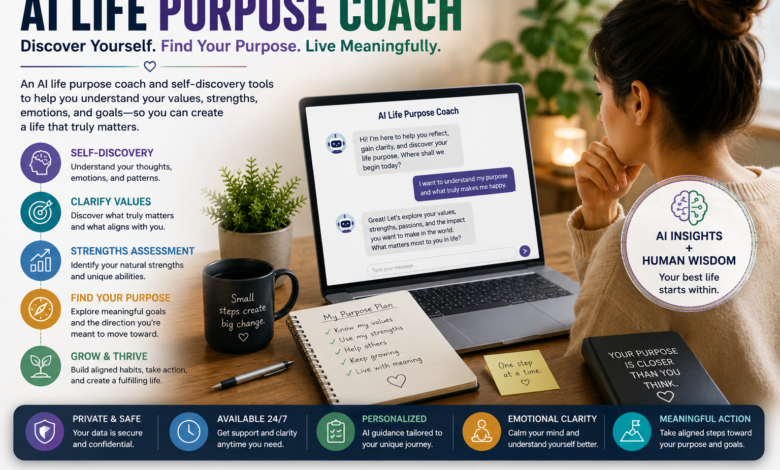
Many people today feel successful on the outside but directionless inside. An AI life purpose coach can help by turning scattered thoughts into clear reflection, but this blog goes deeper than simple tool advice.
Thank you for reading this post, don't forget to subscribe!You will not only learn how an AI life coach works, but also how an AI purpose coach can support values, identity clarity, emotional patterns, strengths, and meaningful action.
Most articles only compare apps or promise quick answers, but here you will understand the psychology behind purpose, the nervous system side of confusion, and the safe boundary between AI guidance and human wisdom.
This guide also explains how AI self-discovery tools can help you journal, reflect, notice patterns, and make better life decisions.
If you want to find your purpose with AI, this blog will help you use technology wisely without losing your own inner voice.
What Is an AI Life Purpose Coach?
An AI life purpose coach is a digital self-reflection tool that helps you organize your thoughts, understand your values, notice your emotional patterns, and explore the direction you want to take in life.
It does not give you one final “life answer.” Instead, it helps you ask better questions, see repeated patterns, and convert confusion into clearer thinking.
This matters because many people are not lost because they lack intelligence. They feel lost because their mind is overloaded, their emotions are tired, and their daily life is full of pressure.
In countries like the USA, UK, Canada, and Australia, many people deal with career stress, loneliness, burnout, identity pressure, and the quiet feeling that life is moving forward but meaning is missing.
An AI life purpose coach can become useful when it is used as a reflection partner. It can help you ask:
- What matters to me?
- What drains my energy?
- What kind of work feels meaningful?
- What decision am I avoiding?
For readers who want to understand how AI can support emotional awareness without replacing human care, this related guide on AI emotional intelligence in mental health fits naturally here.
Why People Search for an AI Life Coach Today
People search for an AI life coach because many want clarity without judgment. They may not be ready to speak with a human coach. They may not know how to explain their confusion.
Some feel embarrassed that they are stuck even after having a job, education, family, or social success. Others are tired of motivational advice that sounds positive but does not help them understand their real inner conflict.
A person may search for an AI life coach when they feel blocked in career decisions, unsure about relationships, disconnected from goals, or tired of repeating the same habits. They may want something available anytime, especially when overthinking at night or feeling emotionally heavy during the day.
The attraction of AI coaching is structure. When the mind is scattered, structure feels calming. A good AI tool can help someone write their thoughts, separate emotions from facts, identify repeated fears, and create one small next step.
If low self-worth or comparison is blocking direction, this guide on AI confidence coaching for self-belief can support the same journey.
How an AI Purpose Coach Supports Self-Discovery
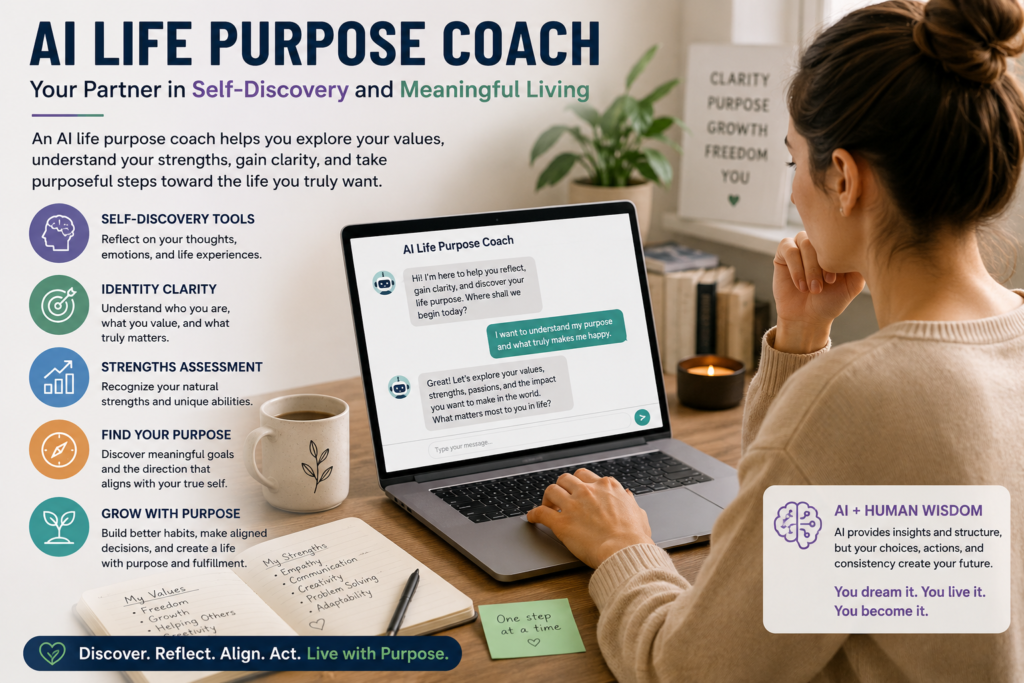
An AI purpose coach supports self-discovery by helping a person explore patterns that are often hard to see alone. When someone writes freely into an AI tool, the tool can help organize thoughts into themes such as values, fears, strengths, goals, emotional triggers, and repeated life choices.
For example, someone may keep saying, “I want freedom,” but after deeper reflection, they may realize they do not only want freedom from work. They want freedom from people-pleasing, emotional pressure, or a life path chosen only to satisfy others.
This is where an AI purpose coach becomes useful. It does not create the truth, but it can help someone notice the truth that was already present.
AI can also help with journaling prompts, values clarification, strengths assessment, habit tracking, and weekly reflection. These are not small things. Purpose often becomes clearer when a person can see what gives energy, what creates resentment, what repeats in relationships, and what kind of contribution feels meaningful.
This is also where AI self-discovery tools become helpful. They can guide questions like:
- What did I enjoy before I started judging myself?
- What problems do I naturally care about solving?
- Which strengths do others notice in me again and again?
- What fear is stopping me from choosing a direction?
When purpose confusion is mixed with emotional overload, AI tools to control emotions can help you pause, reflect, and respond with more clarity instead of reacting from pressure.
AI Can Guide Reflection, But It Cannot Give You a Soul
An AI life purpose coach can guide reflection, but it cannot replace the deeper human process of living, choosing, failing, learning, healing, loving, and acting.
- Purpose is not only a mental idea.
- Purpose becomes real when a person lives according to values, accepts responsibility, and takes repeated action even when emotions are not perfect.
This is the main difference between using AI wisely and becoming dependent on AI. AI can suggest questions.
- It can organize thoughts.
- It can help compare options.
- But it cannot feel your conscience, your lived pain, your spiritual direction, or your personal responsibility.
That is why this blog does not treat AI as a magic solution. It treats AI as a mirror. A mirror can show you your face, but it cannot walk your path for you.
Can AI Help You Find Your Purpose?
Yes, you can find your purpose with AI in the sense that AI can help you reflect more clearly, organize your inner world, and notice patterns that were hidden under stress. But AI should not become the final authority over your life. It is better to use AI as a thinking partner, not as a life controller.
To find your purpose with AI, the reader must ask deeper questions than “What career should I choose?”
A better question is:
- What kind of life would feel honest to me?
- What values do I want my work to express?
- What kind of pain has made me more compassionate?
- What discipline do I need before my purpose becomes stable?
This is where the BBH approach becomes different. Purpose is not explained only as career direction. It is explained as a connection between identity, values, emotional regulation, nervous system safety, responsibility, and conscious action.
The Psychology Behind Purpose and Identity Clarity
Purpose becomes clearer when identity becomes clearer. A person who does not know who they are will often copy other people’s goals. They may chase money because society praises it, choose a career because family expects it, or remain in a life direction because changing feels risky. This is why purpose work is not only about setting goals. It is also about understanding identity.
An AI life purpose coach can support identity clarity by helping the reader observe their own language.
When someone repeatedly writes, “I should,” “I must,” or “I have no choice,” it may show that life direction is being shaped by pressure instead of values.
When someone writes, “I feel alive when…” or “I care deeply about…,” it may reveal a more honest direction.
Psychologically, purpose is connected to meaning, agency, emotional maturity, and responsibility. A person begins to feel purpose when inner values connect with outer action.
This does not always mean a big career change. Sometimes purpose begins with one honest decision, one healthy boundary, one meaningful project, or one disciplined habit repeated daily.
Purpose becomes stronger when life is guided by awareness instead of automatic pressure, which is why this guide on conscious living and personal awareness fits naturally with this article.
“Purpose does not arrive as one perfect answer. Sometimes it begins when your mind becomes quiet enough to hear your honest direction.”
How AI Self-Discovery Tools Help You Understand Yourself
AI self-discovery tools can help you understand yourself by turning scattered thoughts into organized reflection. When life feels unclear, the problem is not always lack of ambition.
Sometimes the deeper problem is that your values, fears, strengths, habits, and emotional needs are all mixed together. An AI life purpose coach can help separate these layers so you can see yourself with more honesty.
This is why AI can be useful for people in the USA, UK, Canada, and Australia who are dealing with fast work pressure, career comparison, relationship confusion, burnout, or life transitions.
Many people do not need one motivational answer. They need a structured way to observe what is happening inside them.
A good AI purpose coach may ask you reflective questions about your daily energy, repeated frustrations, natural strengths, and future goals. These questions can help you notice what your mind keeps ignoring. If used wisely, AI becomes less like a machine giving advice and more like a mirror helping you listen to yourself.
Read Also: AI & CBT And Also This :AI and CBT self-help tools
Values Clarification: Knowing What Actually Matters
Values clarification is one of the most useful parts of working with an AI life coach. Many people think they want success, money, recognition, freedom, or stability. But when they slow down and reflect, they may discover that what they really want is emotional safety, creative expression, meaningful work, healthier relationships, or a life that feels less performative.
An AI life purpose coach can help by asking questions such as:
- What do you keep sacrificing to please others?
- What kind of work makes you feel useful?
- What do you resent because you have ignored your real needs for too long?
- What kind of life would feel honest even if nobody applauded it?
These questions help separate social pressure from authentic direction. This is important because purpose cannot grow from copying other people’s values. Purpose becomes stronger when a person understands what actually matters to them.
Strengths Assessment: Seeing What You Naturally Do Well
An AI purpose coach can also support strengths assessment. Strengths are not only professional skills. They can include emotional sensitivity, pattern recognition, communication, discipline, creativity, empathy, problem-solving, teaching, organizing, healing, building systems, or helping others feel understood.
Many people ignore their strengths because they compare themselves with someone else’s path. They may think, “This comes naturally to me, so it cannot be valuable.” But natural strengths often point toward meaningful direction. What feels normal to you may be deeply useful to someone else.
An AI life purpose coach can help you list your recurring abilities, notice what others ask your help with, and identify where your energy becomes more alive. This can support career clarity, personal confidence, and better decision-making.
Read Aslo : confidence and mindset growth
Why Strengths Feel Hidden During Stress
Strengths often become hidden when the nervous system is under pressure. When a person is anxious, burnt out, emotionally frozen, or overwhelmed, the brain becomes focused on protection.
In that state, it becomes harder to imagine possibility, trust ability, or make long-term decisions.
This is why someone may feel purposeless during stress, even when they have real skills. The issue may not be that purpose is missing. The issue may be that the body does not feel safe enough to access clarity.
The Nervous System Side of Finding Purpose
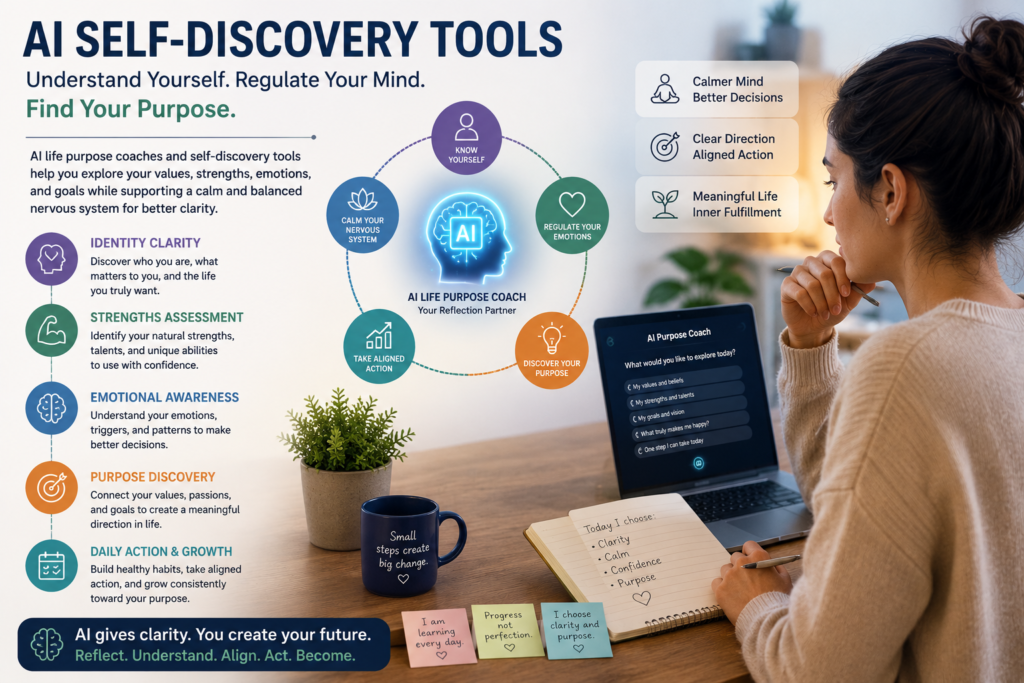
The nervous system plays a major role in purpose clarity. When your body is calm, your mind can reflect, imagine, compare options, and choose with maturity. But when your body is in survival mode, the mind becomes narrow. It looks for danger, avoids risk, and repeats familiar patterns even when those patterns are not meaningful.
This is why an AI life purpose coach should not only focus on goals. It should also help the user notice emotional state, sleep, stress, boundaries, and daily regulation.
Purpose is not only a thinking problem. It is also connected to how safe, rested, and emotionally steady a person feels.
If the reader is struggling with emotional overload, Read Also: nervous system regulation for emotional clarity
Why Anxiety and Burnout Make Life Direction Feel Confusing
Anxiety and burnout can make life direction feel confusing because they keep the mind in short-term survival.
A burnt-out person may not ask, “What is meaningful to me?”
They may only ask, “How do I get through today?”
This is not weakness. It is the nervous system trying to conserve energy.
When someone is anxious, every option may feel risky. When someone is exhausted, even a good opportunity may feel heavy. When someone is emotionally overloaded, their inner voice may become buried under fear, pressure, and mental noise.
This is where AI self-discovery tools can support reflection, but they should be used gently.
Instead of asking AI for a perfect life plan, a better approach is to ask:
- What is one small step that matches my values today?
- What is draining me repeatedly?
- What boundary would protect my energy?
- What decision can wait until I am calmer?
This also connects well with your article on detachment for emotional control because detachment helps people reduce pressure, pause reaction, and return to clearer thinking.
How an AI Life Coach Can Support Daily Regulation
An AI life coach can support daily regulation by helping a person create small reflection routines. This may include a morning clarity prompt, an evening emotional check-in, a weekly values review, habit tracking, sleep reflection, and one next-step plan.
For example, instead of asking, “What is my full life purpose?” a person can ask an AI tool: “Based on my journal this week, what values appear most often?” or “What situations gave me energy and what situations drained me?”
These questions are more grounded because they use real lived patterns instead of abstract fantasy.
An AI life purpose coach becomes more useful when it helps you take one regulated action, not when it gives endless advice. One small action is often more healing than another hour of overthinking.
The goal is not to become dependent on AI. The goal is to use AI as a structure until your own self-trust becomes stronger.
Practical Example: A 7-Day Purpose Clarity Check-In
Here is a simple 7-day reflection plan you can use with an AI purpose coach:
Day 1: What values felt important this week?
Day 2: What drained my emotional energy?
Day 3: What gave me quiet satisfaction?
Day 4: What strength did I use naturally?
Day 5: What fear controlled my decision?
Day 6: What boundary would protect my purpose?
Day 7: What is one small action for next week?
This is how you can find your purpose with AI in a grounded way. You are not asking AI to control your life. You are using it to observe your patterns, understand your energy, and choose one meaningful next step.
When an AI Life Purpose Coach Helps — and When It Is Not Enough
An AI life purpose coach can be helpful when you need structure, reflection, journaling support, goal clarity, or a calmer way to understand your thoughts.
It can help you notice repeated patterns, organize your values, review your habits, and explore what kind of direction feels meaningful. For many people, this is enough to begin moving from confusion toward practical clarity.
But an AI life purpose coach is not enough when the problem is deeper than reflection. If someone is facing severe depression, self-harm thoughts, trauma symptoms, panic, bipolar symptoms, OCD distress, addiction, abuse, or inability to function in daily life, AI should not replace a therapist, doctor, psychiatrist, or trained human support.
This distinction is important for safety. AI can help you think, but it cannot fully understand your body, history, diagnosis, risk, environment, or emotional crisis. It can support self-discovery, but it should not become your only support system.
For readers who need a broader entry point into emotional healing, link here to Start Here for mental clarity and emotional healing.
Use AI for Reflection, Not Emotional Dependency
The safest way to use an AI life coach is to treat it as a reflection tool, not as an emotional authority. It can ask questions, summarize your thoughts, and suggest possible next steps. But it should not decide your identity, your relationships, your career, or your medical choices.
Emotional dependency happens when a person starts needing AI approval before every decision. This can reduce self-trust. A healthy AI purpose coach should help you return to your own judgment, not make you feel powerless without it.
Use AI to ask better questions, not to avoid life. Use it to clarify values, not escape responsibility. Use it to organize your emotions, not replace human connection.
The goal is not to make AI your inner voice. The goal is to strengthen your own inner voice.
When to Choose a Human Therapist, Coach, or Doctor
You should choose a human therapist, coach, doctor, or psychiatrist when your situation needs emotional safety, clinical judgment, diagnosis, treatment, or real-time human care. AI can support reflection, but it cannot provide emergency support, medical evaluation, or trauma-informed human presence.
A therapist may help when emotional pain is repeating, relationships feel unsafe, childhood trauma is active, anxiety is affecting daily life, or self-worth is deeply damaged.
A doctor or psychiatrist may be needed when mood swings, panic, sleep disturbance, compulsions, depression, or medication-related questions are involved.
A human coach may be useful when your mental health is stable but you need accountability, career direction, decision-making support, or goal planning. AI can support the process between sessions, but it should not replace qualified help.
For safe AI-related self-help direction, add this support link: AI therapy and self-help tools.
The Safest Rule: AI Can Support, Humans Must Still Decide
The safest rule is simple: AI can support, but humans must still decide. An AI life purpose coach can reflect your thoughts, but it cannot live the consequence of your choices. It can suggest a direction, but you must test that direction in real life.
Purpose becomes real through action, responsibility, awareness, and emotional maturity. AI can help you prepare, but you still have to walk the path.
How to Use an AI Purpose Coach in Daily Life
You can use an AI purpose coach in daily life by keeping the process simple. Do not ask AI to solve your whole future in one answer. Instead, use it for small reflection routines that help you understand yourself better over time.
In the morning, ask: “What is one meaningful action I can take today?”
At night, ask: “What gave me energy and what drained me today?”
Once a week, ask: “What value did I live, what value did I ignore, and what pattern repeated?”
This kind of practice helps you find your purpose with AI without becoming dependent on AI. The purpose is not hidden inside the tool. The tool only helps you notice the direction already forming through your values, emotions, strengths, and choices.
If deeper emotional healing is part of the purpose journey, add this relevant internal link: emotional healing roadmap for deeper self-understanding.
A Simple Weekly Purpose Reflection Framework
A weekly reflection framework can make AI self-discovery tools more useful. Instead of asking random questions, use a repeated structure every week. Repetition helps the mind see patterns that one-time reflection often misses.
Ask your AI tool these five questions every week:
What gave me quiet energy this week?
What drained me repeatedly?
What value did I ignore?
What strength did I use naturally?
What one action fits my next direction?
These questions are simple, but they reveal a lot.
- If t

AI can guide reflection and reveal patterns, but real purpose grows through human wisdom, emotional awareness, and aligned action. he same activity gives energy every week, it may point toward purpose.
- If the same situation drains you every week, it may show where boundaries are needed.
- If the same strength appears again and again, it may show where your contribution can grow.
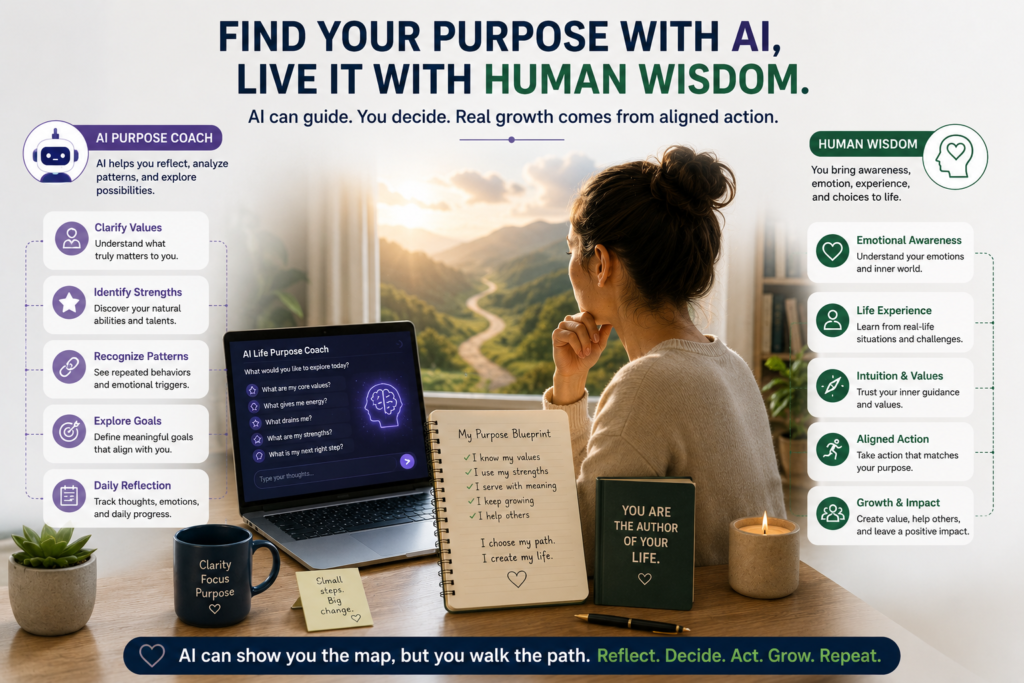
This is how an AI life purpose coach becomes practical. It does not need to give a dramatic life answer. It helps you build awareness through small, repeated observations.
Final Thoughts: AI Can Reflect Your Path, But You Must Walk It
An AI life purpose coach can help you reflect, organize your thoughts, notice emotional patterns, and explore meaningful direction.
- An AI life coach can support goals and habits.
- An AI purpose coach can help you ask deeper questions.
- AI self-discovery tools can guide journaling, values clarification, and weekly reflection.
But purpose is still human. You do not fully find your purpose with AI by receiving one perfect answer.
You find it by listening honestly, calming your nervous system, understanding your values, taking small actions, and learning from real life.
AI can be a mirror, a notebook, and a guide. But your life still needs your presence, your responsibility, your wisdom, and your courage.