AI for Negative Self-Talk: Reframe Thoughts, Rebuild Confidence
Negative Self-Talk AI for Inner Critic Healing

Negative self-talk can feel like truth when it repeats for years, but often it is only a learned inner pattern shaped by stress, fear, shame, and past emotional experiences.
Thank you for reading this post, don't forget to subscribe!This blog explains how AI for negative self-talk can help you slow down harsh thoughts, understand the hidden pattern behind them, and rebuild confidence without forcing fake positivity.
Unlike many guides that only say “think positive,” this article shows how negative self-talk AI can work as a reflection tool, how AI thought reframing can turn self-criticism into balanced thinking, and how an AI confidence coach can support small daily actions that rebuild self-trust.
You will also learn why inner critic healing is not about silencing yourself, but about creating a safer inner voice. This is a practical, emotionally safe guide for readers who want clarity, confidence, and a calmer relationship with their own mind.
Why Negative Self-Talk Feels So Real — And How AI Can Help You See It Clearly
Negative self-talk can feel like a private voice that only you hear, but its effect can shape your confidence, emotions, decisions, relationships, and daily energy.
Many people in the USA, UK, Canada, and Australia are now searching for safer digital ways to understand their thoughts because stress, loneliness, therapy costs, waiting lists, work pressure, and emotional overload are rising.
This is where AI for negative self-talk becomes useful, not as a replacement for therapy, but as a reflective tool that helps you slow down, name your inner pattern, and reframe it with more balance.
The unique value of this blog is simple: it does not tell you to “just think positive.” That advice often fails because negative self-talk is not only a mindset problem. It can come from fear, shame, past criticism, nervous system activation, low mood, sleep anxiety, and repeated inner beliefs.
This guide will show how negative self-talk AI, AI thought reframing, an AI confidence coach, and inner critic healing can work together to help you build a calmer inner voice.
What Is AI for Negative Self-Talk?
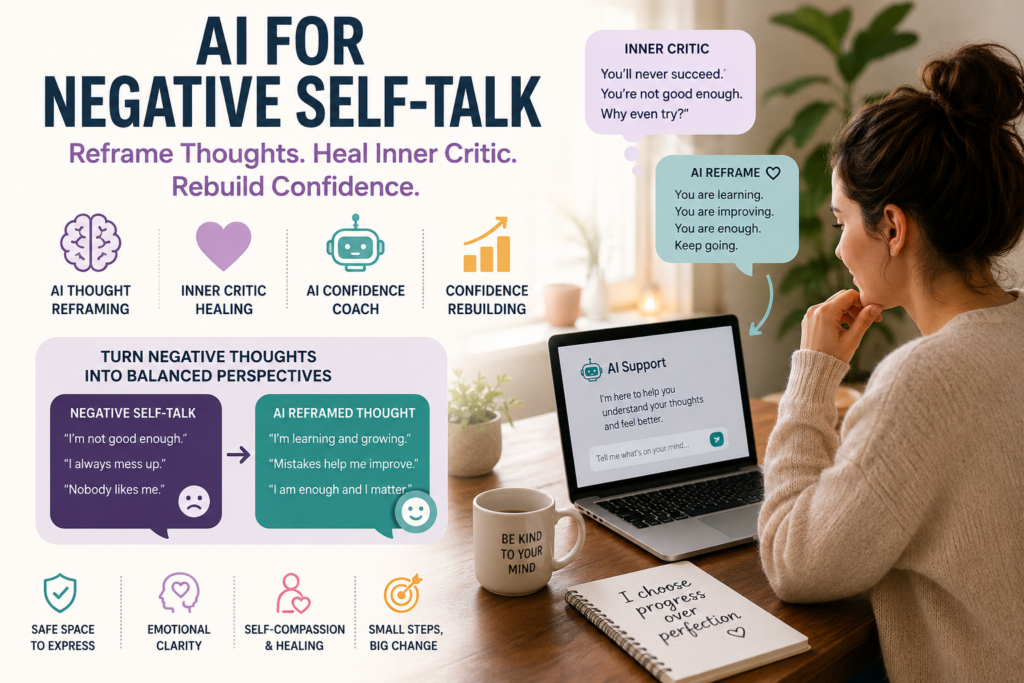
AI for negative self-talk means using artificial intelligence as a guided reflection tool to help you identify harsh inner thoughts, understand emotional patterns, and create more balanced responses.
For example, if your mind says, “I always fail,” AI can help you slow down and ask: Is this a fact, a fear, or an old emotional pattern?
This matters because the brain often repeats familiar thoughts even when they are painful. A person may not consciously choose self-criticism, but the mind may return to it because it feels familiar, protective, or connected to old experiences.
In this way, AI emotional validation can help a reader feel heard before they try to change the thought: emotional-validation-ai-feel-heard-understood
AI should not be treated as a perfect authority. It is better understood as a mirror. It reflects your words back in a clearer form so you can see what your mind is doing.
How Negative Self-Talk Becomes an Automatic Inner Voice
Negative self-talk usually starts as a response to pain, pressure, rejection, comparison, failure, or fear.
Over time, it can become automatic.
- A small mistake becomes “I am useless.”
- A delayed reply becomes “They don’t care about me.”
- A difficult day becomes “My life is not improving.”
This is why people often confuse repeated thoughts with truth. When the same inner sentence appears again and again, the nervous system begins to treat it as familiar. Familiar does not mean accurate. It only means the brain has practiced that pattern many times.
Some common examples include:
- “I am not good enough.”
- “I always mess things up.”
- “People will judge me.”
- “I can’t trust myself.”
- “Nothing works for me.”
When these thoughts become emotionally heavy, people may also experience sadness without fully understanding why. That is why the article on feeling sad for no reason can support this topic well: feeling-sad-for-no-reason
Why AI Can Help You Notice Thought Patterns Faster
When the mind is overloaded, it becomes difficult to separate emotion from fact. A person may know logically that one mistake does not define them, but emotionally it still feels true. This is where negative self-talk AI can help by organizing scattered thoughts into clearer patterns.
For example, you can write: “I feel like I am failing in everything.” AI can help identify whether the thought includes overgeneralization, catastrophizing, shame language, or emotional reasoning. That does not solve everything immediately, but it gives you a starting point.
This is also where AI emotional support tools can become helpful because they allow a person to write, reflect, pause, and reframe without feeling judged: ai-emotional-support-tools
The goal is not to make AI your emotional authority. The goal is to use it as a pause button between the harsh thought and your reaction.
Why Negative Self-Talk Feels So Real
Negative self-talk feels real because it often carries emotion. A calm thought may pass quickly, but a fear-based thought can feel urgent. The body reacts before the mind has time to question it.
Your heart may tighten, your stomach may feel heavy, or your energy may drop. Then the mind says, “See, this must be true.”
This is one reason AI thought reframing should not be fake positive. Telling yourself, “I am amazing,” when you feel broken may create more resistance. A better reframe is realistic: “I am struggling right now, but this one moment does not define my whole ability.”
That kind of balanced thought gives the nervous system a safer message.
The Brain Repeats Familiar Emotional Stories
The brain does not only remember facts. It remembers emotional stories. If you were criticized often, ignored, rejected, compared, or pressured, your inner voice may copy those old patterns. Later, even when no one is attacking you, the inner critic may continue the same tone.
This is why inner critic healing is not about fighting your mind. Fighting the inner critic can create more inner conflict. Healing begins when you ask: What is this voice trying to protect me from? Failure? Rejection? Shame? Disappointment?
Once you understand the fear behind the voice, you can respond with more maturity.
The Nervous System Link: Self-Talk and Emotional Safety
Negative self-talk becomes stronger when the nervous system is tired, overstimulated, anxious, or sleep-deprived. Many people notice their harshest thoughts at night because there are fewer distractions and more emotional space.
This is where sleep anxiety and nighttime overthinking can connect directly with negative self-talk: sleep-anxiety
When the nervous system feels unsafe, the mind searches for danger. Sometimes that danger becomes internal: “I am failing,” “I am behind,” “I am not enough.”
This is why confidence cannot be rebuilt only through motivation. The inner system needs safety, repetition, and small evidence.
An AI confidence coach can support this process by helping you track small wins, create realistic reframes, and choose one grounded action. Confidence grows when your inner voice becomes less attacking and your daily actions become more consistent.
“My inner voice did not become kind in one day; it became softer when I stopped treating every harsh thought as truth.”
How AI Thought Reframing Helps Rebuild Confidence
Understanding negative self-talk is only the first step. The next step is learning how to respond to it without believing every harsh thought immediately.
This is where AI thought reframing becomes useful. It helps you slow down the sentence in your mind, identify the thinking pattern behind it, and create a more balanced response that your nervous system can actually accept.
Many people make one mistake when trying to heal negative self-talk: they jump too quickly into positive thinking. But the mind does not trust fake positivity when the body feels anxious, ashamed, or unsafe.
A better method is to move from self-attack to realistic self-support. That is why AI for negative self-talk should be used as a structured reflection process, not as a quick motivational tool.
How AI Thought Reframing Works for Negative Self-Talk
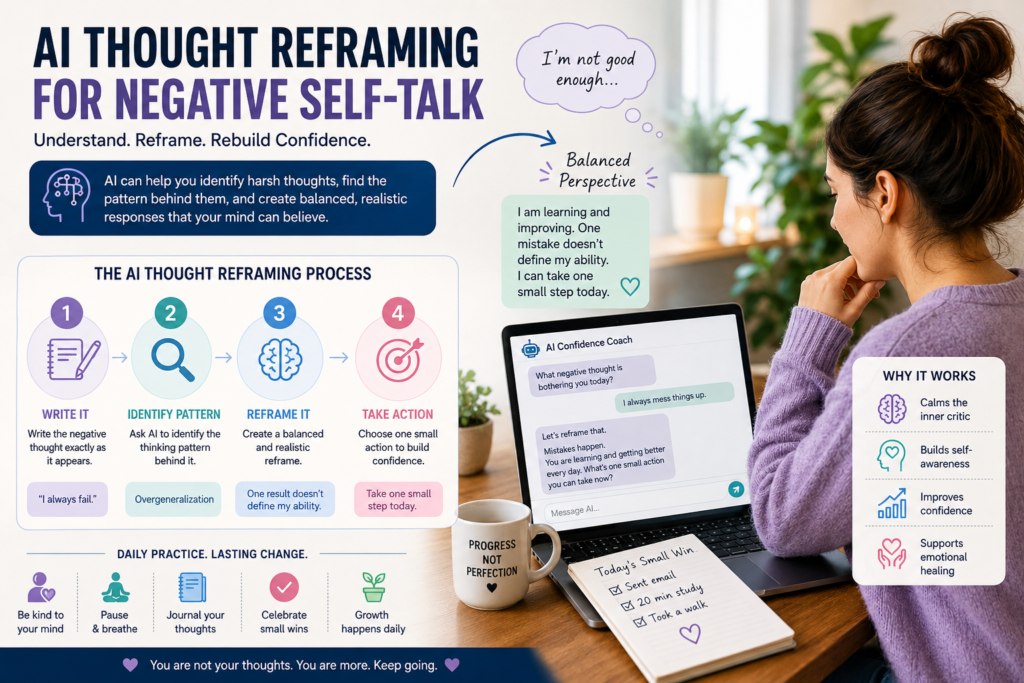
AI thought reframing works best when you use it step by step. Instead of asking AI to simply “make me feel better,” you ask it to help you understand the thought, identify the emotional pattern, and create a balanced response.
This is important because negative self-talk often feels messy inside the mind.
- One thought connects with another. A small failure becomes a life story.
- One uncomfortable emotion becomes a judgment about identity.
- AI can help separate these layers so you can see the difference between fact, fear, interpretation, and action.
Step 1: Write the Harsh Thought Clearly
The first step is to write the negative thought exactly as it appears.
- Do not make it polite.
- Do not edit it.
- Do not hide the painful part.
If your mind says, “I am useless,” write that sentence. If your mind says, “I always ruin things,” write that too.
This does not mean the thought is true. It means you are making the hidden voice visible. Many thoughts feel more powerful when they stay inside the mind. Once written down, they become easier to question.
Do not edit the thought before you understand it
A useful AI prompt is:
“This is my negative thought: ‘I always fail.’ Please help me identify the thinking pattern behind it and reframe it in a realistic way.”
This gives AI a clear job. It should not just comfort you. It should help you observe the structure of the thought.
Step 2: Ask AI to Identify the Thinking Pattern
After writing the thought, ask AI to identify the thinking pattern. Many self-critical thoughts include cognitive distortions such as catastrophizing, overgeneralizing, mind-reading, emotional reasoning, or all-or-nothing thinking.
For example:
| Negative Thought | Possible Pattern |
|---|---|
| “I always fail.” | Overgeneralization |
| “Everyone will judge me.” | Mind-reading |
| “This mistake ruined everything.” | Catastrophizing |
| “I feel worthless, so I must be worthless.” | Emotional reasoning |
This is where negative self-talk AI becomes helpful because it can quickly organize emotional language into clearer categories. Once you see the pattern, the thought becomes less absolute.
Step 3: Create a Balanced Reframe
A good reframe is not fake. It should feel believable. The goal is not to say, “Everything is perfect.” The goal is to say something more accurate than the harsh thought.
Example:
Old thought: “I always fail.”
Balanced reframe: “I failed at this task, but one result does not define my ability. I can review what happened and take one smaller step.”
This is the heart of AI thought reframing. It does not erase pain. It helps you speak to yourself with more fairness.
A good reframe is believable, not forced
If a reframe feels too positive, adjust it. Instead of saying, “I am confident,” say, “I am practicing confidence.” Instead of saying, “I never make mistakes,” say, “I can make mistakes and still learn.”
This kind of language is safer for people who struggle with shame, anxiety, or old self-doubt.
AI Confidence Coach: Can AI Help Rebuild Self-Belief?
An AI confidence coach can support confidence rebuilding when it is used for reflection, planning, and small action.
- Confidence does not return only because someone says positive words.
- Confidence returns when the brain receives repeated evidence that you can act, recover, and continue.
This is why an AI tool can be useful for daily practice. You can ask it to help you create a small goal, track progress, review a difficult thought, or choose one grounded action after a setback.
For example, you can ask:
“Act like an AI confidence coach. Help me turn this self-critical thought into one balanced thought and one small action I can take today.”
This prompt is powerful because it connects thought reframing with behavior. The mind needs new language, but the body needs proof.
Confidence Is Rebuilt Through Evidence, Not Empty Motivation
If your inner voice says, “I cannot do anything properly,” motivation alone may not help.
But completing one small task can create evidence. Sending one message, finishing one paragraph, making one call, or walking for ten minutes can begin to rebuild trust.
This is where AI tools to control emotions can support the pause between the trigger and the reaction: ai-tools-to-control-emotions
When you pause before reacting, you create a small space between emotion and behavior. That space is where confidence begins to return.
Use AI to track small wins
A simple daily prompt can be:
“Help me list three small wins from today, even if they feel small.”
This trains the brain to notice evidence instead of only scanning for failure.
Inner Critic Healing: Why Self-Compassion Matters
Inner critic healing is not about destroying the critical voice. Often, the inner critic developed as a protection system. It tries to stop you from being rejected, embarrassed, abandoned, or disappointed. The problem is that it uses fear as its method.
The inner critic may say, “Don’t try, because you might fail.” It may say, “Be perfect, or people will leave.”
It may say, “Stay small, because judgment is dangerous.”
When you understand this, you stop treating the inner critic as the enemy. You begin treating it as a frightened part of you that needs guidance.
The Inner Critic Often Tries to Protect You Through Fear
A harsh inner voice may be trying to protect you, but it often causes more harm than safety. It keeps the nervous system tense and the mind trapped in self-defense. That is why healing requires both awareness and compassion.
AI can support this by helping you ask better questions:
- What fear is behind this thought?
- What is the inner critic trying to prevent?
- What would a calm, protective voice say instead?
- What small action would support confidence today?
These questions help transform self-criticism into self-leadership.
Why Body State Matters in Negative Self-Talk
One missing point in many AI articles is the body. Negative thoughts often become stronger when the nervous system is overstimulated. Poor sleep, too much caffeine, stress, dehydration, loneliness, and emotional exhaustion can all make the inner voice harsher.
This is why readers should understand the connection between caffeine and anxiety if their thoughts become louder after stimulants: caffeine-and-anxiety
The goal is not to blame caffeine or the body for everything. The goal is to understand that thoughts do not happen in isolation. Your mental state is connected to your physical state.
AI works better when your nervous system is calmer
If you are highly anxious, even a good reframe may feel hard to believe. In that case, start with regulation first. Breathe slowly, drink water, walk, reduce stimulation, or write one sentence.
Then use AI for negative self-talk when your mind has more space.
Safety Note: AI Is Support, Not a Replacement for Therapy
AI can help with reflection, journaling, thought reframing, confidence practice, and emotional organization. But it should not replace professional care when someone is dealing with severe depression, trauma, panic, self-harm thoughts, abuse, or crisis-level distress.
This is why readers should understand AI therapy tools, benefits, and risks before depending on AI for emotional support: ai-therapy-tools-benefits-risks-online-counseling
Used wisely, AI can become a helpful support tool. Used blindly, it can create overdependence or delay real help.
The healthiest approach is balanced: use AI for reflection, but keep human support, professional guidance, and real-world action as part of the healing path.
Safe Ways to Use AI for Negative Self-Talk Without Losing Human Awareness
AI for negative self-talk can be helpful when it is used with awareness, emotional honesty, and clear limits. It can help you pause before believing a harsh thought, create a more balanced reframe, and practice confidence in small daily steps.
But AI should never become the only place where a person brings deep emotional pain. The healthiest use of AI is not dependency. The healthiest use is reflection, clarity, and support.
This matters because negative self-talk can sometimes be connected to deeper issues such as trauma, chronic anxiety, depression, grief, shame, or long-term emotional neglect. In those cases, AI can help organize thoughts, but human support is still important.
A person may use negative self-talk AI to understand patterns, but real healing also needs safety, connection, body regulation, and practical life action.
When AI for Negative Self-Talk Is Helpful
AI is most helpful when the problem is a thought loop, not an emergency. For example, if you are overthinking after a mistake, feeling anxious before a task, comparing yourself to others, or repeating a harsh sentence in your mind, AI can help you slow the pattern down.
You can ask AI to identify the thinking style, create a balanced reframe, or suggest one small action. This can be especially useful for readers in the USA, UK, Canada, and Australia who may be facing therapy waitlists, high counseling costs, workplace stress, social isolation, or digital burnout.
Use AI for awareness, reflection, and gentle reframing
A safe prompt would be:
“Help me understand this negative thought without judging me. Identify the pattern, give me a realistic reframe, and suggest one small action.”
This kind of prompt keeps the process grounded. It does not ask AI to diagnose you. It asks AI to help you observe your thinking.
Best use cases for AI support
AI can support journaling, self-reflection, emotional labeling, confidence practice, and AI thought reframing. It can also help you notice when the same inner critic appears repeatedly.
But the final goal is not just a better sentence. The final goal is a safer relationship with yourself.
When You Should Seek Human Support
AI should not replace professional care when emotional pain becomes intense, dangerous, or long-term.
If a person is having self-harm thoughts, feeling unsafe, experiencing abuse, panic attacks, severe depression, trauma flashbacks, or losing the ability to function, they should reach out to a trusted person, doctor, therapist, local crisis line, or emergency service.
This article is not medical advice. It is a self-help and educational guide. AI can support emotional reflection, but it cannot fully replace human care, clinical judgment, or crisis support.
AI is a tool, not a therapist
This is why readers should understand AI therapy tools, benefits, and risks before using AI deeply for emotional support: Ai-therapy-tools-benefits-risks-online-counseling
The safest approach is balanced. Use AI to reflect. Use people for connection. Use professionals when symptoms are strong. Use daily action to rebuild trust with yourself.
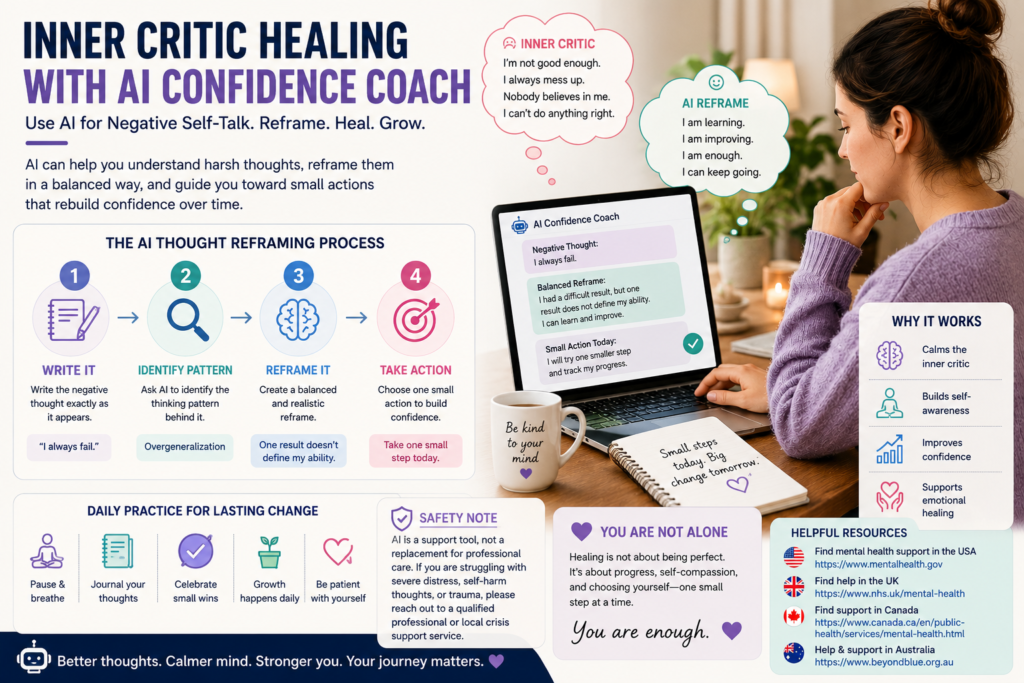
A Simple 7-Day AI Reframing Practice
A simple practice can help turn this blog into action. Do not try to fix your entire inner world in one day. Start with one repeated thought.
Day 1–2: Notice your repeated negative thought
Write down the sentence that appears most often. It may be “I am behind,” “I am not enough,” “I always fail,” or “People will judge me.”
Do not debate it yet. Just notice it.
Day 3–4: Ask AI to find the pattern
Ask:
“What thinking pattern is present in this thought?”
AI may identify overgeneralization, catastrophizing, mind-reading, emotional reasoning, or perfectionism.
Day 5–6: Create a balanced reframe
Ask AI for three reframes, then choose the one that feels most believable.
Example:
Negative thought: “I always fail.”
Balanced reframe: “I had a difficult result, but one result is not my whole identity.”
This is where AI thought reframing becomes practical instead of theoretical.
Day 7: Take one confidence-building action
An AI confidence coach can help you choose one small action that gives your brain evidence. This may be sending one email, completing one task, making one healthy choice, or speaking to yourself with less attack.
Small action proves safety to the brain
Confidence does not grow only from thinking. Confidence grows when thought, emotion, and action begin to align.
Quick Comparison: Negative Self-Talk vs AI Reframed Self-Talk
| Negative Self-Talk | AI Reframe | Small Action |
|---|---|---|
| I always fail | One mistake is not my identity | Try one smaller step |
| I am not good enough | I am learning through practice | Finish one useful task |
| People will judge me | Some people may judge, but I can still act | Send the message |
| I cannot change | Change begins with one repeated practice | Track one small win |
| I ruin everything | I made one mistake, not a life sentence | Repair one thing calmly |
People Also Ask
Can AI help with negative self-talk?
Yes, AI can help with negative self-talk by identifying repeated harsh thoughts, naming thinking patterns, and creating balanced reframes. It works best as a reflection tool, not as a replacement for therapy.
What is negative self-talk AI?
Negative self-talk AI means using AI to understand and reframe self-critical thoughts. It can support journaling, emotional awareness, confidence practice, and inner critic healing.
Is AI thought reframing the same as CBT?
AI thought reframing can use CBT-style ideas, such as identifying distorted thinking and creating balanced alternatives. However, it is not the same as working with a licensed CBT therapist.
Can an AI confidence coach improve self-esteem?
An AI confidence coach may help you track small wins, challenge harsh thoughts, and choose realistic actions. Self-esteem improves when new thoughts are supported by consistent behavior.
How do I heal my inner critic?
Inner critic healing begins by noticing the harsh voice, understanding the fear behind it, and responding with firm but compassionate language. AI can support this process, but deeper pain may need human support.
FAQ
1. Why does negative self-talk feel so true?
Negative self-talk feels true because it often carries strong emotion and repeated memory patterns. The brain may treat familiar thoughts as facts, even when they are only old fear-based interpretations.
2. What is the best AI prompt for negative self-talk?
A useful prompt is: “Help me identify the thinking pattern in this negative thought, reframe it realistically, and suggest one small action I can take today.” This keeps the response practical and emotionally grounded.
3. Is AI thought reframing the same as CBT?
No. AI thought reframing can use CBT-style ideas, such as recognizing distorted thinking and creating balanced alternatives, but it is not the same as therapy with a licensed CBT professional. The American Psychological Association explains that CBT often includes learning to recognize distortions in thinking and change thinking patterns.
4. Can AI help heal the inner critic?
AI can support inner critic healing by helping you notice harsh self-talk and soften it into more compassionate language. Self-compassion practices also emphasize recognizing critical self-talk and changing the way you respond to yourself.
5. When should I stop using AI and seek help?
You should seek human support if negative thoughts become overwhelming, unsafe, repetitive, or connected to trauma, abuse, severe anxiety, depression, or self-harm. AI can organize thoughts, but it cannot replace professional care, emergency help, or trusted human connection.
Final Thought: Your Inner Voice Can Become Safer
The goal of AI for negative self-talk is not to create a perfect mind. The goal is to create a safer inner relationship.
When you stop believing every harsh thought immediately, you create space. In that space, you can question the pattern, understand the fear, reframe the message, and choose a better action.
For deeper support, readers can start your emotional healing journey here:start-here
They can also explore the healing resources hub for more emotional healing and self-help pathways:healing-resources-hub
Negative self-talk may have been practiced for years, but it can still change. With awareness, self-compassion, nervous system safety, and small daily action, the inner critic can become less aggressive. AI can help you see the pattern, but your awareness creates the real change.
External Linking References with URL
- Mental Health America — Changing Thoughts with an AI Assistant
Use for: AI support, thought reframing, negative thinking support
URL:https://screening.mhanational.org/changing-thoughts-with-an-ai-assistant/ - NHS Every Mind Matters — Reframing Unhelpful Thoughts
Use for: CBT-style reframing, checking negative thoughts, replacing unhelpful thoughts
URL:https://www.nhs.uk/every-mind-matters/mental-wellbeing-tips/self-help-cbt-techniques/reframing-unhelpful-thoughts/ - American Psychological Association — What Is Cognitive Behavioral Therapy?
Use for: CBT explanation, distorted thinking, thought pattern change
URL:https://www.apa.org/ptsd-guideline/patients-and-families/cognitive-behavioral - Self-Compassion.org — Changing Your Critical Self-Talk
Use for: inner critic healing, self-compassion, critical inner voice
URL:https://self-compassion.org/exercises/exercise-5-changing-your-critical-self-talk/ - Harvard Health — How to Recognize and Tame Cognitive Distortions
Use for: cognitive distortions, negative thinking patterns, anxiety-related thoughts
URL:https://www.health.harvard.edu/blog/how-to-recognize-and-tame-your-cognitive-distortions-202205042738