AI Apps for Anxiety Relief: How to Choose and Use Them Safely
A Safety-First Guide to Anxiety Apps, Breathing Tools, HRV Tracking, and Human Support

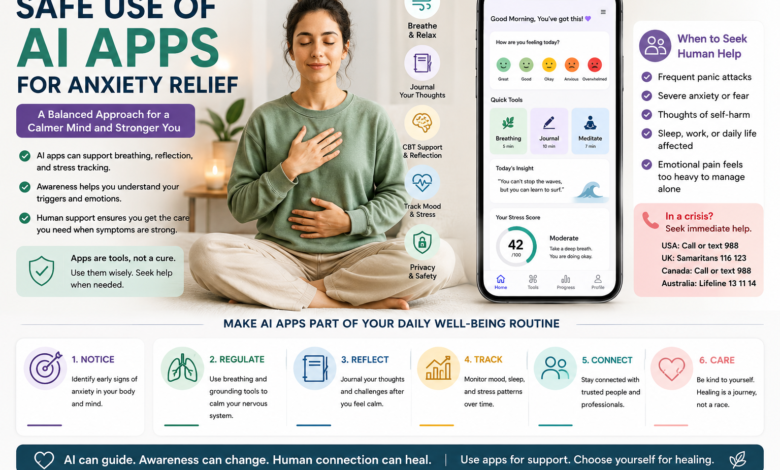
AI apps for anxiety relief are becoming popular in the USA, UK, Canada, and Australia because many people need quick emotional support before anxiety turns into panic, overthinking, or sleepless stress. But this guide is not another “best app list.”
Thank you for reading this post, don't forget to subscribe!A list may tell you what to download, but it may not teach you how to choose safely, protect emotional privacy, or know when human support is still needed.
This article explains how anxiety relief apps can support breathing, journaling, mood tracking, CBT-style reflection, and early stress awareness without pretending that technology can replace therapy.
You will also learn why AI mental health apps should be used carefully, how breathing apps for anxiety may calm the nervous system, and how HRV stress tracking can help some people notice body signals before stress becomes overwhelming.
For a wider foundation, readers can explore BBH’s guide on AI therapy and self-help tools, which explains how digital tools can support emotional clarity without replacing professional care.
What Are AI Apps for Anxiety Relief?
AI apps for anxiety relief are digital tools that help people manage anxiety symptoms through guided support, emotional check-ins, breathing exercises, journaling, mood tracking, CBT-style prompts, and sometimes wearable stress data.
Some apps use AI chatbots to respond to emotional concerns. Some focus mainly on breathing and grounding. Others track sleep, heart rate, stress patterns, or daily mood changes.
The important point is this: these apps are not meant to diagnose anxiety or replace therapy. Their real purpose is to support the small moment between emotional stress and healthy action.
When someone feels overwhelmed, an app may offer a breathing timer, a grounding exercise, a journaling question, or a reminder to pause before reacting.
This is why AI apps for anxiety relief are most helpful when they are used as early support tools, not complete mental health solutions.
Readers who want to understand the body-based side of stress can also visit BBH’s nervous system regulation section, because anxiety often begins in the body before the mind fully understands it.
Why People Search for Anxiety Relief Apps Today
People do not search for anxiety relief apps only because they like technology. They search because they are tired, anxious, overstimulated, and unsure what to do when stress rises.
- A person may sit alone at night with racing thoughts.
- A student may feel chest tightness before an exam.
- A working professional may feel panic before a meeting.
- A parent may feel emotionally overloaded but still need to function.
In the USA, UK, Canada, and Australia, many people also deal with therapy wait times, high costs, workplace stress, loneliness, and constant digital pressure.
This creates a real need for accessible emotional support. An app cannot replace human care, but it can offer an immediate tool when a person needs to breathe, reflect, or calm the body.
For deeper topic learning, readers can also explore BBH’s anxiety and overthinking section.
How AI Mental Health Apps Support Anxiety
AI mental health apps can support anxiety by giving the user a structured place to pause, reflect, and regulate before anxiety becomes stronger.
- Some apps use chatbot-style conversations where the user can write what they feel and receive calming prompts.
- Some use CBT-style reflection to help the person question anxious thoughts.
- Others use breathing exercises, mood tracking, guided meditation, sleep support, or daily emotional check-ins.
The useful part is not only that the app is “intelligent.” The useful part is that it gives structure when the mind feels scattered. During anxiety, the brain can move quickly into worst-case thinking, body tension, fear, and emotional urgency.
A well-designed app may slow that cycle by asking simple questions:
- What are you feeling?
- Where do you feel it in your body?
- What is one safe action you can take now?
For related reading, BBH’s article on AI emotional support can help readers understand how digital tools may support emotional expression and reflection.
What AI Can and Cannot Do
AI can guide breathing, offer journaling prompts, suggest grounding techniques, track moods, and remind the user to pause.
- It can help a person organize emotions when they feel overwhelmed.
- It may also support daily self-awareness by showing patterns such as poor sleep, repeated stress triggers, or frequent anxious thoughts.
But AI cannot diagnose anxiety.
- It cannot understand the full personal history behind trauma, grief, family pressure, medical conditions, or severe panic.
- It cannot replace a licensed therapist, doctor, psychiatrist, or crisis support service.
- This distinction matters because mental health content must protect the reader, not only attract traffic.
The safest message is simple: AI mental health apps can support anxiety management, but they should work beside human care, not above it.
Read Also : can-allergies-cause-anxiety
Best Features to Look for in Anxiety Relief Apps
When choosing anxiety relief apps, the reader should not only ask, “Is this app popular?”
A better question is, “Does this app help me regulate safely?”
The best app is not always the one with the most features. Sometimes, the best app is the one that helps the user take one calm action quickly.
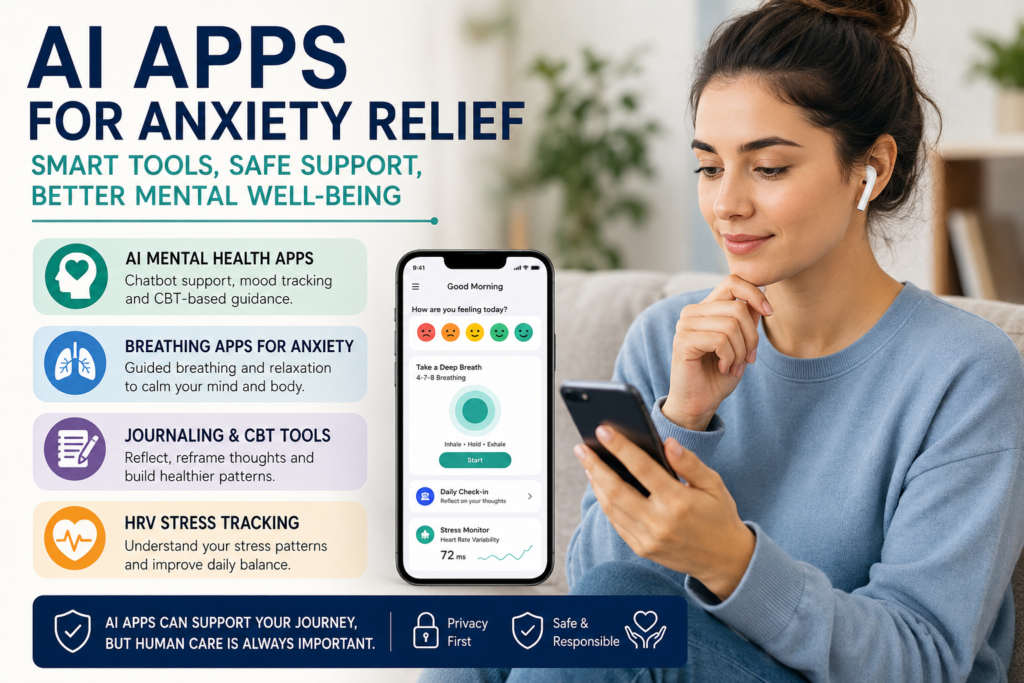
A strong anxiety app should include simple breathing support, mood tracking, journaling, CBT-style reflection, privacy controls, and clear safety guidance. It should also tell users when to seek professional help.
Apps that promise to “cure anxiety instantly” or “replace therapy completely” should be treated carefully.
Breathing, Journaling, CBT, and HRV Support
Breathing apps for anxiety are useful because anxiety often changes the breath before the person notices the thought. The breathing becomes short, fast, or tight.
- A guided breathing app can help the body slow down through simple rhythms, longer exhales, and short calming exercises.
- Mood tracking and journaling help users notice emotional patterns.
- A person may discover that anxiety becomes stronger after poor sleep, conflict, work pressure, caffeine, or late-night screen use.
- This turns anxiety from a confusing enemy into a pattern that can be understood.
CBT-style prompts may help users question anxious thoughts more safely.
- A helpful app may ask: Is this a fact or a fear?
- What evidence supports it?
- What is a calmer way to see this situation?
For deeper support around healthier self-talk, BBH’s guide on CBT AI support for shame and self-worth can be useful.
HRV stress tracking can also help some users notice body signals related to stress, sleep, and recovery. But it should not become obsessive checking. HRV should guide awareness, not create fear.
BBH View: Anxiety Starts in the Body Before the Mind Understands It
The unique BBH view is simple: anxiety often starts as a body signal before it becomes a mental story. The chest tightens, the breath shortens, the heart races, and only then does the mind begin searching for reasons.
This is why AI apps for anxiety relief should not only focus on thoughts. They should also help the user regulate the body.
A good app should help the person pause, breathe, notice the body, name the emotion, and choose one safe next action.
- The goal is not to become dependent on an app.
- The goal is to build internal regulation so the user can recognize anxiety earlier and respond with more stability.
“Technology can remind you to breathe, but healing begins when you stop treating your anxiety as weakness.”
How to Use AI Anxiety Apps Safely During Stress and Panic
AI apps for anxiety relief can be useful when anxiety begins to rise but has not yet become overwhelming. Many people do not notice anxiety at the first stage.
They notice it only when the chest feels tight, thoughts become fast, sleep becomes difficult, or the body starts preparing for danger. This is why the best anxiety relief apps should help users act early, not only after panic becomes intense.
For readers in the USA, UK, Canada, and Australia, this matters because everyday anxiety often appears during work pressure, study stress, loneliness, financial worry, social comparison, health concerns, or late-night overthinking.
An app cannot remove life pressure, but it can help the user pause before the nervous system moves into full alarm.
The safest use of AI mental health apps is simple: use them as support tools for breathing, grounding, journaling, and reflection, while still keeping human support available when symptoms are strong.
How AI Apps Help During Panic, Stress, and Overthinking
During anxiety or panic, the mind often wants a big answer, but the body needs a small instruction. This is where AI apps for anxiety relief can help if they offer simple grounding tools.
A good panic-support feature should not overload the user with long explanations. It should guide the person back to the present moment through breath, senses, body awareness, and one safe action.
Useful tools may include a 5-4-3-2-1 grounding exercise, a breathing timer, a calming emergency note, a short audio guide, or a simple reminder such as “Place both feet on the floor and slow your exhale.”
These tools are helpful because panic often creates a false feeling that something dangerous is happening right now.
Anxiety relief apps should not promise to “stop panic forever.” A safer promise is that they can help the person stay with the body, reduce fear, and move through the wave with more steadiness.
When an App Can Help in the First 60 Seconds
The first 60 seconds of rising anxiety are important because the body is still deciding whether to escalate into stronger alarm.
A simple app prompt can help the user slow down before the mind starts building fear-based stories. This is why breathing apps for anxiety are often more useful than complicated advice during panic.
A strong first-minute app flow may look like this: breathe slowly, name the feeling, relax the shoulders, notice the room, and choose one safe next step.
- The goal is not to analyze the whole life problem immediately.
- The goal is to reduce the body’s threat response enough so the person can think more clearly later.
This is also why BBH connects anxiety support with body regulation. Readers can continue learning through the Nervous System Regulation section, because calming the body is often the first step before calming the mind.
Breathing Apps for Anxiety: Why They Work So Well
Breathing apps for anxiety are useful because anxiety often changes breathing before the person understands what is happening. When the nervous system feels threatened, breathing may become fast, shallow, or tight.
This can make the heart feel stronger, the chest feel uncomfortable, and the mind feel more afraid. Slow breathing gives the body a different signal.
A good breathing app does not need to be complicated. It should guide the user into a slower rhythm, especially with a longer exhale, because the exhale often helps the body shift toward calm. The app may use a visual circle, soft sound, vibration, or short voice instruction.
For readers searching from the USA, UK, Canada, and Australia, breathing tools are practical because they can be used at home, in a car, before a meeting, during study stress, or before sleep.
This makes breathing support one of the most important features in anxiety relief apps.
Avoid Apps That Make Anxiety More Complicated
Some apps look impressive but feel overwhelming. They may include too many dashboards, too many reminders, too many scores, or too many emotional labels. For a person who already overthinks, this can become another source of anxiety.
The best AI apps for anxiety relief should make the next step easier, not heavier. The app should reduce mental load. A clean breathing screen, a short grounding option, and a simple journal prompt may be more helpful than a complex mental health dashboard.
This is important for BBH’s safety-first angle. A tool is only useful if it helps the user return to steadiness. If the app creates dependency, fear, comparison, or obsessive checking, it is not the right tool for that person.
For deeper anxiety education beyond app use, readers can explore BBH’s Anxiety and Overthinking section.
HRV Stress Tracking and AI Stress Prediction
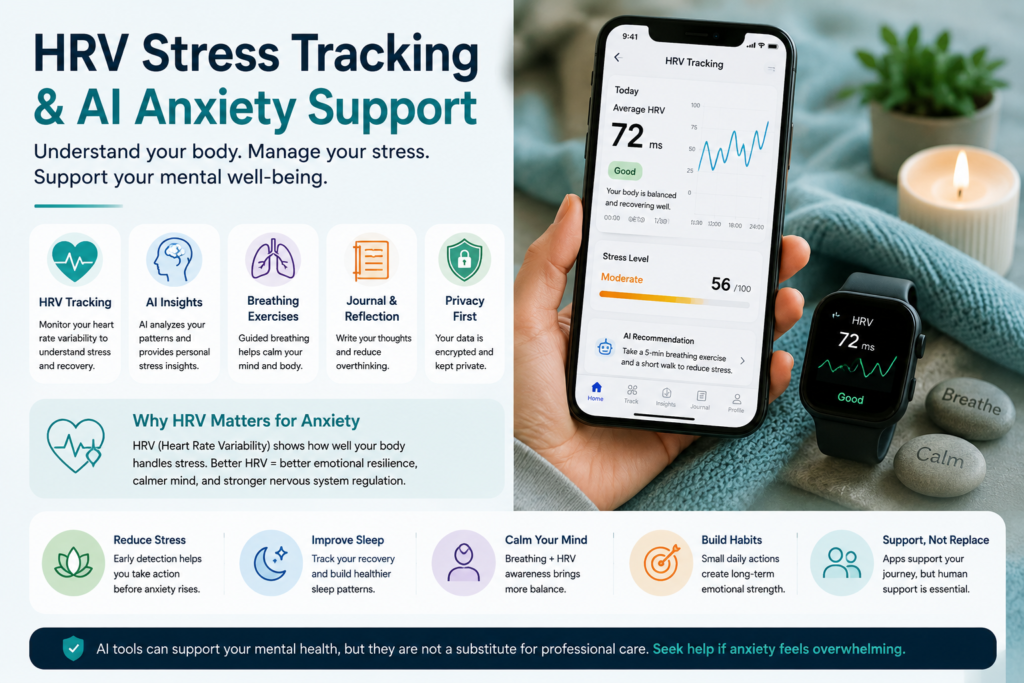
HRV stress tracking is becoming popular because many people want to understand stress before it becomes anxiety or burnout. HRV means heart rate variability.
In simple language, it shows how flexible the body may be in responding to stress and recovery. Some wearable devices and apps use HRV, heart rate, sleep, and activity data to estimate stress patterns.
This can be helpful because anxiety is not always obvious in the beginning. A person may feel “fine” mentally, but the body may already be tired, tense, under-recovered, or overstimulated.
HRV stress tracking can help the user notice that the body needs more rest, gentler work, breathing practice, or emotional boundaries.
But this must be explained carefully. HRV is not an anxiety diagnosis. It is not a perfect mental health measurement. It is only one body signal. AI stress prediction can support awareness, but it should never replace professional assessment or personal wisdom.
Do Not Obsess Over the Numbers
HRV stress tracking can become harmful if the user starts checking numbers again and again. For someone with health anxiety, every small change in heart rate or HRV may become a new reason to worry. This is why the blog must teach balanced use.
The healthy approach is to treat HRV as a general signal, not a final truth. If the number shows stress, the user can ask, “What care does my body need today?”
They do not need to panic, search symptoms, or judge themselves.
A good AI mental health app should encourage regulation, not obsession. It should help the user return to the body with compassion.
The goal is not perfect numbers. The goal is better awareness, calmer choices, and earlier support.
AI Mental Health Apps vs Therapy: What Readers Must Know
AI mental health apps can be helpful, but they are not therapy. This section is essential because mental health content must protect the reader, not only attract traffic.
A good blog on AI apps for anxiety relief should clearly explain the difference between digital support and professional care.
AI tools can help with daily anxiety management, emotional reflection, breathing exercises, habit reminders, mood tracking, and basic coping prompts.
Therapy, however, can include clinical assessment, diagnosis, trauma work, medication referral, treatment planning, crisis support, and a safe human relationship. These are not the same things.
This distinction is especially important for readers in the USA, UK, Canada, and Australia, where many people may use apps while waiting for therapy or trying to manage stress privately. An app can be a bridge, but it should not become the only support when anxiety is severe.
For readers who need a wider healing path, BBH’s Start Here – Your Journey to Mental Clarity & Emotional Healing page can guide the next step.
When Human Help Is Needed
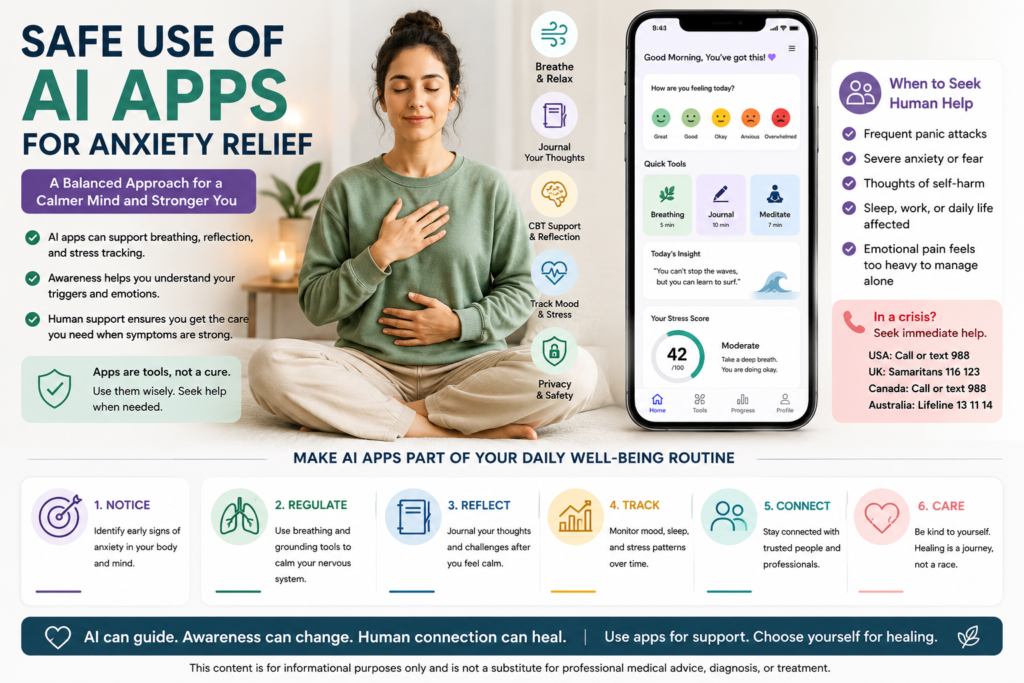
Human help is needed when anxiety becomes severe, frequent, or difficult to manage alone.
If panic attacks happen repeatedly, sleep is badly affected, work or study becomes difficult, relationships are suffering, or the person feels trapped by fear, an app is not enough.
Professional support is also important when anxiety is connected to trauma, self-harm thoughts, substance use, medical symptoms, intense depression, or obsessive fear.
In these situations, AI anxiety apps may still support small coping steps, but they should not be treated as the main solution.
This is where the safety-first angle becomes powerful.
BBH should teach readers to respect their symptoms without shame. Needing therapy, medical advice, or crisis support does not mean the person has failed. It means the nervous system and mind need stronger care.
How to Choose the Right Anxiety Relief App
Choosing the right anxiety relief app is not about downloading the most popular one. The better question is: does this app help me feel safer, calmer, and more aware without increasing fear or dependency?
The right app should match the user’s real need.
- Someone with panic symptoms may need breathing and grounding tools.
- Someone with racing thoughts may need CBT-style reflection.
- Someone with stress overload may need mood tracking, sleep tracking, or HRV stress tracking.
- Someone who feels lonely may need emotional check-ins, but they should still maintain human support.
A trustworthy app should also protect privacy, explain its methods, and tell users when to seek professional help.
After learning about safe app use, readers may continue with BBH’s Emotional Healing Roadmap for broader support beyond one app.
The BBH Safety Framework for AI Apps and Anxiety Support
AI apps for anxiety relief become more useful when they are placed inside a larger healing framework. An app alone cannot heal the full emotional pattern behind anxiety, but it can help the reader notice early stress signals, regulate the body, reflect on thoughts, and decide when human support is needed.
This is the unique BBH angle. The goal is not to make people dependent on AI mental health apps.
The goal is to help them use anxiety relief apps as support tools while slowly building inner regulation.
A breathing app can guide the body.
A journal prompt can organize the mind.
HRV stress tracking can show patterns.
But awareness is what helps the person understand what the body is asking for.
For readers in the USA, UK, Canada, and Australia, this balanced approach is important. Digital tools are easy to access, but anxiety still needs emotional maturity, safe relationships, and professional help when symptoms become serious.
BBH Healing Framework: App + Awareness + Human Support
The safest way to use AI apps for anxiety relief is to follow a simple three-part framework: app, awareness, and human support.
The app gives structure.
- Awareness helps the person understand what is happening inside the body and mind.
- Human support protects the person when anxiety becomes too heavy to manage alone.
This framework prevents two common mistakes. The first mistake is rejecting all digital tools because they are not therapy.
The second mistake is trusting the app too much and avoiding real help. A balanced view is better.
AI mental health apps can support daily regulation, but they should not become the only place where a person shares fear, panic, grief, or emotional pain.
For a broader healing path, readers can continue through BBH’s Start Here – Your Journey to Mental Clarity & Emotional Healing page.
Step 1 — Notice the Body Signal
Anxiety often begins before the person has a clear thought. The heart may beat faster, the breath may become shallow, the chest may tighten, the stomach may feel unsettled, or the body may feel restless. These are not signs of weakness. They are nervous system signals.
AI apps for anxiety relief can help at this stage by asking simple check-in questions:
- What am I feeling?
- Where do I feel it in my body?
- How strong is this feeling from 1 to 10?
- What is one calming action I can take now?
The first step is not to fight the feeling. The first step is to notice it. Once the body signal is noticed, the person has a chance to respond instead of automatically reacting.
Step 2 — Regulate Before Reacting
Once the body signal is noticed, the next step is regulation. This means helping the nervous system feel safer before trying to solve the whole problem. Breathing apps for anxiety can be useful here because they give the user a simple rhythm to follow when the mind feels scattered.
Regulation may include slow breathing, longer exhales, grounding, drinking water, relaxing the shoulders, stepping away from a stressful screen, or taking a short walk. These actions may look small, but they send safety signals to the body.
This is where many people make a mistake. They try to think their way out of anxiety while the body is still in alarm. A better method is to calm the body first, then reflect.
Step 3 — Reflect After Calm Returns
Reflection works best after the body has become a little calmer. If a person tries to analyze anxiety during panic, the mind may create more fear. But after breathing, grounding, or rest, the same person may be able to see the situation more clearly.
AI mental health apps can support this stage through journaling prompts, CBT-style questions, mood tracking, and emotional pattern recognition.
A helpful prompt may ask:
- What triggered this feeling?
- What story did my mind create?
- What evidence supports this fear?
- What is a more balanced thought?
This is not therapy, but it can support self-awareness. Over time, the reader may begin to see repeated patterns: anxiety after poor sleep, anxiety before conflict, anxiety after social media, or anxiety when trying to control uncertain outcomes.
For deeper self-talk support, readers can explore BBH’s article on CBT AI support for shame and self-worth.
Who Should Use AI Apps for Anxiety Relief?
AI apps for anxiety relief may be helpful for people who experience daily stress, mild to moderate anxiety, overthinking, panic signals, emotional confusion, or stress-related sleep difficulty.
These tools are especially useful when the reader wants simple support between therapy sessions, while waiting for help, or while building daily emotional habits.
Students may use anxiety relief apps for exam stress, social anxiety, loneliness, or performance pressure.
Working professionals may use them during deadlines, meetings, burnout, or workplace anxiety.
Parents and caregivers may use them for short breathing breaks, emotional check-ins, and quick grounding during demanding days.
The best user is not someone looking for a magic cure. The best user is someone willing to use the app as a structured support tool.
That means breathing when the body is tense, tracking moods honestly, journaling after triggers, and seeking human help when anxiety becomes too strong.
Who Should Be Careful With AI Anxiety Apps?
Some people should use AI anxiety apps carefully. This includes anyone with severe panic attacks, trauma symptoms, suicidal thoughts, self-harm urges, intense depression, substance misuse, psychosis, or anxiety that prevents normal daily functioning.
In these situations, an app may offer small calming tools, but it should not be the main support system.
Readers should also be careful if an app increases checking, reassurance-seeking, fear, or dependency. For example, if someone checks HRV stress tracking many times a day and feels more anxious after every number, the tool may be making the anxiety loop stronger.
The safest approach is honest self-observation.
- If the app helps the person breathe, reflect, and take healthy action, it may be useful.
- If it increases fear, obsession, avoidance, or isolation, the person should step back and seek human support through a therapist, doctor, crisis line, or trusted person.
For structured next-step support, BBH’s Emotional Healing Roadmap can help readers continue beyond one article or one app.
AI Should Never Be the Only Support in Crisis
AI should never be the only support when someone is in crisis. If a person feels at risk of harming themselves, feels unable to stay safe, or feels completely out of control, they should contact local emergency services or a crisis support line immediately.
This applies to readers in the USA, UK, Canada, Australia, and every country. AI tools can be helpful for daily anxiety support, but crisis care requires trained human response.
This safety message also protects the trust of the article. A responsible mental health blog does not oversell technology. It helps the reader understand both usefulness and limits.
Short FAQ for AI Apps for Anxiety Relief
Are AI apps for anxiety relief safe?
AI apps for anxiety relief can be safe for general support if they have clear privacy policies, responsible guidance, and honest limits. They should support breathing, journaling, mood tracking, and stress awareness, not replace therapy or crisis care.
Can AI mental health apps replace therapy?
No, AI mental health apps cannot replace therapy. They may support daily coping, but therapy provides human care, clinical assessment, treatment planning, trauma support, and professional judgment.
Do breathing apps for anxiety help panic attacks?
Breathing apps for anxiety may help during panic by giving the body a slower rhythm to follow. They can support nervous system calming, but frequent or severe panic should be discussed with a healthcare professional.
Is HRV stress tracking useful for anxiety?
HRV stress tracking can help some users notice stress, recovery, sleep, and body-pattern changes. It should be used as awareness support, not as a diagnosis or obsessive checking tool.
When should someone seek human help instead of using an app?
A person should seek human help if anxiety is severe, worsening, linked to trauma, affecting sleep, work, relationships, or daily functioning. Serious symptoms need professional support, not only digital tools.
Final Thought: Use AI as a Support Tool, Not a Substitute for Care
AI apps for anxiety relief can be valuable when they help the reader pause, breathe, track patterns, and reflect with more awareness.
Anxiety relief apps can support daily stress, AI mental health apps can offer structured emotional check-ins, breathing apps for anxiety can help the body slow down, and HRV stress tracking can reveal patterns that might otherwise go unnoticed.
But the most important truth is this: the app is not the healer by itself. The app is a support tool. Healing still needs awareness, nervous system regulation, honest reflection, emotional safety, healthy relationships, and professional care when symptoms are serious.
For readers in the USA, UK, Canada, and Australia, the safest path is balance. Use digital tools when they help, protect your privacy, avoid dependency, and seek human support when anxiety becomes too heavy to carry alone.
People Also Ask
1. Are AI apps for anxiety relief safe?
AI apps for anxiety relief can be safe for daily stress support when they have clear privacy rules, honest limits, and crisis warnings. They should support breathing, journaling, and reflection, not replace therapists, doctors, or emergency care.
2. Can AI mental health apps replace therapy?
No, AI mental health apps cannot replace therapy. Mayo Clinic explains that anxiety disorders are commonly treated with psychotherapy, medications, or both, depending on the person’s condition and needs.
3. Do breathing apps for anxiety help during stress?
Breathing apps for anxiety may help because slow breathing can support the body during stress and tension. NHS guidance recommends gentle, steady breathing exercises as a practical self-help tool for stress.
4. When should someone seek human help instead of using an app?
A person should seek human help if anxiety is persistent, worsening, affecting daily life, or creating strong fear that feels difficult to control. NIMH explains that anxiety disorders can involve ongoing symptoms and may need proper treatment and support.
5. Is HRV stress tracking useful for anxiety?
HRV stress tracking can help some users notice stress, sleep, and recovery patterns, but it should not be treated as an anxiety diagnosis. It should guide calm awareness, not obsessive checking or fear-based self-monitoring.
External References With URL
- American Psychological Association — Use of Generative AI Chatbots and Wellness Applications for Mental Health
URL: https://www.apa.org/topics/artificial-intelligence-machine-learning/health-advisory-chatbots-wellness-apps
Use this reference for: AI chatbot safety, limits, overreliance, and why AI should not replace professional mental health care. - National Institute of Mental Health — Anxiety Disorders
URL: https://www.nimh.nih.gov/health/topics/anxiety-disorders
Use this reference for: anxiety disorder symptoms, when anxiety becomes serious, and why professional support may be needed. - NHS — Breathing Exercises for Stress
URL: https://www.nhs.uk/mental-health/self-help/guides-tools-and-activities/breathing-exercises-for-stress/
Use this reference for: breathing exercises, stress calming, and why breathing apps for anxiety can support nervous system regulation. - Mayo Clinic — Anxiety Disorders: Diagnosis and Treatment
URL: https://www.mayoclinic.org/diseases-conditions/anxiety/diagnosis-treatment/drc-20350967
Use this reference for: therapy, medication, professional treatment, and why AI apps should not replace clinical care. - NHS Inform — Breathing and Relaxation Exercises
URL: https://www.nhsinform.scot/healthy-living/mental-wellbeing/breathing-and-relaxation-exercises/
Use this reference for: grounding, breathing, relaxation, and panic-friendly self-help techniques.