Detachment in Modern Life: Why You Feel Lost and How to Fix It
Why You Feel Lost in Modern Life (And How to Fix It)

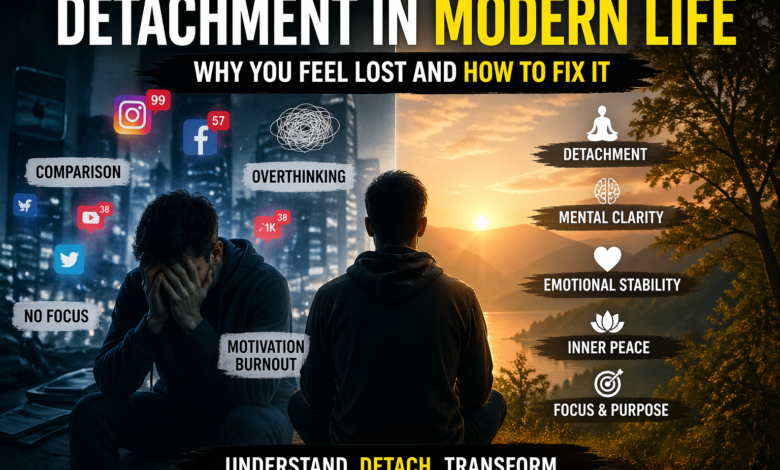
If you feel lost without a clear reason, you’re not alone—and you’re not broken. This is the hidden cost of detachment in modern life, where constant exposure to other people’s success, confidence, and happiness creates silent pressure inside your mind.
Thank you for reading this post, don't forget to subscribe!You scroll, you compare, you try to fix yourself, and yet something still feels off. This is not just distraction—it’s identity confusion psychology shaping how you see yourself every day.
Most people try to solve this using motivation, but that only creates a temporary high followed by a crash. This repeating pattern is known as the motivation burnout cycle, and it keeps you stuck between feeling inspired and feeling inadequate.
Without social media detachment, your mind keeps absorbing unrealistic standards, making your real life feel insufficient.
That’s why understanding modern detachment meaning is no longer optional.
This blog will help you break free from comparison, reduce mental noise, and apply practical detachment techniques that bring real clarity and emotional stability. If you’re tired of feeling inconsistent, overwhelmed, or “not enough,” this is where you finally understand what’s happening—and how to fix it.
Read Also: What Is Detachment and How to Practice Conscious Living, Detachment & Awareness Or Exploring Reading more About Spiritual Psychology
Detachment in Modern Life: Why You Feel Lost Without Realizing It
There are moments when the problem is not your work, not your relationships, not even your effort. The problem is that your mind is constantly reacting to everything it sees. This is the hidden struggle of detachment in modern life—you are present in your life, but internally, you are influenced by everything around you.
You open your phone for a few minutes. That’s all it takes. One post, one video, one success story. It looks normal. But something shifts silently.
You start comparing. Not loudly, not consciously—but internally.
“Am I doing enough?”
“Why does my life not look like this?”
“Why are they always motivated?”
This is where modern detachment meaning becomes important. Because what you think is simple scrolling is actually shaping how you see yourself. And without awareness, you slowly lose clarity about your own identity.
You Are Not Just Watching — You Are Absorbing Identity
How Social Media Detachment Is Failing in Daily Life
Most people believe the problem is distraction. But the real issue is the lack of social media detachment. You are not just consuming content—you are absorbing identity.
Every time you scroll:
- You see confidence
- You see success
- You see happiness
But you don’t see struggle, confusion, or inconsistency.
👉 Your brain does not understand that this is edited reality. It processes it as truth.
And then it compares that truth with your own emotional detachment in daily life, where you feel uncertain, inconsistent, and sometimes lost.
This creates a silent gap:
- Their life looks clear
- Your life feels unclear
And from this gap, identity confusion begins.
👉 “If you want to understand awareness deeply, read: What Is Conscious Living? Meaning Explained
Identity Confusion in Modern Life: The Real Problem
Why Identity Confusion Psychology Is Increasing
You are not just comparing progress—you are comparing identity. This is why identity confusion psychology is becoming a major issue in detachment in today’s world.
You start questioning:
- Who you are
- What you want
- Why you are not like them
This is not growth.
This is self identity confusion.
- One day you feel motivated.
- Next day you feel disconnected.
- Then you try to fix yourself again.
This cycle repeats because your mind is constantly influenced by external standards. Instead of building your identity, you are reacting to others’ identities.
The Motivation Trap: Why You Feel Strong Then Empty
Understanding the Motivation Burnout Cycle
When confusion builds, you try to solve it. You watch motivation. You push yourself. You try to act strong. For some time, it works.
You feel:
- Energized
- Focused
- Clear
But then it disappears.
This is the motivation burnout cycle:
- You feel low → you seek motivation
- You feel high → you push yourself
- Reality returns → you crash
- Crash creates doubt → you repeat
This is not your weakness. This is how the dopamine motivation loop works.
Motivation gives you a temporary high. But it does not give you stability. That is why you feel:
“I try, but I cannot stay consistent.”
👉 The truth is: You are using motivation instead of practicing detachment in modern life.
The Hidden Pressure: Trying to Become Perfect
How Identity Pressure Creates Mental Exhaustion
When motivation fails, your mind does not relax. It tries harder.
You start thinking:
- I need to be more disciplined
- I need to be more focused
- I need to improve everything
This is where perfection pressure begins.
And slowly, your mind becomes obsessive.
You overthink:
- “Am I doing enough?”
- “Is this right?”
- “Should I do more?”
This is where emotional control techniques are missing. You are trying to control everything externally without understanding what is happening internally.
This leads to:
- Mental fatigue
- Emotional instability
- Loss of clarity
👉 You are not feeling peace in action. You are feeling pressure in action.
Read Also: What Is Conscious Living? Meaning Explained
Detachment in Modern Life: What It Actually Means
Modern Detachment Meaning (Clear and Practical)
Most people misunderstand detachment in modern life.
They think:
- It means not caring ❌
- It means avoiding everything ❌
- It means becoming cold ❌
That is not detachment.
Detachment in modern life means:
- You see everything, but you don’t absorb everything
- You engage, but you don’t lose yourself
- You act, but you don’t build identity from comparison
- 👉 Detachment is not disconnection. It is clarity without reaction.
Why You Feel Lost (Simple Truth)
Detachment in Today’s World Is Missing
You feel lost because:
- You are exposed to constant comparison
- You are trying to match unrealistic standards
- You depend on motivation instead of stability
- You don’t practice practical detachment techniques
This is not failure.
This is lack of mental clarity practices in modern life.
Pause and Reflect (Reader Awareness)
Before trying to fix yourself, ask:
- Am I living my life or reacting to what I see online?
- Do I feel stable without motivation?
- Am I trying to grow or trying to become someone else?
These questions are uncomfortable. But they are necessary.
Because without awareness, you will keep chasing a version of life that is not even real.
The Truth You Need to Accept
Modern life is not just fast—it is psychologically demanding. It constantly pulls your attention, shapes your thinking, and influences your identity.
That is why: Detachment in modern life is not optional anymore.
It is necessary for mental clarity and emotional stability.
You don’t need to leave social media.
You don’t need to stop ambition.
You need to stop letting external input define your internal state.
What Comes Next
In the next part, we will go deeper into:
- Why modern life increases attachment and anxiety
- How the brain creates comparison automatically
- And how to actually apply how to practice detachment in real daily situations
Because understanding the problem is only the first step.
👉 The real change begins when you learn how to stay stable in a world that is constantly unstable.
👉 “This confusion often comes from hidden patterns—explained here: Why You Feel Lost in Life (Real Reason Explained)
DETACHMENT IN MODERN LIFE: WHY YOUR MIND FEELS UNSTABLE (REALITY CHECK)
If you observe carefully, the issue is not that you don’t understand detachment in modern life.
The issue is that your environment is constantly pulling you away from it.
Modern life is not neutral.
It is designed to:
- Stimulate your attention
- Trigger comparison
- Create urgency
- Influence your identity
And when you live inside this system without modern detachment meaning, confusion becomes normal.
Why Modern Life Increases Attachment and Mental Pressure
The Real Problem: Overstimulation, Not Weakness
Most people believe:
“I am overthinking too much.”
But the deeper truth is:
👉 You are over-consuming too much information.
Every day, your mind processes:
- Social media content
- Opinions and advice
- Motivation and success stories
- Endless comparisons
This creates what we call:
👉 identity confusion psychology, self identity confusion, identity crisis in modern life, sense of self loss
Because your mind is not given time to:
- Settle
- Reflect
- Stabilize
And without stability, detachment in today’s world becomes difficult.
Social Media Detachment: The Missing Skill
Why Social Media Is Not the Enemy — But Your Reaction Is
Social media itself is not the problem.
The problem is lack of:
👉 social media detachment, detachment from social media, social media comparison psychology, digital comparison stress, online identity pressure
When you scroll without awareness:
- You compare automatically
- You judge your life silently
- You absorb unrealistic standards
And slowly:
You stop seeing your life directly.
You start seeing your life through others.
That is the beginning of emotional detachment in daily life breakdown.
The Identity Distortion Loop (Hidden Damage)
How You Lose Clarity Without Realizing
Your mind works like this:
- You see something impressive
- Your brain compares
- Comparison creates pressure
- Pressure creates self-doubt
- Self-doubt changes identity
This loop repeats daily.
And over time, it creates:
👉 identity confusion psychology, self identity confusion, identity crisis in modern life, personality confusion
You don’t feel stable because your identity keeps shifting based on what you consume.
Read Also: Attachment vs Love: Why You Seek It from the Wrong People
The Motivation Illusion: Why It Feels Good but Fails
Understanding the Motivation Burnout Cycle
When you feel low, you try to fix it.
You use motivation.
You watch videos. You push yourself. You try to become strong.
And for a moment, it works.
But then it fades.
This is:
👉 motivation burnout cycle, dopamine motivation loop, why motivation fails, motivation crash psychology, inconsistent motivation problem
The pattern is simple:
- Low → Motivation
- High → Action
- Drop → Confusion
- Repeat
And every cycle reduces your self-trust.
You start thinking:
“I cannot stay consistent.”
👉 But the truth is: Motivation creates movement. Detachment creates stability.
Dopamine Loop: The Real Brain Mechanism
Why You Feel High Then Empty
Every time you:
- Scroll
- Watch exciting content
- Consume high-energy information
Your brain releases dopamine.
This creates:
- Temporary motivation
- Temporary clarity
- Temporary excitement
But then dopamine drops.
And when it drops, you feel:
- Low
- Unfocused
- Disconnected
So your brain seeks another hit.
This is:
👉 dopamine motivation loop, motivation burnout cycle, inconsistent motivation problem
Inside this loop, detachment in modern life becomes weak, because your mind is always reacting.
👉 “This is clearly explained in: Why Attachment Causes Emotional Suffering
Perfection Pressure and Mental Exhaustion
Why You Try Harder but Feel Worse
When you feel behind, you don’t give up immediately.
You try harder.
You think:
- I need to improve everything
- I need to fix myself
- I need to become better fast
This leads to:
👉 mental clarity practices missing, emotional control techniques missing, practical detachment techniques not applied
And then your mind becomes obsessive.
You overthink:
- Every action
- Every decision
- Every result
This is not growth.
This is pressure-based identity correction.
And it leads to:
- Anxiety
- Mental fatigue
- Emotional instability
Detachment in Modern Life: The Real Meaning (Clear Understanding)
What Detachment Actually Means Today
Now we correct the biggest misunderstanding.
People think detachment means:
- Not caring ❌
- Avoiding everything ❌
- Disconnecting from life ❌
But real detachment in modern life, modern detachment meaning, emotional detachment in daily life, detachment in today’s world is:
- You see everything, but you don’t absorb everything
- You engage, but you don’t lose yourself
- You act, but you don’t build identity from comparison
Detachment is controlled involvement, not emotional shutdown.
Practical Example (Clarity in Action)
👉 Without detachment:
- You see success → You compare → You feel pressure → You doubt yourself
👉 With detachment:
- You see success → You observe → You understand → You continue your path
Same situation.
Different response.
That difference is practical detachment techniques in real life.
Read Also: Attachment vs Love: Why You Seek It from the Wrong People
Why You Feel Lost (Direct Answer)
You feel lost because:
- You consume too many identities
- You compare your real life with edited life
- You depend on motivation instead of stability
- You lack how to practice detachment in daily situations
This is not weakness.
This is lack of:
👉 practical detachment techniques, daily detachment habits, emotional control techniques, mental clarity practices
Pause and Reflect (Important Questions)
Ask yourself honestly:
- How much of my thinking is influenced by what I consume?
- Do I feel stable without external motivation?
- Am I living my life or reacting to others’ lives?
The Truth You Cannot Ignore
Modern life constantly pulls your attention.
If you don’t create boundaries, your identity will be shaped without your awareness.
👉 That is why: Detachment in modern life is not optional. It is necessary for mental clarity and emotional stability.
👉 “To understand the difference between healthy and unhealthy detachment: Emotional Detachment vs Emotional Suppression
HOW TO PRACTICE DETACHMENT IN MODERN LIFE (A PRACTICAL SYSTEM THAT WORKS)
By now, you understand the problem clearly.
- Social media creates identity pressure
- Motivation creates temporary highs
- Your mind keeps reacting instead of stabilizing
So the question is no longer “Why do I feel this way?”
👉 The real question is: How do I actually practice detachment in modern life without leaving everything behind?
This is where most content fails.
They explain detachment…
But they don’t show how to live it.
This part is different.
What Detachment in Modern Life Looks Like in Real Life
Before steps, understand this clearly:
👉 Detachment in modern life, modern detachment meaning, emotional detachment in daily life, detachment in today’s world is not about avoiding life.
It is about:
- Not reacting to everything you see
- Not building identity from comparison
- Not depending on external stimulation to feel okay
Detachment is mental discipline, not emotional distance.
The BBH Practical Detachment System (7 Steps)
This system is built for real life—social media, work, pressure, and daily mental noise.
1. Stop Using Motivation as Emotional Support
Break the Motivation Burnout Cycle
You don’t need motivation every day.
Because:
👉 motivation burnout cycle, dopamine motivation loop, why motivation fails, motivation crash psychology, inconsistent motivation problem
Motivation is temporary.
If you depend on it:
- You will rise → then crash
- Feel strong → then feel empty
What to do instead:
- Act without waiting for motivation
- Accept low-energy days as normal
- Focus on small, consistent actions
Action creates stability. Motivation creates spikes.
2. Practice Social Media Detachment (Not Avoidance)
Control Input Before It Controls You
You don’t need to delete social media.
You need:
👉 social media detachment, detachment from social media, social media comparison psychology, digital comparison stress, online identity pressure
How to apply:
- Limit consumption time (fixed slots)
- Avoid scrolling when emotionally low
- Observe content without comparing
When you see something:
Don’t think → “I should be like this”
Think → “This is one version, not reality”
3. Observe Comparison Instead of Following It
Turn Reaction into Awareness
Comparison will happen automatically.
You cannot stop it completely.
But you can stop reacting to it.
This reduces:
👉 identity confusion psychology, self identity confusion, identity crisis in modern life, sense of self loss
Simple practice:
When comparison starts, pause and say mentally:
- “This is comparison, not truth”
- “I don’t need to act on this thought”
This creates distance.
That distance is detachment in action.
Read Also: How to Gain Control Over Your Thoughts and Emotions
4. Accept Inconsistency (This Will Free You)
Stop Trying to Be “Always Motivated”
One of the biggest illusions is:
👉 “I should feel clear, focused, and motivated all the time”
This belief creates pressure.
Truth:
- Some days you will feel strong
- Some days you will feel confused
- Some days you will feel low
This is normal.
When you accept this, you reduce:
👉 mental clarity practices needed, emotional control techniques required
You stop fighting your state.
And that itself creates stability.
5. Reduce Overstimulation (This Changes Everything)
Less Input = More Clarity
Your mind is not tired because of effort.
It is tired because of constant input.
To practice detachment in modern life, reduce noise.
Do this daily:
- No phone first 30 minutes after waking
- No random scrolling before sleep
- Take short breaks without input
This supports:
👉 mental clarity practices, daily detachment habits, emotional control techniques
When input reduces, your mind stabilizes naturally.
6. Focus on Action, Not Identity
Stop Fixing Who You Are — Start Doing What Matters
Most people think:
“I need to become better”
This creates identity pressure.
Instead:
Focus on:
- What needs to be done today
- Small actions you can control
Ignore:
- “Am I good enough?”
- “Am I like them?”
This shift is powerful.
👉 Because: Identity confusion reduces when action becomes your focus.
7. Detach from Outcome (This Is the Core Shift)
Effort Is Yours — Result Is Not
This is where practical meets spiritual.
You act.
You try.
You improve.
But you don’t attach your worth to results.
This aligns with:
👉 how to practice detachment, practical detachment techniques, daily detachment habits, emotional control techniques, mental clarity practices
You control effort. You don’t control outcome.
When you accept this:
- Pressure reduces
- Fear reduces
- Comparison reduces
👉 “If you want to train your mind practically, read: Awareness Is a Skill (How to Train Your Mind Daily)
Spiritual Insight (Simple but Powerful)
In deeper understanding:
- What you see outside is not complete reality
- What your mind creates is not always truth
This is called Maya—illusion.
Attachment means:
- Believing everything you see and think
Detachment means:
- Seeing clearly without reacting blindly
You don’t leave life.
You understand it.
Real-Life Application (So You Don’t Forget)
When you open social media:
- Observe → Don’t absorb
When you feel low:
- Act small → Don’t wait for motivation
When you compare:
- Notice → Don’t follow
When you feel pressure:
- Pause → Don’t react
This is detachment in modern life in practice.
Final Reflection (Ask Yourself Honestly)
- Do I need motivation… or stability?
- Am I reacting to life… or living it?
- Am I trying to become someone… or understand myself?
Final Closing (Authority Tone)
You are not struggling because life is too hard.
You are struggling because your mind is constantly reacting to what it sees.
And without detachment in modern life,
you will keep adjusting your identity based on external input.
👉 Clarity does not come from more information. It comes from less reaction.
You don’t need to disconnect from life.
You need to stop letting everything define you.
That is detachment.
And that is how you stay stable in a world that is constantly changing.
Read Also: Mindfulness vs Conscious Living: Key Differences Explained
FAQ
What is detachment in modern life?
Detachment in modern life means staying emotionally stable without being influenced by everything you see, especially on social media. It is not about avoiding life but about observing without reacting and not building your identity based on comparison.
Is detachment the same as emotional numbness?
No. Detachment is not emotional numbness. It means you still feel emotions, but you do not let them control your actions or identity. It is awareness with control, not suppression.
Why does social media create identity confusion?
Social media shows edited and idealized versions of life. When you compare your real life to these highlights, your mind creates unrealistic standards, leading to identity confusion and self-doubt.
Why does motivation not last long?
Motivation works on temporary dopamine spikes. Once the effect fades, your energy drops, creating a cycle of highs and lows known as the motivation burnout cycle.
How can I practice detachment in daily life?
You can practice detachment by limiting unnecessary input, observing thoughts without reacting, focusing on actions instead of identity, and reducing comparison with others.
Can detachment improve mental clarity and focus?
Yes. Detachment reduces mental noise, overthinking, and emotional reactions, which helps improve clarity, focus, and decision-making in daily life.
👉 “Start your full journey here: Start Here – Your Journey to Mental Clarity & Emotional Healing
People Also Ask
How do I stop comparing myself on social media?
Limit exposure, observe comparison, and remember it’s edited reality.
Why do I feel lost even when trying?
Due to identity confusion from too much external input.
What are simple detachment techniques?
Pause, observe thoughts, reduce scrolling, focus on action.
Can I stay motivated all the time?
No, stability comes from discipline, not motivation.
How does detachment reduce anxiety?
By reducing emotional reactions and overthinking.
Can detachment improve relationships?
Yes, it reduces expectations and improves calm responses.
📚 REFERENCES (WITH URL)
🧠 Psychology & Identity / Comparison
- Social Comparison Theory – American Psychological Association
https://www.apa.org/monitor/dec00/socialcomparison - Self-Concept & Identity – Simply Psychology
https://www.simplypsychology.org/self-concept.html
📱 Social Media & Mental Health
- Social Media and Mental Health – Mayo Clinic
https://www.mayoclinic.org/healthy-lifestyle/adult-health/in-depth/social-media-and-mental-health/art-20473798 - Impact of Social Media on Mental Health – National Institutes of Health
https://www.ncbi.nlm.nih.gov/pmc/articles/PMC7364393/
🧬 Dopamine & Motivation (Neuroscience)
- Dopamine and Motivation – Harvard Health Publishing
https://www.health.harvard.edu/mind-and-mood/dopamine-the-motivation-molecule - Why Motivation Doesn’t Last – Verywell Mind
https://www.verywellmind.com/why-motivation-isnt-enough-2795373
🧘 Mindfulness, Awareness & Emotional Control
- Mindfulness and Emotional Regulation – Greater Good Science Center
https://greatergood.berkeley.edu/article/item/how_mindfulness_changes_the_brain - Cognitive Behavioral Awareness – National Health Service
https://www.nhs.uk/mental-health/self-help/guides-tools-and-activities/cbt/
🌿 Spiritual Perspective (Detachment Concept)
- Detachment & Karma Yoga – Bhagavad Gita
https://www.holy-bhagavad-gita.org/chapter/2/verse/47 - Mindful Detachment (Modern Interpretation) – Psychology Today
https://www.psychologytoday.com/us/blog/the-athletes-way/201801/how-practice-emotional-detachment