How to Emotionally Detach When Letting Go Feels Hard ?
Why Your Heart Keeps Waiting After Love Ends

Learning how to emotionally detach can feel almost impossible when your mind knows the relationship is over but your heart continues waiting.
Thank you for reading this post, don't forget to subscribe!You may still check your phone, reread old conversations, revisit familiar places, or hope that time will change the person.
Emotional detachment does not mean becoming cold or pretending that your love was false.
It means understanding the emotional attachment loop, accepting repeated relationship evidence, and choosing actions that protect your peace, dignity, health, and future.
How to Emotionally Detach When Letting Go Feels Hard
You may know that the relationship is over and still wake up hoping for one message.
You may check your phone when there is no notification, reread old conversations, revisit familiar places, or imagine that time will change the person. Your mind may understand that they are not choosing you, yet your heart may continue waiting for apology, gratitude, respect, or one final sign that your love mattered.
This emotional conflict often leaves people wondering how to emotionally detach when the bond still feels alive inside the body.
Letting go can feel difficult because you are not releasing only a person. You may also be grieving emotional reassurance, familiar routines, an imagined future, and the hope that occasional kindness would eventually become consistent love.
Emotional attachment after breakup can continue because memories, uncertainty, unfinished conversations, and learned emotional habits keep connecting that person with hope and temporary relief. This is one reason people ask why is letting go hard even after the truth becomes clear.
This article explains why heart keeps waiting, how the nervous system can remain connected to familiar patterns of contact, and how to begin choosing yourself after heartbreak without denying that your feelings were real.
Direct Answer: Why Learning How to Emotionally Detach Feels Difficult
To learn how to emotionally detach, begin by reducing the behaviours that repeatedly reactivate the bond.
These behaviours may include:
- checking messages or social media;
- rereading old conversations;
- revisiting emotionally charged places;
- imagining future reconciliation;
- searching for signs that the person has changed;
- creating reasons to contact them.
Emotional detachment does not mean forcing yourself to stop caring. It means accepting what you cannot control and choosing actions that no longer depend on the other person’s attention.
Detachment becomes easier when you recognise repeated behaviour, identify the hidden hope behind waiting, reduce emotional triggers, regulate your body before acting, and rebuild the areas of life that attachment has pushed aside.
The goal is not immediate emotional numbness.
The goal is to stop allowing longing to decide what you do next.

Why Learning How to Emotionally Detach Feels Difficult
Relationships become part of daily life through repetition.
You may have become used to waiting for their call, checking whether they were online, feeling relief when their name appeared, or feeling anxious when they became distant.
When the relationship changes or ends, your body may continue expecting those familiar signals.
You may experience:
- restlessness;
- poor sleep;
- heaviness;
- difficulty concentrating;
- stomach tension;
- a strong urge to check for contact.
These reactions do not prove that the person is right for you. They may show that your emotional system became accustomed to seeking comfort or certainty from them.
Understanding the body’s learned response is an important part of learning how to emotionally detach without blaming yourself for still caring.
This helps explain why letting go feels painful. You are not only changing a thought. You are interrupting an emotional routine.
- Their silence hurt you, but their reply relieved you.
- Their distance created fear, but occasional kindness restored hope.
- The same person who activated pain may also have become the person you searched for to relieve it.
When reassurance begins controlling your emotional stability, it can help to understand when a relationship starts becoming emotional dependency.
How Emotional Attachment After Breakup Affects the Body
The nervous system responds strongly to familiarity, uncertainty, and repeated emotional patterns.
If contact with someone often brought relief, your body may associate that person with safety even when the broader relationship was inconsistent.
This is why emotional attachment after breakup may continue after your mind has decided to move forward.
You may notice:
- anxiety when they do not reply;
- a rush of hope when the phone lights up;
- temporary calm after receiving a message;
- renewed pain when they disappear again;
- strong reactions to songs, dates, photographs, or places.
An emotional bond after breakup does not prove that the relationship should continue.
Your nervous system may simply be reacting to memory and conditioning.
Intensity is not always compatibility.
You can feel deeply connected to someone who is unable or unwilling to maintain a respectful relationship.
A helpful question is not only: How strongly do I feel?
It is also: What happens to my peace, dignity, health, and identity inside this relationship?
The first question respects your emotions.
The second protects your life.
Occasional Kindness Can Keep Hope Alive
The hardest relationship to release is not always one that was painful every day.
Sometimes there were genuine moments of care.
The person may have listened when you were lonely, returned after distance, remembered something important, or behaved kindly just when you were preparing to leave.
Those moments can keep hope alive.
You may think:
- Maybe they do care.
- Perhaps they are only afraid.
- Maybe time will change them.
- Their ego may soften.
- One day they may understand my heart.
- Perhaps they will apologise.
Hope is not foolish.
But occasional kindness cannot replace consistent love.
A few caring moments cannot substitute for:
- accountability;
- respect;
- emotional presence;
- gratitude;
- apology;
- changed behaviour;
- mutual effort.
You may remain still attached after breakup because you are waiting for the person’s kindest moments to become their permanent character.
Sometimes you are not attached only to the person. You are attached to who you hoped they would become.
Learning how to emotionally detach also means interrupting the checking behaviour that repeatedly renews hope and emotional pain.
A Real Human Insight
“My mind knew they were not choosing me, but my heart kept waiting. Their occasional kindness made me believe that time might change them—that one day they would understand my feelings, lower their ego, and care enough to repair what had been broken.
I kept checking my phone, rereading messages, revisiting old places, and imagining a reply. What hurt most was not only losing the relationship, but receiving no apology, gratitude, respect, or acknowledgement for the love I had given.”
This is not only the pain of missing someone.
It is the pain of feeling that your sincerity was seen but not valued.
You may not only be waiting for contact. You may be waiting for recognition.
You may want them to say:
- I understand what you gave.
- I recognise how I hurt you.
- I am sorry.
- Your feelings mattered.
- Thank you for caring.
When that acknowledgement never arrives, the mind may keep returning to the relationship as though one final conversation could complete the story.
But closure does not always come from the person who created the wound.
Sometimes emotional recovery begins when you stop asking an unavailable person to confirm that your pain was real.
Why Ego Can Prevent Repair
Love alone does not repair a relationship.
Repair requires humility.
A person must be willing to:
- recognise their impact;
- admit mistakes;
- listen without immediately becoming defensive;
- offer a sincere apology;
- change repeated behaviour;
- value the relationship more than appearing right.
Some people may have feelings but lack the emotional willingness to repair what they damaged.
They may protect pride, avoid vulnerability, minimise your pain, or treat apology as weakness.
- Your love cannot force emotional maturity.
- Your patience cannot create accountability.
- Your loyalty cannot force gratitude.
- Your pain cannot force apology.
Time alone does not create change. Change requires willingness, self-reflection, responsibility, and sustained action.
Waiting becomes harmful when you are no longer responding to evidence. You are responding to the hope that time will transform someone who has not shown a genuine willingness to change.
Why Heart Keeps Waiting
The question of why heart keeps waiting is often connected to unfinished emotional needs.
Your heart may be waiting for:
- an apology;
- acknowledgement;
- gratitude;
- proof that you mattered;
- renewed affection;
- the return of the person’s kinder version;
- confirmation that your patience was not wasted.
Waiting can temporarily protect you from grief.
As long as change remains possible in your imagination, you do not have to fully accept the loss.
But hope also has a cost.
You may be physically present in your work or home while emotionally standing beside a closed door.
One part of you is moving forward.
Another part is listening for footsteps.
The heart may resist acceptance because acceptance means facing the possibility that the apology or love you deserved may never come from that person.
That truth is painful.
It can also begin setting you free.
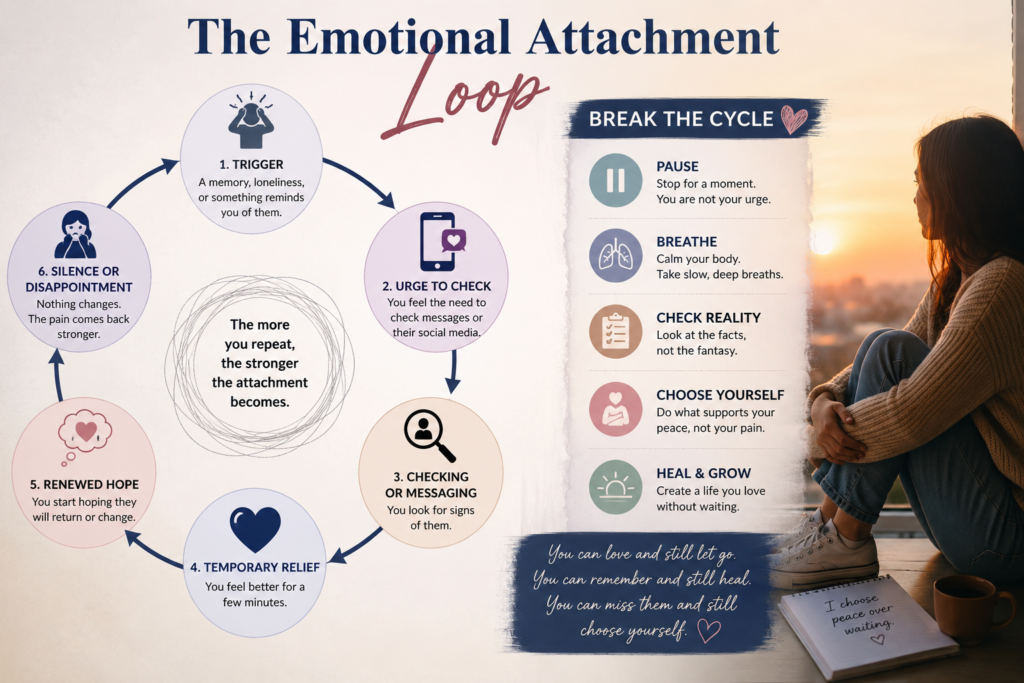
The Emotional Attachment Loop
People who feel unable to move on are often caught in a repeated cycle of pain and temporary relief.
The loop may look like this:
Trigger → urge to check → checking or messaging → brief relief → renewed hope → silence → deeper pain
For example:
- You feel lonely.
- A memory appears.
- Your body becomes restless.
- You check their profile.
- You briefly feel connected.
- Hope returns.
- Nothing meaningful changes.
- The pain becomes stronger.
Checking may be an attempt to regulate discomfort.
You may not be searching only for information. You may be searching for relief. Because the relief is temporary, the behaviour becomes repetitive.
Looking honestly at repeated behaviour can help you understand how to emotionally detach from imagined potential and return to reality.
Learning how to emotionally detach requires a different sequence:
Trigger → pause → name the feeling → calm the body → examine the evidence → choose a safer action
Why You Keep Checking the Phone
Phone checking may appear to be a small habit, but emotionally it can represent much more.
You may be checking for:
- reassurance that you still matter;
- evidence that they miss you;
- an apology;
- proof that they have changed;
- relief from uncertainty;
- permission to continue hoping.
The phone becomes the place where emotional rescue might appear.
Every notification can create anticipation. Every silent screen can feel like rejection.
Practical digital boundaries can reduce this repeated activation.
Try:
- muting their updates;
- hiding their activity status;
- archiving conversations;
- removing profile shortcuts;
- keeping the phone away from the bed;
- creating fixed no-checking periods;
- writing down what you hope to find before checking.
Before opening their profile, ask: What am I hoping this action will give me?
Then ask: Has checking given me lasting peace, or only a few minutes of relief?
That pause can begin weakening post-breakup attachment.
Why Old Places Pull You Back
Attachment can become connected to roads, cafés, songs, rooms, and cities.
A place may represent the time you felt understood or the future you imagined. Returning there may briefly recreate emotional closeness.
You do not need to avoid every meaningful location forever. But repeatedly visiting emotionally charged places may keep reopening the bond.
You can create new associations by:
- visiting with a trusted person;
- taking another route;
- choosing different music;
- creating a new ritual;
- asking whether the visit supports healing or longing.
The goal is not to erase memory. It is to stop allowing memory to control your next action.
Part of learning how to emotionally detach is choosing your own peace even when another part of you still misses the person.
Relationship Reality Versus the Imagined Future
Sometimes you are grieving more than the real person.
You may also be grieving the future you imagined:
- emotional safety;
- companionship;
- marriage;
- a shared home;
- consistent affection;
- finally being chosen;
- growing older together.
This is why emotional attachment after breakup can remain powerful. You may be grieving both what happened and what never became real.
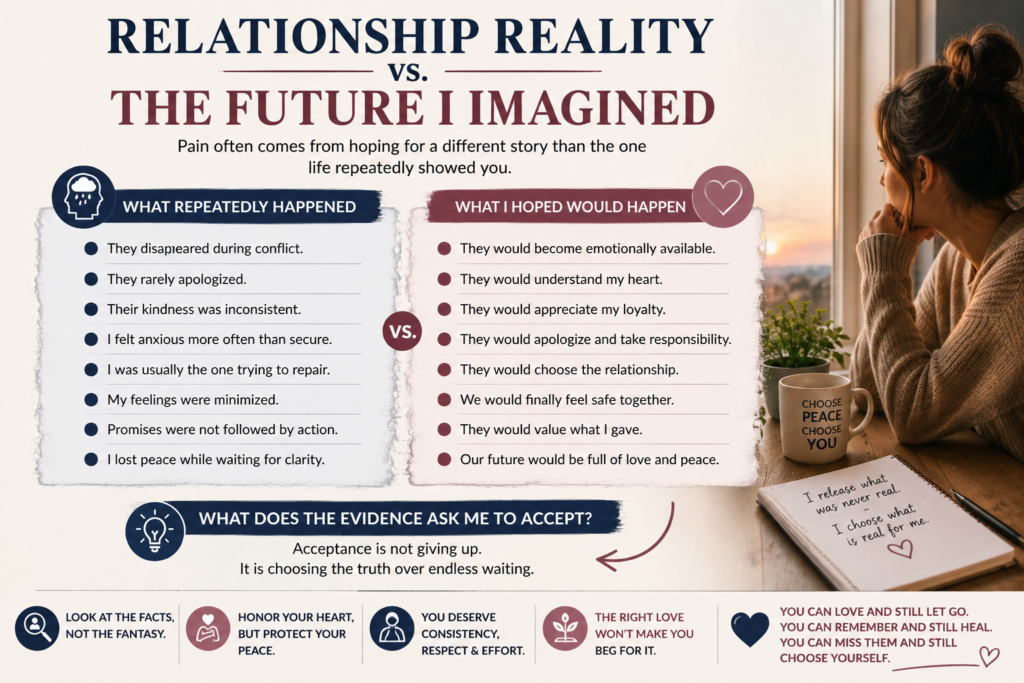
Create two lists.
What repeatedly happened?
- They disappeared during conflict.
- They rarely apologised.
- Their kindness was inconsistent.
- I felt anxious more often than secure.
- I was usually the one trying to repair.
- Promises were not followed by action.
What did I hope would happen?
- They would become emotionally available.
- They would understand my heart.
- They would appreciate my loyalty.
- They would apologise.
- They would choose the relationship.
- We would finally feel safe.
One list describes the relationship you experienced.
The other describes the relationship you were waiting for.
You begin to detach when you stop confusing imagined potential with repeated evidence.
When Attachment Starts Costing You Yourself
A meaningful relationship may require effort. It should not require you to disappear from your own life.
Ask what the attachment has been costing you.
Has it affected your:
- peace;
- sleep;
- health;
- food;
- focus;
- dignity;
- work;
- self-respect;
- spiritual practice;
- trust in your judgement?
Pain is not always proof that you should remain connected.
Sometimes pain is information.
If rejection has damaged your confidence, learning to recover self-worth after an attachment wound can support healing.
You may also need to begin trusting your emotional judgement again.
Choosing yourself does not mean your love was false. It means you will no longer prove love through self-neglect.
Practical Recovery Table
| Painful moment | What may be happening | Safer next action |
|---|---|---|
| You want to check their profile | You are searching for certainty | Delay for 20 minutes and move your body |
| One message creates hope | Contact feels like rescue | Judge the relationship by repeated behaviour |
| You reread old messages | You are searching for an earlier version of them | Read your reality list beside the messages |
| You revisit familiar places | The location carries emotional memory | Create a new association or pause visits |
| You want to contact them at night | Loneliness has activated the bond | Sleep before deciding or contact a safe person |
| You imagine they will change | Hope is protecting you from grief | Look for sustained actions, not promises |
| You need an apology | You want acknowledgement | Validate the harm and seek healthy support |
How to Emotionally Detach Without Becoming Cold
Healthy detachment does not require cruelty or numbness.
It means:
- seeing the person clearly;
- accepting what you cannot control;
- reducing behaviours that reinforce dependency;
- allowing grief without using contact for relief;
- protecting daily functioning;
- returning energy to your own life;
- keeping compassion without surrendering boundaries.
Learning how to emotionally detach does not mean erasing every memory.
- You can care and stop waiting.
- You can remember and stop checking.
- You can wish them well and protect your peace.
Readers seeking a deeper reflective framework can explore the spiritual side of emotional healing.
You can also learn about practising conscious detachment without becoming emotionally cold.
Seven Practical Steps for Emotional Detachment
1. Trust patterns, not isolated kindness
Repeated behaviour is more reliable than occasional reassurance.
One message cannot erase months of absence.
One apology cannot repair a pattern without changed behaviour.
2. Name what you are really waiting for
Are you waiting for the person, or for apology, recognition, justice, gratitude, or proof that you mattered?
Naming the hidden hope makes the attachment clearer.
3. Reduce unnecessary triggers
Mute updates, archive conversations, limit checking, and keep unavoidable communication practical.
Boundaries are not punishment. They give your emotions space to settle.
4. Calm your body before acting
Walk, breathe slowly, drink water, stretch, or write the message without sending it.
Do not let the strongest emotional moment make the decision.
5. Keep a relationship-evidence record
Write what repeatedly happened, how conflict was handled, what changed after apologies, and what the relationship cost you.
This helps when nostalgia removes the painful parts.
6. Return to neglected areas of life
Rebuild sleep, food, work, movement, friendships, creativity, finances, and spiritual practice.
Small actions remind you that your life still exists beyond the relationship.
7. Choose yourself repeatedly
Choosing yourself after heartbreak happens through ordinary decisions:
- not checking tonight;
- eating properly;
- completing your work;
- resting;
- saying no;
- accepting evidence;
- asking for support;
- protecting dignity.
The Turning Point: Love Cannot Force Care
One of the hardest truths is also one of the most freeing:
Love cannot force care.
- Your sincerity cannot make another person emotionally responsible.
- Your patience cannot create humility.
- Your loyalty cannot force gratitude.
- Your pain cannot force apology.
A mature relationship requires reciprocity, accountability, respect, emotional presence, and repair.
The turning point often arrives when you stop asking: How can I make them understand?
And begin asking: Why am I continuing to lose myself while waiting?
Understanding that love cannot force care is not bitterness.
It is clarity.
Choosing Yourself After Heartbreak
You may feel guilty when you begin stepping away.
You may wonder whether they will return after you move on or whether a boundary means you never truly loved them.
But protecting your peace is not betrayal. Distance does not make your feelings false. Acceptance does not mean that what happened was acceptable.
Choosing yourself after heartbreak means recognising that your life cannot remain paused until another person develops the capacity to care for it.
- You can still miss them and choose peace after breakup.
- You can love them and rebuild self-respect.
- You can begin emotional recovery without waiting for them to participate.
Personal Note
There was a time when I believed patience might change everything.
Small moments of kindness kept me emotionally connected. I thought time might soften the other person’s ego. Maybe they would understand my feelings, recognise the depth of my heart, or return with an apology.
I waited not only for the person. I waited for acknowledgement, gratitude, respect, and the day when the love I had given would finally be valued.
Meanwhile, waiting began taking pieces of my life—peace, sleep, focus, health, work, dignity, self-respect, and trust in myself.
My mind knew they were not choosing me, but my heart continued waiting.
The turning point was understanding that love cannot force care. I could continue waiting for them to change, or I could begin choosing myself. Choosing myself did not mean my love was false.
It meant that my life also deserved love.
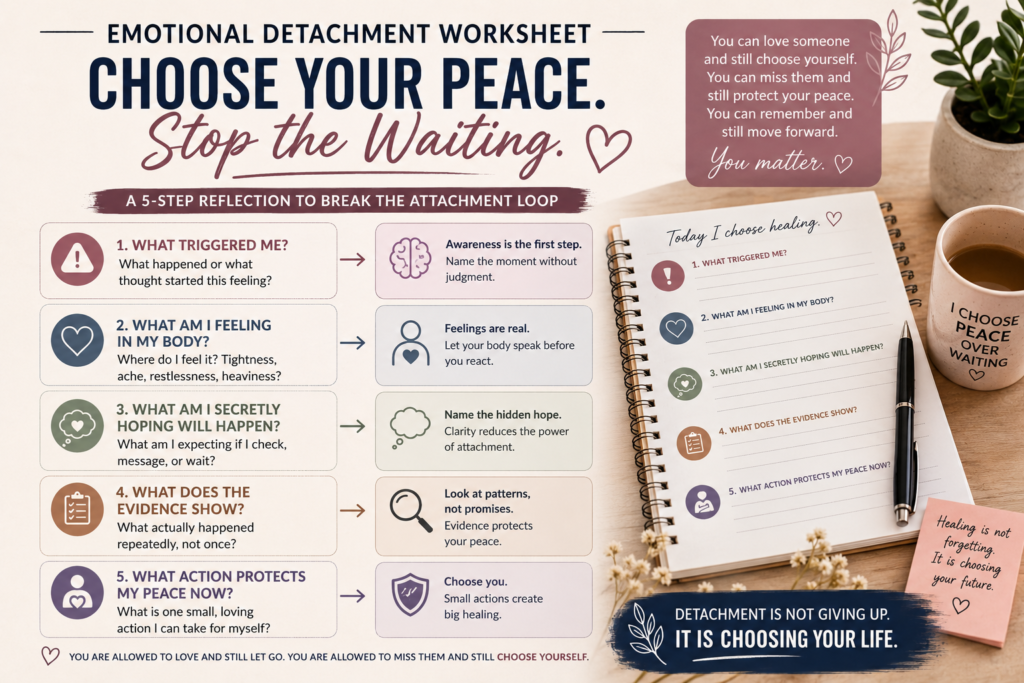
BBH Emotional Detachment Reflection
When the urge to contact, check, or wait becomes strong, write:
- What triggered me?
- What am I feeling in my body?
- What am I secretly hoping will happen?
- What does the repeated evidence show?
- What action protects my peace now?
Readers who need a starting point can begin with BBH’s emotional-healing guidance.
Important Safety Note
Emotional attachment after a relationship ends is a common human experience. This article provides general education and is not a diagnosis or substitute for individual mental-health care.
Emotional detachment can support healing, but it cannot replace safety planning, firm boundaries, or professional help when abuse, coercion, stalking, threats, humiliation, or fear are present.
Seek professional support when distress repeatedly disrupts sleep, eating, health, work, or daily functioning, or when you feel unable to cope safely.
People Also Ask
How do you emotionally detach from someone you still love?
Reduce behaviours that reactivate the bond, examine repeated behaviour, regulate your body before acting, and return attention to your own life. Emotional detachment usually develops through repeated boundaries rather than one sudden decision.
Why is letting go hard after a relationship ends?
Letting go may be difficult because the person became connected with emotional safety, routine, identity, or an imagined future. Difficulty letting go does not prove that the relationship should continue.
Why am I still attached after breakup?
Good memories, occasional kindness, unresolved questions, and hope for change may keep the bond active. Repeated checking and imagined reconciliation can also reinforce post-breakup attachment.
Why does my heart keep waiting?
Your heart may be waiting for apology, acknowledgement, gratitude, or the return of the person’s kinder version. Identifying what you are truly waiting for can support acceptance.
Can no contact help emotional recovery?
No contact may reduce triggers and repeated cycles of hope and disappointment. Where full separation is impossible, structured low contact may provide a more realistic boundary.
Frequently Asked Questions
How long does emotional attachment after breakup last?
There is no universal timeline. Progress may appear as less checking, improved sleep, stronger focus, and more emotional stability rather than complete absence of feeling.
Does missing someone mean I should contact them?
No. Missing someone shows that the relationship mattered, but it does not establish that renewed contact would be healthy.
Why do I keep checking their messages?
Checking may briefly reduce uncertainty or create closeness. Because relief is temporary, the behaviour can become repetitive.
Is emotional attachment the same as love?
Not always. Love can include respect and reciprocity, while painful attachment may also involve fear, uncertainty, dependency, or a need for reassurance.
When should I seek professional support?
Seek help when the distress becomes overwhelming, disrupts daily functioning, leads to unsafe contact, or includes severe panic, hopelessness, or thoughts of self-harm.
Final Reflection
Learning how to emotionally detach does not mean pretending the relationship never mattered.
Sometimes you are releasing more than a person. You are releasing a routine, an imagined future, a need for acknowledgement, and the belief that love will eventually change what someone refuses to face.
Letting go begins when you care enough about your own life to stop feeding the cycle that keeps hurting you.
You do not need to insult your heart for hoping. But you are allowed to accept that love cannot force care.
You are allowed to rebuild your sleep, work, health, dignity, peace, and trust in yourself.
You are allowed to choose yourself.
External References
- APA Dictionary of Psychology — Attachment Style
https://dictionary.apa.org/attachment-style - Cleveland Clinic — Attachment Styles: Causes and What They Mean
https://my.clevelandclinic.org/health/articles/25170-attachment-styles - Cleveland Clinic — Understanding Attachment Theory and Its Stages
https://health.clevelandclinic.org/attachment-theory - NHS — Get Help With Grief After Bereavement or Loss
https://www.nhs.uk/mental-health/feelings-symptoms-behaviours/feelings-and-symptoms/grief-bereavement-loss/ - National Institute of Mental Health — Caring for Your Mental Health
https://www.nimh.nih.gov/health/topics/caring-for-your-mental-health