Free AI Goal Planner for Fear and Overthinking
Turn Fear and Overthinking Into Weekly Action


You may have goals, dreams, and ideas for a better life, but still feel blocked when it is time to execute them. Fear, overthinking, inconsistency, and confusion can make even simple goals feel heavy.
Thank you for reading this post, don't forget to subscribe!This free AI goal planner is designed to help you use an AI goal planner, an AI goal-setting tool, a SMART goal generator, and a simple goal setting worksheet PDF to turn emotional overwhelm into one clear weekly action plan.
This is not only a blog for people who want a productivity template. This is for someone who has tried to plan before, started with hope, stopped after a few days, felt guilty, and then promised themselves, “This time I will be serious.”
But the same pattern returned.
The real problem is not always laziness. Many people do not fail because they have no goals. They struggle because their goal has no simple execution system, no emotional safety, no weekly tracking, and no restart rule.
At BBH, we look at goals through both structure and nervous system reality. A goal is not only a future target. A goal is an emotional, mental, and practical pathway toward a better life.
What an AI Goal Planner Can Do When Execution Feels Hard
An AI goal planner is a digital planning support system that helps you turn a broad goal into smaller steps, timelines, reminders, milestones, and reflection questions. It can help you move from “I want to improve my life” to “This week I will take three clear actions, track what happened, and restart without guilt if I stop.”
That shift matters because vague goals often create pressure, while specific goals give direction.
Goal-setting research has long emphasized that specific and challenging goals can improve performance more than vague “do your best” goals when the person has commitment, ability, and feedback. Locke and Latham’s goal-setting theory is one of the most widely cited frameworks in this area.
But BBH adds one important human truth: a goal should not become a punishment system.
A goal may be specific and still fail if the person’s emotional reality is ignored. If someone is already tired, anxious, ashamed, overwhelmed, or afraid of failing again, a very strict plan may not create growth. It may create shutdown.
A better planning system should ask:
- What do I want?
- Why does this matter?
- What blocks me?
- Where do I usually stop?
- What is the smallest action I can repeat?
- How will I restart when I miss a day?
This is where AI can support clarity, but the human still remains the decision-maker.
For readers whose goals are blocked by worry, read this support guide next: free-ai-chatgpt-prompts-for-anxiety
Why a Free AI Goal Planner Helps With Fear and Overthinking
Many people search for a free AI goal planner because they do not only want a blank template. They want help thinking.
A blank planner can feel simple when your mind is calm. But when your mind is crowded, a blank page can feel like pressure. You may write one goal, then another, then another. Soon the goal becomes too big, too emotional, and too unclear.
Fear may say:
- “What if I fail again?”
- “What if I am too late?”
- “What if I cannot continue?”
- “What if I start and stop like last time?”
Overthinking may say:
- “First I need the perfect plan.”
- “Maybe this goal is not the right goal.”
- “Maybe I should research more.”
- “Maybe I will start tomorrow.”
Inconsistency may say:
- “I was doing well, but then I stopped.”
- “Now everything is ruined.”
- “I will restart from Monday.”
- “I cannot trust myself.”
A supportive planning system should not attack these patterns. It should help you understand them.
A good plan does not only tell you what to do. It helps you see why you stop. That is where the real transformation begins.


Founder Voice: The Real Reason Many Goals Stop
I did not fail because I had no dreams. I failed because I had no system that respected my emotional capacity.
For a long time, the problem was not that I did not want a better life. The problem was execution. I had ideas, goals, and plans, but day-to-day action became difficult because fear, overthinking, inconsistency, and confusion interrupted me.
I needed a proper tracking system that could show me where I stopped, why I stopped, and what small action could bring me back.
A goal is not only a dream. A goal is an idea, a direction, and a plan for becoming better, solving real life problems, and creating a more stable life.
This is why the BBH planner is not only a productivity planner. It is also an emotional clarity worksheet and a weekly action tracker for someone who feels confused, emotionally tired, or ready to start life again.
For readers who confuse fear with fact, this reflection tool can help: free-ai-fact-vs-fear-tool
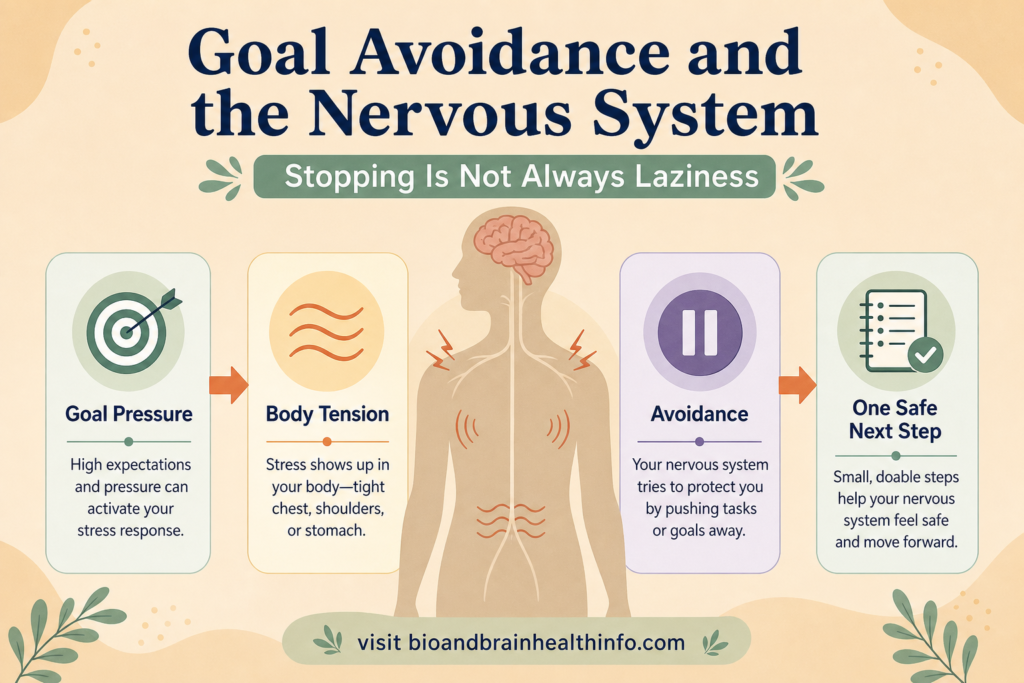
The Nervous System Reason Goals Start Strong and Then Collapse
Many people begin a goal with strong motivation. The first day feels powerful. The second day feels possible. Then real life comes.
Sleep gets disturbed. Work pressure increases. A family issue appears. Health becomes unstable. Money stress rises. Emotional heaviness returns. The plan that looked simple on paper suddenly feels too much in the body.
This is not always lack of discipline.
Sometimes the nervous system has moved from planning mode into protection mode.
When the body feels unsafe, overwhelmed, judged, or pressured, the brain may choose familiar survival patterns:
- delay
- avoidance
- scrolling
- sleeping more
- over-researching
- perfectionism
- emotional eating
- starting another plan instead of finishing this one
The mind may still want the goal, but the body may resist the pressure around the goal.
That is why BBH goal planning begins with emotional capacity. Before asking, “What is your big goal?” we must also ask, “What is your real capacity this week?”
A plan that ignores capacity becomes another reason for self-criticism. A plan that respects capacity can become a bridge back to self-trust.
How to Use an AI Goal-Setting Tool Without Overwhelming Yourself
An AI goal-setting tool can be helpful when you use it as a thinking partner, not as a strict authority.
Do not ask AI to create a perfect life plan for the next one year when you are emotionally tired today. Start smaller. Ask it to help you organize one goal for one week.
Use this simple prompt:
Prompt to Copy
“I want to work on this goal: [write your goal]. My current situation is: [write your real situation]. My main blocks are fear, overthinking, inconsistency, and difficulty with day-to-day execution. Please help me create a simple weekly action plan with small steps, one tracking method, and one restart rule. Make the plan practical, emotionally manageable, and not too strict.”
This type of prompt helps AI understand that you need structure and emotional realism together.
After AI gives you a plan, do not follow it blindly. Read it slowly and ask:
- Is this realistic for my current life?
- Is this too much?
- What can I reduce?
- Which step can I do even on a low-energy day?
- What will I track?
- When will I review?
AI can suggest. You must choose.
That one difference protects your agency.
SMART Goal Generator vs Human Goal Planning
A SMART goal generator can be useful because it turns vague goals into clearer goals.
SMART usually means:
- Specific
- Measurable
- Achievable
- Relevant
- Time-bound
Many universities and professional development resources use SMART goal worksheets because they help people define what they will do, how success will be measured, and when progress will be reviewed.
For example:
Vague goal: “I want to get healthier.”
SMART goal: “I will walk for 20 minutes on Monday, Wednesday, and Friday for the next four weeks.”
That is clearer.
But BBH adds one more layer:
SMART is useful, but it is not enough if the goal is emotionally loaded.
A person may create a SMART goal and still avoid it because the goal touches shame, fear, old failure, comparison, or identity pressure.
So instead of only asking whether a goal is SMART, also ask whether it is emotionally safe enough to begin.
A goal should be clear, but not cruel.
Measurable, but not obsessive.
Time-bound, but not panic-based.
Challenging, but not punishing.
That is the difference between pressure and progress.
For readers exploring safe digital support, visit this BBH resource: free-ai-mental-health-tools-for-emotional-support
BBH Goal Planning Chart: From Confusion to Weekly Action
| Goal Problem | What It Sounds Like | What Is Really Happening | Better Planning Question | Weekly Action Example |
|---|---|---|---|---|
| Too broad | “I want to fix my life.” | The goal has no focus | Which one area matters most this week? | Choose health, work, money, study, routine, or emotional stability |
| Fear-based delay | “What if I fail again?” | The body remembers past disappointment | What is one action small enough to feel safe? | Do one 15-minute task |
| Overthinking | “I need the perfect plan.” | Thinking is replacing action | What is the first imperfect step? | Start with one draft, one call, one walk, or one review |
| Inconsistency | “I stopped, so I failed.” | No restart rule exists | How will I return without punishment? | Restart with one small action the next available day |
| No tracking | “I don’t know where I lost rhythm.” | The pattern is invisible | Where did I stop and why? | Track action, mood, block, and next step |
| Emotional tiredness | “I want it but I feel heavy.” | Capacity is low | What is the minimum useful action? | Reduce the plan by 50% |
| Too many goals | “Everything is important.” | Priority is unclear | What goal solves the biggest current pain? | Pick one main goal for 7 days |
This table matters because real planning is not only about ambition. It is also about pattern recognition.
When you know where you stop, you can stop turning every pause into a personal failure.
BBH Goal Setting Worksheet PDF for Weekly Tracking
A goal setting worksheet PDF is useful because it moves your goal out of your mind and into a visible structure.
The mind can hide patterns. A worksheet reveals them.
A good worksheet should include:
- goal name
- reason behind the goal
- emotional block
- fear or overthinking pattern
- day-to-day execution step
- weekly tracker
- restart rule
- review question
This is different from writing a motivational quote in a diary. Motivation may help for one day, but tracking helps you understand your pattern over time.
For example, if you stop every Thursday, you may discover that your week becomes overloaded by then. If you stop after one missed day, you may discover that perfectionism is the real barrier. If you avoid the same task repeatedly, you may discover fear hidden under “I am busy.”
The worksheet is not there to shame you. It is there to show you the truth gently.

How to Build a Weekly Action Plan That You Can Actually Follow
A weekly plan works better than a long fantasy plan because it brings the goal close enough to act on.
Use this simple BBH structure:
1. Choose One Main Goal
Do not start with ten goals. Choose one.
Example:
“This week, I will improve my work routine.”
2. Choose Three Small Actions
Do not write twenty actions. Choose three.
Example:
- Make client follow-up list
- Complete two focused work sessions
- Review pending payment or project sheet
3. Choose One Tracking Method
Keep it simple.
Example:
Tick mark, notebook, spreadsheet, habit tracker, or printable planner.
4. Choose One Emotional Check
Ask:
“What feeling stopped me today?”
This helps you understand whether the block was fear, tiredness, confusion, resistance, or lack of clarity.
5. Choose One Restart Rule
Use this:
“If I stop for two days, I do not punish myself. I restart with one small action.”
This rule is powerful because it removes the drama from stopping. Stopping does not become identity. It becomes information.
For readers who want more BBH healing resources, visit the resource hub: healing-resources-hub
How to Turn Fear Into a Smaller Step
Fear becomes stronger when the goal feels too big.
If your goal is “write a book,” the mind may freeze.
If your step is “write one paragraph,” the body may cooperate.
If your goal is “build a business,” the mind may panic.
If your step is “call one client,” the body may move.
If your goal is “fix my health,” the mind may feel tired.
If your step is “walk for 10 minutes,” the body may accept.
This is why small steps are not weak. They are nervous-system intelligent.
A small action protects continuity. Continuity rebuilds self-trust. Self-trust makes bigger action possible later.
The mistake many people make is trying to rebuild life through intensity. But intensity often collapses. Rhythm is stronger.
For readers who want to understand AI and emotional thinking, read this guide: ai-and-cbt
How to Know Your Plan Is Too Heavy
Your plan may be too heavy if:
- you avoid opening it
- you feel ashamed before starting
- you need perfect conditions
- you keep rewriting the plan
- you feel tired just reading it
- one missed day makes you quit
- the plan depends only on motivation
A better plan should feel clear, grounded, and slightly challenging, but not terrifying.
Ask yourself:
“Can I do this on an average day, not only on my best day?”
If the answer is no, reduce the plan.
Reducing the plan is not failure. It is intelligent design.
BBH Support Resource
Want a simple tool to practice this?
Download the BBH AI Goal Clarity Worksheet + Weekly Action Tracker to reflect on your goal, emotional block, execution gap, weekly action, tracking method, and restart rule.
Download Here :- BBH_AI_Goal_Clarity_Worksheet_Weekly_Action_Tracker
This worksheet is designed for people who have goals but struggle with fear, overthinking, inconsistency, and day-to-day execution. It helps you see where you stop, why you stop, and what small step can bring you back.
Email Request Note:
Email info@bioandbrainhealthinfo.com and write:
“Send me the BBH AI Goal Clarity Worksheet.”
This resource works best as a mix of:
- productivity planner
- emotional clarity worksheet
- weekly action tracker
It is not made to pressure you. It is made to help you return to your plan without self-punishment.
Read Also : free-ai-tool

People Also Ask
1. What is the best free AI goal planner?
The best option is one that helps you clarify your goal, break it into realistic weekly actions, track progress, and adjust the plan when life interrupts. A helpful system should combine AI prompts with a printable or digital worksheet so your goal becomes visible and trackable.
2. Can AI help me set better goals?
Yes. AI can help you organize your thoughts, define specific goals, create action steps, and identify possible obstacles. It works best when you give honest details about your real life, emotional blocks, time limits, and current capacity.
3. What is an AI goal-setting tool?
An AI goal-setting tool is a digital tool or prompt system that helps you define a goal, break it into smaller tasks, create timelines, and review progress. It should support your thinking, not replace your judgment.
4. Is a SMART goal generator useful?
Yes, a SMART goal generator can help when your goal is too vague. It can make the goal specific, measurable, achievable, relevant, and time-bound. However, you should still adjust the goal so it fits your emotional capacity and daily life.
5. What should a goal setting worksheet PDF include?
A useful worksheet should include the goal, reason, emotional block, weekly action steps, progress tracker, reflection questions, and restart rule. It should help you understand both what you are doing and why you stop.
Read Also : ai-and-cbt
FAQ
1. Why do I keep setting goals and not following them?
You may be setting goals that are too broad, too strict, or disconnected from your real capacity. Fear, overthinking, inconsistency, and lack of tracking can also interrupt execution. The solution is not more self-criticism. The solution is a smaller plan, visible tracking, and a clear restart rule.
2. Should I use AI for personal goal planning?
You can use AI for reflection, planning, and structure. It can help you organize your thoughts and create a weekly plan. But you should review all suggestions carefully and make your own decisions based on your health, safety, finances, responsibilities, and professional advice when needed.
3. What is the difference between a goal planner and a weekly tracker?
A goal planner helps you define the goal and break it into steps. A weekly tracker helps you monitor whether you actually took action. Both are useful, but tracking is especially important for people who stop and do not know where the pattern broke.
4. Can goal planning help with anxiety?
Goal planning may reduce some anxiety by making next steps clearer. However, it is not a treatment for anxiety disorders, trauma, panic, depression, or crisis situations. If emotional symptoms are intense or unsafe, professional support is important.
5. How often should I review my goals?
A weekly review is usually realistic. Daily review can become pressure for some people. Weekly review gives enough space to notice patterns, adjust the plan, and restart without turning every missed day into failure.
YMYL Safety Note
This article is for educational and self-reflection purposes only. It does not provide medical advice, diagnosis, therapy, crisis care, financial advice, legal advice, or a replacement for qualified professional support.
If your goal is connected to mental health symptoms, trauma, abuse, coercion, financial distress, unsafe relationships, or medical concerns, please involve qualified professional support.
Secure communication can support healthier repair, but it cannot replace safety, boundaries, or professional help when abuse, coercion, humiliation, or fear is present.
Personal Note
I have learned that many people do not fail because they have no dreams. They fail because they do not have a system that respects their real emotional capacity.
A person may have goals, ideas, and strong desire, but still struggle with execution. Fear comes. Overthinking starts. Inconsistency breaks the rhythm. Then guilt enters, and the person begins to believe, “Maybe I am not disciplined enough.”
But sometimes the real issue is not discipline. Sometimes the real issue is that the plan was too unclear, too heavy, or too disconnected from the person’s real day-to-day life.
That is why I believe goal planning should include both structure and self-understanding.
You need to know:
- What is my goal?
- Why does it matter?
- What stops me?
- Where do I usually break the plan?
- What is the smallest next action?
- How do I restart without guilt?
My own restart rule is simple:
“If I stop for two days, I do not punish myself. I restart with one small action.”
That one small action matters. It tells the nervous system, “We are not starting from shame. We are starting from direction.”
Closing Thought
A goal is not only a future achievement.
A goal is a relationship with your own direction.
AI can help you organize the plan. A worksheet can help you track the pattern. A weekly review can help you return when you stop.
But the real success begins when you stop using goals as proof that you are failing, and start using them as a gentle system for returning to your life.
Start with one goal.
Make it small.
Make it honest.
Make it trackable.
And if you stop, restart with one small action.
That restart may become the real success.
External References
- Google Search Central – Creating Helpful, Reliable, People-First Content
URL: https://developers.google.com/search/docs/fundamentals/creating-helpful-content
Use for: People-first writing and avoiding search-engine-first content. - Google Search Central – Image SEO Best Practices
URL: https://developers.google.com/search/docs/appearance/google-images
Use for: Writing useful alt text and avoiding keyword stuffing in image alt attributes. - PubMed – Building a Practically Useful Theory of Goal Setting and Task Motivation
URL: https://pubmed.ncbi.nlm.nih.gov/12237980/
Use for: Goal-setting theory and the value of specific goals, feedback, and motivation. - Lake Superior State University – SMART Goals Worksheet
URL: https://www.lssu.edu/wp-content/uploads/2021/09/SMART-Goals-Worksheet-1.pdf
Use for: SMART goal worksheet structure and questions. - University of California Office of the President – SMART Goals: A How to Guide
URL: https://www.ucop.edu/local-human-resources/_files/performance-appraisal/How%2Bto%2Bwrite%2BSMART%2BGoals%2Bv2.pdf
Use for: SMART goal examples and goal-writing guidance. - QuillBot – AI SMART Goals Generator
URL: https://quillbot.com/ai-writing-tools/ai-smart-goals-generator
Use for: SERP context around AI-supported SMART goal tools. - Easy-Peasy AI – SMART Goal Generator
URL: https://easy-peasy.ai/templates/smart-goal-generator
Use for: SERP context around AI-powered goal generation.