
Why do i struggle with consistency ?
You make a plan that feels sensible. For a few days, you follow it. Then an appointment runs late, your body feels heavy, someone needs your help, or the work takes longer than expected. You miss a day.
Thank you for reading this post, don't forget to subscribe!The next morning, the task has company: disappointment, guilt and the thought that you have done this before.
“Why can’t I stay consistent?” can become a judgement about your whole character when it began with one interrupted routine. You may care deeply about your work and still struggle to return to it. Wanting something does not automatically make its daily demands manageable.
This guide helps you examine what interrupts your routine, choose a realistic version of the task, and return without turning a missed day into a personal verdict.
Why Can’t I Stay Consistent? The Quick Answer
Start by checking the fit between your plan and your actual life. A routine may be too demanding, unclear, dependent on enthusiasm, or difficult to resume after an interruption. Stress, poor sleep, health problems and competing responsibilities may also affect follow-through.
Choose one meaningful action, connect it to a practical cue, and decide in advance what to do when a day goes wrong. Consistency is a pattern of returning at an appropriate frequency. It does not require identical output every day.
Health note:
Difficulties with consistency do not diagnose a dopamine deficiency or a mental health condition.
Persistent weakness, loss of interest or difficulty functioning deserves professional assessment.
Why a Missed Day Can Become a Missed Week
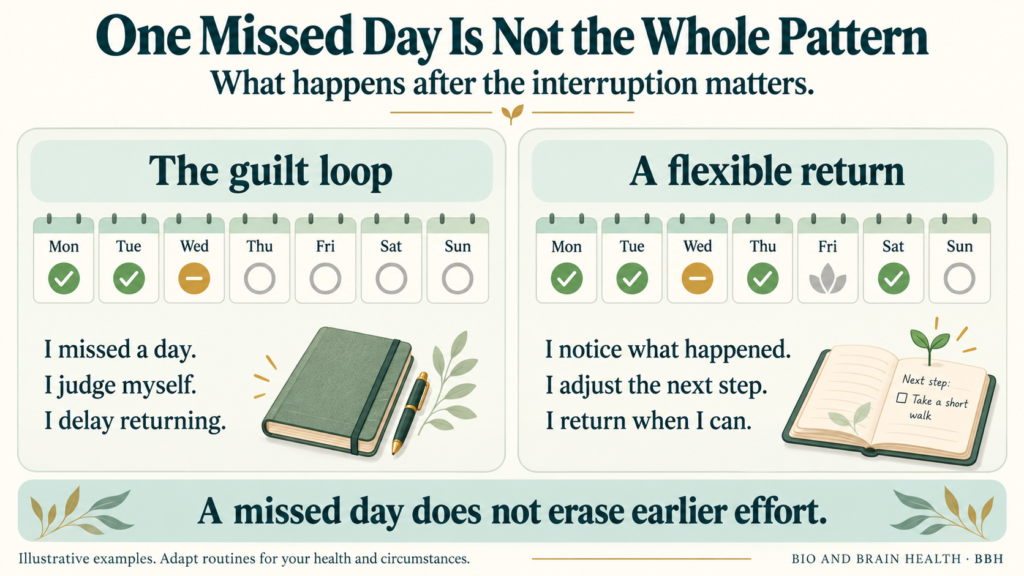
The original interruption may be ordinary. You had a demanding day and could not finish your planned work. The difficulty grows when the meaning of that interruption changes: “I missed today” becomes “I never follow through.”
Now returning means facing both the unfinished task and the story you have attached to it. You might avoid the planner because it displays the gap. You might wait until Monday because restarting midweek feels untidy. Or you might design an even stricter routine to prove that this time will be different.
If “why can’t I stay consistent?” is your recurring question, examine what happens immediately after a miss. Do you adjust the plan, or increase the punishment?
A useful restart does not need to repay every unfinished hour. It needs a clear next opportunity and an action you can realistically perform.
For the mechanics of repeated behaviour and environmental cues, read Why Habits Don’t Stick. Here, our focus is recovering when the routine has already been interrupted.
Please Read This :- Brain Mastery and Discipline and action
Why Do I Struggle With Consistency? Six Barriers
Different barriers need different responses. Use this table as a reflection tool, not a diagnosis.
| What You Notice | Possible Barrier | A Useful Adjustment |
|---|---|---|
| You start with an ambitious schedule, then cannot maintain it | The plan exceeds available capacity | Reduce the frequency, duration or number of commitments |
| You keep moving between tasks | The next action is unclear | Name one visible action, such as replying to one client email |
| One missed day makes the entire week feel ruined | All-or-nothing expectations | Resume at the next suitable opportunity without catching up everything |
| You postpone because the result might be imperfect | Fear of mistakes or judgement | Separate a rough first attempt from later editing |
| You repeatedly lose the planned time | Competing demands or interruptions | Protect a smaller block, request help, or renegotiate the deadline |
| You feel weak, unusually tired or unable to enjoy things | A possible health or mood concern | Seek appropriate assessment rather than escalating productivity demands |
When you wonder, “why do I struggle with consistency?”, look for the barrier you can actually change. Buying another planner will not supply missing project details.
A stricter alarm will not treat an underlying illness. Accountability will not create hours that caring responsibilities have already used.
Why Do I Struggle With Consistency When Life Gets Busy?
“Why do I struggle with consistency?” is worth asking alongside a second question: how many responsibilities have I assigned to the same hour? A work plan that ignores meals, appointments, caring duties and necessary rest can become difficult to repeat even when the goal matters.
When you ask “why do I struggle with consistency?”, compare an ordinary day with the day your plan assumes. If the routine requires uninterrupted time you rarely have, change its timing or size. This is a practical adjustment you can test.
Another way to explore “why do I struggle with consistency?” is to notice where you stop. Before starting, you may need clearer instructions. Halfway through, you may need a smaller work block. After a missed session, you may need a specific return plan.
Write “why do I struggle with consistency?” at the top of a page, then list observable barriers underneath. Replace broad labels such as “I am hopeless” with details such as “I cannot find the file” or “the deadline is unclear.” Specific problems are easier to discuss and address.
What Stress Can Feel Like Inside the Body
You sit down to work, but your shoulders remain tense. Your attention keeps moving to an unpaid bill, a family problem or an unfinished conversation. You read the same sentence repeatedly and feel frustrated that a simple task is taking so much effort.
Stress and anxiety can involve tension, worry and disrupted sleep. The National Institute of Mental Health’s stress guidance explains that symptoms which persist or interfere with everyday life may need professional support.
This does not mean your nervous system has rejected your goals or that every delayed task is a trauma response. It means your physical and emotional state belongs in the planning conversation.
Before beginning, try one brief check: “Am I missing information, feeling worried, or physically unwell?” Then respond to that need. You might write down the worry, ask a clarifying question or move the task to a more suitable time.
For related learning, explore BBH’s Nervous System Regulation Guide. Use educational explanations to increase understanding, without treating them as an individual diagnosis.
How to Stop All-or-Nothing Thinking About Routines
Sometimes the task becomes a test of whether you are capable or worthy. Writing one imperfect paragraph no longer feels like an ordinary part of learning; it feels like evidence against you.
Notice the rule beneath the pressure. Is it “If I cannot finish everything, starting does not count”? Or “If I need rest, I am falling behind everyone else”?
Learning how to stop all-or-nothing thinking begins with making that rule visible. Replace an absolute judgement with a specific observation: “I had less time than expected, so I completed one section.” That statement leaves room for improvement without erasing what happened.
Past experiences of criticism or approval may be relevant for some readers. However, inconsistency alone does not establish an attachment pattern, and you do not need to identify a childhood cause before adjusting a difficult routine.
If “why can’t I stay consistent?” carries intense shame, ask a more informative question: “What expectation makes returning feel so threatening?” Persistent distress may be worth exploring with a qualified therapist.
How to Stop All-or-Nothing Thinking After an Imperfect Session
A practical starting point for how to stop all-or-nothing thinking is to separate the event from the verdict. “I completed twenty minutes instead of an hour” describes an event. “Nothing I do counts” adds a conclusion that ignores those twenty minutes.
When practising how to stop all-or-nothing thinking, use a middle-ground statement that remains honest: “This was less than planned, and I can review what is still needed.” You do not have to pretend that a missed deadline has no consequences.
Another exercise in how to stop all-or-nothing thinking is to define three acceptable responses in advance: the usual action, a reduced action and a planned pause. Choose according to the situation rather than treating every day as a test of personal worth.
If your attempts at how to stop all-or-nothing thinking become another demand to think perfectly, simplify the exercise. Notice one harsh judgement and write one more specific description. Persistent distress may need support beyond a worksheet.
When Your Body Needs Attention
Not every difficulty is solved by making the task smaller. Physical weakness, prolonged fatigue and changes in mood or concentration deserve attention in their own right.
The NHS guidance on tiredness and fatigue describes several possible causes, including sleep problems, stress, medicines and medical conditions. Vitamin B12 or folate deficiency can also cause fatigue and other symptoms, as described in the NHS deficiency overview.
A clinician can decide whether tests are appropriate. Do not assume you need supplements or injections because work feels difficult; treatment depends on the cause. If you already have a health condition, follow your existing care plan and discuss new symptoms with your healthcare team.
During illness, the right adjustment may be rest, a reduced workload or practical help. A minimum task is optional, not a debt you must pay to deserve recovery.
BBH’s Feeling Sad for No Reason offers an additional educational perspective when changes in motivation accompany low mood.
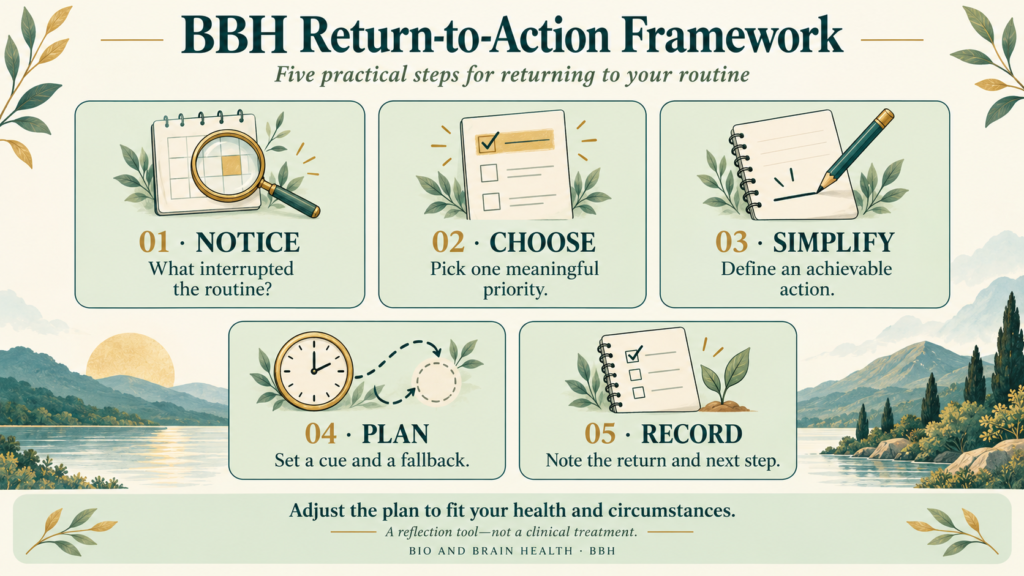
The BBH Return-to-Action Framework
This is a practical reflection tool, not a clinically validated treatment. Use it to make returning more concrete when you are well enough to work.
1. Why Can’t I Stay Consistent After a Missed Day?
Write what happened in one factual sentence: “Two appointments used the afternoon I had planned for editing.” Avoid adding “because I always fail.”
If the interruption repeats, treat that as planning information. Your routine may need a different time or less work assigned to that day.
2. Choose one priority
A list of twenty responsibilities tells you what exists; it does not tell you what to do next. Choose one action based on its importance, deadline and the consequences of delay.
For a freelancer, that could be sending an overdue invoice. For a student, it might be identifying the next assignment deadline. Put unrelated tasks on a separate list so they do not compete during the same work block.
3. Define an achievable version
Replace “work on the article” with “write three rough bullet points for the introduction.” Make the completion visible.
An achievable version should still serve the goal. Reorganizing files for an hour may feel productive while avoiding the client message you actually need to send.
4. Choose a cue and a fallback
A cue gives the action a place: “After lunch, I will open the draft and write the bullet points.” A fallback accounts for real life: “If an appointment runs late, I will reassess after dinner and either do the smaller version or reschedule.”
Research by Lally and colleagues on habit formation studied repeated behaviours in stable contexts. It supports the importance of repetition and context, while showing that habit development varies. There is no universal deadline by which your routine must feel automatic.
5. Record the return and leave a next step
After the action, write one useful sentence: “The outline is started; next I need one source for section two.” This gives your next session an entry point.
Count your returns as well as your interruptions. The aim is to learn which conditions help you resume, without using the record to criticize yourself.
A Worked Example: Returning Without Catching Up Everything
Imagine Maya, a self-employed writer who planned to edit for an hour every weekday. After two disrupted days, she feels she must complete three hours before she is back on track. The size of that imagined catch-up session makes her avoid the document.
Her adjustment is smaller and more specific: edit one subsection after lunch on three weekdays. If that time is lost, she reviews whether a brief alternative is possible. She leaves a note showing where to resume.
Maya also notices that afternoon appointments are common. Instead of describing every appointment as a failure, she changes the weekly schedule. The lesson is not that smaller always means better. It is that the plan should respond to the pattern of her actual week.
This is a fictional illustration, not a reported client story or a guarantee of results.
How to Stay Consistent With Habits When Repetition Feels Boring
Necessary work can become repetitive. You do not have to feel inspired by every invoice, editing pass or household task.
Give repetitive work a boundary. Decide what the batch contains, what “finished for today” means, and when you will stop. Prepare a reusable checklist for tasks that genuinely repeat. Keep the checklist brief enough to reduce work rather than becoming another project.
You can vary an optional feature, such as the order of similar tasks, while keeping the essential action clear. Review whether automation, a template or practical help would remove unnecessary repetition.
BBH’s Free AI Goal Planner for Fear and Overthinking may help you turn a vague project into steps. Keep private information out of prompts and check the output yourself. Planning assistance should leave you with less uncertainty, not another elaborate system to maintain.
How to Stay Consistent With Habits During an Ordinary Week
Learning how to stay consistent with habits includes choosing a frequency that fits the activity. A weekly accounts review does not need a daily streak. Define the appropriate repetition before judging your follow-through.
If you are exploring how to stay consistent with habits, prepare the materials you will need before the planned session. For example, keep the relevant document, checklist and project details together so the first few minutes do not disappear into searching.
Practical advice on how to stay consistent with habits should also include a stopping point. Decide whether today’s session means editing one subsection, answering three messages or checking one invoice. A defined finish can make repetitive work more manageable.
How to Stay Consistent With Habits Without Doing Everything Daily
Your experiment with how to stay consistent with habits should leave room for adjustment. If the routine repeatedly conflicts with essential responsibilities, reduce the commitment, change the cue or ask for support. Review what happened before adding another rule.
Spiritual Grounding: A Calmer Way to Begin
Shubhangi describes mala practice as helping her feel calmer before work. This is her personal experience, not proof of a particular chemical change or increased physical stamina.
If spiritual practice matters to you, a brief period of mala, prayer or reflective reading can be an optional transition into the day. If you prefer a secular approach, quiet reflection or writing one intention may suit you better.
Research on some meditation approaches suggests potential benefits for stress-related symptoms, with important limitations. The NCCIH meditation overview also notes that adverse experiences can occur. Adapt or stop a practice that increases distress and seek advice when needed.
The purpose is not to become perfectly calm before acting. It is to create a supportive beginning when that helps you. Spiritual practice does not replace medical or mental health care.
For broader background, read How to Increase Dopamine Naturally, which discusses supportive daily habits rather than guaranteed chemical boosts.
How to Get Back on Track After Missing a Day
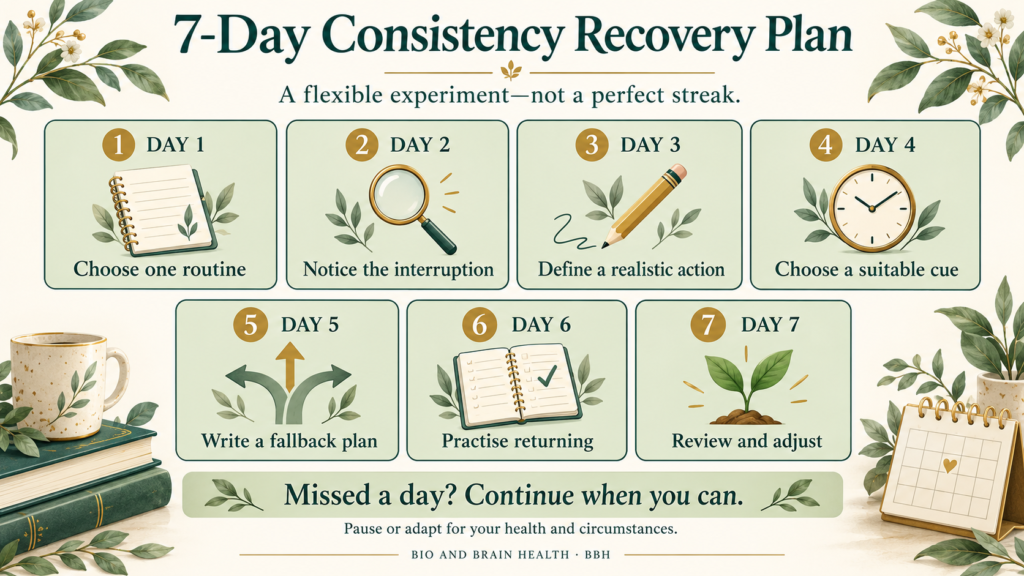
If you are searching for how to get back on track after missing a day, try observing one routine for a week. These are flexible prompts, not seven compulsory consecutive days.
| Day | Experiment | Reflection |
|---|---|---|
| 1 | Choose one routine to examine | Why does this matter to me? |
| 2 | Describe the most common interruption | Is it time, uncertainty, pressure or health? |
| 3 | Define a realistic version | What would count as a useful completion? |
| 4 | Connect it to a suitable cue | When does this fit my actual day? |
| 5 | Write a fallback plan | What will I do if that opportunity disappears? |
| 6 | Try returning without catch-up punishment | What made the return easier or harder? |
| 7 | Review and change one thing | Should I simplify, reschedule, ask for help or pause? |
If you miss part of the experiment, continue where it is useful. Health care and necessary rest take priority over completing the table.
How to Get Back on Track After Missing a Day Without Catch-Up Pressure
The first decision in how to get back on track after missing a day is whether the missed task still matters. Some actions should be rescheduled; others have become unnecessary. Review the priority before carrying yesterday’s entire list into today.
For a student wondering how to get back on track after missing a day, the next step might be one practice question and a check of the assignment deadline. The immediate aim is a useful return, followed by a realistic review of remaining work.
For a freelancer learning how to get back on track after missing a day, a return may begin with a brief client update or opening the exact section awaiting revision. Avoid turning the restart into another complete redesign of your business system.
Knowing how to get back on track after missing a day also means recognizing when returning is not appropriate yet. During illness or a serious disruption, rescheduling and arranging help may be the responsible response. Prescribed healthcare schedules require individual professional guidance.
People Also Ask: Five Common Questions
Why can’t I stay consistent even when I want to change?
Wanting change and having a workable routine are different things. Check the task size, clarity, timing and competing demands. Also consider sleep, health and emotional pressure. Start by adjusting the most obvious barrier rather than assuming you need stronger willpower.
Is consistency more important than motivation?
Motivation can help you begin, while clear cues and realistic routines can support repetition when enthusiasm varies. Neither makes your physical needs irrelevant. A useful approach combines meaningful goals with a plan that fits your available capacity.
Does missing one day ruin a habit?
A missed day does not automatically erase previous learning. Habit research suggests occasional misses need not derail development. Resume at the next suitable opportunity and examine repeated interruptions. Medical treatments and prescribed schedules require their own professional guidance.
How long does it take to become consistent?
There is no universal timetable. The behaviour, environment and person’s circumstances matter. Focus on whether the routine is becoming easier to repeat and whether the plan handles interruptions, rather than expecting a fixed number of days to transform your habits.
Can stress affect consistency?
Yes. Stress may involve worry, tension and sleep disruption that make routine tasks harder. Reducing practical demands or seeking support may help. Persistent symptoms that interfere with daily functioning warrant professional assessment rather than another productivity challenge.
Frequently Asked Questions
Should I start several routines together?
If you already feel overwhelmed, choose one priority first. Observe how much time and effort it actually requires before adding another commitment. Essential healthcare routines should follow your clinician’s advice.
What if a five-minute task still feels impossible?
Check whether you are missing information, physically unwell, distressed or facing a task that needs help. Rest, clarification or support may be more appropriate than another timer. Repeated difficulty is information to investigate, not a reason for punishment.
Should I use a streak tracker?
Use one only if it helps. If a broken streak creates shame, record completed sessions, helpful conditions or returns after interruptions instead. A weekly record may suit a weekly task better than daily boxes.
Can mala or prayer help me return to work?
Some people find these practices calming or meaningful. They can be an optional transition before a manageable action. They are not proven guarantees of consistency and should not replace treatment, sleep or practical changes to an overloaded schedule.
When should I get professional help?
Seek assessment when fatigue, low mood, anxiety, concentration problems or loss of interest persist or interfere with life. Get urgent local help for immediate danger or thoughts of self-harm. A routine cannot substitute for appropriate medical or mental health care.
A Personal Reflection: Caring About the Work and Still Struggling
In Shubhangi’s words:
“I understand that repetitive work is important,
but it wears down my patience and willingness to work.”
That experience matters because it shows how caring about a goal can coexist with frustration about its daily demands. You may understand the work and still feel worn down by the number of decisions and responsibilities surrounding it.
Instead of ending with “why can’t I stay consistent?”, leave yourself a more useful instruction: “This is the next action, this is when I will try it, and this is what I will change if it does not fit.”
The aim is not to win an argument against your feelings. It is to build a routine you can return to, while taking your health and circumstances seriously.
FREE BBH PRINTABLE
BBH Support Resource
BBH 7-Day Consistency Recovery Worksheet
Use this free four-page printable worksheet to record one priority, a realistic version of your action, a suitable cue, a fallback plan, and what you learn after returning.
Email request:
Email :- info@bioandbrainhealthinfo.com
Please Download 7-Day Consistency Recovery Worksheet | BBH
BBH note:
This worksheet supports personal reflection. It is not a diagnostic assessment or treatment and does not replace professional care.
MORE FROM BBH
Continue Your Journey With BBH
Explore our Brain Mastery menu and Discipline & Action collection for more guidance on habits, motivation and realistic daily action.
If you are unsure where to begin, visit our Start Here mental health guide
Find additional tools in the BBH Healing Resources Hub
Related Reading
- How to Increase Dopamine Naturally — explore everyday habits that support motivation.
- Why Habits Don’t Stick — understand what makes routines difficult to maintain.
- Nervous System Regulation Guide — learn about stress and emotional responses.
- Feeling Sad for No Reason — explore low mood alongside changes in motivation.
Editorial Disclaimer
This article is educational and cannot replace diagnosis or individualized care. The BBH framework is an editorial reflection tool, not a clinically validated intervention. Scientific findings have limits and should be reviewed as evidence changes.
Written by Shubhangi Halande for Bio and Brain Health (BBH).
Personal experience is identified as such. Maya is a fictional example. No clinical review is implied.
References
- European Journal of Social Psychology / Wiley — How are habits formed: Modelling habit formation in the real world. Lally et al. Published online 2009; journal volume 2010. https://doi.org/10.1002/ejsp.674
- National Institute of Mental Health — I’m So Stressed Out! Fact Sheet. https://www.nimh.nih.gov/health/publications/so-stressed-out-fact-sheet
- NHS — Tiredness and fatigue. https://www.nhs.uk/symptoms/tiredness-and-fatigue/
- NHS — Vitamin B12 or folate deficiency anaemia. https://www.nhs.uk/conditions/vitamin-b12-or-folate-deficiency-anaemia/
- NCCIH — Meditation and Mindfulness: Effectiveness and Safety. https://www.nccih.nih.gov/health/meditation-and-mindfulness-effectiveness-and-safety