IVF Ethical Issues: Spiritual, Emotional, and Parenting Questions
IVF Ethical Issues and Spiritual Parenting: A Balanced Guide for Parents

IVF ethical issues are usually explained through medical, legal, or religious arguments, but parents often need something deeper: emotional clarity, spiritual grounding, and compassionate guidance without judgment.
Thank you for reading this post, don't forget to subscribe!This blog is different because it does not treat IVF as only a procedure or only a moral debate. It explores the ethical considerations of IVF, the hidden emotional pressure parents carry, and the quiet spiritual questions many people feel but rarely speak about.
You will understand spirituality and IVF in a balanced way, without fear-based language or blind approval. You will also learn about the emotional effects of IVF on parents, including hope, anxiety, guilt, attachment, and nervous system stress.
Most importantly, this guide explains IVF and natural conception differences through a conscious parenting lens, helping parents approach birth, technology, and love with more awareness, responsibility, and inner peace.
What Are IVF Ethical Issues?
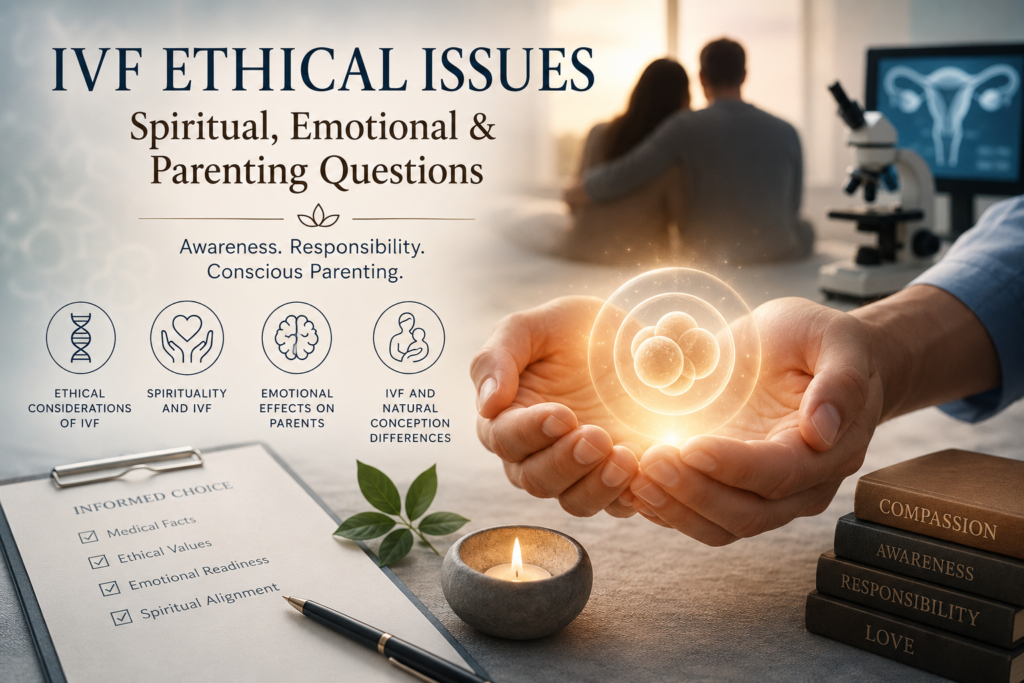
IVF ethical issues are the moral, emotional, medical, social, and spiritual questions that arise when conception happens with the help of assisted reproductive technology. IVF, or in vitro fertilization, involves combining an egg and sperm outside the body in a laboratory and later transferring an embryo into the uterus.
This makes IVF different from natural conception because the process may involve medical decisions about egg retrieval, sperm use, embryo creation, embryo storage, genetic testing, embryo transfer, and sometimes donor involvement.
Medical sources describe IVF as a complex fertility treatment used to help pregnancy happen when conception is difficult or when genetic concerns need medical attention.
The ethical questions begin because IVF touches more than biology. It touches life, hope, grief, identity, family pressure, faith, money, and the emotional meaning of becoming a parent.
A couple may ask whether creating multiple embryos is morally acceptable, what should happen to unused embryos, whether embryo selection is fair, whether genetic testing crosses a boundary, and how much medical control should enter the beginning of life.
These questions do not always have one simple answer, because every family carries different beliefs, medical realities, cultural expectations, and emotional pain.
Read Also : karma-and-conception-how-past-lives-influence-ivf
Why IVF Is More Than a Medical Procedure
IVF is a medical procedure, but for parents it rarely feels only medical. It often begins after months or years of trying, waiting, hoping, testing, and silently comparing life with others. By the time a person reaches IVF, the decision may already be carrying grief, exhaustion, urgency, and fear.
This is why IVF ethical issues cannot be understood only through laboratory steps. They must also be understood through the emotional life of the parents who are making these decisions under pressure.
A fertility clinic may explain the science clearly, but the heart still asks deeper questions.
- Am I forcing something?
- Am I doing the right thing?
- What will happen to the embryos?
- Will my child ever feel different?
- Is this aligned with my values?
- These questions are not signs of weakness.
They are signs that the parent understands the weight of the decision.
- A conscious parent does not need fear-based judgment.
- A conscious parent needs medical clarity, ethical awareness, emotional support, and space to reflect honestly.
Common Ethical Considerations of IVF
The ethical considerations of IVF usually include embryo creation, embryo selection, unused embryos, informed consent, donor sperm or donor eggs, genetic testing, access to treatment, cost, religious beliefs, and emotional wellbeing.
Embryo ethics is one of the biggest topics because IVF may create more embryos than are transferred. Parents may then face decisions about freezing, future use, donation, or disposal.
These decisions can feel deeply personal, especially for people who hold spiritual or religious beliefs about when life begins.
Another major area is informed consent. Parents should understand what procedures are being done, what risks exist, what choices may come later, and what legal or clinic policies apply.
- Access is also an ethical issue because IVF can be expensive, which means fertility treatment may be easier for some families and harder for others.
- Genetic testing can also raise ethical concerns, especially when embryo selection moves beyond serious medical conditions and enters questions about preferred traits.
- Bioethics discussions commonly include embryo status, consent, fairness, access, and reproductive responsibility as central IVF concerns.
The Core Ethical Question
The core question is not simply, “Is IVF right or wrong?”
A better question is: Can medical technology help create life while still protecting dignity, consent, fairness, emotional wellbeing, and spiritual responsibility?
This question gives parents a calmer way to think. It does not shame IVF, and it does not blindly ignore its serious choices. It invites awareness.
Why Parents Search for IVF Ethical Issues Before or During Treatment
Many parents search for IVF ethical issues because they are not only looking for information; they are looking for reassurance, language, and inner permission to think clearly.
- Some are already in treatment and suddenly feel overwhelmed by embryo decisions.
- Some are considering IVF but feel religious, cultural, or family conflict.
- Some feel guilty because they want a child so deeply that they fear their desire may be stronger than their clarity.
- Others simply want to understand whether IVF can fit with their values.
This search often happens privately. A parent may not want to tell family members, friends, or even their partner how many questions they are carrying.
They may fear being judged by religious people, dismissed by medical people, or misunderstood by relatives who say, “Just relax” or “Why are you thinking so much?” But IVF is not a small emotional event.
It is a life decision involving the body, future child, money, marriage, family identity, and sometimes spiritual belief. That is why this discussion must be serious, compassionate, and practical.
The Emotional Pressure Behind Fertility Decisions
The emotional pressure behind fertility decisions can be intense. IVF may come after repeated disappointment, miscarriages, infertility diagnosis, social comparison, age pressure, medical advice, or family expectations. When time feels limited, parents may feel pushed to make choices quickly.
They may sign forms, attend appointments, take injections, manage costs, and carry hope while also fearing failure. This pressure can make ethical thinking harder because the nervous system is not calm; it is often in survival mode.
Research on IVF and emotional health shows that infertility and IVF treatment can be connected with anxiety, stress, distress, and emotional difficulty, especially during waiting periods or after failed treatment cycles.
One review noted emotional adjustment across IVF phases, including anxiety, depression, and general distress, while another study discussed how depression and anxiety may increase after IVF treatment failure.
This matters because ethical decisions are best made when parents are supported, not emotionally cornered.
A parent who is exhausted may still make a good decision, but they deserve more care, more explanation, and more time to ask questions.
Read Also: natural-ways-to-get-pregnant-and-mental-health-connection
Why Judgment Does Not Help IVF Parents
Judgment does not help IVF parents because shame closes the mind, tightens the body, and makes honest reflection harder. If a parent is told they are selfish, unnatural, unspiritual, or morally wrong, they may stop asking important questions.
They may become defensive, secretive, or emotionally isolated. That does not create better ethical decisions. It creates fear. A shame-free approach is not the same as saying every choice is automatically right. It means serious choices should be explored without attacking the person making them.
This is where BBH’s conscious parenting lens becomes important. A parent can ask hard questions with dignity. They can discuss embryos, donor options, medical limits, and spiritual concerns without turning the process into self-hatred.
Ethical clarity should make a person more responsible, not more broken. Spiritual reflection should increase compassion, not fear.
“A parent does not need more fear while making a sacred decision; they need clarity, support, and a calmer nervous system.”
This is why inner steadiness matters. A calmer nervous system can help parents listen better, ask clearer questions, and separate love from panic.
For deeper emotional support, readers can explore nervous system regulation and spiritual psychology as part of their decision-making journey.
IVF Ethical Issues and the Question of Embryos
The question of embryos is one of the most sensitive IVF ethical issues because embryos carry medical, emotional, moral, and spiritual meaning. In IVF, eggs and sperm are combined outside the body, and embryos may be created in a laboratory before one or more are transferred into the uterus.
This medical process helps many people build families, but it can also create decisions that natural conception usually does not place in front of parents so directly. Parents may have to decide how many embryos to create, whether to freeze embryos, what to do with unused embryos, and whether genetic testing should be used.
For some parents, an embryo is understood mainly through medical development. For others, an embryo carries spiritual significance from the beginning.
Some may hold religious beliefs that make embryo storage or disposal emotionally difficult. Others may not have a fixed belief but still feel the weight of choosing.
This is why embryo ethics should be handled gently. Parents need accurate medical explanation, legal clarity from the clinic, and space to reflect on their values before decisions become urgent.
Embryo Creation, Selection, and Storage
Embryo creation, selection, and storage raise ethical questions because they involve choices about possible life. Clinics may create several embryos to increase the chance of pregnancy, but not every embryo may be transferred.
Some embryos may be frozen for future use, some may not develop further, and some may become part of difficult decisions later. This can create emotional conflict for parents who did not realize IVF would involve these choices before treatment began.
Embryo selection can also raise questions about fairness and limits. Genetic testing may help identify serious inherited conditions in some cases, but selection for non-medical traits creates deeper ethical debate.
Recent public discussions around embryo screening for predicted traits such as IQ or height show why many experts worry about inequality, social pressure, and the idea of “better” or “worse” embryos.
A responsible approach does not require panic. It requires informed consent, clear clinic communication, and values-based decision-making. Parents should ask what testing is for, what it can and cannot predict, what choices may follow, and whether the decision protects dignity.
How to Think About Embryo Ethics Without Fear
Parents can think about embryo ethics without fear by slowing the decision down and separating three layers: medical facts, legal options, and personal values.
- Medical facts explain what is possible.
- Legal and clinic policies explain what is allowed.
- Personal values explain what the parent can live with peacefully.
- When these layers are mixed together, confusion grows.
- When they are separated, the decision becomes more honest and less emotionally chaotic.
A parent can ask the fertility specialist:
- How many embryos may be created?
- What happens to unused embryos?
- What are the storage rules?
- What decisions will we need to make later?
- What does genetic testing actually tell us?
- What are the limits of the test?
- What support is available if we feel emotionally overwhelmed?
These questions are not negative. They are responsible.
From a BBH perspective, embryo ethics should not become a punishment field. It should become a clarity field. The goal is not to scare parents away from IVF or push them toward IVF.
The goal is to help them act with awareness, compassion, and responsibility. Conscious parenting begins before birth when parents learn to make difficult choices without denying their emotions or abandoning their values.
Spirituality and IVF: Can Science and Sacred Intention Work Together?
Spirituality and IVF are often discussed as if they are opposite paths, but many parents experience both at the same time.
One part of them trusts medical science, fertility specialists, injections, scans, embryo transfer, and clinical timing.
Another part quietly asks deeper questions about destiny, prayer, divine timing, emotional readiness, and the soul of the child they hope to welcome.
This inner conflict is not strange. It is human. IVF brings the body into a medical process, but the heart still searches for meaning, safety, and inner permission.
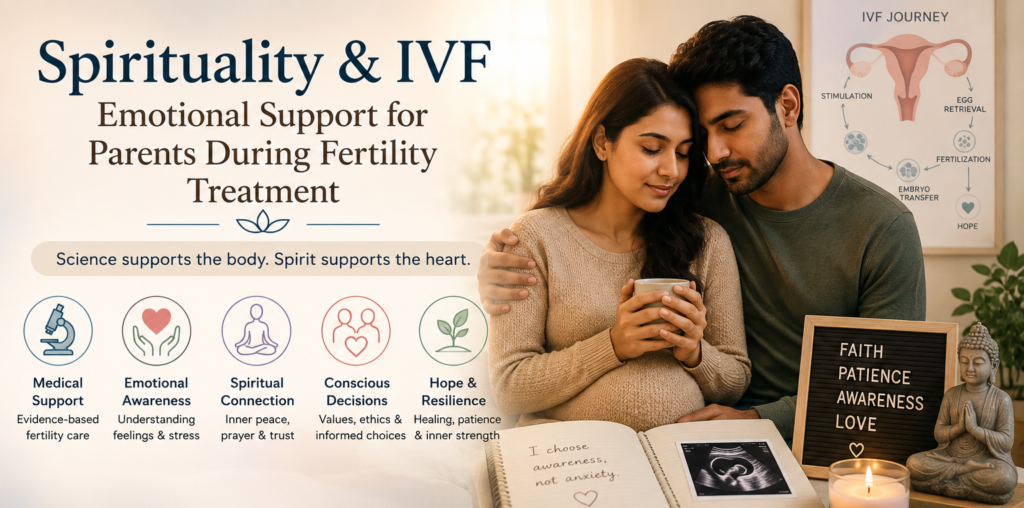
A balanced view does not need to reject science or blindly spiritualize everything. Medical care can support the body, while spiritual awareness can support the mind, emotions, and values of the parents.
This is where Spiritual Psychology can help readers understand that spirituality is not about fear or judgment; it is about awareness, meaning, responsibility, and inner honesty.
The real question is not whether IVF is spiritual or unspiritual. The better question is whether parents can move through IVF with responsibility, consent, emotional honesty, and love. When spirituality becomes grounding instead of fear, it can help parents feel less alone during one of the most vulnerable decisions of their life.
IVF Does Not Have to Be Spiritually Cold
For many parents, IVF can feel emotionally cold because the process is scheduled, monitored, and medically controlled. There are appointments, reports, hormone levels, injections, scans, lab updates, embryo grading, and waiting periods.
In natural conception, many of these steps remain unseen.
In IVF, every stage can become visible, measured, and emotionally charged.
This visibility can help medically, but it can also make parents feel as if the sacredness of conception has been replaced by numbers, procedures, and clinical language.
This is where spiritual parenting can restore inner connection. A parent may choose to pray before appointments, sit quietly before embryo transfer, speak gently to the hoped-for child, journal emotions, or create a peaceful home environment during treatment.
These practices do not replace medical care. They help the parent stay emotionally present inside the medical process. IVF does not have to feel like only science. It can also become a path of humility, surrender, patience, and conscious love when parents bring awareness into each step.
For readers who want to understand this inner way of living, What Is Conscious Living? Meaning Explained can support the deeper meaning of conscious decision-making.
Spiritual Preparation Without Rejecting Medical Science
Spiritual preparation during IVF should never become pressure, superstition, or self-blame. A failed IVF cycle does not mean the parent lacked faith.
A successful cycle does not mean one person was more spiritually worthy than another. This distinction is very important because fertility already carries enough pain. Spirituality should not become another place where parents judge themselves. It should become a place where they feel held, steadied, and reminded of their dignity.
A healthier spiritual approach is simple: prepare the mind, calm the body, clarify values, and stay connected to love while following qualified medical guidance.
Parents can ask themselves:
- Are we making this decision from love or panic?
- Have we understood the ethical considerations of IVF?
- Have we discussed embryo-related choices honestly?
- Are we emotionally supported?
- Are we listening to both medical advice and inner wisdom?
These questions create maturity. They help parents avoid blind urgency while still respecting the real medical and emotional reasons that may lead them toward IVF.
This is also where Detachment & Awareness becomes useful, because detachment does not mean not caring; it means caring without losing inner clarity.
A Better Spiritual Question
Instead of asking, “Is IVF spiritual or unspiritual?” parents can ask, “Can we approach this process with responsibility, humility, love, and awareness?”
This question opens a better path. It does not shame medical help. It does not ignore ethical responsibility. It invites parents to bring consciousness into a difficult decision.
Emotional Effects of IVF on Parents
The emotional effects of IVF on parents can be deep because IVF is not only a treatment plan; it is a repeated emotional cycle of hope, waiting, fear, and possible disappointment.
- Every appointment can carry expectation.
- Every report can affect mood.
- Every delay can create anxiety.
- Every embryo update can feel personal.
Parents may try to stay strong on the outside while privately carrying grief, jealousy, guilt, or fear that their dream of having a child may not happen.
This emotional pressure becomes heavier when people around them do not understand the process.
- Friends may announce pregnancies easily.
- Family members may ask uncomfortable questions.
- Society may treat parenthood as natural and simple, while IVF parents know how complex the journey can become.
This difference can create loneliness. Some parents may also feel guilt for needing medical help, even though infertility is not a personal failure. A compassionate article must say this clearly: needing IVF does not make a parent less loving, less natural, or less worthy.
For readers who are stuck in repeated fear loops, the Anxiety & Overthinking section can give broader support for emotional regulation and anxious thinking.
Hope, Anxiety, Guilt, and Waiting
The IVF journey often moves between hope and anxiety. At one moment, parents may feel excited because treatment has begun. At another moment, they may feel afraid because the outcome is uncertain.
The waiting period after embryo transfer can be especially difficult because the parent may feel emotionally attached to a possibility that has not yet become confirmed.
This is where the mind can become restless, scanning every body sensation and trying to predict the result.
- Guilt can also appear in unexpected ways.
- Some parents feel guilty about money spent on treatment.
- Some feel guilty about embryos that may not be used.
- Some feel guilty for feeling jealous of others who conceive naturally.
- Some feel guilty for being emotionally tired when they believe they should be grateful.
These emotions are not signs of a bad parent. They are signs of a nervous system carrying too much uncertainty. IVF ethical issues must therefore include emotional wellbeing, because decisions made during emotional exhaustion need extra care, support, and compassion.
Readers who need a deeper healing path can continue through the Emotional Healing section.
How IVF Can Affect the Nervous System
From a BBH perspective, IVF can strongly affect the nervous system because the process keeps parents in a state of uncertainty. The body may remain alert before scans, lab reports, embryo updates, transfer dates, pregnancy tests, and doctor conversations.
When the nervous system stays in this alert state for too long, parents may feel tired, reactive, emotionally sensitive, or unable to rest fully. They may overthink every result, search online repeatedly, or feel panic after small changes.
This does not mean the parent is weak. It means the body is trying to protect them from possible disappointment. The nervous system is designed to scan for threat when something deeply important feels uncertain. During IVF, the “threat” may not be physical danger; it may be emotional loss, failed treatment, social judgment, financial strain, or fear of time running out.
This is why Nervous System Regulation matters during fertility treatment. A calmer body cannot guarantee pregnancy, but it can help parents make clearer decisions, communicate better, and suffer less while moving through the process.
A Gentle Regulation Practice During IVF
Before an appointment, test result, or embryo update, place one hand on the chest and one hand on the lower belly. Take three slow breaths.
Let the exhale become slightly longer than the inhale.
Then say quietly: “I can care deeply without forcing certainty.”
This sentence helps the body remember that love and control are not the same. You can be devoted without living in panic.
IVF and Natural Conception Differences
IVF and natural conception differences should be explained with sensitivity because parents do not need comparison that creates shame. IVF and natural conception are different in process, but difference does not mean one child is more loved, more sacred, or more meaningful than another.
Natural conception usually happens inside the body without visible medical steps. IVF involves medical support outside the body, including egg retrieval, sperm preparation, fertilization in a lab, embryo development, and embryo transfer.
The emotional experience can also be different. In natural conception, many parents may not see each biological stage. In IVF, parents may receive updates about eggs, embryos, timing, quality, and transfer decisions. This visibility can create both hope and pressure.
Some parents feel comforted by medical guidance. Others feel overwhelmed because every step becomes something to monitor.
The ethical considerations of IVF often come from this visibility. Because decisions are brought into awareness, parents may have to think about questions that natural conception usually does not ask directly.
Medical Timing vs Natural Timing
One major difference between IVF and natural conception is timing. Natural conception often happens through intimacy and biological timing that may not be consciously tracked in detail. IVF, however, follows a clinical timeline.
There may be hormone stimulation, egg retrieval, fertilization, embryo monitoring, freezing, transfer scheduling, and pregnancy testing.
This medical timing can be helpful because it gives doctors a structured way to support conception, but it can also make parents feel that life has become too controlled.
Spiritually, this can create inner discomfort for some people. They may wonder whether medical timing interferes with divine timing or natural flow.
- A balanced answer is that medical timing and spiritual surrender do not have to be enemies.
- A person can use medical support while still respecting life as sacred. The issue is not only timing.
- The deeper issue is whether decisions are made with awareness, informed consent, and emotional readiness.
For readers who struggle with control, timing, and surrender, How to Practice Detachment in Daily Life can support a calmer way to act without becoming emotionally consumed by the outcome.
Why Difference Does Not Mean Less Love
The most important message for IVF parents is this: difference does not mean less love. A child conceived through IVF is not less natural in emotional value, less worthy of dignity, or less connected to their parents.
The path of conception may be different, but love is built through care, protection, emotional safety, truth, and presence. Parenting is not proven only by how conception happened. Parenting is proven by how the child is received, raised, listened to, and emotionally held.
This is also important for parents who worry about future conversations with their child. The goal should not be secrecy rooted in shame. The goal should be age-appropriate honesty rooted in love.
An IVF child does not need to carry the emotional burden of the process. They need to feel wanted, safe, and respected. Conscious parenting means parents process their own fear first so they do not pass confusion, guilt, or secrecy into the child’s identity.
This connects naturally with Child Emotional Development, because a child’s emotional safety is shaped by honesty, warmth, and secure connection.
Conscious Parenting Begins After the Decision
Conscious parenting begins when parents stop asking only,
“How did this child come?” and begin asking, “How will this child feel with us?”
IVF ethical issues matter, but the child’s emotional world matters too. A parent’s presence, honesty, nervous system steadiness, and love shape the future more than the method of conception alone.
This is where Conscious & Gentle Parenting can support parents after IVF, helping them move from fear and secrecy toward emotional safety, truth, and connection.
How Conscious Parenting Can Support IVF Families
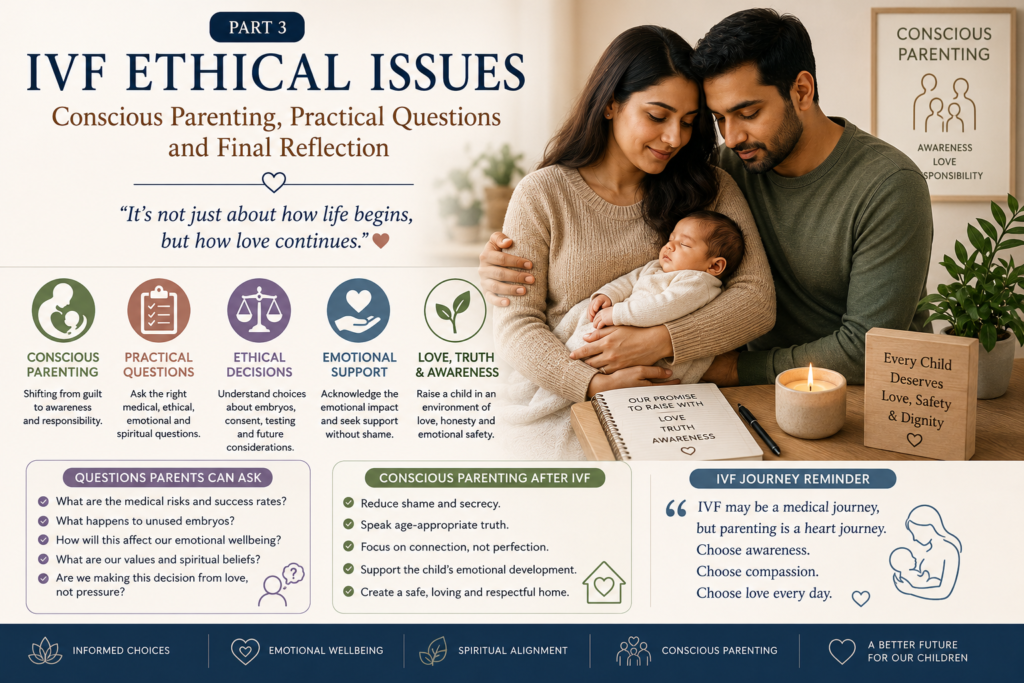
After parents understand IVF ethical issues, the next step is not to live inside guilt, fear, or endless moral confusion. The deeper step is to ask: “How can we become more conscious, emotionally steady, and responsible parents from this point forward?”
IVF may raise difficult ethical questions, but those questions should lead parents toward awareness, not self-attack.
- A child does not need parents who are perfect.
- A child needs parents who are emotionally available, honest, protective, and willing to keep growing.
Conscious parenting can help IVF families because it moves the focus from only “how the child was conceived” to “how the child will be loved, guided, and emotionally held.”
This shift matters deeply. The beginning of life may involve science, medical timing, embryo decisions, and treatment stress, but parenting itself is built through daily presence.
The most important question becomes whether the child will grow in an environment of safety, dignity, truth, and unconditional acceptance.
For parents who want to understand this path more deeply, Conscious & Gentle Parenting can support the movement from fear-based parenting toward emotional awareness and connection.
From “Was This Right?” to “How Can I Parent With Awareness?”
Many IVF parents quietly ask, “Was this right?” This question can come from religious belief, family pressure, embryo decisions, failed cycles, or the feeling that conception became too medical.
The question deserves respect, but if it remains unanswered for too long, it can become a loop of guilt. At some point, the parent also needs a new question: “How can I parent with awareness now?” That question is more healing because it moves the mind from past fear into present responsibility.
Parenting with awareness means the parent does not deny the IVF journey, but they also do not make the child carry the emotional weight of it.
- The child should never feel like a project, a medical success story, or proof that the parents finally won.
- The child is a person with their own emotional world.
- Conscious parenting means the parent receives the child with humility, not ownership.
It means the parent works through their own pain so the child does not become responsible for healing it.
Raising an IVF Child Without Shame or Secrecy
One of the most important parts of conscious parenting after IVF is reducing shame and secrecy. Some parents may feel tempted to hide the IVF journey because they fear judgment from relatives, community, religion, or the child in the future.
But secrecy can sometimes create more tension than truth. This does not mean parents must tell everyone everything. It means the child’s story should not be treated as something dirty, embarrassing, or unnatural.
Age-appropriate truth is often healthier than fear-based silence. When a child is young, the language can be simple: “We wanted you very much, and doctors helped us.”
As the child grows, parents can add more detail with love and calmness. The tone matters more than the technical explanation.
- If parents speak with shame, the child may absorb shame.
- If parents speak with warmth and dignity, the child can understand their story without feeling less valued.
This connects strongly with Child Emotional Development, because children build identity not only from facts, but from the emotional tone around those facts.
What Every IVF Child Deserves
Every IVF child deserves love without burden, truth without shame, and emotional safety without secrecy.
The child deserves to know that their life is not reduced to a procedure, an embryo report, or a difficult fertility journey.
They are not a medical outcome. They are a human being who deserves dignity, tenderness, and secure connection.
Questions Parents Can Ask Before IVF Decisions
Before beginning or continuing IVF, parents can reduce confusion by asking clear questions. These questions are not meant to create fear. They are meant to create responsible awareness.
Many ethical considerations of IVF become easier to handle when parents do not wait until the last moment to understand them.
IVF can involve complex choices about embryos, consent, genetic testing, storage, donor involvement, cost, medical risk, and emotional readiness. Asking questions early can help parents feel less trapped later.
This is also where partners should communicate honestly.
- One person may feel ready while the other feels unsure.
- One may focus on medical success while the other carries spiritual discomfort.
- One may want to move quickly while the other needs time.
- These differences do not mean the couple is weak.
They mean the decision is serious. Calm discussion, doctor guidance, and emotional support can protect the relationship while treatment decisions are being made.
Medical and Ethical Questions
Parents can ask their fertility specialist:
- How many embryos may be created?
- What happens to unused embryos?
- What are the clinic’s rules for freezing and storage?
- What are the legal requirements?
- What does genetic testing check, and what are its limits?
- What are the success rates for our specific situation?
- What are the physical risks?
- What happens if treatment fails?
- What decisions might we need to make later that we may not be thinking about today?
These questions are practical, but they are also ethical. Informed consent means more than signing forms. It means parents understand the meaning of the choices placed before them. IVF ethical issues become less overwhelming when medical facts are explained clearly and parents are not rushed emotionally.
Emotional and Spiritual Questions
Parents can also ask themselves:
- Are we choosing IVF from love, panic, pressure, or fear of time?
- Have we spoken honestly about embryos, cost, expectations, and emotional limits?
- Do we have support if the cycle fails?
- Are we prepared for the waiting period?
- Are we using spirituality as comfort, or are we using it to judge ourselves?
- Can we respect medical guidance while staying connected to our values?
These questions help parents stay human inside the process. Spirituality and IVF should not become a battlefield. It should become a place for emotional grounding, prayer if meaningful, reflection, humility, and compassion.
For deeper support, readers can visit Start Here – Your Journey to Mental Clarity & Emotional Healing and the Emotional Healing Roadmap to continue building steadiness beyond this article.
Final Reflection: IVF, Ethics, Love, and Responsibility
IVF ethical issues should not be answered with shame. They should be approached with medical clarity, ethical responsibility, emotional support, and spiritual humility. Parents who choose IVF are often not choosing convenience.
Many are choosing a difficult path after grief, waiting, uncertainty, and deep longing. They deserve information, but they also deserve compassion.
At the same time, compassion does not mean ignoring hard questions. Embryo decisions, consent, genetic testing, cost, access, and emotional pressure all matter. A conscious parent can honor these questions without turning them into self-punishment. This is the deeper BBH view: awareness should make us more responsible, not more afraid.
IVF and natural conception may follow different paths, but the child’s emotional future depends on love, safety, honesty, and presence.
If parents can combine medical guidance with emotional regulation, spiritual reflection, and conscious parenting, IVF does not have to become only a clinical journey. It can become a path of responsibility, tenderness, and deeper human awareness.
For continued inner work, readers can explore Detachment & Conscious Living to understand how to care deeply without becoming consumed by fear, outcome, or control.