IVF vs Natural Conception: Differences, Baby Health & Emotions
IVF Pregnancy vs Natural Pregnancy: Key Differences Explained

When people search IVF vs natural conception, they are not only looking for medical facts. They are often carrying fear, hope, confusion, guilt, and many silent questions about the future.
Thank you for reading this post, don't forget to subscribe!This blog explains the difference between IVF and natural conception in a simple way, but it also goes deeper than most medical articles.
You will understand IVF pregnancy vs natural pregnancy, the truth behind IVF babies vs naturally conceived babies, and the real emotional impact of IVF on the mind, body, relationship, and nervous system.
The uniqueness of this blog is that it does not treat conception only as biology or only as spirituality. It brings medical clarity, emotional awareness, nervous system understanding, and a compassionate spiritual view together.
If you are comparing both paths, this article will help you feel less judged, less confused, and more grounded in your decision.
What Is the Difference Between IVF and Natural Conception?
Many couples search for IVF vs natural conception because they are standing between hope and uncertainty.
- Some are trying to understand the medical difference.
- Some are worried whether IVF changes pregnancy.
- Some quietly fear that a child conceived through IVF may be “different” from a child conceived naturally.
- Others carry emotional questions that they may not feel safe sharing with family, friends, or even doctors.
This comparison matters because conception is not only a biological event. It also affects the heart, the nervous system, the relationship between partners, and the way parents emotionally prepare for a child.
A helpful article should not shame IVF, glorify natural conception, or create fear. It should bring clarity, compassion, and balanced understanding.
From a BBH perspective, the real question is not, “Which path is superior?”
The better question is, “How can parents move through any conception journey with awareness, emotional safety, love, and responsibility?”
This is where medical clarity and conscious living meet.
Read Also: How Detachment Reduces Anxiety and Stress.
What Is the Difference Between IVF and Natural Conception?
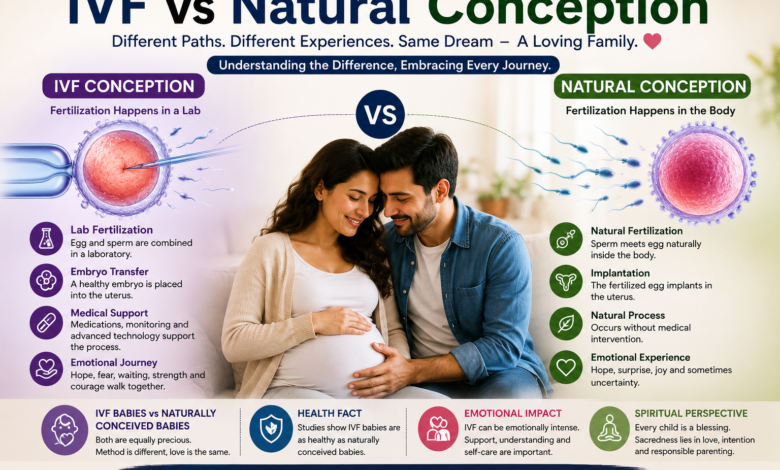
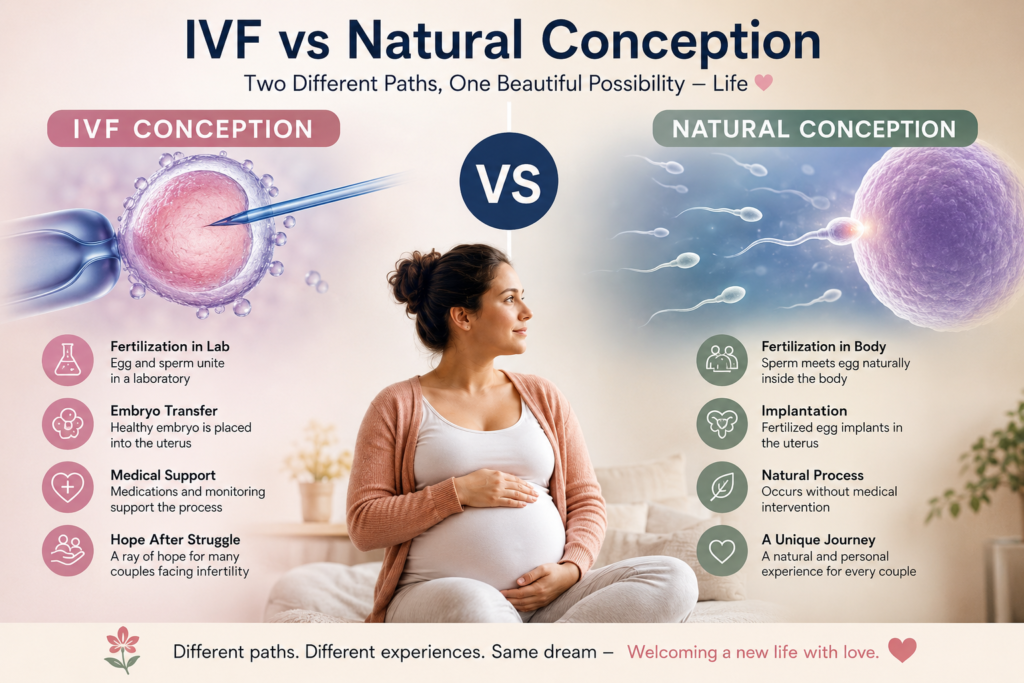
The main difference between IVF and natural conception is where fertilization happens. In natural conception, fertilization usually happens inside the body when sperm meets the egg in the fallopian tube. If the fertilized egg successfully travels and implants in the uterus, pregnancy begins naturally.
In IVF, or in vitro fertilization, eggs are collected from the ovaries and fertilized with sperm outside the body in a laboratory setting. After fertilization, one or more embryos may be transferred into the uterus. If the embryo implants successfully, pregnancy begins.
So the difference is not that one child is more “real” than another. The difference is mainly the method through which conception happens. Natural conception happens inside the body without laboratory fertilization. IVF involves medical assistance, fertility treatment, embryo development outside the body, and embryo transfer.
This is why the phrase IVF vs natural conception should be understood carefully. It does not mean “natural child vs artificial child.” It means two different paths through which pregnancy may begin.
How Natural Conception Happens
Natural conception usually begins when ovulation releases an egg from the ovary. During intercourse, sperm travels through the reproductive tract and may meet the egg. If fertilization happens, the fertilized egg moves toward the uterus and may implant in the uterine lining.
This process may look simple from the outside, but many things must align: ovulation timing, sperm health, fallopian tube function, hormone balance, uterine lining, and implantation.
Even natural conception involves many delicate biological steps. That is why couples should not blame themselves if pregnancy does not happen quickly.
How IVF Happens
IVF is a medically assisted process used when natural conception is difficult or unlikely. It may involve ovarian stimulation, egg retrieval, sperm collection, fertilization in a lab, embryo monitoring, and embryo transfer.
After transfer, doctors usually monitor hormone levels and early pregnancy signs more closely.
For many couples, IVF is not an “easy shortcut.” It can involve injections, appointments, waiting periods, financial pressure, emotional stress, and repeated hope.
That is why the emotional impact of IVF is important to understand, not only the medical process.
The Core Difference in One Simple Line
Natural conception happens inside the body, while IVF helps fertilization happen outside the body before the embryo is transferred into the uterus. Both paths can lead to pregnancy. Both paths can involve love, fear, hope, and responsibility.
IVF Pregnancy vs Natural Pregnancy: What Changes?
A common question is whether IVF pregnancy vs natural pregnancy feels different after pregnancy begins. Biologically, once implantation is successful and pregnancy continues, many pregnancy stages are similar. The baby grows in the uterus, the mother’s body changes, and regular pregnancy care becomes important.
The difference is often stronger in the early journey. IVF pregnancies may involve more monitoring, early blood tests, scans, medication support, and emotional waiting. Parents may feel more aware of every symptom because they already know the exact timeline of embryo transfer and expected testing dates.
In natural conception, many women may not know the exact moment of fertilization. Pregnancy may be discovered after a missed period or home test. In IVF, the process is more medically tracked, which can give clarity but also increase anxiety. Every report, number, scan, and waiting period can feel emotionally heavy.
This is why IVF pregnancy is not always harder physically, but it may feel heavier emotionally. The body may be pregnant, but the nervous system may still be in a state of alertness because the journey has already involved uncertainty, effort, and fear.
Read Also: How Detachment Helps Control Emotions.
Early Pregnancy Monitoring and Medical Support
In IVF pregnancy, doctors may monitor early pregnancy more closely. This can include blood tests, hormone checks, ultrasound timing, and sometimes medication support.
For some parents, this brings comfort because they feel guided. For others, it creates pressure because every medical update feels like a judgment on the future.
Natural pregnancy may have less intense early tracking unless there is a medical reason. This does not make one path better than the other. It simply means the emotional experience can differ. IVF often gives more information earlier, but more information can also create more worry.
Waiting, Uncertainty, and Emotional Pressure
The waiting period after embryo transfer can be one of the most emotionally intense parts of IVF. The mind may keep checking symptoms, searching for signs, comparing stories, and fearing disappointment. This can create a cycle of hope and anxiety.
Natural conception can also bring waiting and uncertainty, especially when a couple has been trying for a long time. But IVF often adds structured medical timelines, financial investment, and visible procedures, which can make the emotional pressure feel stronger.
What Usually Feels Different for Parents
What feels different is often not only pregnancy itself, but the emotional path before pregnancy begins.
IVF parents may carry more medical memories, appointment stress, fear of failure, and cautious hope.
Natural conception may feel less medically intense, but it can still carry fear, especially after loss, infertility, or health concerns.
Are IVF Babies Different From Naturally Conceived Babies?
One of the most sensitive questions is about IVF babies vs naturally conceived babies. Many parents worry whether IVF babies are weaker, emotionally different, spiritually different, or less connected to the mother. This fear should be handled with compassion, not judgment.
A child’s value is not decided by the method of conception. IVF babies are not “less natural” as human beings. They grow, bond, learn, feel, and need love like any other child. The medical process may be different, but the child’s dignity is not reduced.
Parents should also avoid comparing children through fear-based language. Every child has a unique body, temperament, nervous system, emotional environment, and family story.
Some naturally conceived children face health issues, and many IVF children grow well. The method of conception is only one part of a much larger human story.
Read Also: Why Attachment Causes Emotional Suffering.
Common Myths and Fears
Common fears include:
- “Will my IVF baby be different?”
- “Will bonding be weaker?”
- “Is IVF less sacred?”
- “Did we interfere with nature?”
These questions often come from fear, cultural pressure, spiritual confusion, or lack of emotional support.
Instead of judging these fears, we should understand them. Infertility and IVF can make parents feel vulnerable. When people are emotionally vulnerable, the mind searches for certainty. Myths become powerful when the heart is already afraid.
A Balanced, Reassuring Perspective
A balanced view is simple: IVF changes the method of conception, not the worth of the child. Parents may need extra emotional support because the journey can be stressful, but that does not mean love is weaker.
Bonding grows through presence, touch, care, emotional availability, safety, and repeated connection. Whether pregnancy begins naturally or through IVF, conscious parenting matters deeply.
Difference Between IVF and Natural Conception Beyond the Medical Process
The difference between IVF and natural conception is medical at the beginning, but emotional and spiritual questions may appear later. Natural conception may feel private and spontaneous for some couples. IVF may feel planned, medical, expensive, and emotionally exposed. This can affect how parents experience hope, fear, identity, and faith.
But this is where conscious understanding becomes important. IVF is not a failure of the body. It is one possible medical path when conception needs support.
Natural conception is not automatically emotionally peaceful. Both paths can carry love. Both paths can carry fear. Both paths can become sacred when parents meet the journey with responsibility and awareness.
Emotional Impact, Nervous System Stress, and Spiritual Questions Around IVF
The emotional impact of IVF is often deeper than people can see from outside. To others, IVF may look like a medical process: appointments, injections, scans, reports, egg retrieval, embryo transfer, and waiting.
But for the person living through it, IVF can become an emotional journey filled with hope, fear, pressure, grief, guilt, and silent comparison.
Many couples do not enter IVF casually. They usually arrive there after months or years of trying, disappointment, medical tests, family questions, and private pain.
That is why IVF is not only about fertility treatment. It is also about identity, body trust, relationship strength, and the emotional meaning of becoming a parent.
In a simple medical comparison, IVF vs natural conception explains where fertilization happens. But emotionally, the comparison is much deeper.
Natural conception may feel private and spontaneous for some couples, while IVF may feel planned, monitored, and exposed. This does not make IVF less sacred. It simply means the journey often asks for more emotional support.
Fear, Hope, and the Weight of Uncertainty
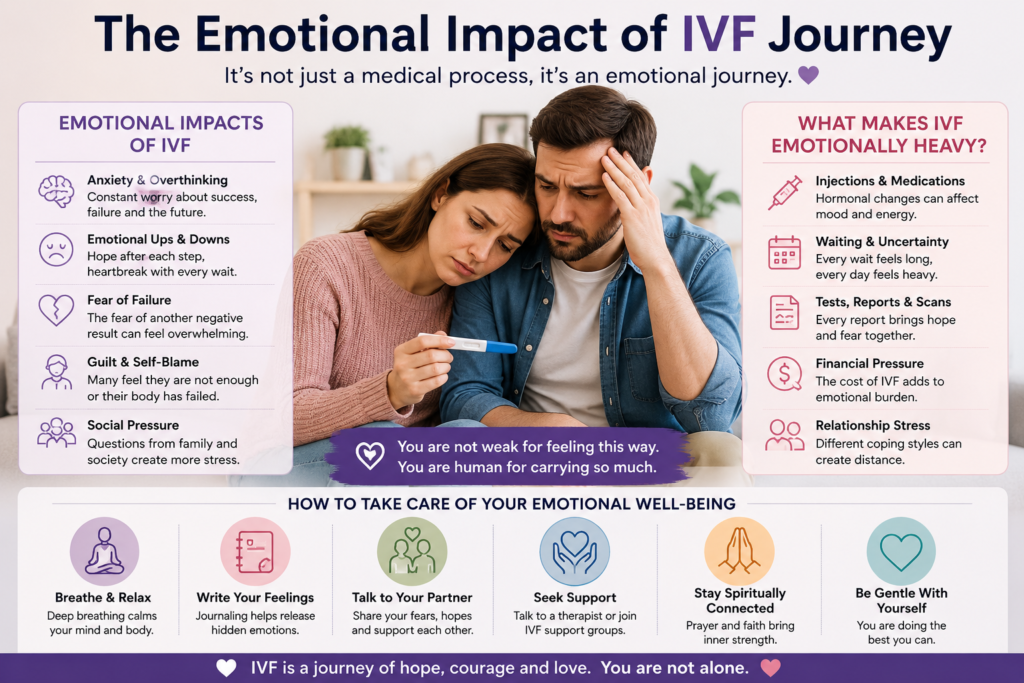
IVF creates a unique emotional rhythm: hope rises, fear follows, and uncertainty sits between both. After every injection, scan, embryo update, or transfer, the mind may ask, “Will this work?” “What if it fails?” “Can I handle another disappointment?” This constant emotional waiting can become exhausting.
The hardest part is that the person may look normal from outside while feeling emotionally overloaded inside. They may continue work, speak normally, and smile in front of others, but their nervous system may remain alert. Every small symptom can feel like a sign. Every report can feel like a verdict.
This is why the emotional impact of IVF should never be minimized. The medical process may be structured, but the emotional experience is deeply personal.
Guilt, Shame, and Feeling “Why Is This Happening to Me?”
One of the most painful parts of IVF is silent guilt. Some people feel guilty because they need medical help to conceive.
- Some feel shame because society still attaches unnecessary judgment to infertility.
- Some women may feel that their body has failed them, even when infertility is never a moral failure.
This is where the article must be very clear: needing IVF does not make someone weak, incomplete, or less natural as a parent. Fertility struggles are medical, biological, emotional, and sometimes unexplained. They are not a measure of worth.
When people compare IVF pregnancy vs natural pregnancy, they often focus on medical differences. But emotionally, the comparison should include compassion.
A person going through IVF may need more reassurance because the journey may already have touched deep wounds of identity, body confidence, and self-worth.
Why the IVF Journey Can Feel Heavier Than It Looks
IVF can feel heavy because it combines medical uncertainty, emotional investment, money pressure, family expectations, body changes, and fear of failure.
- It is not just one event.
- It is a series of emotional peaks and crashes.
Without support, this journey can make even strong people feel fragile.
How the IVF Journey Affects the Nervous System
The IVF journey can keep the nervous system in a state of survival mode. When the body and mind repeatedly face uncertainty, waiting, medical procedures, and emotional risk, the nervous system may start behaving as if danger is always near. This does not mean the person is overreacting. It means the body is trying to protect them from possible pain.
This is one of the most important BBH angles in this blog. Most articles explain the difference between IVF and natural conception only through biology.
But BBH must also explain what happens inside the emotional body. IVF can affect sleep, appetite, mood, patience, energy, concentration, and relationship communication.
A person may become more sensitive, irritable, withdrawn, or tearful. They may feel hopeful one day and defeated the next. This emotional change is not weakness. It is a nervous system response to prolonged uncertainty.
For deeper emotional regulation support, readers can continue with Emotional Detachment vs Emotional Suppression, because IVF requires calm emotional space without forcing people to suppress pain.
Injections, Reports, Waiting, and Survival Mode
Injections, blood reports, ultrasound updates, embryo grading, transfer dates, pregnancy tests, and doctor visits can create a cycle of nervous-system activation. The body may stay tense because it is waiting for the next result. Even when the person tries to stay positive, the nervous system may still feel unsafe.
The waiting period after embryo transfer is especially intense.
The mind may scan the body constantly:
- “Is this symptom good?”
- “Is this cramp normal?”
- “Should I feel something?”
- “What if I feel nothing?”
- This mental checking can turn the body into a place of worry instead of safety.
This is why IVF support should include more than medical instructions. It should include breathing, rest, emotional expression, partner support, and mental grounding.
Why the Body Holds More Stress Than People Realize
The body remembers repeated emotional pressure. If someone has already faced failed cycles, miscarriages, infertility diagnosis, or family judgment, IVF may activate old fear. Even a routine scan may feel emotionally intense because the body remembers previous disappointment.
This is also why some people feel disconnected from their body during IVF. The body may start feeling like a project, a test, or a medical case.
When this happens, gentle reconnection becomes important.
The person needs to remember: “My body is not my enemy. My body is going through something difficult and deserves care.”
Signs of Emotional Overload
Signs of overload may include constant checking, sleep disturbance, irritability, sudden crying, emotional numbness, fear of hope, avoiding people, relationship tension, or feeling detached from the body. These signs are not proof of failure. They are signals that the person needs more support and emotional safety.
Relationship Stress, Family Pressure, and Emotional Exhaustion
IVF can place pressure on relationships because both partners may process stress differently.
- One may want to talk, while the other becomes silent.
- One may feel hopeful, while the other is afraid to hope.
- One may focus on medical facts, while the other carries emotional grief.
These differences can create distance if couples do not communicate with care.
Family pressure can make this harder. Questions like “When will you have a baby?” or “Why don’t you try this?” may feel harmless to others, but deeply painful for couples. Social comparison also adds weight. Seeing pregnancy announcements, family celebrations, or casual advice can reopen emotional pain.
This is why IVF needs relational protection. Couples must remember that they are not enemies on opposite sides of the problem. They are two people trying to walk through uncertainty together.
For readers facing emotional pressure in close relationships, Read Also: How to Practice Detachment in Relationships.
Partner Tension and Silent Grief
Silent grief is common during fertility challenges.
One partner may grieve privately because they do not want to increase the other’s pain. But silence can slowly become distance.
Couples need safe moments where they can say, “I am scared,” “I feel tired,” or “I need comfort today,” without blame.
Social Comparison and Outside Pressure
Outside pressure can make IVF feel like a public test of personal worth. But conception is not a competition.
- Someone else’s pregnancy does not reduce your value.
- Someone else’s natural conception does not make your IVF journey inferior.
Emotional boundaries are necessary during this time.
Emotional and Spiritual Questions Around IVF
Many people carry emotional and spiritual questions around IVF but feel afraid to ask them.
They may wonder, “Is IVF spiritually wrong?” “Is this interfering with nature?” “Will my child feel less connected to me?” “Is natural conception more sacred?”
These questions should not be mocked. They should be answered with compassion.
A spiritual view should never be used to shame parents who are already suffering. If spirituality increases guilt, fear, or self-attack, it has lost its healing purpose.
- A wiser spiritual view asks: Is there love?
- Is there responsibility?
- Is there conscious care?
- Is the child being welcomed with dignity?
This is where IVF babies vs naturally conceived babies must be discussed with emotional maturity. A child’s soul, dignity, and human worth are not reduced because conception involved medical assistance. IVF may change the process, but it does not make love artificial.
Read Also: Parenting and Conscious & Gentle Parenting
Is IVF Less Sacred?
No, IVF is not less sacred simply because science is involved.
Many sacred things in human life are supported by medicine: healing, childbirth, surgery, recovery, and survival. Medical help does not automatically remove spiritual meaning.
The sacredness of conception does not depend only on whether it happened naturally or medically. It also depends on love, intention, emotional safety, responsibility, and how consciously the child is welcomed.
Sacredness Comes From Love, Intention, and Care
A child conceived through IVF can be deeply wanted, prayed for, waited for, protected, and loved. That love carries meaning. The long waiting, the painful hope, the emotional courage, and the careful preparation can also become part of the child’s sacred story.
Natural conception can also be sacred, but it is not automatically more conscious. IVF can be sacred, but it also needs emotional support.
- The real measure is not the method.
- The real measure is the awareness, care, and love surrounding the child.
A Compassionate Spiritual View
A compassionate spiritual view says this: do not turn fertility struggles into shame.
- Do not turn medical support into moral judgment.
- Do not turn natural conception into superiority.
- Every child deserves dignity.
- Every parent deserves support.
- Every journey deserves honest reflection without fear.
“I do not believe a child becomes less sacred because the journey was medically assisted. Sometimes the deepest love is revealed in the path people never wanted, but still walked with courage, care, and hope.”
Part 2 ends with this truth: IVF may be medically assisted, but the emotional and spiritual journey is still deeply human. In Part 3, the focus will shift toward grounding practices, relationship protection, professional support, and how parents can move forward with more peace.
How to Stay Emotionally Grounded and Make Peace With the Journey
The journey of IVF vs natural conception is not only about how pregnancy begins. It is also about how parents protect their emotional world while moving through uncertainty. Whether conception happens naturally or through IVF, the heart needs steadiness, the body needs safety, and the mind needs support.
For many people, IVF brings a different kind of emotional pressure. The dates are known. The reports are watched. The body is monitored. The hope becomes structured around injections, scans, embryo updates, transfer day, and pregnancy tests. This can make the mind feel as if it must stay alert all the time.
Natural conception can also carry pressure, especially after long-term trying, pregnancy loss, medical worry, or family expectations. So the goal is not to say one path is emotionally easy and the other is difficult. The goal is to help parents understand that every conception journey needs emotional care.
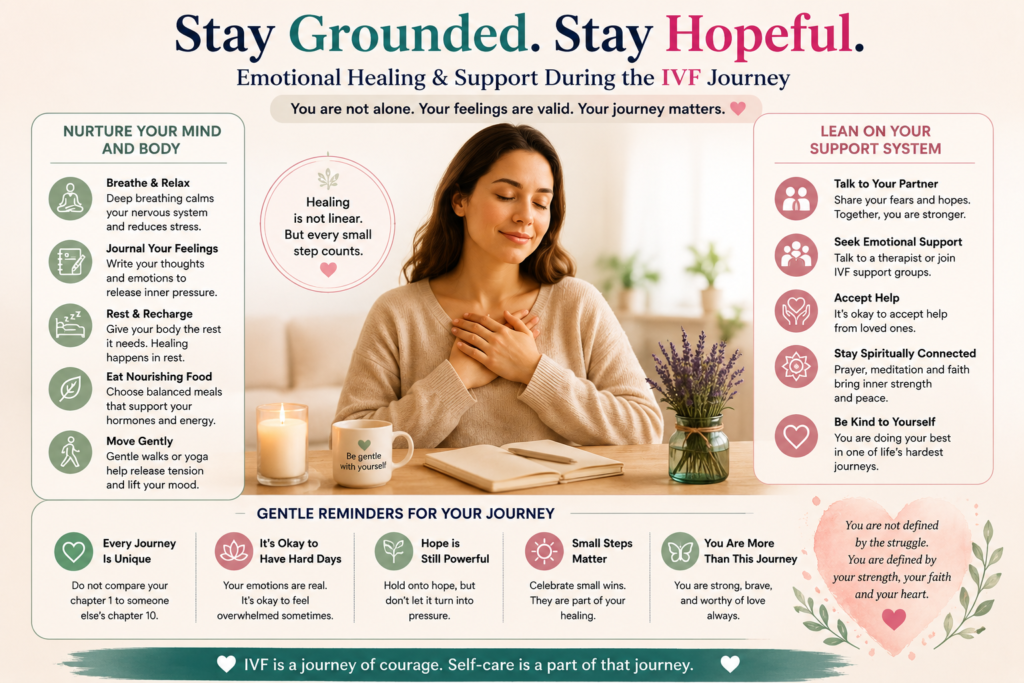
Grounding does not mean pretending everything is fine. It means creating small moments where the nervous system can feel: “I am safe enough for this moment.” That one shift can reduce emotional overload.
Breathing, Journaling, and Nervous System Regulation
During IVF or conception challenges, simple daily practices can help the nervous system return from survival mode. Slow breathing, gentle walks, prayerful silence, journaling, and body relaxation can create emotional space. These practices do not guarantee pregnancy, and they should not be treated like magical solutions. Their purpose is to help the person feel less trapped inside fear.
A helpful journaling question is: “What am I feeling today, and what support do I need without judging myself?” This question helps the mind move from self-blame to self-awareness.
Breathing can also be simple. A person can inhale slowly, exhale longer, and place one hand on the heart or stomach.
The message is not, “I must control the outcome.” The message is, “I can support myself while the outcome is still unknown.”
For deeper emotional support, explore Start Here – Your Journey to Mental Clarity & Emotional Healing.
Prayer, Meaning, and Emotional Anchoring
Prayer, meditation, and spiritual reflection can help many parents feel held during the uncertainty of IVF. But these practices should never become another form of pressure.
- A person should not feel that if they are anxious, they are spiritually weak.
- Anxiety during IVF is understandable because the journey touches hope, identity, body trust, money, family, and future dreams.
A balanced spiritual practice may sound like this: “
- May I stay grounded.
- May I act with love.
- May I accept support.
- May I not turn this journey into shame.”
This kind of prayer softens the heart without forcing certainty.
Spirituality becomes healing when it brings compassion. It becomes harmful when it creates guilt. That difference matters deeply in a topic like IVF pregnancy vs natural pregnancy, where many readers are already emotionally sensitive.
Small Daily Practices That Create Stability
Small practices can include limiting excessive online searching, choosing one trusted medical source, speaking honestly with a partner, taking rest after appointments, reducing comparison, and avoiding conversations that create shame. Stability grows through repetition, not perfection.
How Couples Can Protect Their Relationship During the IVF Journey
IVF can test a relationship because both partners may carry stress differently.
- One partner may become more emotional. The other may become practical.
- One may want to discuss every report. The other may avoid talking because they fear saying the wrong thing.
- These differences can create misunderstanding if the couple does not protect the relationship consciously.
The relationship should not become another battlefield. During fertility challenges, both partners need to remember that they are on the same side.
- The problem is not “you versus me.”
- The problem is the stress, uncertainty, and pain surrounding the journey.
A couple may benefit from creating small check-in moments. Instead of only discussing reports and appointments, they can ask:
- “How are you emotionally today?”
- “What felt heavy this week?”
- “What kind of support do you need from me?”
These questions may look simple, but they protect emotional closeness.
Honest Communication and Shared Grief
Shared grief is important because fertility struggles can create invisible sadness. A failed cycle, a negative test, or a delayed result can feel like a private loss. If both partners stay silent, pain can turn into distance.
Honest communication does not mean talking all the time. It means making space for truth without blame.
A partner may say, “I am scared,” “I feel tired,” “I do not know how to stay hopeful,” or “I need comfort, not advice.” These statements help the relationship stay human.
Avoiding Blame and Silent Withdrawal
Blame can damage emotional safety.
- No partner should be made to feel like their body is the enemy.
- No one should carry the full emotional burden alone.
- Fertility challenges already create enough pressure; the relationship should become a place of support, not judgment.
Silent withdrawal can also hurt. Sometimes people withdraw because they do not want to create more stress, but the other partner may experience that silence as emotional abandonment. Gentle communication is better than perfect communication.
Is IVF Better Than Natural Conception? Or Is That the Wrong Question?
Many readers ask whether IVF is better than natural conception, or whether natural conception is better than IVF. But this may be the wrong question.
The better question is: Which path is medically appropriate, emotionally sustainable, and aligned with the couple’s health, values, and support system?
The difference between IVF and natural conception is real. IVF involves medical assistance, laboratory fertilization, embryo transfer, and closer monitoring. Natural conception usually happens inside the body without assisted fertilization. But this difference should not become a moral ranking.
Natural conception is not automatically superior. IVF is not automatically inferior. Both paths can lead to love. Both paths can involve fear. Both paths can become part of a meaningful family story.
Medical Path vs Moral Judgment
IVF is a medical path, not a moral failure. Natural conception is a biological path, not a spiritual badge of superiority. When society turns conception into judgment, parents suffer unnecessarily.
- Some people conceive naturally but feel emotionally unprepared.
- Some people use IVF after years of longing and welcome the child with deep awareness.
- This is why the method alone cannot measure love, responsibility, or spiritual depth.
The question of IVF babies vs naturally conceived babies should also be handled with dignity. A child should never be reduced to the method of conception. The child is not a procedure. The child is a human being deserving safety, love, and respect.
The Better Question for Parents to Ask
Instead of asking, “Which path is better?” parents can ask:
“How can we move through this journey with medical clarity, emotional steadiness, spiritual compassion, and respect for the child’s dignity?”
That question is more healing. It removes shame and brings responsibility. It also helps parents focus on what they can actually influence: communication, emotional care, medical decisions, lifestyle support, stress reduction, and conscious preparation.
Read Also:How Detachment Reduces Anxiety and Stress.
When to Seek Support From Professionals
Because IVF is a medical topic, readers should always consult a qualified fertility doctor for personal diagnosis, treatment options, risks, success chances, and pregnancy care.
This blog is for education, emotional support, and spiritual reflection. It is not medical advice and should not replace professional fertility guidance.
Emotional support is also important.
- If IVF stress becomes overwhelming,
- if anxiety affects sleep,
- if depression symptoms appear,
- if relationship conflict increases, or
- if grief feels too heavy, speaking with a mental health professional can be helpful.
Support does not mean weakness. It means the person is taking the journey seriously. Fertility challenges affect the body, mind, relationship, and identity. A strong support system can make the process less isolating.
Also explore Healing Resources Hub for broader emotional healing support.
Fertility Doctor, Mental Health Support, and Emotional Guidance
- A fertility doctor can guide the medical path.
- A therapist or counselor can help process fear, grief, shame, and uncertainty.
- A supportive partner, trusted friend, or spiritual mentor can help the person feel less alone.
The strongest journey is not walked in isolation. It is walked with informed care.
Final Thoughts: Every Birth Deserves Dignity
The comparison of IVF vs natural conception should never become a comparison of human worth. IVF may change how conception begins, but it does not reduce the dignity of the child.
Natural conception may happen without medical assistance, but it is not automatically more sacred or emotionally superior.
The deeper truth is this: every child deserves dignity, and every parent deserves compassion.
- Some families begin through natural conception.
- Some begin through IVF.
- Some carry long stories of waiting, grief, prayer, medical help, and hope.
- None of these stories should be treated with shame.
The sacredness of birth is not only in the method. It is in the love, responsibility, emotional safety, and conscious care surrounding the child.
A child’s dignity is not decided by the method of conception. The deeper question is whether the child is welcomed with love, emotional safety, responsibility, and conscious care.
People Also Ask —
1. What is the main difference between IVF and natural conception?
The main difference is where fertilization happens. In natural conception, fertilization happens inside the body; in IVF, eggs and sperm are joined outside the body before embryo transfer.
2. Is IVF pregnancy different from natural pregnancy?
After successful implantation, many pregnancy stages are similar. IVF pregnancies may involve closer early monitoring, hormone support, and more emotional waiting because the process is medically tracked.
3. Are IVF babies different from naturally conceived babies?
IVF changes the method of conception, not the child’s human worth. Baby health depends on many factors, including parental health, pregnancy type, medical history, and whether it is a singleton or multiple pregnancy.
4. Is IVF emotionally stressful?
Yes, IVF can create emotional stress because of injections, reports, waiting periods, financial pressure, and fear of failure. Emotional support, partner communication, and medical guidance are important during the journey.
5. Is IVF spiritually wrong or less sacred?
IVF should not be treated as less sacred only because medical help is involved. A compassionate spiritual view focuses on love, responsibility, emotional safety, and how consciously the child is welcomed.
FAQ —
1. What is IVF?
IVF, or in vitro fertilization, is a fertility treatment where eggs are fertilized with sperm outside the body in a laboratory, then an embryo may be transferred into the uterus.
2. What is natural conception?
Natural conception usually happens when sperm meets an egg inside the body, and the fertilized egg implants in the uterus. It depends on ovulation, sperm health, fallopian tube function, and implantation.
3. Can IVF babies be healthy?
Yes, many IVF babies are healthy. Like all pregnancies, outcomes depend on medical, genetic, maternal, pregnancy, and birth-related factors, so doctor guidance is important.
4. Why does IVF feel emotionally heavy?
IVF can feel heavy because the journey is monitored, expensive, uncertain, and emotionally invested. The waiting period can keep the nervous system in fear, hope, and constant checking.
5. Should I choose IVF or natural conception?
This decision should be made with a qualified fertility doctor based on age, fertility diagnosis, health history, emotional readiness, and personal values. This blog is educational, not medical advice.
External References
- Mayo Clinic — In Vitro Fertilization (IVF)
Website: Mayo Clinic
URL: https://www.mayoclinic.org/tests-procedures/in-vitro-fertilization/about/pac-20384716 - MedlinePlus — In Vitro Fertilization (IVF)
Website: MedlinePlus
URL: https://medlineplus.gov/ency/article/007279.htm - MedlinePlus — Assisted Reproductive Technology
Website: MedlinePlus
URL: https://medlineplus.gov/assistedreproductivetechnology.html