Attachment and Suffering: 10 Reasons Your Mind Can’t Let Go
10 Reasons Thoughts Repeat Due to Attachment

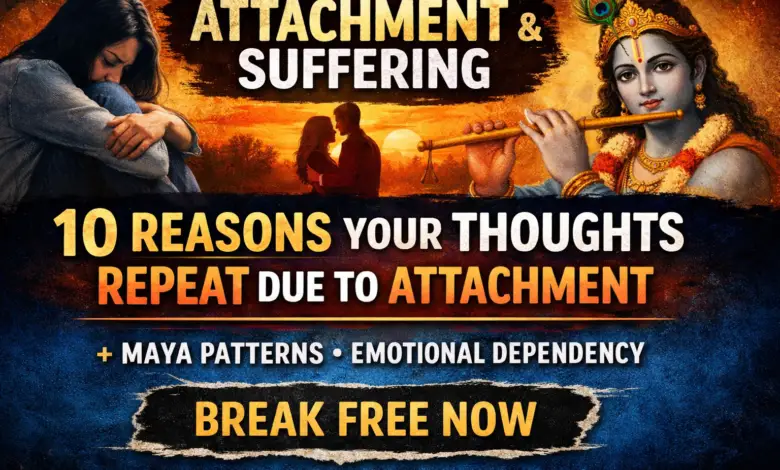
Why Attachment Feels Like Love but Becomes Suffering (Attachment and Suffering Explained)
Thank you for reading this post, don't forget to subscribe!It starts as comfort.
As belonging.
As a quiet feeling that “this matters to me.”
And that is why most people never question it.
You don’t see attachment and suffering in the beginning.
You only see connection.
But slowly… something begins to change.
Your mood starts depending on someone else’s behavior.
Your thoughts begin repeating the same emotional patterns.
Your reactions become stronger than the situation itself.
And without realizing it, what once felt like love starts turning into attachment pain.
This is where the shift happens.
Not outside.
Inside.
My Story of Emotional Dependency and Attachment Pain
For me, attachment was not just connection.
It became my emotional center.
Especially with my parents.
They were not just family.
They became the place where my expectations, reactions, and emotional stability were tied together.
And I didn’t see it at that time.
I thought it was normal.
I thought it was care.
But slowly, I started noticing something uncomfortable:
- My anger was stronger than the situation
- My reactions were not always intentional
- I felt disturbed even when nothing serious had happened
This is where I began to see emotional dependency.
Not as a concept.
But as a pattern.
I was not just responding to situations…
I was reacting from attachment.
The Attachment and Suffering Loop I Could Not Understand
There was a cycle I kept repeating:
- Expectation
- Emotional reaction
- Regret
- Silence
- Restart
Again… and again.
Even when I didn’t want to react, something inside pushed me.
And after that reaction, there was always a feeling:
“Why did I do that?”
That confusion is important.
Because it shows something deeper is happening.
This is not just behavior.
This is attachment and suffering working together.
Why Emotional Dependency Feels Like Love but Creates Suffering
One of the biggest misunderstandings is this:
👉 Emotional dependency feels like love.
Because:
- You think about that person constantly
- Their behavior affects your mood
- You feel connected, involved, invested
But look deeper.
If your peace is dependent…
If your stability is affected…
If your emotions are controlled by someone else…
Then it is not just love.
It is emotional dependency.
And this is where attachment pain begins.
The Hidden Fear Behind Attachment and Emotional Dependency
Every attachment carries something hidden.
Fear.
Not always visible.
But always present.
- Fear of losing
- Fear of not being understood
- Fear of not being valued
- Fear of emotional distance
This fear silently drives behavior.
And when that fear is triggered…
Reaction happens.
Not because the situation is big…
But because the attachment is deep.
This is why small situations can create big emotional reactions.
Because the reaction is not about the present moment.
It is about attachment and suffering combined with fear.
Read Also : When Love Becomes Emotional Drain: Relationship Psychology
Why the Mind Repeats Attachment and Suffering Patterns
At one point, I realized something important.
Even when nothing was happening…
My mind was still going back to the same thoughts.
Same people.
Same situations.
Same emotional triggers.
Why?
Because attachment is not just emotional.
It is also mental conditioning.
The mind gets used to:
- Thinking about the same person
- Replaying the same situations
- Trying to control or fix outcomes
This creates a loop.
And that loop becomes attachment pain.
Not because something is happening…
But because the mind does not know how to let go.
Attachment Is Not the Problem — Unawareness Creates Suffering
Let’s be clear.
Attachment itself is not wrong.
Connection is natural.
Care is human.
But unconscious attachment becomes suffering.
When you don’t see:
- Why you are reacting
- What you are expecting
- Where your emotional dependency is coming from
…then attachment starts controlling you.
This is the real problem.
Not attachment.
But unawareness of attachment and suffering.
Where Maya and Attachment Begin in Real Life
Most people think Maya means illusion.
But in real life, Maya is more practical than that.
Maya is when:
👉 You don’t see the pattern behind your thoughts and emotions
For me, Maya was not outside.
It was inside my reactions.
- Why am I reacting like this?
- Why is this affecting me so much?
- Why do I repeat the same emotional cycle?
These questions opened something deeper.
I started seeing:
This is not just emotion.
This is maya and attachment working together.
Not illusion…
But misunderstood reality.
Read Also : Attachment vs Love: Why You Seek It from the Wrong People
From Reaction to Awareness — Breaking Attachment Pain Patterns
The biggest shift did not come from control.
It came from awareness.
Instead of asking:
👉 “Why is this happening to me?”
I started asking:
👉 “What inside me is reacting?”
That small shift changed everything.
Because now I was not just inside the emotion.
I was observing it.
And this is where attachment and suffering slowly started becoming visible.
Not as pain.
But as a pattern.
Before We Go Deeper…
Before we understand the deeper layers of why attachment causes suffering, one thing must be clear:
👉 You are not weak because you feel attachment
👉 You are not wrong because you feel emotional dependency
You are simply:
- Unaware of the pattern
- Conditioned by emotional experience
- Trying to find stability in the wrong place
And that can be understood.
Read Also: What Is Detachment Meaning? The Truth Most People Get Wrong
The Psychology Behind Attachment and Suffering (Emotional Dependency Explained)
In Part 1, we saw how attachment and suffering are not separate experiences—they are deeply connected through patterns of emotional dependency.
Now we go deeper.
Because until you understand why this happens…
You will keep trying to control something that is actually automatic.
Attachment is not just emotional.
It is:
- Psychological
- Neurological
- Behavioral
And that is why attachment pain feels so powerful.
1. Emotional Dependency as a Survival Pattern (Why Attachment Feels Necessary)
Let’s correct one misunderstanding first.
👉 Emotional dependency is not weakness
It is a learned survival mechanism
Your mind learns:
- “This person gives me stability”
- “This connection makes me feel safe”
- “Without this, I feel unstable”
So naturally…
You start depending on it.
This is how emotional dependency forms.
Not by choice.
But by repeated emotional experience.
And once this dependency is formed…
Losing control over it creates attachment pain.
2. Dopamine and Attachment Pain — Why Emotional Dependency Feels Addictive
Now we go one layer deeper.
Why does attachment feel so strong?
Because of dopamine.
Every time:
- You get attention
- You feel understood
- You receive validation
Your brain releases dopamine.
And dopamine teaches one thing:
👉 “Repeat this experience”
So your mind starts doing this:
- Thinking about the person
- Replaying conversations
- Imagining future interactions
This is not just emotion.
This is a reward loop.
And this loop strengthens attachment and suffering together.
Because:
👉 When the reward is missing → pain begins
That pain is attachment pain.
3. Fear of Loss and Attachment Pain in Emotional Dependency
Attachment is not just about pleasure.
It is also about fear.
Your brain constantly scans:
- “What if I lose this?”
- “What if things change?”
- “What if I am not valued?”
This activates your threat system.
And when that happens:
- Small situations feel big
- Delays feel like rejection
- Silence feels like distance
This is why emotional reactions become intense.
Because your system is not reacting to reality.
It is reacting to fear linked with emotional dependency.
4. The Attachment and Suffering Loop Explained Psychologically
Now combine everything:
- Dopamine (reward)
- Fear (threat)
- Emotional dependency
You get a loop:
- You feel connected → dopamine
- You expect consistency
- Something changes → fear triggers
- Emotional reaction
- Regret / confusion
- You seek connection again → dopamine
And the cycle continues.
This is the attachment loop.
And this loop is the core reason behind:
👉 why attachment causes suffering
Because the mind is trapped between:
- Wanting connection
- Fearing loss
5. Overthinking Caused by Emotional Dependency and Attachment Pain
One of the strongest symptoms of attachment is:
👉 Overthinking
But overthinking is not random.
It is the mind trying to:
- Predict outcomes
- Control uncertainty
- Avoid emotional pain
So it keeps asking:
- “Why did this happen?”
- “What did they mean?”
- “What if things go wrong?”
This creates mental exhaustion.
And this is where attachment and suffering become constant.
Not because something is happening…
But because your mind is constantly engaged.
6. Identity Attachment — When Emotional Dependency Defines You
This is one of the deepest layers.
Attachment becomes suffering when:
👉 Your identity starts depending on someone else
Examples:
- “I feel good only when they respond well”
- “My mood depends on them”
- “Their opinion defines my value”
At this point…
It is no longer connection.
It is identity-level emotional dependency.
And this is where attachment pain becomes intense.
Because now you are not just losing connection…
You feel like you are losing yourself.
7. Why Letting Go of Emotional Dependency Feels Impossible
Many people say:
👉 “Just detach”
👉 “Just let go”
But this advice does not work.
Because attachment is not logical.
It is:
- Conditioned in the brain
- Reinforced by emotions
- Strengthened by repetition
So when you try to let go…
Your system reacts with:
- Anxiety
- Restlessness
- Emotional discomfort
This is withdrawal.
Just like breaking any habit.
That is why attachment and suffering feel inseparable.
8. Attachment as a Habit Pattern — Why Attachment Causes Suffering Repeatedly
This is the most practical understanding:
👉 Attachment is a habit pattern
- Thinking habit
- Emotional habit
- Reaction habit
And habits don’t break by force.
They change by awareness + repetition.
Until then…
The same patterns continue.
And this is why:
👉 why attachment causes suffering is not just philosophical
👉 It is practical, measurable, repeatable
9. Nervous System Response in Attachment and Suffering (Freeze, Fight, Flight)
You mentioned something very important earlier:
👉 Feeling paralyzed during emotional overwhelm
This is not random.
Your nervous system has 3 main responses:
- Fight (anger)
- Flight (avoidance)
- Freeze (paralysis)
When attachment is triggered strongly…
And your system cannot handle it…
It goes into freeze mode.
That is why you feel:
- Stuck
- Numb
- Unable to act
This is also part of attachment and suffering.
10. You Are Not the Problem — Emotional Dependency Pattern Is
After understanding all this, one thing must be clear:
👉 You are not the problem
👉 Your pattern is the problem
Your system learned:
- To depend
- To react
- To repeat
And now it is simply following that pattern.
So instead of blaming yourself…
Start observing the pattern.
Because:
👉 Awareness breaks what force cannot
Read Also : Repeating Patterns Psychology: Why You Repeat the Same Emotional Patterns
10 Reasons Your Thoughts Keep Repeating Due to Attachment and Emotional Dependency
Before we go into the reasons, understand this clearly:
Your thoughts are not repeating because something is wrong with you.
They are repeating because your mind is trying to hold on to something it believes is important.
This is how attachment and suffering stay active.
When emotional dependency forms, the mind does not let go easily.
It keeps returning to the same person, the same situation, the same emotional loop.
These 10 reasons will help you see your own pattern clearly.
1. Emotional Dependency Keeps Your Mind Stuck in Attachment and Suffering
When your emotional stability depends on someone, your mind naturally keeps going back to them.
This is not random thinking.
This is emotional dependency in action.
Your mind is trying to reconnect with the source of emotional security, even when it creates attachment pain.
2. Dopamine Addiction Strengthens Attachment Pain and Thought Repetition
Every interaction, memory, or validation releases dopamine.
Your brain remembers this.
So it keeps replaying thoughts to recreate that feeling.
This is why attachment and suffering feel addictive—because your brain is trained to seek the same emotional reward again and again.
3. Fear of Loss Triggers Emotional Dependency and Attachment Pain
When you are attached, fear becomes silent but powerful.
Fear of losing that person or connection makes your mind hyperactive.
It keeps asking:
- “What if I lose this?”
- “What if things change?”
This fear strengthens attachment pain and keeps your thoughts repeating.
4. Need for Control Creates Attachment and Suffering Mental Loops
Attachment creates a hidden desire:
👉 To control outcomes, reactions, and situations
But when reality doesn’t match expectations, the mind keeps replaying scenarios to “fix” it.
This is where why attachment causes suffering becomes clear—because control is never fully possible.
5. Unresolved Emotions Keep Attachment Pain Active in the Mind
If something is left unsaid or unresolved, your mind keeps revisiting it.
It tries to:
- Find closure
- Create imaginary conversations
- Correct past reactions
This keeps the loop alive and deepens attachment and suffering.
6. Identity-Based Emotional Dependency Deepens Attachment and Suffering
At a deeper level, attachment becomes identity.
You start feeling:
- “This person defines my emotional state”
- “Without this, I feel incomplete”
Now your mind is not just thinking about them.
It is protecting your identity.
This is intense emotional dependency.
7. Habitual Thinking Reinforces Attachment Pain and Repetition
Your mind gets used to thinking about the same person or situation.
Over time, it becomes a habit.
Even without any trigger, thoughts return automatically.
This shows that attachment and suffering are not just emotional—they are habitual patterns.
8. Overthinking as a Response to Emotional Dependency and Uncertainty
The mind does not like uncertainty.
So it keeps thinking to create a sense of control.
- Analyzing
- Predicting
- Replaying
But instead of solving anything, it increases attachment pain and mental exhaustion.
9. Nervous System Activation Keeps Attachment and Suffering Alive
When attachment is triggered, your nervous system reacts:
- Anxiety
- Stress
- Emotional overwhelm
This keeps your system active and your mind alert.
That’s why thoughts don’t stop.
This is also part of why attachment causes suffering—because your body is involved, not just your mind.
10. Maya and Attachment — Unawareness of Your Own Pattern
The deepest reason is this:
👉 You are not aware of the pattern
You think:
- “This thought is important”
- “This feeling is truth”
But in reality, it is just a repeated pattern.
This is maya and attachment.
When you don’t see the pattern, you live inside it.
When you see it, the loop begins to weaken.
Closing Line for This Section
These 10 reasons are not separate.
They are connected layers of the same system.
And once you start recognizing them inside yourself…
You don’t need to force your mind to stop.
You start understanding why it is repeating.
And that understanding slowly breaks the cycle of attachment and suffering.
After seeing these patterns, one thing becomes clear:
👉 Your suffering is not just emotional or psychological.
👉 It is also rooted in how you perceive and identify with your experience.
This is where understanding maya and attachment becomes essential.
Because without seeing this deeper layer…
You may understand the pattern, but still remain inside it.
Maya and Attachment — Why Attachment and Suffering Continue (Gita Perspective)
Where we will understand:
- What Maya actually means in practical life
- How attachment creates illusion of control
- Why detachment is not disconnection
- How awareness frees you from attachment and suffering
When Psychology Is Not Enough…
By now, you understand the mechanism:
- Emotional dependency creates instability
- Dopamine and fear strengthen patterns
- The mind repeats attachment loops
- This is why attachment and suffering feel inseparable
But even after understanding this…
Something still remains.
Because knowledge explains the pattern…
But it does not fully dissolve it.
This is where the concept of maya and attachment becomes essential.
Read Also : Maya Meaning in Psychology: The Illusion of Perception
What Maya Really Means (Beyond Illusion)
Most people think Maya means illusion.
But in practical life, Maya is not just illusion.
👉 What Is Maya and Attachment in Practical Life (Beyond Illusion)
It is when:
- You believe your reaction is truth
- You believe your attachment is love
- You believe your dependency is necessary
Without questioning it.
This is the real meaning of maya and attachment.
Not something outside…
But something happening inside your perception.
How Maya Creates Emotional Dependency and Attachment Pain
Let’s break this simply.
Maya works in three steps:
- Identification
You start identifying with something:
- A person
- A role
- An expectation
Example:
👉 “They are important for my emotional stability”
- Dependency
That identification slowly becomes emotional dependency
- You expect consistency
- You expect understanding
- You expect emotional safety
Now your peace is no longer internal.
- Disturbance
When reality does not match expectation:
- Reaction happens
- Pain arises
- Confusion increases
This is where:
👉 attachment and suffering become visible
Why Attachment Feels Real but Still Causes Suffering
Here is something important:
👉 Attachment is real
👉 But your interpretation of it is distorted
You are not imagining the connection.
But you are misinterpreting:
- Its role
- Its importance
- Its control over you
This distortion is Maya.
That is why:
👉 why attachment causes suffering is not because attachment is wrong
👉 It is because perception is unclear
The Bhagavad Gita Insight on Attachment and Suffering
In the Bhagavad Gita, attachment is explained very clearly.
Not as something to remove…
But something to understand.
A core idea:
👉 When you attach your identity to outcomes or people…
You create suffering.
Because:
- Outcomes are not fully in your control
- People are not fully in your control
But your mind behaves as if they are.
This is Maya.
Detachment vs Emotional Dependency — The Real Meaning
One of the biggest misunderstandings:
👉 Detachment ≠ leaving people
👉 Detachment ≠ becoming emotionless
Real detachment means:
- You care… but you are not dependent
- You connect… but you are not controlled
- You love… but you are not attached to outcomes
This is the shift from:
👉 emotional dependency → conscious connection
And this shift reduces attachment pain.
Losing Yourself in Emotional Dependency and Maya
The deepest suffering happens when:
👉 You lose awareness of yourself inside attachment
Examples:
- Your mood depends on someone else
- Your thoughts revolve around one person
- Your identity gets linked to their behavior
At this point:
You are not just attached.
You are identified.
And identification is the strongest form of maya and attachment.
The Illusion of Control in Attachment and Suffering
One hidden layer of attachment is control.
You may not see it directly, but it exists:
- Trying to control outcomes
- Trying to control reactions
- Trying to control how others behave
But reality does not follow your internal expectations.
So what happens?
👉 Frustration
👉 Emotional reaction
👉 Attachment pain
This is why:
👉 why attachment causes suffering is deeply linked with control
Maya as Pattern Blindness in Emotional Dependency
You said something very powerful earlier:
“Maya is meaning behind patterns and thoughts”
This is correct.
Maya is not just illusion.
👉 It is the unconscious pattern running your reactions
- Why you react
- Why you repeat
- Why you attach
When you don’t see the pattern…
You live inside it.
When you see the pattern…
You start stepping out of it.
Awareness as the Exit From Attachment and Suffering
You cannot force detachment.
You cannot suppress emotion.
But you can observe.
And observation changes everything.
When you start noticing:
- “This is emotional dependency”
- “This is attachment pain”
- “This is my pattern repeating”
Then something shifts.
You are no longer fully inside the experience.
You are watching it.
And this is the beginning of freedom from:
👉 attachment and suffering
Read Also : Spiritual Psychology
How to Reduce Emotional Dependency and Break Attachment and Suffering Patterns
Pause Before Reaction — First Step to Break Attachment Pain
Earlier, your question was:
👉 “Why am I reacting like this?”
Now it becomes:
👉 “What pattern inside me is creating this reaction?”
This shift is powerful.
Because:
- Reaction keeps you inside Maya
- Awareness takes you outside it
And slowly…
Attachment starts losing its unconscious control.
Separate Identity From Emotional Dependency and Attachment
Let’s bring everything together.
👉 Attachment is not the problem
👉 Emotional dependency is not the enemy
The real issue is:
👉 Unconscious identification (Maya)
When you:
- Identify with thoughts
- Depend on emotions
- Expect control over others
Then suffering is natural.
But when you:
- Observe your pattern
- Separate identity from reaction
- Accept reality as it is
Then attachment transforms.
Healing System: How to Reduce Emotional Dependency and Break Attachment Patterns
When Understanding Is Not Enough… Action Begins
By now, you understand:
- Why attachment and suffering are connected
- How emotional dependency forms
- Why your mind repeats patterns
- How maya and attachment keep you identified
But clarity alone does not change your experience.
Because patterns are not broken by thinking.
They are changed by consistent awareness + small actions.
This is where healing begins.
Not by removing attachment…
But by transforming your relationship with it.
Step 1 — Awareness Before Reaction (Pause the Pattern)
The first shift is simple, but powerful:
👉 Pause before reacting
When you feel:
- Anger
- Urgency
- Emotional discomfort
Don’t act immediately.
Just notice:
- “This is emotional dependency”
- “This is attachment pain”
This small awareness creates distance.
And distance weakens the automatic loop of attachment and suffering.
Step 2 — Separate Emotion from Identity
One of the biggest mistakes is this:
👉 “I feel this, so this is me”
But that is not true.
Instead, practice:
👉 “This is an emotion I am experiencing, not who I am”
When you separate identity from emotion:
- Reaction reduces
- Clarity increases
- Dependency weakens
This directly reduces emotional dependency.
Step 3 — Stop Expectation-Based Thinking
Attachment becomes suffering when expectation becomes constant.
Notice your thoughts:
- “They should understand me”
- “This should not happen”
- “This must stay the same”
Now gently shift:
👉 Replace expectation with observation
- “This is what is happening”
- “I don’t control this fully”
This reduces frustration and attachment pain.
Step 4 — Break the Thought Loop (Interrupt Repetition)
When your mind repeats the same thoughts:
Don’t fight it.
Don’t follow it.
Instead:
👉 Change the direction of attention
- Move your body
- Shift your focus
- Engage in a simple task
This breaks the mental loop.
Because attachment and suffering stay active only when attention stays stuck.
Step 5 — Reduce Emotional Dependency Gradually
You don’t remove dependency in one day.
You reduce it slowly.
Start asking:
- “What else can give me stability?”
- “Can I sit with this feeling without reacting?”
Build small internal support:
- Silence
- Self-reflection
- Writing your thoughts
This creates internal stability and reduces emotional dependency.
Step 6 — Accept Discomfort Without Escaping
One of the reasons attachment continues is:
👉 You don’t want to feel discomfort
So you:
- Overthink
- React
- Seek reassurance
Instead, try this:
👉 Sit with the discomfort for a few minutes
Observe:
- Where you feel it in your body
- What thought is repeating
This builds emotional strength.
And reduces attachment pain over time.
Step 7 — Understand You Cannot Control Others
This is a turning point.
You cannot control:
- How someone behaves
- How someone responds
- How situations unfold
But attachment tries to control all of this.
That is why:
👉 why attachment causes suffering is deeply linked with control
When you accept:
👉 “I don’t control this”
You release a major part of suffering.
Step 8 — Create Inner Stability (Your Own Emotional Base)
Instead of depending on one person or situation…
Start building your own base.
Simple practices:
- Sitting quietly without distraction
- Writing your thoughts without judgment
- Doing small consistent work daily
These are not big actions.
But they slowly reduce attachment and suffering.
Because stability becomes internal.
Step 9 — Replace Reaction with Conscious Response
Earlier:
👉 Trigger → Reaction
Now:
👉 Trigger → Awareness → Response
Before responding, ask:
- “Is this necessary?”
- “Am I reacting or responding?”
This one question can change your pattern.
And reduce both emotional dependency and attachment pain.
Step 10 — Practice Detachment Without Disconnection
Detachment is not leaving people.
It is:
- Staying connected without dependency
- Caring without losing yourself
- Being present without expectation
You can still:
- Talk
- Care
- Stay involved
But without making them your emotional center.
This is true freedom from maya and attachment.
The Healing Direction — What Actually Changes
With these steps, something gradual happens:
- Your reactions become slower
- Your thoughts become clearer
- Your dependency becomes lighter
- Your awareness becomes stronger
You don’t suddenly stop feeling.
But you stop being controlled by those feelings.
And this is how:
👉 attachment and suffering begin to separate
Final Realization — You Are Not Meant to Be Controlled by Attachment
You are not meant to:
- Repeat the same emotional loops
- Feel unstable because of others
- Lose yourself inside attachment
You are meant to:
- Understand your pattern
- Build awareness
- Create inner stability
And from there…
Live with connection, but without dependency.
Personal Note
For a long time, I thought my reactions were the problem.
But slowly, I realized…
It was not the reaction.
It was the attachment behind it.
When I started seeing the pattern instead of fighting it…
Clarity came.
Not suddenly.
But steadily.
Closing Line
You don’t have to remove attachment to end suffering.
You only have to see it clearly.
Because the moment you truly understand your pattern…
👉 attachment loses control, and awareness takes its place
Read Also : Start Here – Your Journey to Mental Clarity & Emotional Healing
FAQs
Why does attachment cause suffering?
Attachment causes suffering because it creates emotional dependency and expectation. When reality does not match expectation, it leads to attachment pain and mental disturbance.
What is emotional dependency in simple terms?
Emotional dependency means your mood and stability depend on another person or situation instead of your internal state.
How is Maya related to attachment?
Maya is unconscious identification with thoughts and emotions. When you identify with attachment, it creates suffering because you stop observing your pattern.
Can attachment ever be healthy?
Yes, attachment can be healthy when it is not based on dependency or control. Conscious connection without expectation reduces suffering.
Why do I keep thinking about the same person?
This happens due to emotional dependency, dopamine reinforcement, and unresolved emotional patterns, which keep the mind repeating thoughts.
How can I reduce attachment pain?
You can reduce attachment pain by increasing awareness, reducing expectations, and building internal emotional stability.
Is detachment the same as ignoring people?
No, detachment means staying connected without emotional dependency. It is not about avoiding or ignoring others.
Why is it so hard to let go of attachment?
Attachment is deeply conditioned in the brain through emotional patterns and habits, which makes it difficult to break immediately.
What is the first step to breaking attachment patterns?
The first step is awareness—recognizing your emotional dependency and observing your reactions without acting immediately.
Can understanding attachment really reduce suffering?
Yes, understanding creates awareness, and awareness reduces unconscious reactions, which gradually reduces suffering.
🔍 People Also Ask
1. Why does attachment and suffering happen in emotional dependency?
Attachment and suffering happen when emotional dependency creates expectations and fear of loss. When those expectations are not met, it leads to attachment pain and repeated emotional reactions.
2. How does emotional dependency cause attachment pain and overthinking?
Emotional dependency causes attachment pain because your mind relies on someone for stability. This creates overthinking as the brain tries to control outcomes and avoid emotional discomfort.
3. What are the main reasons thoughts repeat due to attachment and suffering?
Thoughts repeat due to attachment and suffering because of emotional dependency, dopamine reinforcement, fear of loss, and unresolved emotional patterns that keep the mind engaged.
4. How is maya and attachment connected to emotional suffering?
Maya and attachment are connected because Maya represents unconscious identification with thoughts and emotions. This identification creates emotional dependency, leading to attachment pain and suffering.
5. Why is it so hard to break emotional dependency and attachment patterns?
Breaking emotional dependency is difficult because attachment patterns are reinforced by brain chemistry, habits, and emotional conditioning, making them feel necessary for stability.
6. Can attachment and suffering be reduced without losing emotional connection?
Yes, attachment and suffering can be reduced by practicing awareness and detachment. This allows you to stay connected without emotional dependency or loss of inner stability.
7. What is the difference between love and emotional dependency in attachment?
Love allows freedom and stability, while emotional dependency creates attachment pain and suffering by making your emotions dependent on another person’s behavior.
8. How can I stop overthinking caused by attachment and emotional dependency?
You can reduce overthinking by observing your thoughts, reducing expectations, and shifting focus away from repetitive patterns, which gradually weakens attachment and suffering.