AI Emotional Intelligence and Mental Health
Benefits, Risks, and Safe Use of Emotion AI


Most people searching for AI emotional intelligence mental health are not only curious about technology; they are looking for safer emotional clarity in a world where stress, loneliness, anxiety, and therapy access problems are increasing in the USA, UK, Canada, and Australia.
Thank you for reading this post, don't forget to subscribe!This blog is different because it does not blindly praise AI or reject it with fear. It explains how AI mental health support can help you notice emotional patterns, how emotion AI may read signals from words, mood, tone, or behavior, and where its limits become serious.
You will also understand when an AI therapy chatbot may support reflection, journaling, and emotional vocabulary, and when human care is still necessary.
The unique BBH angle is simple: AI emotional support should be a mirror, not a therapist. This guide helps you use AI for awareness, regulation, and safer next steps without losing human judgment.
What Is AI Emotional Intelligence in Mental Health?
AI emotional intelligence mental health is the use of artificial intelligence to recognize, organize, and respond to human emotional signals in a supportive way.
These signals may come from written words, voice tone, mood tracking, journaling patterns, facial expressions, or repeated behavior.
In simple terms, AI does not “feel” your emotions like a human being, but it can identify patterns in the way you describe your feelings.
This matters because many people in the USA, UK, Canada, and Australia are searching for faster emotional support. Therapy wait times, cost, loneliness, workplace pressure, relationship stress, and anxiety are real issues.
In that gap, AI mental health support is becoming a common first step for people who want to understand what they are feeling before they speak to another person.
How Emotion AI Reads Emotional Signals
Emotion AI works by studying emotional clues. For example, if someone repeatedly writes words like “tired,” “hopeless,” “overwhelmed,” or “stuck,” an AI tool may recognize signs of stress or emotional overload.
Some tools also use voice tone, typing patterns, facial expression analysis, or mood records to estimate emotional states.
But this point is very important: emotion AI is not the same as human empathy.
It can detect patterns, but it does not know the full story of your life, your body, your trauma, your relationships, your culture, or your spiritual pain.
It may help you notice an emotional pattern, but it should not become the final judge of your mental health.
That is why BBH sees AI as a reflection tool, not a replacement for human care.
Why This Topic Matters Now
People are not searching for AI emotional intelligence mental health only because AI is popular. Many people are searching because they feel emotionally overloaded and do not know where to begin.
- Someone may not be ready to call a therapist.
- Someone may feel ashamed to talk to family.
- Someone may want a private space to write, reflect, and understand what is happening inside.
This is where AI emotional support can feel useful. It may help a person name the emotion, separate facts from fear, organize thoughts, and prepare for a better conversation with a therapist, doctor, counselor, or trusted person.
For readers who want deeper help with emotional validation, you can also read this BBH guide on AI emotional validation and feeling understood.
It connects directly with this topic because many people first turn to AI because they want to feel heard without judgment.
Why People Are Searching for AI Mental Health Support
The real search intent behind AI mental health support is not only technology curiosity. People want immediate emotional clarity. They want to know why they are reacting strongly, why their mood keeps changing, why they feel disconnected, or why stress is becoming difficult to manage.
In the USA, UK, Canada, and Australia, many people use digital tools before they seek professional help. This does not always mean they want to avoid therapy. Sometimes it means they need a softer entry point. They want to understand their feelings first so they can speak more clearly later.
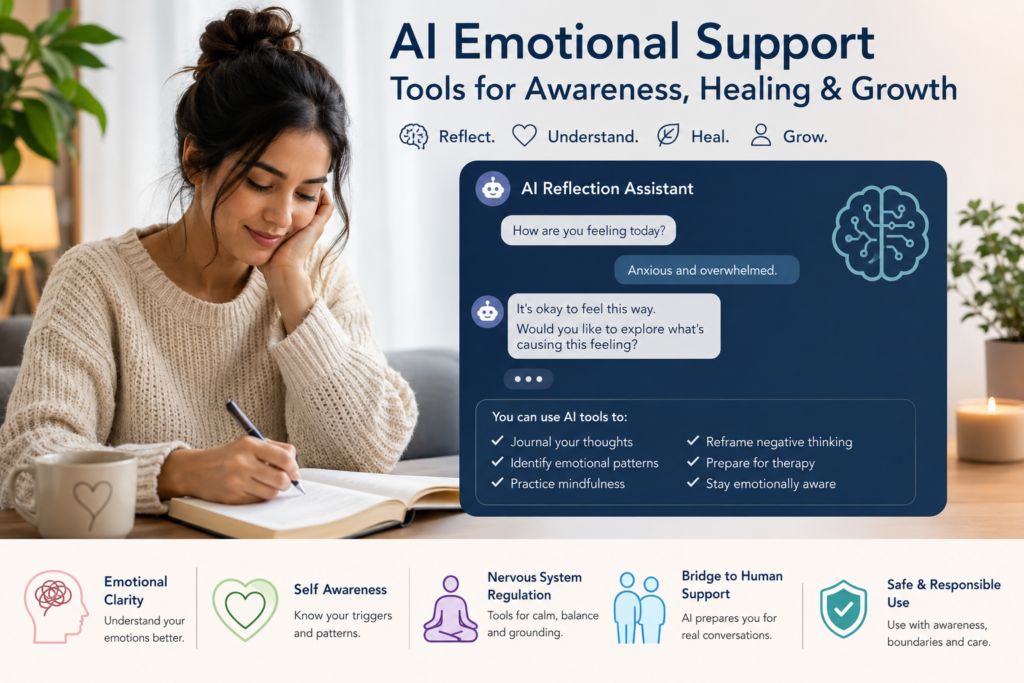
An AI therapy chatbot may help with simple reflection questions, journaling prompts, emotional vocabulary, or grounding reminders.
For example, it may ask, “What happened before this feeling started?” or “Is this thought based on fact, fear, or past experience?” These questions can be helpful when used carefully.
The Real Need Behind AI Emotional Support
The deeper need behind AI emotional support is often emotional safety. People want a place where they can express sadness, fear, shame, anger, or confusion without feeling immediately judged.
This is why AI tools can feel comforting at first. They respond quickly, they do not interrupt, and they can help turn emotional chaos into words.
But comfort is not the same as healing. A person can feel temporarily soothed by an AI response and still need real human support.
Emotional pain often lives in the nervous system, relationships, memories, body reactions, and daily habits. These areas need more than text-based support.
This is why tools like AI emotional support tools should be used as part of a wider emotional-care system, not as the whole system.
Where an AI Therapy Chatbot Can Help First
An AI therapy chatbot may be useful when a person needs help organizing thoughts before taking action.
It can help with journaling, identifying emotional triggers, preparing questions for therapy, or practicing healthier self-talk.
It may also help someone notice repeated patterns such as over-apologizing, people-pleasing, fear of rejection, or emotional shutdown.
For example, if someone writes every night about feeling anxious before work, AI may help them notice the pattern.
Is the anxiety connected to workload, fear of failure, workplace conflict, sleep problems, or old self-worth wounds?
This kind of reflection can become useful when the person later speaks with a therapist or trusted support person.
You can connect this section with AI therapy tools and safe online counseling support because that blog helps readers understand both the benefits and risks of using AI in therapy-related spaces.
Where AI Must Stay Limited
AI must stay limited when the situation is serious. It should not diagnose depression, anxiety disorder, bipolar disorder, trauma, addiction, or any other mental health condition. It should not replace a therapist, doctor, psychiatrist, emergency service, or crisis support line.
This is especially important when someone is having thoughts of self-harm, feeling unsafe, experiencing abuse, losing touch with reality, or feeling unable to function.
In those moments, AI emotional intelligence mental health tools are not enough. Human care is necessary.
A safe rule is simple: use AI for reflection, not final decisions. Use AI to prepare for support, not to avoid support.
BBH View: AI Is a Mirror, Not a Therapist
The unique BBH view is this: AI is a mirror, not a therapist. It can reflect your words back to you in a clearer way, but it cannot fully understand your pain, history, body, nervous system, relationships, or soul-level struggle.
This matters because emotional healing is not only about getting the right answer. Healing also needs presence, safety, accountability, body regulation, and real-world action. A chatbot may help you name an emotion, but you still need to decide what to do with that awareness.
This is why AI emotional intelligence mental health should be understood as a support layer.
- It may help you pause before reacting.
- It may help you write instead of suppress.
- It may help you notice a pattern before it becomes a crisis.
But it should always move you toward wiser human action.
Emotional Intelligence Technology Can Reflect Patterns
Emotional intelligence technology can be useful when it helps people see repeated emotional patterns.
For example, AI may help someone recognize that their anxiety rises after social comparison, that their anger appears when they feel ignored, or that their sadness becomes stronger when they isolate.
This pattern awareness can be powerful because many people do not suffer only from one emotion. They suffer from repeating loops.
The same trigger creates the same thought, the same body reaction, and the same behavior. When AI helps name this loop, the person may feel less confused and more prepared to change.
For practical emotional regulation, readers can also use AI tools to control emotions as a connected guide.
Human Healing Still Needs Human Connection
The safest future for AI mental health support is not a future where humans become dependent on machines. The safest future is where AI helps people reach human support earlier. This may mean preparing better notes for therapy, recognizing emotional warning signs, practicing grounding skills, or understanding when a situation needs professional care.
In Western countries like the USA, UK, Canada, and Australia, AI tools may become common in self-help, coaching, workplace wellness, and therapy preparation.
But the human boundary must remain clear. A person should not build their whole emotional life around an AI system.
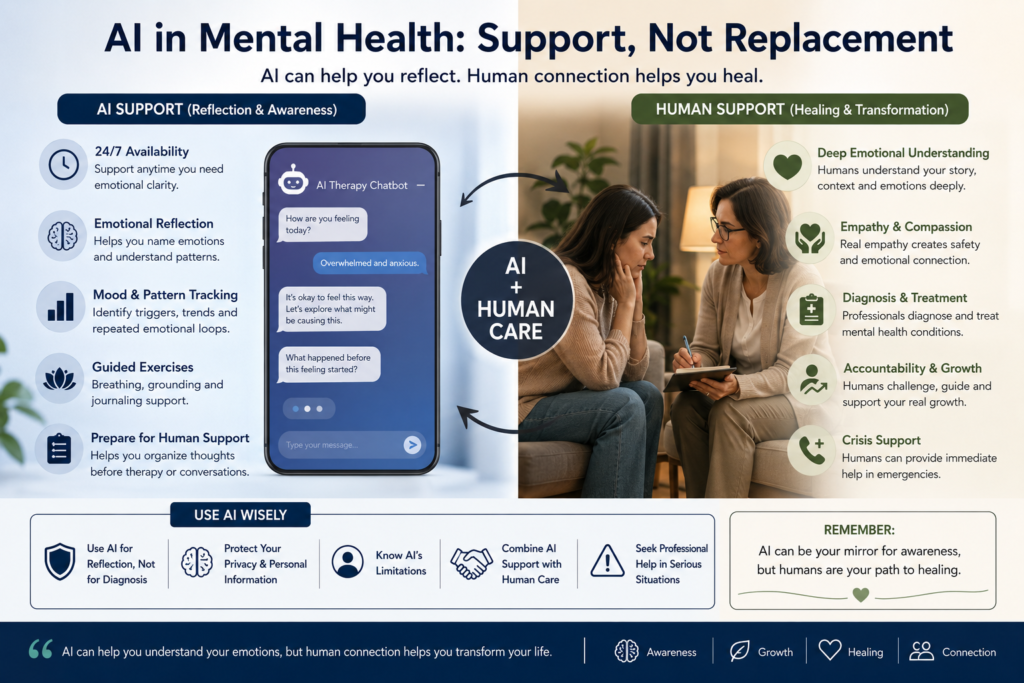
AI can help you reflect. A human can help you be seen, challenged, protected, and supported in real life.
“AI can reflect your words, but it cannot live your pain. Healing begins when reflection becomes honest human action.”
Benefits of AI Emotional Intelligence Mental Health Tools
The biggest benefit of AI emotional intelligence mental health tools is not that they can replace human care. Their real value is that they can help people slow down, name what they feel, and notice emotional patterns before those patterns become harder to manage.
For many readers in the USA, UK, Canada, and Australia, this matters because emotional support is not always available immediately.
Someone may feel anxious at night, overwhelmed after work, or ashamed after a relationship conflict.
In that moment, AI mental health support may help them organize their thoughts, write down what happened, and separate the emotion from the facts. This is useful because many emotional reactions feel confusing until they are put into words.
Earlier Emotional Pattern Recognition
One helpful use of emotion AI is emotional pattern recognition. A person may not notice that their anxiety increases after social media, that anger appears after feeling ignored, or that sadness becomes stronger after isolation.
AI tools can sometimes help highlight these repeated emotional loops through journaling, mood tracking, and reflective questions.
This does not mean AI knows the full truth. It only means it can help a person observe what keeps repeating. That observation can become the first step toward emotional responsibility.
When someone sees a pattern clearly, they can stop blaming themselves as “too sensitive” and start asking a better question: “What is this reaction trying to show me?”
For this reason, your related article on can AI detect mental health patterns can be a strong internal link here. It supports the same search intent around AI, emotional signals, and mental health awareness.
Better Emotional Vocabulary
Many people do not have a clear emotional vocabulary. They may say, “I feel bad,” “I feel stressed,” or “I feel tired,” but the real feeling may be loneliness, rejection, fear, grief, shame, disappointment, or nervous system overload. AI emotional support may help readers explore these deeper emotional words in a less judgmental way.
This can be useful because naming an emotion often reduces confusion.
A person who says “I am broken” may discover, through reflection, that they are actually overwhelmed, unsupported, or afraid of failing.
That shift matters. When the language becomes more accurate, the next action becomes more realistic.
In BBH language, emotional clarity is not just a mental exercise. It is a nervous system shift. When the brain names the experience more clearly, the body often begins to feel less trapped inside it.
Support Between Therapy Sessions
An AI therapy chatbot may also help people between therapy sessions, especially when it is used carefully.
A person already working with a therapist may use AI to write notes, track emotions, prepare questions, or remember coping tools. This can make therapy conversations more focused and useful.
For example, someone may ask AI to help summarize one week of mood changes before a counseling session. Another person may use it to list emotional triggers they noticed after a family conflict.
In this role, AI is not replacing therapy. It is helping the person become more prepared for real therapy.
This is where AI mental health support can become practical. It can help people bring clearer language, better examples, and more honest self-observation into human care.
Best Use Case: Reflection, Not Diagnosis
The safest use of AI emotional intelligence mental health tools is reflection. AI can help someone ask better questions, organize thoughts, prepare for therapy, or practice emotional awareness.
But it should not be used to diagnose a disorder, decide medication, confirm trauma, or replace professional mental health care.
A strong boundary is simple: use AI to understand your inner experience, not to label your identity.
When AI becomes a reflection tool, it can support emotional growth. When it becomes the final authority, it can become risky.
Risks of Emotion AI and AI Therapy Chatbots
The risks of emotion AI are just as important as the benefits. Mental health is not like asking AI for a recipe, travel plan, or general explanation.
Emotional pain is personal, sensitive, and sometimes dangerous when it is misunderstood. This is why readers need a balanced view before trusting any AI therapy chatbot too deeply.
AI can give helpful language, but it can also miss serious emotional risk.
- It can sound confident even when it does not understand the full situation.
- It can validate a person without challenging unhealthy thinking.
- It can also create emotional dependence if someone starts using it as their only source of comfort.
The danger is not that AI is useless. The danger is using AI without boundaries.
AI Can Miss Subtle Emotional Risk
Some people do not express distress directly. They may not say, “I am in danger.”
They may write softer sentences like “I feel empty,” “I don’t see the point,” “I am tired of everything,” or “I just want to disappear.”
A human therapist may hear the emotional weight behind those words, ask follow-up questions, and check safety. AI may not always respond with the same depth or caution.
This is why AI emotional intelligence mental health tools should never be the only support during severe distress. AI may detect patterns in language, but it may not understand cultural context, family pressure, trauma history, physical symptoms, abuse, substance use, or hidden crisis signals.
If someone feels unsafe, at risk of self-harm, or unable to function, they need immediate human support, not only AI emotional support.
Over-Validation Can Become Harmful
One hidden risk of AI emotional support is over-validation. A person may tell an AI chatbot, “Everyone is against me,” and the tool may respond with comfort instead of gently helping the person examine the thought.
Comfort can feel good in the short term, but if it strengthens fear, anger, avoidance, or victim identity, it can become unhealthy.
Real healing sometimes needs warmth and challenge together. A good therapist, counselor, or wise support person may validate the pain while also helping the person question the story around the pain. AI may not always hold that balance well.
This is why AI should not become an emotional echo chamber. If it only repeats what a person wants to hear, it may reduce growth instead of supporting it.
Privacy and Sensitive Emotional Data
Mental health conversations include private information: fears, trauma, relationships, sexuality, family conflict, work pressure, shame, anger, grief, and personal identity questions.
When readers use AI mental health support, they should understand that they may be sharing sensitive emotional data.
This does not mean every AI tool is unsafe, but it does mean users should be careful. They should read privacy policies, avoid sharing unnecessary personal details, and never enter information that could harm them if exposed.
People in the USA, UK, Canada, and Australia may have different privacy rights and healthcare regulations, but the personal rule should remain cautious.
Before sharing deeply sensitive information, ask: “Would I be comfortable if this data was stored, reviewed, or used to improve a system?” If the answer is no, keep the details more general.
Red Flag Rule for AI Emotional Support
A useful red flag rule is this: if AI makes you more dependent, more isolated, more anxious, or less likely to seek human help, pause immediately. A tool is not helping if it keeps you stuck in a private emotional loop.
Healthy AI emotional intelligence mental health use should move you toward clarity, regulation, and better real-world action.
It should not replace friendship, therapy, medical care, community, or personal responsibility.
If AI becomes the only place where someone feels safe, that person may need more human support, not more chatbot time.
This is especially important for people dealing with trauma, narcissistic abuse patterns, emotional dependency, or chronic shame. In those cases, AI may support awareness, but human care and safety planning matter more.
Safe Ways to Use AI Mental Health Support
The safest way to use AI mental health support is to treat it as a tool for reflection, not treatment. This means asking questions that help you understand yourself better, not asking AI to decide what is wrong with you.
It also means using AI as a bridge to human care when the emotional issue is serious or repeated.
A healthy question might be: “Help me organize what I am feeling so I can discuss it with a therapist.”
An unsafe question might be: “Tell me if I have a disorder and what I should do instead of seeing a professional.”
The difference is important.
AI can support self-awareness, but it should not become the authority over your mind, body, or life choices.
Use AI for Reflection, Not Diagnosis
An AI therapy chatbot may help you describe what happened, identify the emotion, and notice possible patterns.
But it should not diagnose depression, anxiety disorder, PTSD, bipolar disorder, OCD, addiction, or trauma.
Diagnosis requires trained professional judgment, clinical context, and often a deeper understanding of symptoms over time.
This boundary protects the reader. Many people already feel shame around mental health. A wrong label from AI can increase fear or confusion.
Instead of asking AI, “What disorder do I have?” ask, “What emotions and patterns should I discuss with a mental health professional?”
That keeps AI in the right place: supportive, not authoritative.
Use AI as a Bridge to Human Help
The best use of AI emotional support is often preparation. A person can use AI to write a short summary before therapy, list questions for a doctor, or organize thoughts before speaking to a trusted friend.
This makes human support easier to access.
- For example, someone may ask AI: “Help me write a clear note about my anxiety symptoms for my counselor.”
- Another person may ask: “Help me explain my emotional triggers without blaming anyone.”
- These uses are safer because they move the person toward connection, not away from it.
This is also where your related BBH article on CBT AI for shame recovery can be linked naturally, because shame often stops people from seeking help.
Use Grounding Prompts During Overwhelm
When emotions are high, AI can help with grounding prompts if the person is not in crisis. It may suggest naming five things in the room, slowing breathing, writing down facts versus fears, or identifying one small next step. These tools can support nervous system regulation when used gently.
A reader may ask: “Give me a grounding exercise for emotional overwhelm.”
Or: “Help me separate what happened from what I am imagining.”
These are practical ways to use emotion AI and AI support without giving it too much power.
Read Also: nervous system regulation and emotional balance.
Crisis Safety Note
If someone feels at risk of harming themselves, harming someone else, losing touch with reality, experiencing abuse, or feeling unable to stay safe, AI is not enough.
They should contact local emergency services, a crisis line, a doctor, therapist, or trusted person immediately.
This safety note is important for readers in the USA, UK, Canada, and Australia because crisis resources differ by country.
The blog should not try to replace local emergency guidance. It should clearly say that AI emotional intelligence mental health tools are not crisis care.
AI may help with reflection during normal emotional stress. It should not be treated as emergency mental health support.
How to Use an AI Therapy Chatbot Without Losing Human Judgment
Using an AI therapy chatbot safely requires self-boundaries. The user must remember that the chatbot is not a therapist, not a doctor, not a crisis worker, and not a person who knows their full life.
It is a tool that can help organize thoughts, but the final judgment must remain human.
This is especially important when the chatbot gives advice that sounds confident. AI can sometimes sound wise even when the situation needs professional care.
A calm tone does not always mean a correct answer. A supportive response does not always mean safe guidance.
The user’s responsibility is to keep checking: “Is this helping me take healthier action in real life?”
Ask Better Questions
Better questions create safer answers.
Instead of asking, “What is wrong with me?” ask, “What emotion might I be feeling, and what facts should I check?”
Instead of asking, “Should I leave this person?” ask, “What questions should I reflect on before making a serious relationship decision?”
Useful prompts include:
- “What emotion am I avoiding right now?”
- “What facts support this fear, and what facts do not?”
- “What is one safe next step I can take today?”
- “What should I discuss with my therapist or counselor?”
- “Help me write this feeling without blaming myself.”
These questions keep AI mental health support focused on reflection and clarity.
Keep a Human Checkpoint
Every serious emotional pattern needs a human checkpoint. If the same fear, sadness, panic, shame, anger, or relationship pattern keeps repeating, it should not stay only inside a chatbot conversation.
The person should bring it to a therapist, doctor, counselor, trusted friend, support group, or safe family member.
This is where AI can become useful in the right way.
- It can help prepare the person for that conversation. It can help them write what they want to say.
- It can help them notice the pattern before the appointment. But the healing process still needs real-world support.
Read Also : Gita psychology and conscious awareness, especially if you want to connect AI limits with awareness, soul, identity, and human consciousness.
The BBH Safe-Use Framework for AI Emotional Intelligence Mental Health
The safest way to understand AI emotional intelligence mental health is through one simple principle: AI should help you become more aware, not more dependent. When used wisely, AI mental health support can help you pause, name the emotion, notice the pattern, and choose a healthier next step.
But when used without boundaries, it can become a private loop where a person keeps talking to a tool instead of moving toward real support.
The BBH framework keeps AI in the right place.
It treats emotion AI as a reflection tool, not a therapist.
It helps readers in the USA, UK, Canada, and Australia use AI for emotional awareness while still protecting human judgment, professional care, and real-world action.
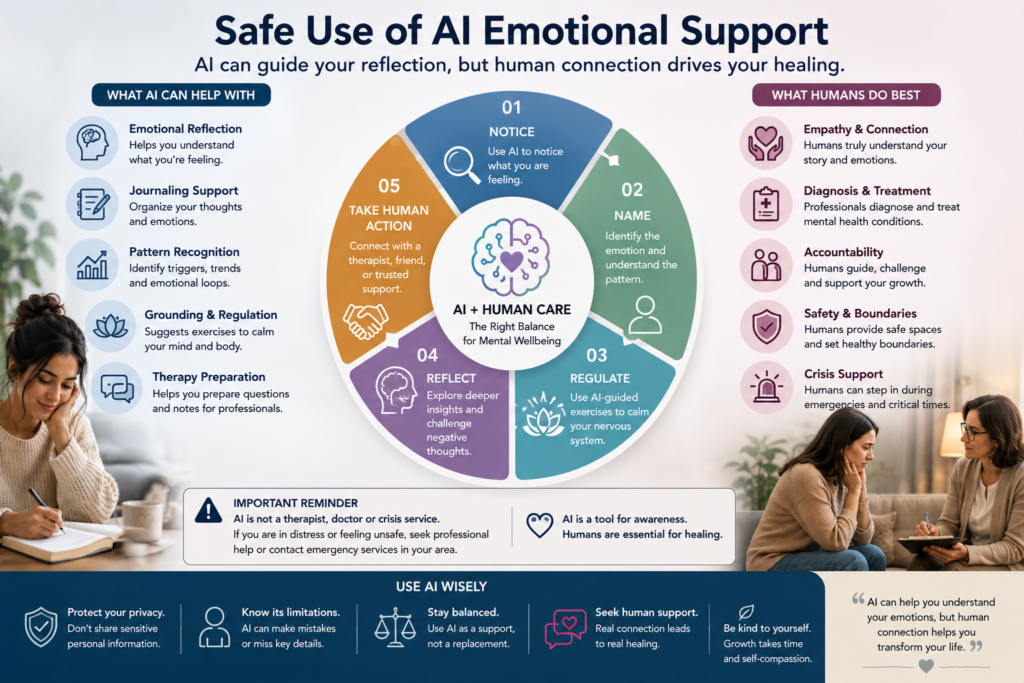
Step 1 — Notice the Emotion
The first step is to use AI emotional support to notice what is present. Many people react before they understand what they are feeling.
They may say, “I am angry,” but underneath the anger may be fear, rejection, shame, grief, loneliness, or exhaustion.
An AI tool can help by asking simple reflection questions:
- “What happened before this feeling started?”
- “Where do you feel this emotion in your body?”
- “What word best describes this state?”
- These questions can slow the mind and create emotional distance.
This is where AI becomes useful. It helps turn emotional confusion into language. But the person must still remain in charge of meaning and action.
Helpful Prompt
Ask the AI:
“What emotion might be underneath this reaction, and what are three healthier ways to name it?”
Step 2 — Name the Pattern
The second step is to look for the repeated pattern. Emotional pain is rarely random.
A person may feel anxious before every meeting, ashamed after every mistake, angry when ignored, or empty after social comparison. Emotion AI and journaling tools may help reveal these loops.
This pattern awareness is valuable because it reduces self-attack. Instead of saying, “I am broken,” the person may begin to say, “This is a repeated emotional response.” That shift creates space for healing.
For example, someone may notice that their anxiety rises after online comparison. Another person may notice that rejection fear creates over-apologizing. When the pattern becomes visible, emotional responsibility becomes possible.
Helpful Prompt
Ask the AI:
“What emotional pattern keeps repeating in this situation, and what trigger may be starting it?”
Step 3 — Regulate the Nervous System
The third step is regulation. AI emotional intelligence mental health tools are not only useful for thinking; they can also guide small nervous-system practices when distress is mild or moderate. This may include breathing, grounding, body scanning, short journaling, walking, or separating facts from fear.
This is important because emotional intelligence is not only mental understanding. A person may understand the issue and still feel unsafe in the body. That is why nervous system regulation matters.
AI can suggest a calming exercise, but the person must actually practice it. Healing does not happen only by reading a response. It happens when awareness becomes a physical and behavioral shift.
Helpful Prompt
Ask the AI:
“Give me one simple grounding exercise for this emotion, and help me separate facts from fear.”
Step 4 — Choose a Human Action
The fourth step is the most important. After noticing, naming, and regulating, the person should choose one human action.
This may mean talking to a therapist, calling a doctor, messaging a trusted friend, setting a boundary, resting, asking for help, or preparing for a real conversation.
This protects the person from becoming dependent on an AI therapy chatbot. The goal is not endless private reflection. The goal is wiser movement in real life.
Read Also: start your healing journey.
BBH Core Line
AI should move you toward more awareness, more regulation, and more human connection. If AI keeps you isolated, dependent, or emotionally stuck, it is no longer helping in the healthiest way.
Future of Emotion AI in Mental Health Care
The future of emotion AI in mental health care will likely grow quickly. In countries like the USA, UK, Canada, and Australia, digital mental health tools are already becoming part of therapy preparation, workplace wellness, self-help, emotional journaling, and mood tracking.
AI may become better at noticing emotional changes, supporting early intervention, and helping people prepare for professional care.
But the future should not be built around replacing therapists, doctors, counselors, or human connection.
The best future is not “AI instead of human care.”
The best future is “AI helping people reach the right support earlier.”
That is the balanced future BBH should stand for: technology with ethics, support with boundaries, and emotional intelligence with human dignity.
What Could Improve
AI may improve access to basic emotional reflection. Someone who feels ashamed, isolated, or confused may use AI mental health support to take the first step. It may help them write a therapy note, track a mood pattern, or recognize when stress is becoming unmanageable.
This can be especially useful for people who are not ready to speak openly yet. AI may create a low-pressure space to begin naming emotions.
It may also support people between therapy sessions by helping them remember coping tools and organize thoughts.
Used correctly, AI can become a bridge between silence and support.
What Must Be Protected
The future must also protect privacy, consent, safety, and human judgment. Mental health data is deeply sensitive. People may share fear, trauma, shame, relationships, identity questions, or crisis thoughts. These details must not be treated casually.
An AI therapy chatbot should not be marketed as a full replacement for therapy. It should not diagnose serious conditions, handle crisis situations alone, or encourage emotional dependence. Readers must know the difference between reflection support and professional mental health care.
The safest future is one where AI helps people understand themselves better while still keeping trained human care at the center.
Future-Focused BBH Angle
The real promise of AI emotional intelligence mental health is not artificial empathy.
The real promise is earlier awareness.
If AI helps someone notice emotional pain earlier, regulate sooner, and ask for human help faster, then it has served a meaningful purpose.
Who Should and Should Not Use AI Emotional Support
AI emotional support can be useful for people who want help with journaling, emotional vocabulary, self-reflection, therapy preparation, habit tracking, or mild emotional stress. It can help someone organize their thoughts before speaking to a therapist, partner, friend, or doctor.
But AI is not enough for every situation. People dealing with severe depression, self-harm thoughts, abuse, addiction crisis, trauma flashbacks, psychosis symptoms, or inability to function should not rely on AI alone. They need professional care, emergency support, or trusted human help.
This distinction matters because a helpful tool can become harmful when used in the wrong situation. AI can support awareness, but it cannot replace safety.
Good Fit for AI Mental Health Support
A good fit is someone who uses AI with clear boundaries. They may ask for journaling prompts, emotional reflection, grounding exercises, or help preparing questions for therapy. They are not asking AI to diagnose them or make major life decisions.
For example, a person may ask, “Help me understand why I felt anxious after this conversation.”
Another may ask, “Help me prepare what to discuss with my counselor.” These are safer uses because they support clarity and connection.
Readers can also visit the healing resources hub for broader emotional healing tools and guidance beyond AI-based support.
When AI Is Not Enough
AI is not enough when the emotional situation involves danger, crisis, severe symptoms, or loss of control. If someone feels unsafe, wants to harm themselves, wants to harm someone else, is being abused, or feels unable to stay grounded, they need immediate human support.
This blog should be very clear: AI emotional intelligence mental health tools are not emergency care.
They are not a crisis service.
They are not a substitute for a therapist, psychiatrist, doctor, emergency number, or local mental health hotline.
AI can help with reflection during normal stress. It should not be trusted as the only support during serious distress.
How AI Can Help Reframe Negative Self-Talk
One practical area where AI emotional support may help is negative self-talk. Many people do not only struggle with emotions; they struggle with the meaning they attach to those emotions.
They may say, “I am weak,” “I always fail,” “Nobody understands me,” or “I cannot change.”
AI can help gently reframe these thoughts when used carefully.
It may suggest more balanced language, such as “I am overwhelmed right now,” or “This is a difficult moment, but it is not my whole identity.”
This does not solve everything, but it can reduce self-attack.
For readers who need this deeper support, Read Also: AI reframe negative self-talk for confidence. It connects naturally with emotional awareness, confidence, and safer AI use.
FAQs About AI Emotional Intelligence and Mental Health
Can AI help with mental health?
AI can help with mental health when it is used for reflection, journaling, emotional vocabulary, and preparation for human support. AI mental health support may help people notice patterns earlier, but it should not replace therapy, diagnosis, or crisis care.
What is emotion AI in mental health?
Emotion AI in mental health refers to technology that tries to recognize emotional signals from text, voice, mood data, facial expression, or behavior patterns. It is connected with affective computing, but it detects patterns rather than truly feeling human emotions.
Is an AI therapy chatbot safe?
An AI therapy chatbot may be safe for basic reflection, grounding prompts, and organizing thoughts when used with boundaries. It is not safe as the only support for crisis, diagnosis, severe distress, trauma danger, or major mental health decisions.
Can AI understand human emotions?
AI can identify emotional signals and respond with supportive language, but it does not understand emotions the way a human does. It does not know your full life, body, culture, relationships, trauma history, or personal meaning unless you explain them.
Can AI emotional support replace therapy?
No. AI emotional support may support self-reflection between therapy sessions, but it cannot replace a trained therapist, doctor, counselor, psychiatrist, crisis worker, or trusted human relationship. It should be used as a support layer, not a substitute.
Final Thought: AI Should Support Healing, Not Replace Humanity
The final lesson of AI emotional intelligence mental health is simple: AI should support healing, not replace humanity.
It can help people name emotions, notice patterns, prepare for therapy, and practice basic self-reflection.
It can offer structure when the mind feels crowded and language when emotions feel unclear.
But AI cannot live your pain, hold your history, understand your body fully, or replace the safety of real human connection.
Emotion AI can detect signals, and an AI therapy chatbot can support reflection, but healing still needs wisdom, accountability, nervous system regulation, and human care.
The best use of AI is not dependency. The best use is direction. Let AI help you pause, understand, and prepare. Then take the next real human step.
“Use AI as a mirror for awareness, not as a master of your life. Healing becomes real when insight moves into human action.”
People Also Ask
Can AI emotional intelligence help with mental health?
Yes, AI emotional intelligence mental health tools can help people reflect on emotions, notice patterns, and organize thoughts before speaking to a therapist or trusted person. They are useful for awareness and journaling, but they should not replace professional mental health care.
What is emotion AI in mental health?
Emotion AI in mental health means technology that tries to recognize emotional signals from text, voice, facial expression, mood tracking, or behavior patterns. It can support emotional awareness, but it does not truly feel or understand pain like a human being.
Is AI mental health support safe?
AI mental health support can be safe for basic reflection, grounding prompts, and emotional vocabulary when used with boundaries. It becomes risky if someone uses it for crisis care, diagnosis, major life decisions, or as a replacement for therapy.
Can an AI therapy chatbot replace a therapist?
No, an AI therapy chatbot cannot replace a therapist, counselor, doctor, psychiatrist, or crisis worker. It may help prepare questions or organize feelings, but serious distress needs trained human support.
What are the risks of AI emotional support?
The main risks of AI emotional support include privacy concerns, over-dependence, wrong advice, emotional over-validation, and missed crisis signals. AI should guide reflection, not become the only place where someone seeks help.