Developmental Milestones for Children Ages 8–15
Child Development Milestones Ages 8–15


Understanding developmental milestones for children ages 8–15 can help Pune families notice growing strengths, respond to changing needs and recognise when professional guidance may be useful. Between middle childhood and adolescence, children change in how they think, move, communicate, form friendships and manage feelings. Yet development is not a race: a milestone describes a common pattern, not a deadline or a diagnosis.
Thank you for reading this post, don't forget to subscribe!This evidence-informed educational guide focuses on families in Pune, including Undri, Hadapsar, Hinjewadi, Magarpatta, Kondhwa and Wakad. It distinguishes typical variation from concerns that merit assessment, offers a practical age-band checklist, and explains why school, language, disability, puberty and family circumstances matter.
Understanding Developmental Milestones for Children Ages 8–15
Development has several overlapping domains. Physical development includes growth, coordination and puberty. Cognitive development includes memory, attention, reasoning and flexible problem-solving. Language development involves conversation, explanation and understanding increasingly complex ideas. Social-emotional development includes empathy, friendship, identity and managing disappointment. Adaptive skills include planning, self-care and taking responsibility.
Milestone charts are best interpreted as broad educational guides. The CDC’s formal developmental milestone checklists primarily address children from birth to five years; they should not be stretched into a precise diagnostic checklist for 8–15-year-olds. For older children, parents can draw on developmental guidance from the American Academy of Pediatrics, adolescent-health research and school observations while recognising wide individual variation.
Children can be advanced in one area and need support in another. An excellent reader may struggle with organisation; a confident athlete may find peer conflict difficult. Neither difference alone identifies a disorder. Ask whether a difficulty is new, persistent, present in multiple settings and interfering with everyday life.
Ages 8–9: Building Skills and Belonging
Many children aged eight or nine become more capable of following multi-step instructions, explaining their reasoning and participating in group activities. Friendships often become more important, and fairness or belonging may strongly influence feelings. They may manage familiar routines with less prompting, although organisation still requires adult help.
What parents may notice
A child might read more independently, explain game rules, recognise another person’s viewpoint, complete a simple household task or cope with a minor disappointment after reassurance. Some children remain cautious in unfamiliar social situations; others are highly outgoing. Temperament should not be mistaken for a measure of development.
How to support ages 8–9
Offer concrete responsibilities such as packing a school bag using a checklist. Encourage games that require taking turns and discussing rules. Ask open questions about a story or everyday problem. If reading, communication or classroom participation is consistently difficult, discuss observations with the teacher and paediatrician rather than waiting for the child to “grow out of it.”
Ages 10–11: Independence and Changing Friendships
When considering developmental milestones for children ages 8–15, remember that for many children the preteen years bring more complex friendships, stronger awareness of peer opinions and greater interest in privacy. Some begin puberty while others do not; both patterns can be normal depending on age and individual circumstances. Executive skills such as planning and time management continue developing and should not be expected to function like an adult’s.
At this age, children may compare themselves with classmates, feel embarrassed by mistakes or resist public correction. Parents can support autonomy by offering limited choices while keeping predictable boundaries. Ask children to help plan homework and leisure time, but provide reminders and realistic schedules rather than treating missed tasks as character flaws.
Developmental milestones for children ages 8–15: When differences matter
A sudden withdrawal from friends, marked change in school performance, ongoing sleep disruption or repeated distress deserves curiosity and support. Puberty-related changes may contribute, but should not automatically explain away persistent problems. Involve qualified professionals when difficulties significantly affect wellbeing or participation.
Ages 12–13: Early Adolescence
Early adolescence often includes rapid physical change, more abstract thinking and heightened attention to social acceptance. Young people may question rules, experiment with identity and prefer some private conversations with peers. Emotional intensity does not mean a teenager is incapable of reasoning; however, stress, sleep loss and social pressure can affect judgement.
Respect growing privacy while discussing safety, consent, online behaviour and trusted adults. Invite the adolescent to explain their perspective before setting limits. For example, a discussion about phone use can begin with sleep, homework and online safety rather than an assumption that all screen use is harmful.
Supporting healthy development at 12–13
Teach practical strategies for organising tasks: break a project into steps, estimate time and review progress. Discuss how to evaluate online claims, including AI-generated information. Encourage movement and enjoyable activities without body comparison. If puberty is unusually early, late or distressing, consult a paediatrician for individual guidance.
Ages 14–15: Identity, Judgement and Responsibility
Older adolescents may become better at considering hypothetical situations, future plans and multiple viewpoints, although these abilities vary by task and context. Peer relationships and a sense of identity remain important. They often want meaningful input into decisions affecting their education, hobbies, friendships and schedules.
Adults can provide opportunities for decision-making with proportionate safeguards: comparing study options, planning a budget for a small project or discussing how to respond to social pressure. Encourage young people to recognise uncertainty, ask for help and reconsider choices without shame. Independence grows through supported practice, not abrupt withdrawal of guidance.
What not to expect
A 15-year-old is not a fully developed adult. Occasional forgetfulness, emotional reactions and changing interests are not automatically warning signs. Focus on patterns: can the teenager maintain important relationships, participate in daily activities, recover from setbacks and seek support when needed?
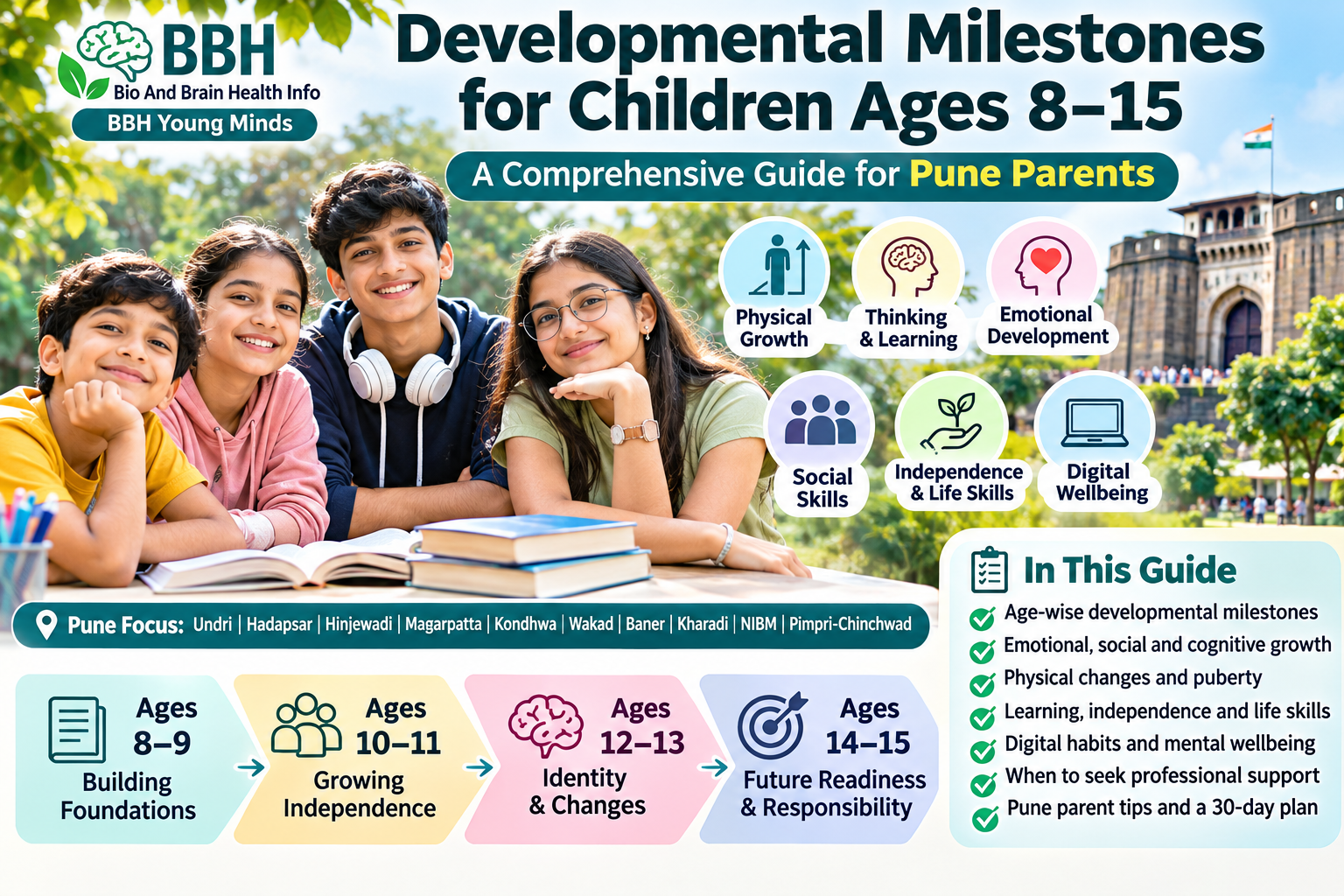
Developmental Milestones for Children Ages 8–15: At-a-Glance Table
The following table summarises broad tendencies, not required achievements at a particular birthday. It is deliberately phrased as “may” rather than “must.”
| Age band | Often developing | Helpful adult support |
|---|---|---|
| 8–9 | Group play, explanations, familiar responsibilities | Clear routines, reading and cooperative play |
| 10–11 | Peer awareness, planning practice, early puberty for some | Privacy, checklists, reassurance and body respect |
| 12–13 | Identity exploration, abstract ideas, changing emotions | Listening, boundaries, digital literacy and sleep |
| 14–15 | Future planning, autonomy, complex relationships | Shared decisions, realistic responsibility and safety |
Use the table to start conversations, not to score children against classmates. A child’s developmental profile may be uneven, and neurodivergent or disabled children may follow different pathways while still making meaningful progress.
Physical Growth, Puberty and Sleep
Puberty does not start at the same age for everyone. Changes may include growth spurts, body hair, skin changes, breast development, testicular growth and menstruation. The sequence and timing differ. Avoid comparing siblings or classmates, and explain bodily changes using respectful, medically accurate language. Consult a clinician about concerns regarding unusually early or delayed puberty, severe pain or significant distress.
Sleep is especially relevant because school schedules and late-night device use can conflict with growing sleep needs. The American Academy of Sleep Medicine recommends 9–12 hours per 24 hours for ages 6–12 and 8–10 hours for ages 13–18. These are population-level recommendations, not a substitute for assessment of persistent insomnia, snoring or daytime sleepiness.
WHO guidance recommends an average of at least 60 minutes of moderate-to-vigorous physical activity per day across the week for ages 5–17, with activities adapted to ability and circumstances. Safe play, cycling, walking, sports and dance can all contribute. For Pune families, heat, monsoon weather, traffic and available space should shape practical choices.
Emotional Development, Friendship and Bullying
Emotional development is not simply being calm or obedient. It involves recognising feelings, communicating needs, considering others and recovering after difficult experiences. Children can learn these skills through modelling, practice and supportive relationships. Adults who acknowledge their own mistakes demonstrate that repairing relationships is possible.
Friendship difficulties may include exclusion, arguments or changes in social groups. Listen before offering solutions. Ask whether the child feels safe, whether the problem is repeated and whether adults at school need to intervene. Repeated bullying, threats or harassment require a coordinated response, not advice to ignore it.
Why emotional safety matters
Family stress, conflict, financial pressure or discrimination can influence behaviour and concentration. These circumstances should not be used to blame parents or label children. Instead, identify practical supports, preserve predictable routines where possible and avoid making children responsible for adult problems. A warm relationship can coexist with clear limits.

Learning, Attention and Executive Skills
Attention, organisation and working memory are still developing throughout adolescence. Difficulty finishing homework may reflect unclear instructions, an overwhelming workload, sleep loss, a learning difference, stress or several factors together. A single observation cannot distinguish among them.
Try a practical approach: break assignments into steps, write down deadlines, reduce unnecessary distractions and agree on a brief check-in. Ask the child which strategy helps. When difficulties are longstanding, occur in several settings or interfere significantly with functioning, seek a professional evaluation rather than assuming laziness or diagnosing ADHD from an online quiz.
Multilingual development in Pune
Children may use Marathi, Hindi, English or another language across home and school. Vocabulary and confidence can vary by language and setting. Evaluate communication in the languages a child actually uses; speaking less fluently in a newer school language is not by itself evidence of a developmental disorder. A qualified speech-language professional can help when concerns persist across languages.
Digital Development, AI Literacy and Online Safety
Online spaces can offer creativity, connection and learning, but also misinformation, bullying, privacy risks and disrupted sleep. Rather than treating every minute of screen time as equivalent, consider what the child is doing, who they interact with and whether use displaces sleep, schoolwork, movement or relationships.
Teach children not to share addresses, passwords, school details or intimate images. Explain how to block and report harassment, and assure them that asking for help is safer than hiding a troubling experience. For AI-generated content, practise checking claims against trusted sources and discussing why convincing text or pictures can still be inaccurate.
Healthy digital independence should grow with maturity. A family agreement can identify device-free times, trusted contacts and procedures for reporting concerns. Review the agreement together rather than imposing a permanent rule that ignores changing needs.
Content Gap: Context Before a Milestone Checklist
Many milestone articles list expected skills without asking whether the environment allows a child to demonstrate them. A child who has never been taught to manage a bus route cannot be judged delayed for not doing so. A child experiencing grief, bullying, illness or a recent school change may temporarily show less independence. Access to assistive technology, disability accommodations, language support and safe opportunities matters.
A five-question context check
- Opportunity: Has the child had a fair chance to learn and practise the skill?
- Setting: Does the difficulty appear at home, school and with peers, or only in one situation?
- Duration: Is this a long-term pattern, a recent change or a single incident?
- Impact: Does it interfere with learning, relationships, health or daily activities?
- Strengths: Which abilities and supports are already helping the child succeed?
This five-question framework is an original BBH educational reflection tool, not a validated screening instrument. It can improve the quality of conversations with teachers and clinicians, but cannot diagnose or rule out developmental conditions.
When Parents Should Seek a Developmental Assessment
Consider professional advice when a child loses previously acquired skills, has persistent difficulty communicating or learning, experiences major changes in mood or behaviour, or struggles to function at home or school. Physical concerns such as significant growth changes, persistent fatigue or troubling puberty symptoms also warrant medical discussion.
Begin with a paediatrician, who can consider health, hearing, vision, sleep and developmental factors and refer to specialists when appropriate. A psychologist, psychiatrist, occupational therapist, speech-language professional or learning specialist may be involved depending on the concern. No single provider is suitable for every situation.
Urgent safety concerns
Seek immediate emergency assistance if a child is in imminent danger, expresses intent to harm themselves or others, or has a serious acute medical problem. Do not wait for a routine milestone review. In less urgent situations, document what changed, when it began and how it affects daily functioning.
A Practical 30-Day Observation Plan for Pune Parents
Rather than checking every milestone in one sitting, use a four-week observation approach. In week one, notice strengths, interests and daily routines. In week two, ask the child and, where appropriate, a teacher what feels easy or difficult. In week three, try one supportive adjustment such as a homework checklist, a calmer bedtime or a more predictable transition after school. In week four, review whether the change improved participation or wellbeing.
Keep notes descriptive: “needed three reminders to start homework” is more useful than “unmotivated.” Record successful strategies too. This plan is for communication and reflection, not a medical test. Do not delay professional help when concerns are significant or urgent.
For families in Undri, Hadapsar, Hinjewadi, Magarpatta, Kondhwa, Wakad, Baner, Kharadi, NIBM and Pimpri-Chinchwad, consider commute length, school start times and safe access to play when designing routines. These are local planning factors, not evidence that one Pune neighbourhood produces better developmental outcomes.
Frequently Asked Questions
Are developmental milestones for children ages 8–15 strict rules?
No. They describe broad developmental tendencies. Skills vary with individual differences, opportunities, disability, language, culture and context. Concerns should be assessed by qualified professionals.
Can a child be strong academically but struggle socially?
Yes. Development is uneven. A child may excel in mathematics while needing additional support with friendships, organisation or emotional coping.
Does late puberty always mean a health problem?
No. Timing varies, but a clinician can assess whether a pattern warrants investigation, especially when there are other symptoms or significant distress.
Are personality-development classes necessary?
No. Many developmental skills grow through supportive families, schools, play and community experiences. Paid programmes are optional, and claims of guaranteed developmental results should be viewed critically.
What should I bring to a professional appointment?
Bring specific observations, approximate dates, relevant school feedback, health history and questions. Share the child’s own perspective when possible.
BBH Young Minds and Related Parent Resources
BBH Young Minds is developing educational content for parents and children aged 8–15. Possible future Pune programmes are under consideration; locations, staffing, dates and enrolment are not confirmed. For educational enquiries or future updates, contact info@bioandbrainhealthinfo.com. Do not email sensitive personal health information about a child.
Main menu: Relationship · Submenu: Children · Support Resources
Related BBH reading
For additional context on difficult family dynamics, see Characteristics of a Narcissistic Parent: Child Impact.
- Parenting with a Narcissist: Protecting Children
- Father’s Respect for Mother in Parenting
- How to Build Self-Esteem After Attachment Wounds
- Characteristics of Narcissistic Parenting
Conclusion and Research Sources
Use developmental milestones for children ages 8–15 to understand emerging abilities, not to rank children. A helpful parent notices strengths, creates opportunities, checks context and seeks assessment when difficulties persist or safety is at risk. Sustainable routines, respectful communication and responsive support matter more than achieving every skill on a fixed timetable.
Research and authoritative guidance
- CDC — Child Development (background; CDC milestone checklists primarily concern younger children)
- American Academy of Pediatrics — HealthyChildren.org (school-age and adolescent parenting guidance)
- World Health Organization — Physical Activity
- American Academy of Sleep Medicine — Sleep Duration Consensus Statement
- UNICEF — Parenting
Evidence note: age bands are educational summaries, not a validated 8–15 diagnostic milestone scale. Specific developmental concerns require individual assessment.