How Childhood Criticism Shapes Self-Esteem
Why Feedback Can Make You Feel Not Good Enough


Your manager leaves a comment asking you to clarify one paragraph. You make the edit in five minutes. Hours later, while you’re washing dishes, you’re still thinking about the comment. You wonder whether your manager regrets hiring you. By bedtime, you’re remembering mistakes from three jobs ago.
Thank you for reading this post, don't forget to subscribe!It can be hard to understand why a small correction takes up so much space. If you grew up hearing that you were careless, selfish, or a disappointment, today’s feedback may bring back an old question. What does this say about me?
The connection between childhood criticism and self-esteem becomes easier to see when you catch that jump from an event to a judgment about yourself. This guide gives you words to use when feedback stings, an exercise for the thoughts that linger afterward, and examples parents can use to guide children through mistakes.
Quick answer
Repeated childhood criticism can contribute to low self-esteem, especially when adults use hurtful labels or make affection feel dependent on how well a child behaves or performs. In adulthood, this may show up as harsh self-talk, difficulty taking in praise, or a strong reaction to feedback. If you’re exploring the link between childhood criticism and self-esteem, start with one recent moment. Identify what happened, what you assumed it meant about you, and what the situation needs from you.
Medical safety and mental health support
This article is for general education. For assessment or treatment, speak with a licensed mental health professional. If distress regularly interferes with work, relationships, or daily life, you can bring a specific example from this article to that conversation.
Read the BBH mental health and self-help guidance.
Childhood criticism and self-esteem: When correction becomes personal
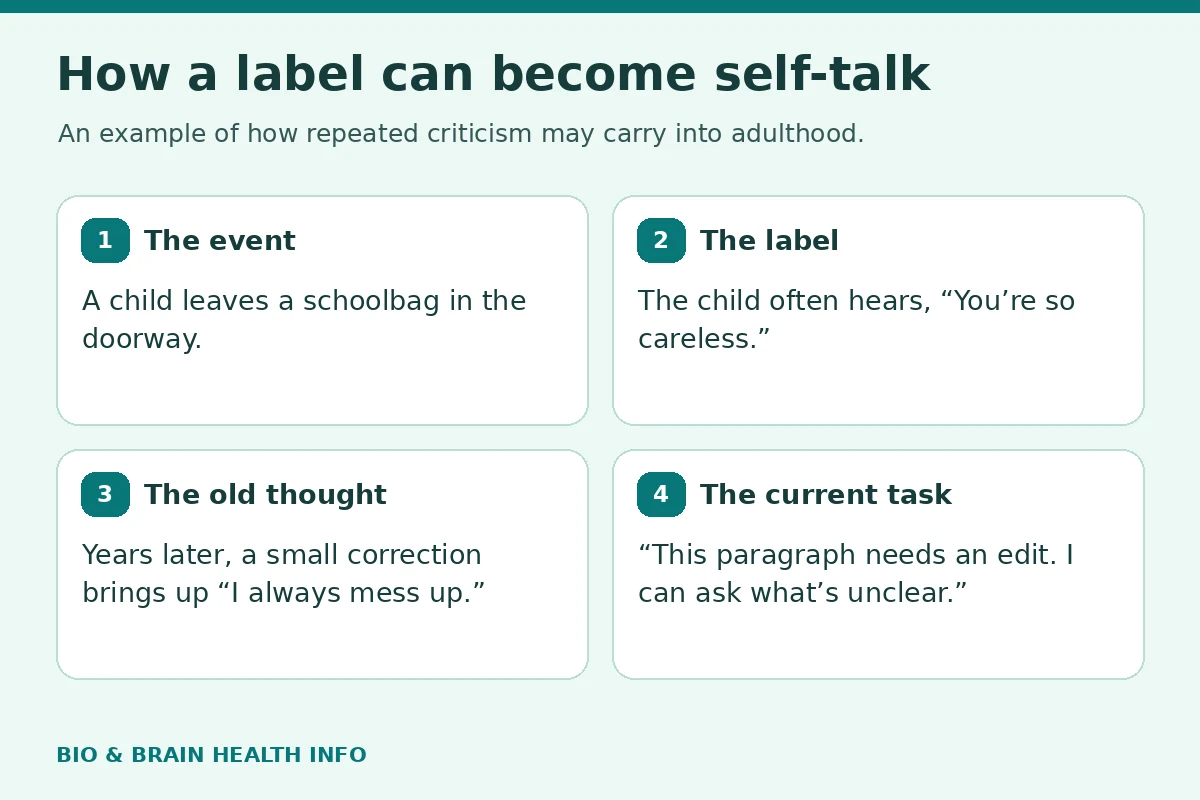
Imagine two children who leave their schoolbags in a doorway. One hears, “Someone could trip over your bag. Please put it next to the desk.” The other hears, “You’re so careless. How many times do I have to tell you?”
The first child knows what happened, why it matters, and what to do next. The second hears a label that can follow them well beyond the doorway. If the same word comes up when they spill a drink, forget homework, or get distracted while setting the table, they may begin using it to describe themselves.
Self-concept includes the beliefs you hold about yourself. Self-esteem involves how you evaluate yourself. A child might start with “I’m forgetful” and come to believe “People can’t count on me.” Questioning a belief you’ve held for years takes time.
What research says about childhood criticism and self-esteem
A 2024 review of 134 studies found a small overall association between exposure to trauma and more negative self-concept in children and adolescents. The strength of the association varied depending on factors including the kind of exposure and whether it happened repeatedly. The review looked at trauma and maltreatment broadly. Its results describe a group-level association and cannot tell us whether a particular comment changed one child’s self-esteem. A separate U.S. study linked harsh verbal discipline to later increases in depressive symptoms and conduct problems among adolescents. It measured those outcomes, while the review examined self-concept. Wang and Kenny, 2014. Melamed et al., 2024
One way to reflect on your own experience is to ask, After I made a mistake, what usually happened next? Perhaps an adult helped you find a solution. Perhaps the whole family laughed at you. Perhaps you spent the evening listening for someone’s footsteps, trying to work out whether they were still angry. When you reflect on childhood criticism and self-esteem, that pattern can help you identify what feels familiar in a present-day situation.
When approval feels like something you have to earn
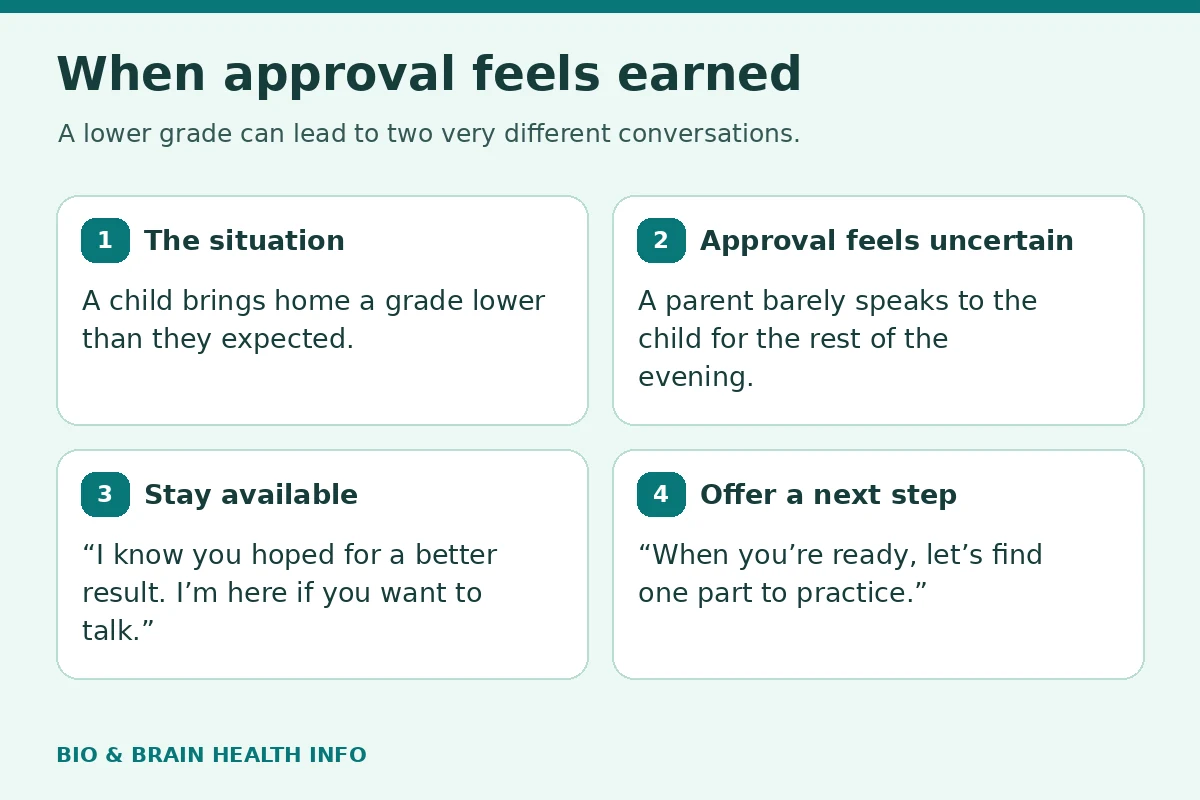
Picture a student who brings home a high grade and gets a warm conversation over dinner. The next month, they receive a lower grade. A parent barely speaks to them that evening. Over time, the child may start watching for small changes in tone or facial expression to work out whether things are okay at home.
Researchers use the term parental conditional regard for a pattern in which affection or approval is offered or withdrawn depending on whether a child meets expectations. A meta-analysis found that this pattern was associated with greater contingent self-esteem, which means a person’s sense of worth depends more on meeting standards or receiving approval. The researchers also found an association with feeling less connected to others. Haines and Schutte, 2023
A parent can be concerned about a grade and stay available to the child. They might say, “I know you hoped for a better result. When you’re ready, let’s look at which part of the test was difficult.” The child has a specific problem to work on and knows who they can ask for help.
The concern about approval can surface in adulthood in a different setting. Imagine sending a client a project you’re proud of. By the following afternoon, they still haven’t replied. You open the file again and start finding flaws in work you thought was solid yesterday. Before making changes, ask yourself, What new information do I have about the work? BBH explores a related pattern in its guide to emotional neglect in adulthood.
Childhood criticism and self-esteem in adulthood
When considering the link between childhood criticism and self-esteem, use these examples as starting points for reflection. Similar reactions can come from current stress, difficult relationships, and other experiences.
| Everyday situation | What your inner critic might say | A more specific response |
|---|---|---|
| A manager asks you to revise a section. | “They think I’m incompetent.” | “They asked for a clearer explanation in one section.” |
| A friend sends a short reply. | “I must have annoyed them.” | “The reply was brief. If something feels unresolved, I can ask about it.” |
| You forget to answer a message. | “I’m unreliable.” | “I missed this message. I can reply now and set a reminder if I need one.” |
| Someone compliments your work. | “They’re just being polite.” | “They said the examples helped them. I can use that information next time.” |
| You consider trying something new. | “I’ll embarrass myself.” | “I can start with one part and give myself time to practice.” |
How a harsh inner critic can prolong simple tasks
You write a straightforward email and check it eight times. You read it for tone, add an apology, delete the apology, and ask a friend whether it sounds rude. The email took ten minutes to write. By the time you send it, an hour has passed.
Give the final read a specific purpose. Ask yourself whether your request is clear, respectful, and complete. Once you’ve answered those three questions, you have a practical point at which to press send.
You remember the complaint and forget the compliment
You can recall a complaint word for word, but when someone asks what went well, you come up blank. Try writing down the specific thing someone appreciated. “The instructions helped me finish the form” tells you something you can use. You might realize that explaining steps in plain language is a skill you can bring to your next project. See also BBH’s guide to self-worth and comparison.
You apologize before you know what happened
A colleague says, “Can we talk about the order?” You start explaining that you were busy when it came in. You haven’t heard their question yet. Start with, “Of course. Which part of the order should we look at?” Their answer gives you something concrete to respond to. If the question stays on your mind after the conversation, see why overthinking can be hard to stop.
Why feedback can feel personal even when it’s useful
Some feedback is clear and fair. Some is vague, disrespectful, or incorrect. When your first reaction is to judge yourself, it gets harder to hear what the person actually said.
If a client says, “I’m unhappy with this,” ask which part fell short. A delivery-date misunderstanding and a design problem call for different responses.
Pay attention to how the feedback was delivered. “This invoice has the wrong date” gives you a fact you can check. “You’re hopeless at this” is a personal insult. You can address the practical issue and ask for respectful communication. For example, “I’ll correct the date. If there’s another issue with the invoice, please tell me what it is.”
When feedback makes you want to apologize right away
Your manager writes, “Can you take another look at this?” You’ve already typed “I’m so sorry” when you realize you still don’t know what they want changed.
Try asking, “Sure. Is there a particular part you’d like me to revisit?”
They reply, “Just the last paragraph. I lost track of your point halfway through.” You clarify the paragraph. If you’re still replaying the exchange after you send it back, use the exercise below to explore why it stuck with you.
When feedback is partly right and poorly delivered
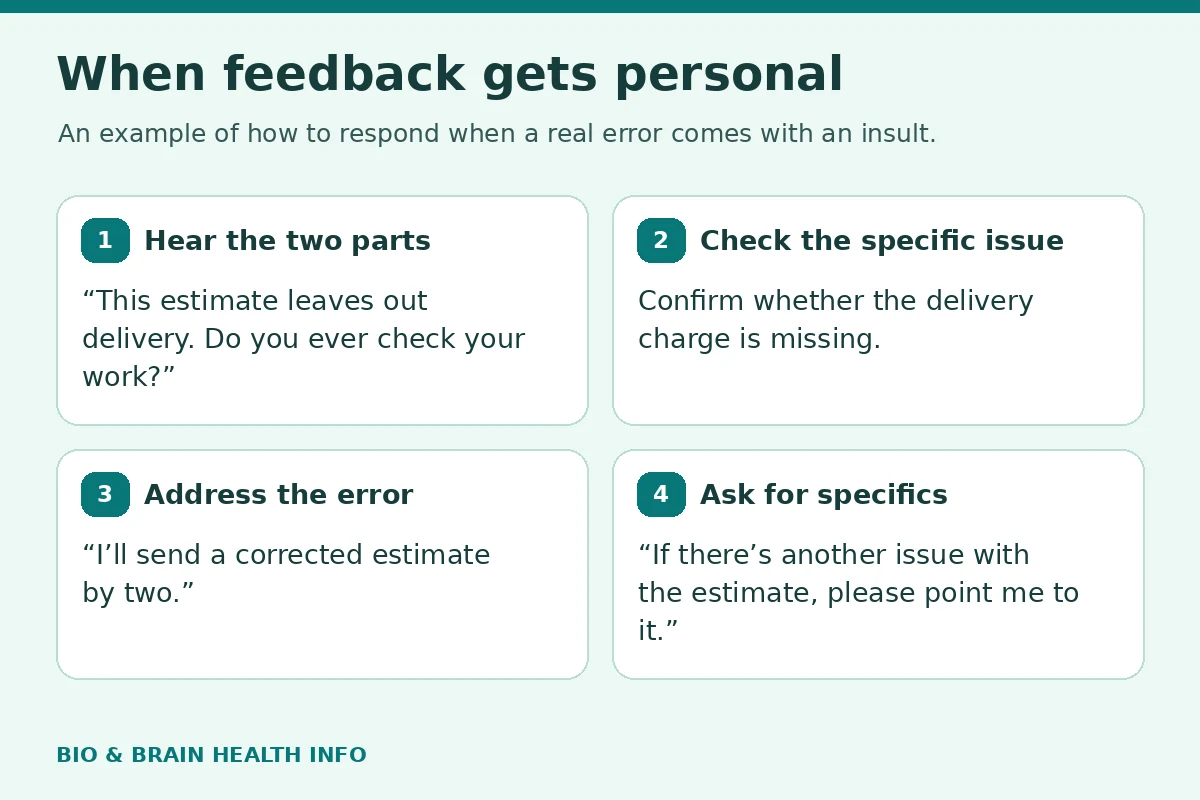
A client says, “This estimate leaves out delivery. Do you ever check your work?” Read that as two separate statements. The missing delivery charge is something you can verify. The personal remark is something you can address if you choose.
Reply you can use. “You’re right about the delivery charge. I’ll send an updated estimate by two. If there’s another issue with the estimate, please point me to it.”
If remarks like this keep happening, keep a factual record and consider who can help you address the pattern. If the personal remark is what stays with you, see BBH’s guide to CBT-informed reflection on shame.
A four-step exercise for responding to a harsh inner critic
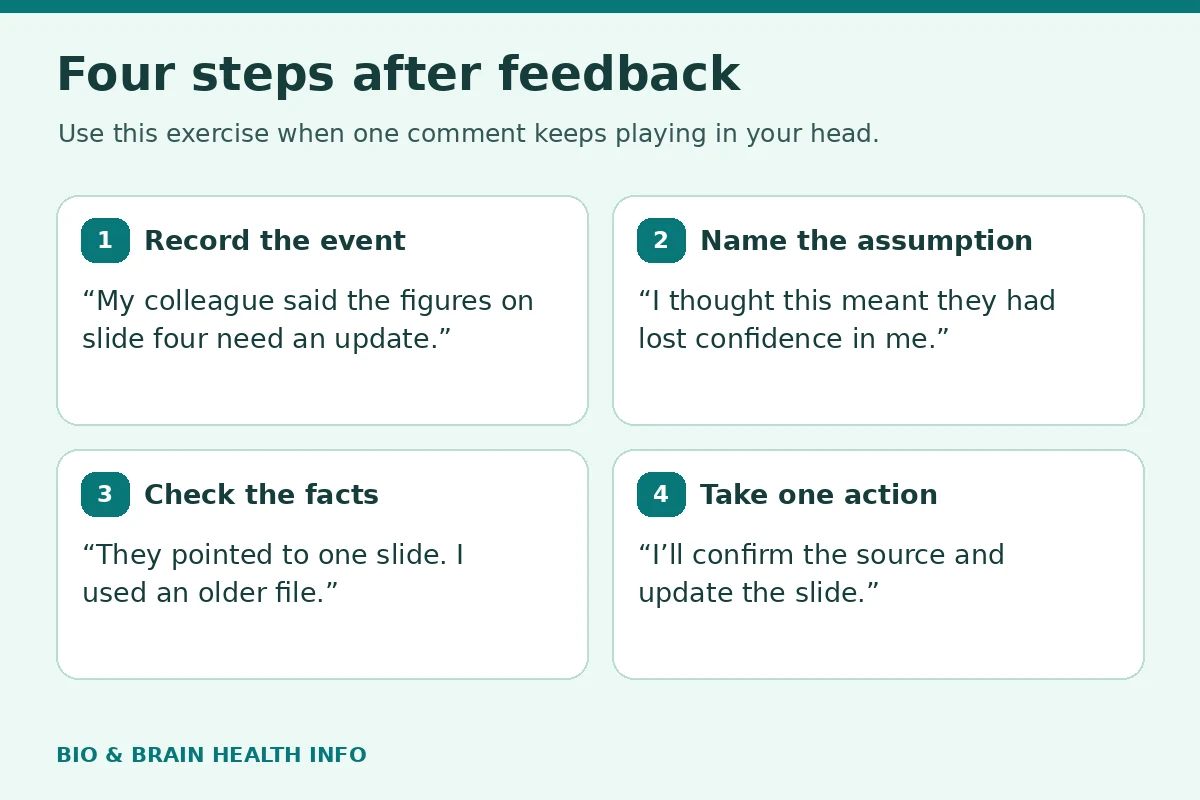
Choose a specific incident from the past week. A missed deadline, an awkward conversation, or a request to revise your work is enough. You can do this in a notebook or in the notes app on your phone.
1. Write down what happened
Describe what a camera or microphone could have captured. One sentence is enough.
Example. “My colleague said the figures on slide four needed to match the spreadsheet.”
2. Write down what you made it mean
Capture the thought as it originally appeared, even if it sounds unfair now. Seeing it written down can make it easier to look at what you concluded in the moment.
Example. “I always mess things up. They probably think I shouldn’t be working on this project.”
3. Write a fairer assessment
Include the facts you have and any responsibility you genuinely need to take. If you caught yourself guessing what someone thought, make room for that uncertainty.
Example. “The slide used figures from an earlier version of the spreadsheet. I can check the source and correct the slide. My colleague raised one issue with this presentation.”
4. Choose the smallest useful next action
Sometimes the next action is a correction. Sometimes it’s a question, a boundary, or deciding you’ve done what the situation requires.
Example. “I’ll update slide four and confirm which spreadsheet the team should use from now on.”
Four prompts to save
What happened?
What did I assume it meant about me?
What is a fairer way to describe the situation?
What is one useful thing I can do next?
A systematic review found that self-compassion-related interventions reduced self-criticism on average, though results and study quality varied. A useful answer can be as simple as, “I made a mistake in the figures, and I know how to fix it.” Wakelin et al., 2022 For more examples, see BBH’s tools for reflecting on negative self-talk.
How parents can correct behavior without shaming a child
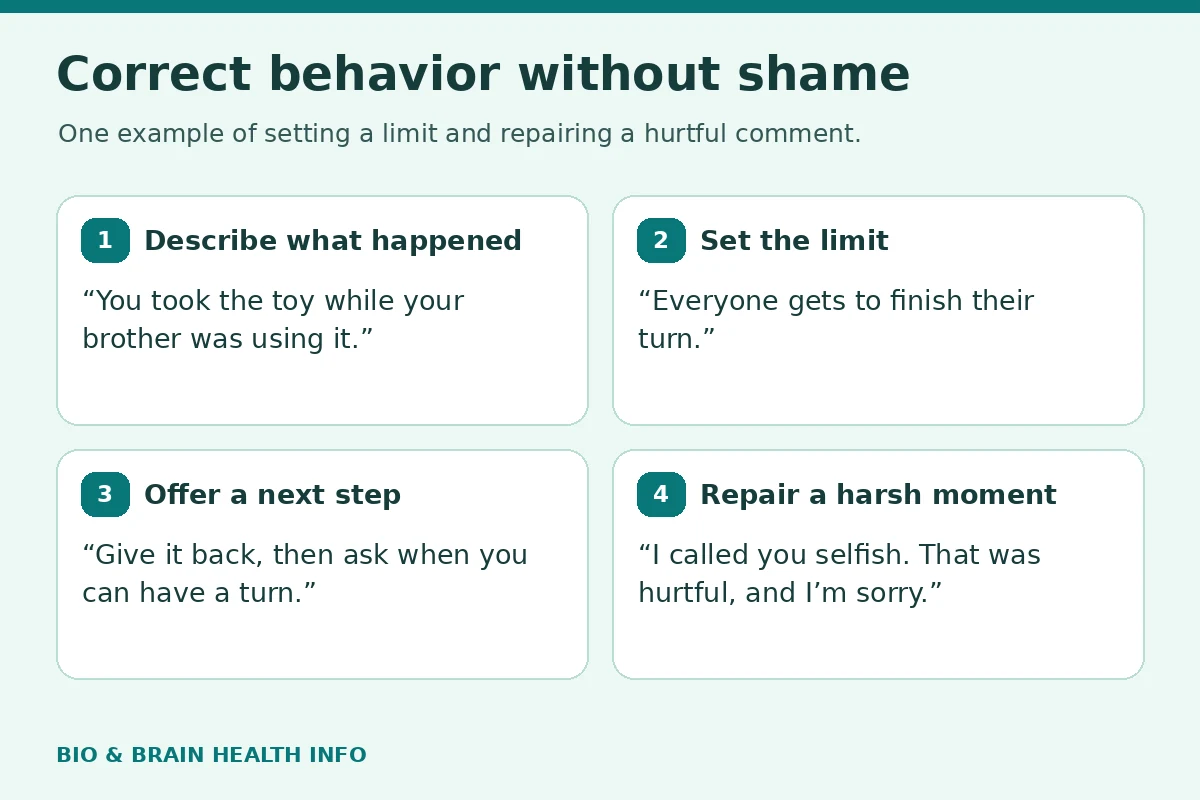
The American Academy of Pediatrics advises against using yelling or shaming as discipline. It recommends approaches such as setting limits, redirecting behavior, and reinforcing behaviors you want to see. American Academy of Pediatrics
When you need to correct a child, tell them what happened, why it matters, and what they can do next. If everyone is upset, a short instruction may be enough to handle the immediate problem. You can talk through the rest when things are calmer.
| Situation | What you can say |
|---|---|
| A child spills juice while carrying a full cup. | “The juice spilled. Let’s get a cloth. Use both hands when you carry a full cup.” |
| A child hits a sibling. | “I won’t let you hit. Step back with me. We’ll talk when everyone is safe.” |
| A child forgets an assignment. | “The assignment is still at home. Where could you leave your folder tonight so you’ll see it in the morning?” |
| A child is upset about a low grade. | “You look disappointed. When you’re ready, we can find one part to practice.” |
Make encouragement specific. “You drew a picture when you got stuck on that math problem” gives the child a strategy they can try again.
How to repair a harsh comment without dropping the limit
Suppose you called your child selfish after they grabbed a toy from their sibling. When you’re calm, go back and have a brief conversation.
“I called you selfish when I was upset. That was hurtful, and I’m sorry. Your brother was still using the toy. Please give it back and ask him when you can have a turn.”
Give your child time to respond. They may still be upset. Following through calmly the next time helps make the apology concrete.
For more on family communication and emotional development, explore BBH Parenting.
Frequently Asked Questions
Can childhood criticism affect self-esteem in adulthood?
It can be one influence. A person who often heard hurtful labels as a child may later use similar language toward themselves after everyday mistakes. Other experiences, including how people treat them now, may also shape their self-esteem. Notice the words you use when something goes wrong and ask whether they describe the event or judge you as a person.
Is self-esteem fixed by age three?
Self-esteem can change throughout life. A review of longitudinal studies covering ages 4 to 94 found changes in average self-esteem across the lifespan. Orth, Erol, and Luciano, 2018.
Can I work on my self-esteem if my parents never apologize?
Yes. Pick something within your control. The next time you hear yourself say, “I ruin everything,” describe the particular thing that happened. You might write, “I forgot to confirm the appointment, and I’ll call to reschedule.” If family conversations still involve hurtful criticism, you can also decide ahead of time what you want to say and when you want to end the conversation.
When might it help to talk to a therapist?
Consider speaking with a licensed mental health professional if fear of criticism regularly interferes with your work, relationships, or everyday decisions. You can bring a recent example to the conversation and describe what the other person said, how you interpreted it, and what you did afterward.
One thing to try this week
If childhood criticism and self-esteem are concerns for you, choose one moment you keep replaying. Write one sentence about what happened and one sentence about what you made it mean. Then ask what the situation needs from you today. It might need a corrected file, a clarifying question, or simply your attention back on the rest of your day.
For more on self-worth and emotional recovery, visit BBH Emotional Healing.
This article is for general education. See the BBH mental health and self-help guidance.
Research and References
- Melamed et al. (2024). Trauma, maltreatment, and negative self-concept in children and adolescents. Meta-analysis.
- Wang and Kenny (2014). Harsh verbal discipline and adolescent conduct problems and depressive symptoms. Longitudinal study.
- Haines and Schutte (2023). Parental conditional regard. Meta-analysis.
- Wakelin, Perman, and Simonds (2022). Self-compassion interventions and self-criticism. Systematic review and meta-analysis.
- Orth, Erol, and Luciano (2018). Development of self-esteem from age 4 to 94. Meta-analysis of longitudinal studies.
- American Academy of Pediatrics (2018). Effective Discipline to Raise Healthy Children. Policy statement.