Pear: Nutrition, Benefits and Side Effects
Pear Health Benefits, Nutrition and Risks

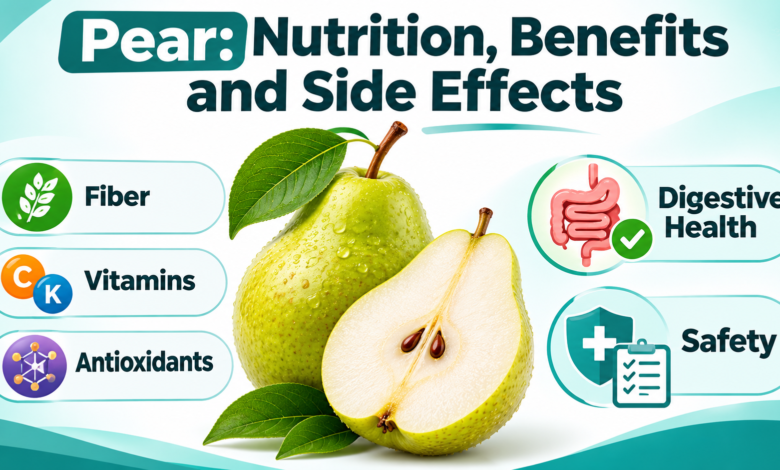
A ripe pear can be an easy snack, but nutrition advice about pears sometimes sounds contradictory. One person recommends them for constipation, another avoids them because of bloating, and someone managing diabetes may wonder whether their sweetness is a problem. These experiences are not necessarily inconsistent. The same fruit contains dietary fiber, water and fermentable carbohydrates, and the effects depend on the person, portion and preparation.
Thank you for reading this post, don't forget to subscribe!Understanding pear health benefits means looking beyond a list of vitamins to the actual food, the quality of human research and individual tolerance. This guide uses US reference serving sizes and metric weights for readers in the United States, United Kingdom, Canada and Australia. It explains how pears can fit into everyday meals without presenting them as a treatment for chronic disease.
Medical Safety & Disclaimer
This article provides general nutrition education, not individualized medical advice. If you have diabetes, persistent constipation, irritable bowel syndrome, kidney disease or suspected food allergy, follow your healthcare team’s recommendations. Do not replace prescribed treatment with fruit, juice or supplements.
Quick Answer
One medium raw pear (178 g edible portion) provides approximately 101 calories, 27.1 g total carbohydrate and 5.5 g fiber. Pears can contribute to bowel regularity and a balanced dietary pattern. Their fructose and sorbitol can trigger symptoms in susceptible people. Human evidence does not establish pears as a treatment for diabetes or hypertension.
In This Guide
What you will learn
Nutrition facts • Fiber and bowel regularity • Fructose and sorbitol • Heart health evidence • Diabetes portions • Whole versus peeled or canned pears • Weight management • Allergy and food safety • Practical meal ideas • FAQs
1. Pear nutrition facts: What does a serving contain?
The edible part of a pear consists mainly of water and carbohydrate. It supplies fiber, modest amounts of vitamin C and potassium, and a variety of plant compounds. The following reference values describe raw pear rather than pear juice, dried fruit or a product packed in syrup. Fruit size and cultivar affect the actual nutrient amounts, so weighing the edible portion is useful when precision matters.
| Nutrient | Per 100 g | Medium pear (178 g) |
|---|---|---|
| Energy | 57 kcal | 101 kcal |
| Total carbohydrate | 15.23 g | 27.1 g |
| Total sugars | 9.75 g | 17.4 g |
| Fiber | 3.1 g | 5.5 g |
| Protein | 0.36 g | 0.64 g |
| Fat | 0.14 g | 0.25 g |
| Vitamin C | 4.3 mg | 7.7 mg |
| Potassium | 116 mg | 206 mg |
Sources: USDA FoodData Central, raw pear record 169118 and USDA-derived pear serving values. Values are rounded and refer to a generic USDA reference fruit. Other database records, including individual pear cultivars, can report slightly different figures. In US nutrition labeling, fiber and sugars are included in total carbohydrate. A medium pear contains about one fifth of the US label Daily Value for fiber (28 g). This is a general reference rather than a personal daily requirement.
Which nutrients explain pear health benefits?
Fiber contributes to normal bowel function and helps people meet dietary fiber recommendations. Vitamin C supports normal collagen production and immune function. Potassium has established roles in nerve and muscle physiology. Pears are not exceptionally rich in every vitamin, nor do they supply much protein or fat. Their nutritional value is best understood alongside other foods that provide the nutrients pears contain in smaller quantities.
2. Pear health benefits for digestion and bowel regularity
Dietary fiber is a broad category of carbohydrates and related substances that are not fully digested in the small intestine. Different fibers retain water, contribute to stool bulk or undergo fermentation by gut microbes to different degrees. Pears provide a mixture of fiber types, including pectin. These properties may support bowel regularity in the context of a varied diet.
The NIDDK: nutrition for constipation recommends obtaining adequate fiber from food and increasing intake gradually. Fluid requirements should also be individualized. A sudden increase in fiber is not necessarily better than a gradual change, especially for someone who already experiences abdominal discomfort. People with prescribed fluid restrictions should not automatically increase drinking water without medical advice.
Direct clinical research establishing a particular number of pears as a treatment for chronic constipation remains limited. The 2025 British Dietetic Association constipation guidelines evaluated dietary interventions and highlighted evidence for particular fiber supplements and foods. Those findings should not be generalized to an equivalent weight of pear or assumed to establish a therapeutic pear dose.
Digestive Safety
Persistent constipation, blood in stool, unexplained weight loss or substantial changes in bowel habits deserve medical evaluation. Severe pain with vomiting or inability to pass stool or gas can require urgent assessment. Do not delay care while trying fruit remedies.
3. Content gap: Pear health benefits and the fiber–FODMAP paradox
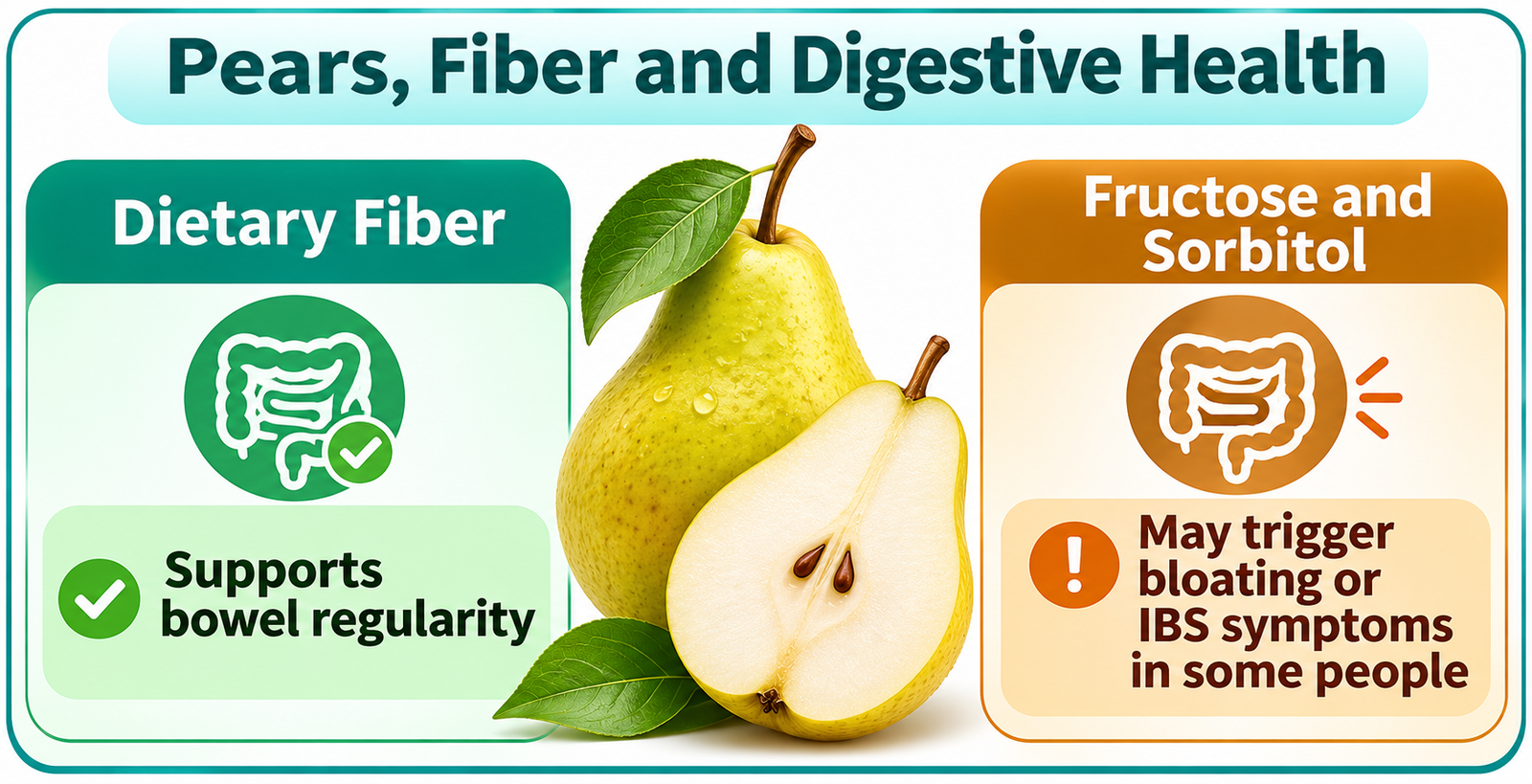
Pears contain fructose and sorbitol as well as fiber. According to Monash University: FODMAP food guidance, these are the main FODMAPs of concern in pears. FODMAPs are fermentable short-chain carbohydrates that may be incompletely absorbed in the small intestine. They can draw water into the bowel and be fermented by intestinal microorganisms. These properties help explain why a fruit with useful nutritional characteristics can nevertheless provoke digestive symptoms.
| Reader situation | Potential relevance of pears |
|---|---|
| Low dietary fiber intake | A suitable portion can contribute fiber. |
| Constipation without marked sensitivity | Fiber and food variety may support regularity. |
| IBS or fructose/sorbitol sensitivity | A portion may cause gas, bloating or loose stools. |
| Persistent or unexplained symptoms | Medical assessment is more important than testing larger portions. |
A food may change stool frequency without improving overall comfort. For example, someone might experience a bowel movement after consuming a large pear but also develop considerable cramping. That is not necessarily a successful dietary outcome. A more useful assessment considers pain, urgency, stool consistency and daily functioning as well as bowel frequency.
The distinction is particularly relevant to constipation-predominant IBS. Having constipation does not establish that every high-fiber fruit will be tolerated. A dietitian can help select foods that meet fiber requirements without unnecessarily worsening symptoms. A structured low-FODMAP strategy generally involves a temporary restriction, systematic reintroduction and personalization rather than lifelong avoidance of all listed foods.
For readers seeking alternatives, Kiwi: Nutrition, Benefits and Side Effects discusses clinical evidence for green kiwifruit and constipation. This is not a recommendation to replace pears with kiwi in every case, particularly for people with kiwi allergy. The comparison illustrates why the most appropriate fruit depends on evidence for the desired outcome and personal tolerance.
4. Pear and blood sugar: Can people with diabetes eat pears?
Pears are carbohydrate-containing foods, and many people with diabetes can include them in an individualized eating plan. Their fiber does not make the carbohydrate disappear. The size of the edible portion, other foods in the meal, activity, medications and individual physiology all influence the glucose response.
| Edible pear portion | Approximate total carbohydrate | Approximate fiber |
|---|---|---|
| 50 g | 7.6 g | 1.6 g |
| Half medium (89 g) | 13.6 g | 2.8 g |
| 100 g | 15.2 g | 3.1 g |
| Small (148 g) | 22.5 g | 4.6 g |
| Medium (178 g) | 27.1 g | 5.5 g |
| Large (230 g) | 35.0 g | 7.1 g |
About 98–100 g of raw pear supplies close to 15 g of total carbohydrate, corresponding to one carbohydrate choice in common US diabetes education. The calculation is a reference example, not an insulin dosing instruction. Labeling conventions differ internationally, including how carbohydrate and fiber are reported. Use the counting method recommended by your local diabetes team.
Why glycemic index is not a complete meal plan
Glycemic index compares glucose responses to a standardized quantity of available carbohydrate under specified test conditions. It does not automatically describe the effect of an ordinary serving. Glycemic load incorporates serving carbohydrate, but it also remains an estimate rather than a prediction of an individual’s response. A large pear and a small pear are not interchangeable simply because they belong to the same fruit category.
Consider whether pear is replacing another carbohydrate-rich food or being added to an existing meal. For instance, a measured portion with plain yogurt may have a different nutritional profile from a large pear smoothie with sweetened milk and additional fruit. Read Fruit and Diabetes: Portions and Choices and Carb Counting for Diabetes: Beginner Guide for more complete carbohydrate planning guidance.
Blood Sugar Safety
Pears can raise blood glucose. Do not adjust medication based on one food response. For hypoglycemia, use the fast-acting carbohydrate recommended in your personal care plan; severe symptoms require emergency assistance.
5. Pear health benefits for heart health: What human research shows
The 2019 randomized pear trial examined fresh pear consumption in 40 adults aged 45–65 with metabolic syndrome. Participants were assigned in a crossover design to two fresh medium pears daily or a calorie-matched control beverage during 12-week intervention periods. This was a specific research comparison, not a universal prescription.
After the pear intervention, systolic blood pressure changed from approximately 134 to 130 mmHg relative to baseline, but the result did not reach the conventional statistical significance threshold (P = 0.07). Pulse pressure decreased significantly relative to baseline. Selected waist and leptin measures also showed changes. These findings do not establish that pears reliably treat hypertension or prevent cardiovascular events.
The 2019 apple and pear systematic review and meta-analysis reviewed research involving apples, pears and their products. Its findings include both intervention studies and observational associations. Combining fruits in an analysis limits the ability to isolate the independent effect of pears. Observational associations may also reflect other differences in lifestyle and diet. A nutritious dietary pattern remains the better-supported foundation.
Evidence Literacy
A change in a secondary outcome or a comparison with baseline does not necessarily prove superiority over a control intervention. Do not replace blood pressure or cholesterol medicines with pears.
6. Pear health benefits and plant compounds: Skin, flesh and variety
Pear varieties differ in color, texture, sweetness and composition. Bartlett, Anjou and Bosc pears are familiar European-type varieties, while Asian pears have distinct characteristics. The 2025 review of pear nutrients and bioactive compounds describes differences by cultivar, maturity and plant part. A finding involving a particular peel extract or young fruit cannot be automatically transferred to an ordinary ripe pear.
The skin contributes fiber and contains various plant compounds, but eating it is not mandatory for everyone. Someone with texture-related difficulties or individualized dietary restrictions may choose a different preparation. Peeling does not reliably remove the fructose or sorbitol present in the flesh, and it cannot guarantee safety for someone with a food allergy.
Laboratory antioxidant measurements and experiments on concentrated extracts are useful for investigating mechanisms. They are not proof that a serving of pear prevents cancer, dementia or inflammatory disease. The 2015 systematic review of pears and health identifies the need for further pear-specific human research. It is reasonable to enjoy pears for their nutritional contribution without attributing unproven medical effects to them.
7. Fresh, peeled, cooked, canned and juiced pears
| Food form | Practical consideration |
|---|---|
| Whole raw pear | Retains the original food structure and skin fiber. |
| Peeled pear | Some fiber and other compounds are removed with the peel. |
| Cooked pear | Texture changes; added ingredients influence nutritional composition. |
| Canned pear | Check packing liquid, drained serving weight and nutrition label. |
| Pear juice | Usually contains substantially less fiber than whole fruit. |
| Dried pear | Lower water content concentrates carbohydrate per gram. |
Unsweetened frozen or canned fruit may be convenient when fresh fruit is unavailable. A product packed in juice or syrup can supply additional carbohydrate if the liquid is consumed. Draining the fruit changes the amount eaten, but the exact nutritional value depends on the product. Compare the serving described on the label with the portion you actually consume.
For people with IBS, processing does not guarantee low FODMAP content. Cooking softens the fruit but does not reliably eliminate the relevant carbohydrates. Check preparation-specific guidance if following a structured dietary plan. People with suspected food allergy should not use cooking as an unsupervised test of safety.
8. Pears, appetite and weight management
Whole pears can be satisfying because they contain water and fiber and require chewing. Replacing an energy-dense snack with an appropriate fruit portion may help some people meet their nutrition goals. Adding fruit on top of an otherwise unchanged diet is a different intervention. Neither approach proves that pears have a unique fat-burning effect.
A balanced snack can include a measured portion of pear with a suitable protein-containing food. The aim is to support satisfaction and overall nutritional adequacy rather than impose a restrictive fruit-only diet. For readers who need individualized advice, a dietitian can help design a pattern that fits their medical circumstances and budget. Read Mediterranean Diet and Type 2 Diabetes and Diabetes Snacks: Balanced Options.
9. Pear side effects and medical precautions
Pollen-food allergy syndrome and serious reactions
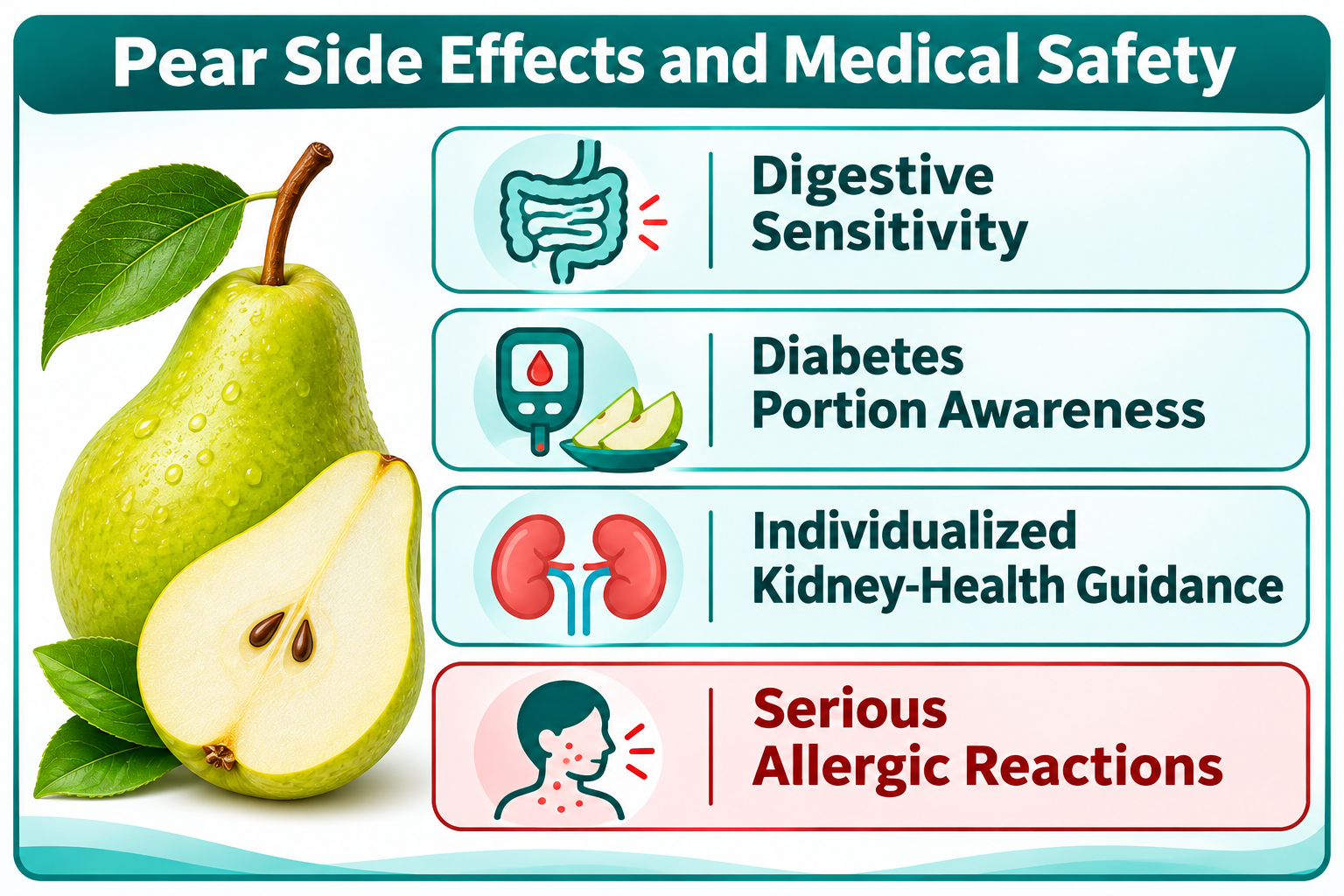
The ACAAI: pollen-food allergy syndrome identifies pear among foods that can cross-react with birch pollen in susceptible individuals. Some people experience mouth or throat itching after eating raw fruit. The International allergy consensus (2024) emphasizes individualized allergy management. Not everyone with hay fever has a pear allergy, and pear allergy can also occur outside the typical pollen-food pattern.
Stop eating the fruit if you suspect an allergic reaction. Throat swelling, breathing difficulty, faintness or rapidly progressing symptoms may indicate anaphylaxis. Call local emergency services and use prescribed epinephrine according to the allergy action plan. Do not assume that peeling or cooking will make the fruit safe after a previous serious reaction.
Allergy Safety
Mouth itching may represent an allergic reaction. Seek medical advice for suspected allergy, and emergency care for breathing difficulty, throat swelling or faintness.
Kidney disease and digestive restrictions
A medium reference pear provides approximately 206 mg potassium. People with kidney disease may have individualized potassium, fluid or other nutritional targets. A single generic food list cannot determine whether pears are suitable. Large fruit portions can contribute more potassium and carbohydrate than expected. Seek advice based on laboratory results and your care plan.
10. How to enjoy pear health benefits safely
Wash pears under running water before eating or cutting, even if you plan to remove the skin. Use clean utensils and refrigerate cut fruit promptly. Follow FDA produce safety and local recall notices. For young children or people with swallowing difficulties, prepare textures and pieces appropriate to their developmental or clinical needs.
Try pear slices with plain yogurt, oatmeal or an appropriate protein source. If digestive sensitivity is a concern, discuss portion adjustments or alternative fruits with a dietitian rather than forcing yourself to consume a large serving. Use US household measures or metric weights as preferred, and compare local nutrition labels when buying packaged products in the UK, Canada or Australia.
11. Frequently asked questions
Can I eat pears every day?
Pears can fit a varied diet when tolerated. No universal daily requirement exists.
Are pears good for constipation?
They provide fiber and water, but direct evidence for a standardized therapeutic serving is limited. They can worsen symptoms in some people with IBS.
Can people with diabetes eat pears?
Many can include measured portions in their meal plan. Count carbohydrate as recommended.
Is pear skin necessary?
No. It contributes fiber and plant compounds, but preferences and medical needs may influence preparation.
Are pears better than apples?
Neither is universally superior. Both provide nutrients and fiber, and both can cause FODMAP-related symptoms in susceptible people.
Conclusion
The most dependable pear health benefits arise from the fruit’s fiber, nutrients and contribution to dietary variety. Pear-specific cardiovascular trials are interesting but limited. The fiber–FODMAP distinction helps explain why digestive effects differ. Choose suitable portions and preparations, respect individual tolerance and continue necessary clinical care.
BBH Key Takeaway
Enjoy pears as food rather than medicine. Measure portions when needed, distinguish fiber benefits from fermentable carbohydrate sensitivity, and seek professional advice about persistent symptoms or allergic reactions.
Scientific references
USDA FoodData Central, raw pear record 169118 • USDA-derived pear serving values • 2015 systematic review of pears and health • 2019 randomized pear trial • 2019 apple and pear systematic review and meta-analysis • 2025 review of pear nutrients and bioactive compounds • NIDDK: nutrition for constipation • 2025 British Dietetic Association constipation guidelines • Monash University: FODMAP food guidance • ACAAI: pollen-food allergy syndrome • International allergy consensus (2024) • FDA produce safety
Related reading on BBH
Explore: Physical Health → Weight, Nutrition & Metabolic Health