What Causes Narcissism? What Research Shows
How Narcissism Develops: Causes and Factors


What causes narcissism? There’s no established single cause of narcissistic personality disorder. Researchers have studied parenting experiences, childhood maltreatment, and genetic and environmental influences on narcissistic traits. These studies can help explain patterns across groups. They cannot tell you exactly why a particular person developed a trait or whether that person has a disorder. Mayo Clinic: narcissistic personality disorder causes
Thank you for reading this post, don't forget to subscribe!The question often feels personal. Perhaps someone takes credit for your work, or a family member repeatedly expects you to set your needs aside. Knowing their history might help you understand part of the picture. You can also decide what you need to address today while the history remains uncertain. This guide explains how to read the evidence and what to do with the information you actually have.
What causes narcissism depends on what researchers measure
In everyday conversation, the word narcissism can refer to behavior that seems self-centered or entitled. In research, it can refer to traits measured by a questionnaire, or to a more impairing pattern studied under the term pathological narcissism. Narcissistic personality disorder is a clinical diagnosis. A study about scores on a childhood trait questionnaire answers a different question from a study of adults assessed for the disorder. Pincus and Lukowitsky’s clinical review · Mayo Clinic overview
Here is a practical way to see the difference. Suppose a child often wants to be first in line. A researcher may record that response as one part of a questionnaire about preferences and expectations. A clinician assessing an adult would consider a much wider pattern, including the person’s history and functioning. Even with similar words in the questions, a childhood score cannot stand in for an adult diagnosis. For real-life examples of grandiosity, see What Is Grandiosity in Narcissism?.
What causes narcissism and what merely resembles it?
Healthy self-esteem includes valuing yourself and having some confidence in your abilities. Narcissistic traits involve a different set of features, such as feeling superior or expecting special treatment. A research review distinguishes narcissism and self-esteem in their development and social consequences. That matters when you interpret a loud boast, a child’s pride, or a person’s willingness to take recognition for work they did. A single example usually needs context. Brummelman, Thomaes, and Sedikides, 2016 · Self-Care vs Narcissism
What causes narcissism in childhood?
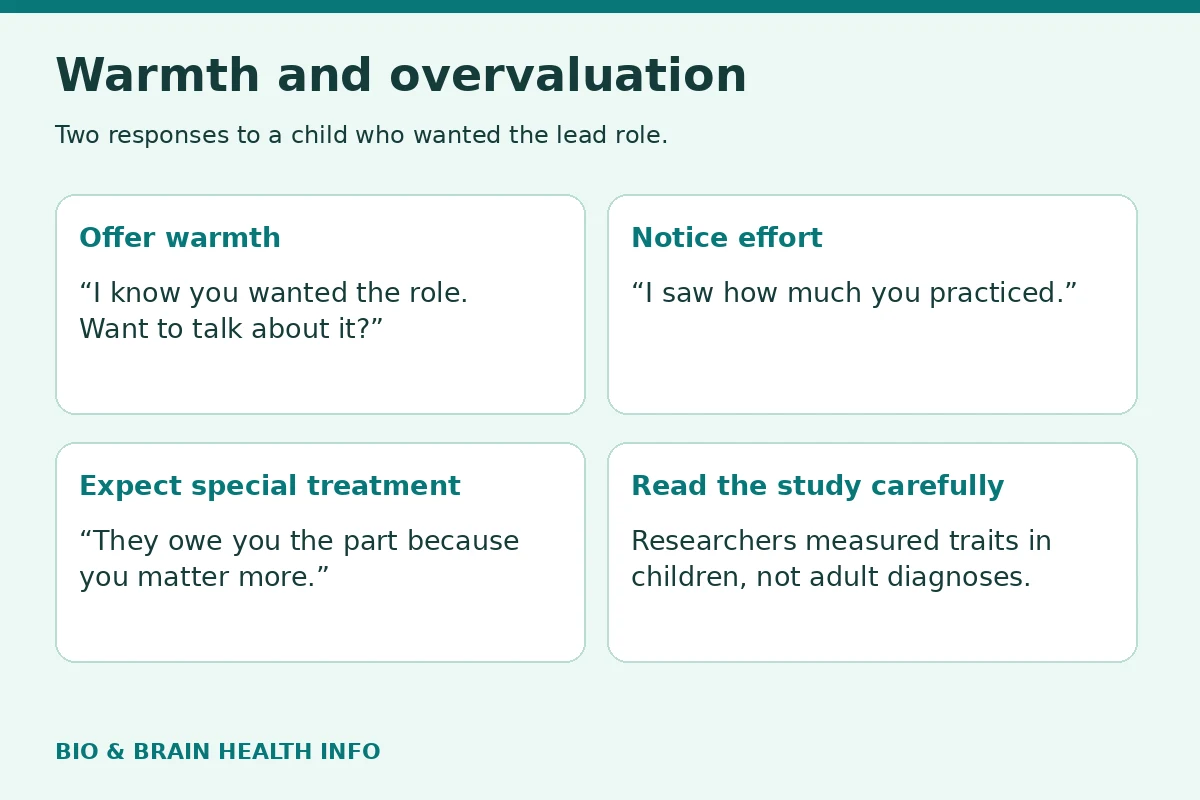
Brummelman and colleagues followed 565 children aged 7 to 12 and their parents across four assessments, each about six months apart. Parental overvaluation predicted later narcissistic traits in the study. Parental warmth predicted later self-esteem. Overvaluation refers to treating a child as more special or deserving than others. Warmth refers to affection and support. The findings concern these group-level measures over the study period. They do not establish that praise caused a particular child’s behavior or that any child developed a personality disorder. Brummelman et al., 2015, PNAS
A useful distinction for parents is what the message teaches. “I saw how much you practiced” tells the child that someone noticed their effort. “They should have picked you because you’re better than everyone” tells the child how to rank themselves against others. Parents can be proud and affectionate, celebrate accomplishments, and help children tolerate disappointment. One awkward compliment does not tell you much about a family’s pattern.
Does praise itself explain what causes narcissism?
The study examined overvaluation and warmth, not a rule about the number of compliments a child received. Consider two responses to a child who says, “I should have got the main part.” One is, “I know you wanted it. Do you want to talk about the audition?” Another is, “They owe you the main part because you’re more important than the other children.” Both responses engage with disappointment. Only one encourages the child to expect an exception based on superiority.
If you think you praised in a way that put too much weight on winning, you can change the next conversation. Ask the child what they enjoyed, what was hard, or whether they want to try again. A parent can offer warmth and acknowledge effort without deciding that the outcome was unfair. For related reading on childhood feedback and its limits, see How Childhood Criticism Shapes Self-Esteem.
Adversity, genetics, and what the evidence can establish
A meta-analysis by Gao and colleagues found associations between childhood maltreatment and measures of both vulnerable and grandiose pathological narcissism. The associations were modest and differed by the type of narcissism measured. A group-level association cannot establish an individual’s childhood history. Exposure to adversity has many possible outcomes, and you do not need to infer a history you have never been told. Gao et al., three-level meta-analytic review
Twin research uses similarities and differences between twins to estimate contributions to variation in traits. One study of 304 twin pairs in Beijing examined grandiosity and entitlement and found evidence of genetic and environmental contributions. The findings concern variation in questionnaire scores in that sample. They cannot assign a percentage of one person’s behavior to genes, identify a single gene, or establish who will develop narcissistic personality disorder. Institute of Psychology, Chinese Academy of Sciences: twin study
Mayo Clinic includes environment, genetics, and neurobiology among possible influences on the disorder and says its cause is not known. Research on culture, parenting, or biology asks different questions. A claim that a particular environment influences a trait needs evidence that fits the population and outcome. An explanation that sounds plausible still needs testing. Mayo Clinic: proposed causes and risk factors
| Finding | What it supports | What it cannot establish |
|---|---|---|
| Parental overvaluation preceded changes in childhood trait scores in one study. | A possible developmental influence worth further study. | A diagnosis, or the cause of one child’s behavior. |
| Childhood maltreatment was associated with pathological narcissism across studies. | A group-level link that can inform further research. | Whether a particular adult experienced adversity, or how an individual survivor will develop. |
| Twin modeling found genetic and environmental contributions to measured traits. | Both kinds of influence can contribute to variation. | A genetic test or a personal breakdown of causes. |
A practical test for claims about what causes narcissism
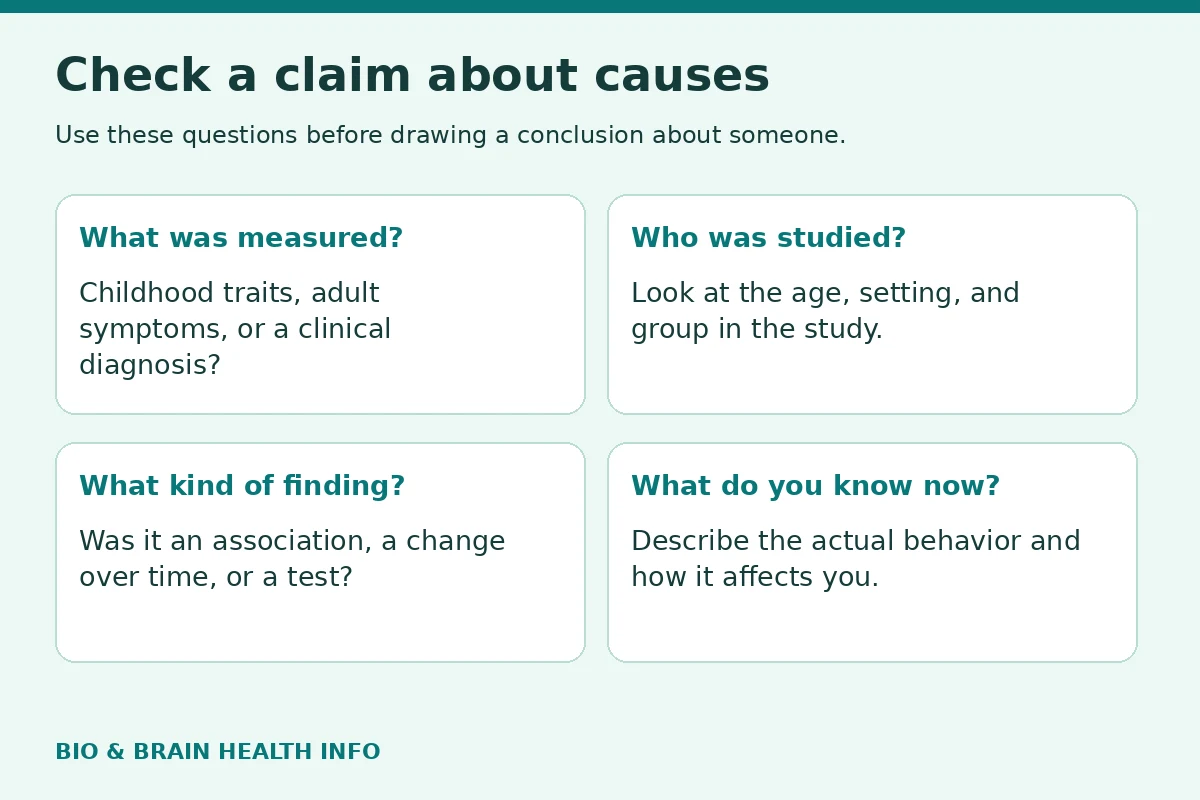
When a post says “this causes narcissism,” ask three questions. What did researchers measure? Which people did they study? Was the finding a pattern across groups, a change over time, or evidence from an intervention? Answering these questions often makes the claim narrower and more useful.
Worked example: One claim, two different questions
Imagine an article says, “A person who constantly wants praise must have been neglected as a child.” Set that claim beside what you can actually observe. Perhaps your coworker repeatedly redirects a meeting to their achievements. You know what they said and how the discussion changed. You may know very little about their childhood. A review finding that two things are associated across groups cannot supply a missing history.
If the immediate problem is that you cannot finish delivering your part of the agenda, you can ask for uninterrupted time or raise a recurring issue through the appropriate work channel. If the behavior occurs in an intimate relationship and you are worried about retaliation, ask someone qualified about confidential support. The action depends on what the situation requires. It does not have to wait for an explanation of the person’s development.
If two accounts of someone’s childhood differ
A sibling may remember the family as affectionate. Another sibling may remember constant comparison. Both can describe what they experienced. Different accounts can be useful in clinical work, but you cannot combine them into a diagnosis from one conversation. Start by asking what information each person actually has and what question you are trying to answer.
If the question is why you feel hurt now, you may learn more from noticing what happened in recent interactions. “He repeatedly made jokes about my work after I asked him to stop” gives you something specific to address. You don’t have to frame it as a dispute over whether someone was praised too much or too little. Recognizing Narcissistic Tendencies in Relationships
Why an earlier event is easier to identify than a cause
A family might notice that a child’s behavior changed after a move. That timing is worth describing. It leaves several possibilities open. The child may have changed schools, lost regular contact with friends, taken on a new role at home, or had to handle unfamiliar expectations. If you already expect the move to explain everything, it can be easy to overlook the other changes.
Researchers use different designs to narrow those possibilities. Repeated measurements show what preceded what. A review can show whether studies tend to find a similar association. Both still leave questions about how the variables were measured and what else might explain the result. For a reader trying to make a decision today, the useful limit is simple. Say what happened, describe how it affected you, and leave room for what you have yet to learn.
What you can do with what you already know
Describe the behavior, its effect, and one practical change you need. At work that could mean asking for accurate credit in shared notes. At home it might mean taking a pause when insults begin, if you can safely do so. If the behavior recurs, ask someone you trust or a qualified professional about options. Share a specific example and how it affected you.
An explanation for hurtful behavior may bring context. It does not decide the terms of your relationship. You can have compassion for what someone experienced while taking their actions seriously. If you fear threats, monitoring, or retaliation, seek confidential advice rather than assuming a stronger script will make it safer. BBH guide to boundaries and confidential support
If you recognize a pattern in yourself
You might notice that you get defensive when someone else gets credit, or that you expect exceptions you would not offer others. Pick one recent event. How did the other person respond? Is there something you can repair or do differently next time? A sincere correction can be concrete: “I took credit for the analysis in that meeting. I’ll update the notes so your contribution is visible.”
If the pattern is persistent or causing distress, a qualified mental health professional can help you think through it and assess whether more support is useful. In the United States, primary care or a mental health professional can be a starting point. In the UK, Canada, and Australia, ask a local health service or primary care professional how to access an assessment or counseling. U.S. NIMH: Help for Mental Illnesses · BBH Mental Health Support Resources
Personal reflections from the original article
The following reflections describe one perspective. They are separate from the population-level research discussed above.
Personal note: Understanding adaptation helped me stop treating reactions as character.
Personal note: Recognizing bodily signals softened how I judged my thoughts.
Personal note: Understanding motivation stopped me from labeling myself by reactions.
Personal note: I noticed growth when slowing down felt natural, not forced.
Personal note: Ethical framing helped me understand behavior without condemning the person.
Personal note: Relief began when certainty softened before emotions did.
Personal note: My body trusted repetition more than insight.
Personal note: Quiet focus was my earliest sign of recovery.
Personal note: My values returned before certainty did.
Personal note: Being mirrored calmly mattered more than advice.
Personal note: Wholeness felt familiar, not new.
Understanding what causes narcissism shifted how I approached my own reactions and responsibilities. I stopped interpreting patterns as personal defects and began seeing them as responses formed under pressure.
Learning about childhood trauma narcissism helped me recognize how early environments can shape protection without defining character. That insight didn’t excuse harm or remove accountability—it clarified context.
With clarity, self-attack softened, and reflection became steadier. I no longer needed to defend or diagnose myself. I needed to understand how behavior can form without becoming identity.
Frequently asked questions
Is narcissism genetic or learned?
Research suggests that both genetic and environmental factors contribute to variation in some measured traits. How those influences relate to a particular person, and whether that person has a clinical disorder, cannot be determined from a family resemblance or one childhood experience. Twin study of grandiosity and entitlement · Mayo Clinic overview
Does childhood trauma always lead to narcissism?
No. The research reports associations across groups, with many possible outcomes after adversity. A person can experience trauma without developing narcissistic traits, and seeing a trait does not tell you what happened to them as a child. Child maltreatment and pathological narcissism meta-analysis
Can I understand what causes narcissism from a family story alone?
A family story may provide context. It rarely gives you enough information to separate temperament, experience, remembered events, and current behavior. If you are concerned about a clinical diagnosis, bring your observations to a qualified mental health professional. If you are trying to decide what to do in a relationship, begin with the behavior you can describe.
Research and references
- Brummelman et al. (2015). Origins of narcissism in children. Proceedings of the National Academy of Sciences, 112(12), 3659–3662. DOI: 10.1073/pnas.1420870112.
- Gao et al. (2024). The association between child maltreatment and pathological narcissism: A three-level meta-analytic review. Trauma, Violence, & Abuse.
- Institute of Psychology, Chinese Academy of Sciences. A behavioral genetic study of intrapersonal and interpersonal dimensions of narcissism.
- Pincus, A. L., and Lukowitsky, M. R. (2010). Pathological narcissism and narcissistic personality disorder. Annual Review of Clinical Psychology, 6, 421–446.
- Brummelman, E., Thomaes, S., and Sedikides, C. (2016). Separating narcissism from self-esteem. Current Directions in Psychological Science, 25(1), 8–13.
- Mayo Clinic. Narcissistic personality disorder: Symptoms and causes.