Health Insurance Quotes: How to Compare
Compare Health Insurance Quotes: 2027 US Guide


A low monthly insurance price can look like a solution when household bills are rising. But a plan that seems inexpensive today may leave you facing substantial charges when you need a specialist, prescription or hospital stay. Learning to compare health insurance quotes means looking beyond the advertised premium and understanding what each policy actually provides. This guide is for US consumers evaluating individual and family coverage for 2027, including people buying insurance for the first time or replacing an existing policy.
Thank you for reading this post, don't forget to subscribe!In This Guide: Quote sources, price factors, financial assistance, annual costs, benefit documents, provider networks, medications, family coverage, the BBH comparison audit, enrollment and FAQs.
What is a health insurance quote?
A quote is a price estimate for a particular insurance product based on the information supplied by the prospective applicant. It may show the gross monthly premium, estimated financial assistance and the amount expected to remain payable. It is not proof that an application has been approved or that coverage has started. A preliminary price can change if household information, eligibility, the requested effective date or other relevant details change.
Start with the plan year and product type. Individual Marketplace coverage, employer-sponsored group coverage, Medicare and temporary insurance follow different rules. A price comparison between fundamentally different products can create an impression of savings without measuring the same protection. Ask for the full policy name and insurer, rather than relying on a marketing label such as premium, preferred or basic.
Where to compare health insurance quotes online
The official HealthCare.gov plan preview tool allows consumers to explore estimated prices. Residents of states operating their own exchanges can follow the federal site to the appropriate state program. The preview is useful for narrowing choices, while the application obtains more information needed for an actual eligibility determination.
An insurer or licensed agent may also provide quotes. Ask whether the agent represents multiple companies, whether all available plans are displayed and whether the quoted product is Marketplace coverage or a different policy. If you prefer assistance without selecting an agent independently, use the official Marketplace local help directory. Verify an agent’s license with your state insurance department before providing sensitive information.
Do not submit a Social Security number, medical records or payment information merely to obtain a generic advertised price from an unfamiliar website. The official application may legitimately require sensitive information, but verify that you are using the authentic service. A quote request does not authorize someone to enroll you in a policy.
Five factors that affect individual insurance prices
According to HealthCare.gov premium guidance, relevant Marketplace pricing factors include geographic location, age, tobacco use, plan category and whether dependents are included. State restrictions may limit how some factors are used. Marketplace insurers cannot charge more based on sex or medical history. This protection should not be assumed to apply to every limited-benefit product.
Use the same ZIP code, ages, household members and tobacco information for each comparison. Quotes for different coverage years or different family members cannot be compared directly. Ask whether dental coverage is included or separately priced. If a family member is eligible for another program, compare the arrangements using the actual eligibility results rather than assuming everyone must purchase a single policy.
How to compare health insurance quotes after financial assistance
The gross premium is the price before any applicable subsidy or employer contribution. The net premium is the amount remaining after the assistance applied to that premium. Compare gross and net amounts separately. Marketplace estimates depend on projected household income, relevant tax family details and other eligibility requirements. Consult the official household and income guidance.
If an offer of qualifying employer insurance affects your eligibility, an attractive Marketplace estimate might not be available on final application. Likewise, advance premium tax credits are reconciled when filing the relevant federal tax return. Changes in income or household composition can alter the final amount. Keep the monthly insurance budget separate from any potential tax reconciliation reserve and seek qualified tax assistance if necessary.
Compare health insurance quotes using annual costs
An annual comparison starts with the premiums payable for the actual coverage period. Add estimated patient charges for covered care, then separately consider noncovered services and expenses outside the plan’s protection. Avoid adding the deductible twice: if your estimated medical cost sharing already includes deductible payments, it should not be added again. The official total-cost guide describes why premiums alone are insufficient.
The deductible applies to particular services under the contract. A copayment is usually a fixed charge for a covered service, while coinsurance is a percentage of the relevant allowed amount. Some services have a copayment before the deductible is met; others require the deductible first. Prescription benefits may have separate rules. Read the contract rather than assuming every service follows the same cost-sharing arrangement.
A realistic three-scenario cost comparison
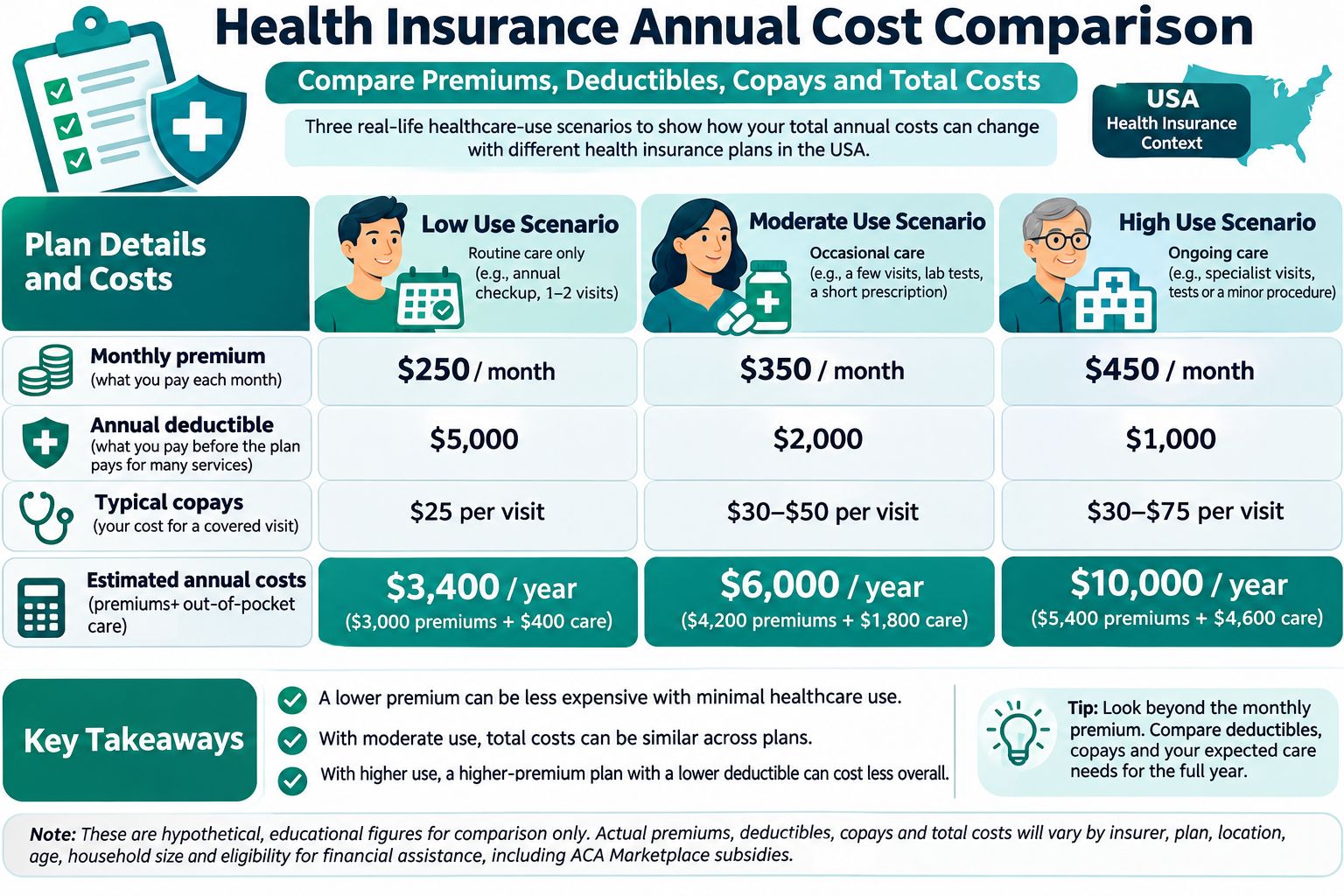
Consider two fictional individual policies. Plan A has a net monthly premium of $250 and Plan B costs $400 monthly. Assume the patient pays $400 under Plan A and $300 under Plan B in a low-use year. Annual totals become $3,400 and $5,100. In a moderate-use year, assume patient charges of $3,000 and $1,200 respectively: both totals are $6,000. In a high-use year, assume charges of $7,000 and $3,500: totals become $10,000 and $8,300. These figures are invented, not actual quotes. The assumed covered charges must fit the respective policies’ terms.
| Scenario | Plan A | Plan B |
|---|---|---|
| Annual premiums | $3,000 | $4,800 |
| Low use total | $3,400 | $5,100 |
| Moderate use total | $6,000 | $6,000 |
| High use total | $10,000 | $8,300 |
A lower-premium policy may work well under one scenario and become more expensive under another. Do not choose a plan by predicting that you will remain healthy. Consider whether your household could fund an unexpected medical bill early in the coverage year.
Understand the out-of-pocket maximum
A plan’s applicable out-of-pocket maximum limits certain covered patient expenses during the benefit year. Premiums, many noncovered services and some out-of-network charges do not count. A useful stress-test figure is the annual net premium plus the actual applicable in-network out-of-pocket limit, with other potential expenses listed separately. This is not a universal ceiling on all healthcare spending. See the Marketplace glossary.
For families, ask whether individual spending limits operate within the family limit and whether the medical and prescription deductible arrangements are separate. If the policy starts partway through the year, confirm its benefit period. Changing insurers may reset accumulated spending. Do not assume previous deductible payments will transfer.
Compare health insurance quotes across metal categories
Marketplace Bronze, Silver, Gold and Platinum categories describe general differences in the share of covered costs paid by the plan. They are not rankings of physician quality. A higher metal category may charge a larger premium but generally requires a smaller share of covered medical costs. Actual benefit designs differ even within the same category.
Some eligible Marketplace applicants qualify for cost-sharing reductions when choosing an appropriate Silver plan. That can change the relative affordability of Silver and Bronze coverage substantially. Use the eligibility determination and actual plan variant in the comparison, not a generic Silver example. Review official metal category guidance.
Read the Summary of Benefits and Coverage before enrolling
The CMS Summary of Benefits and Coverage resource explains standardized information used to compare health plans. Request the document for the exact plan being quoted. Review the deductible, patient charges, exclusions and coverage examples. These standardized examples aid comparisons but are not personalized estimates of your future medical bills.
A summary cannot answer every question. For an expensive planned service, request information about the relevant policy provisions, authorization process and cost estimate. Ask whether a procedure is billed in a hospital outpatient department or a physician’s office, since the setting may affect costs. Keep the insurer’s written response and date.
Compare health insurance quotes for actual provider access
A broad network description is not enough to establish that a particular specialist participates. Verify the exact plan name with the insurer and the clinician’s office. Confirm whether the clinician accepts new patients, whether referrals are required and whether the relevant treatment facility participates. A hospital may have several billing entities, so check the specific service where possible.
HMO and EPO arrangements often limit nonemergency care outside their networks, while PPO arrangements may provide some out-of-network benefits at greater expense. POS arrangements may use referral requirements and other rules. These labels are starting points, not substitutes for reading the policy. For ongoing treatment, verify the practical availability of care as well as the provider directory.
Prescription coverage and chronic medical needs
Create a private list of prescribed medicines, strengths, formulations and usual pharmacies. Check each item against the current formulary for the quoted plan. Identify the drug tier, deductible, prior authorization, quantity limits, step therapy and specialty pharmacy requirements where applicable. Ask the treating team about a safe continuity plan if a change is anticipated; do not independently switch medicines to fit a formulary.
A person with diabetes may also need coverage for monitoring devices and supplies, while a person receiving specialist treatment may have medication expenses billed under the medical benefit. Check the precise product and supplier rather than assuming all equipment is included. Read BBH’s health insurance for people with diabetes for additional questions.

Family health insurance quotes and split coverage
A household may have several eligible insurance pathways. Compare employer insurance, Marketplace coverage and public programs for each person as appropriate. Include dependent premiums, individual and family deductibles, prescription access and different enrollment deadlines. A cheaper arrangement with separate plans may require more administrative work and may have different provider networks. Do not assume children and parents qualify for the same assistance.
Original BBH content gap: the quote confidence audit
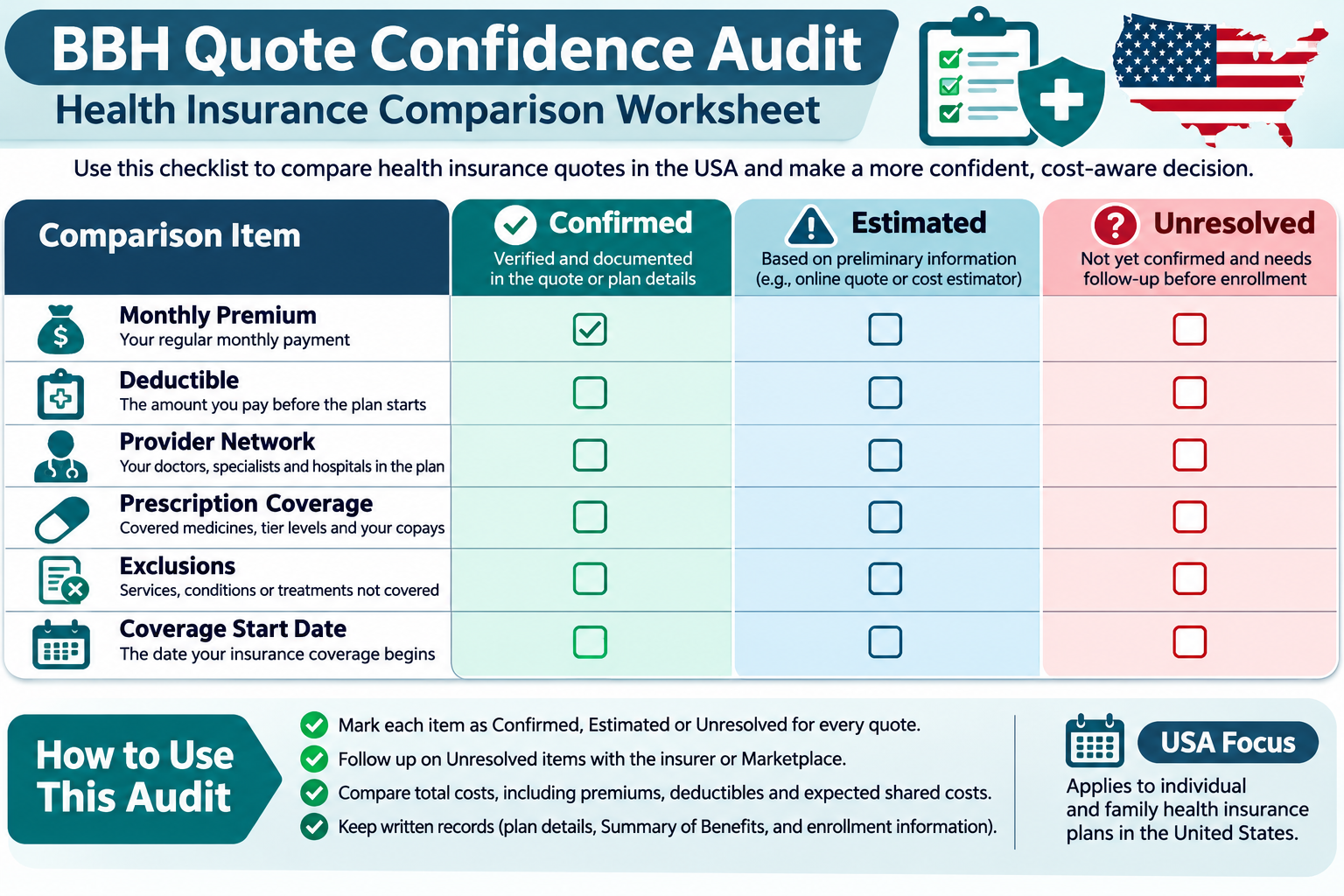
Before ranking any policy by price, classify every important field as confirmed, estimated or unresolved. A confirmed field is supported by a current document or an appropriate written response for the exact plan. An estimated field uses clearly identified assumptions. An unresolved field lacks enough information for a meaningful comparison. Never enter zero merely because the price is unknown.
For example, a fictional applicant compares a $250 monthly plan with a $400 monthly plan. The cheaper plan appears to save $1,800 in annual premiums, but a necessary medication’s coverage is unresolved. If a written estimate later identifies an extra $2,400 in annual expenses compared with the alternative, the apparent savings disappear. This does not mean the higher-priced plan is always preferable. It means the first comparison was incomplete. The BBH audit is an original educational method, not a validated actuarial model.
Repeat the audit at renewal. Premiums, networks, drug lists and coverage conditions can change. Preserve a copy of the relevant documents and note when you obtained them. Keep sensitive household and medical information in a secure location rather than posting it publicly.
Avoid misleading quotes and coverage gaps
A temporary policy, fixed indemnity product or discount arrangement may be advertised alongside comprehensive insurance. Ask what the contract pays, what is excluded and whether it provides the protections you need. Do not mistake a fixed cash benefit for reimbursement of a hospital bill. Read BBH’s short-term insurance guide before comparing such products.
Confirm your eligibility for enrollment, selection deadline, effective date and initial payment requirement. A quote is not an active policy. Avoid canceling current insurance before verifying replacement coverage. If an employer or insurer gives conflicting dates, obtain clarification directly. Check Marketplace enrollment guidance for the appropriate coverage period.
BBH checklist to compare health insurance quotes
Use identical household assumptions, obtain the full plan documents, verify assistance, check providers and medicines, estimate routine and high-use expenses, and test immediate affordability. Keep uncertain items visible until resolved. Confirm enrollment and payment directly with the authorized service. Compare private health insurance, high-deductible health plans and self-employed health insurance for more context.
Frequently asked questions
Can I obtain an insurance estimate without enrolling?
Yes. Official Marketplace previews provide estimates before an application is completed. Final eligibility and pricing require the relevant application.
Is the cheapest quote always the best?
No. Consider covered benefits, treatment access, total expenses and the household’s ability to pay unexpected charges.
Can I change insurance at any time?
Not necessarily. Enrollment periods and qualifying events depend on the coverage type and circumstances.
Do quotes include every medical expense?
No. They usually describe premiums and benefit terms, not the cost of every service you might need.
Conclusion
When you compare health insurance quotes, prioritize confirmed coverage and sustainable annual costs rather than a single advertised price. Use the official application and verify plan details before making a decision. Explore the BBH Health Insurance and Healthcare Costs support page for related guides.
Editorial disclosure: HealthCare.gov pricing, plan comparison and income guidance and CMS benefit summary guidance consulted November 29, 2026. Examples are hypothetical. Educational information only, not individualized medical, insurance or tax advice.