Health Insurance Without a Deductible
Zero-Deductible Health Insurance: US Guide

Health insurance without a deductible can be appealing to individuals and families who want more predictable healthcare expenses. Instead of meeting an initial annual spending requirement for benefits subject to a deductible, members of a zero-deductible plan can begin sharing eligible medical expenses with their insurer according to the policy’s terms. However, the absence of a deductible is only one feature of an insurance contract. Monthly premiums, prescription benefits, provider networks and other patient charges remain important.
Thank you for reading this post, don't forget to subscribe!In This Guide: Zero-deductible coverage; how copayments work; medical versus pharmacy deductibles; Marketplace options; Silver plan savings; 2027 spending limits; annual cost comparisons; family coverage; chronic illness; practical checklist and FAQs.
What is health insurance without a deductible?
A deductible is an amount a member may need to pay for specified covered services before the insurer begins contributing to their cost. Insurance without a medical deductible removes that particular threshold. The insurer and member may instead share eligible expenses through other arrangements from the beginning of coverage.
The precise meaning of a zero deductible depends on the benefit being described. An advertisement may refer only to in-network medical services, while a separate deductible applies to prescription drugs or certain out-of-network services. Ask which benefit has a zero-dollar threshold before comparing prices.
Consult the official HealthCare.gov deductible explanation and request the policy’s complete benefit documents. The Summary of Benefits and Coverage can help identify the major financial requirements, but the detailed contract remains important when evaluating a particular service.
Does zero-deductible health insurance mean free healthcare?
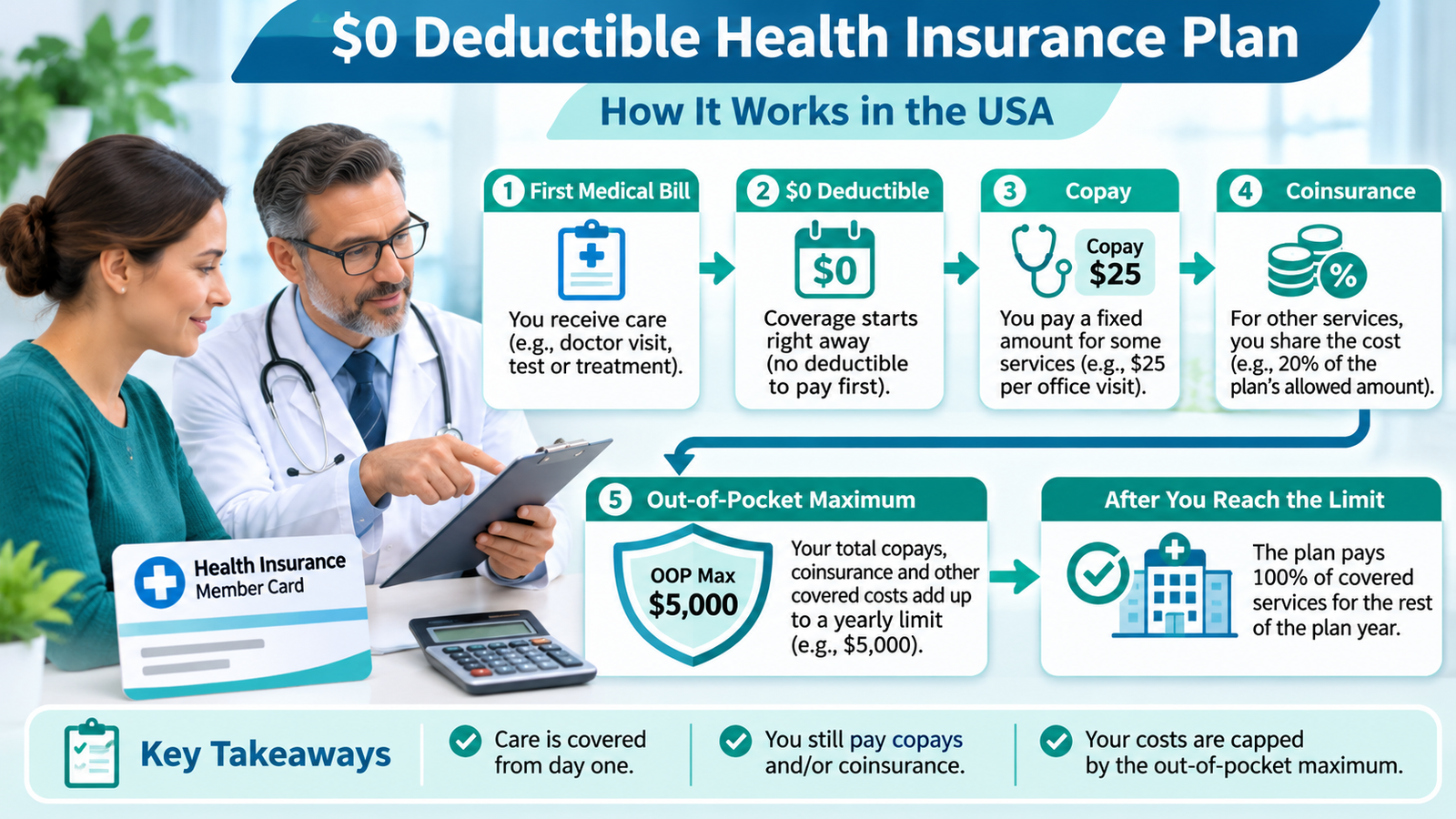
No. A zero-deductible policy may still involve a monthly premium and charges for individual healthcare services. A copayment is generally a specified dollar charge for a covered service, while coinsurance represents a percentage of an eligible expense. Some preventive benefits may be covered without these charges under applicable rules.
For example, a hypothetical policy with a zero-dollar medical deductible might charge $25 for a primary care appointment and $60 for a specialist visit. If a covered imaging procedure has an allowed amount of $600 and the contract applies 20% coinsurance, the member’s share would be $120, assuming no other relevant charges or limits. These figures illustrate payment mechanisms rather than actual insurance quotations.
An insurer’s contribution also depends on whether a service is covered, whether the provider participates and whether applicable approval requirements have been met. A zero deductible does not remove these conditions. Ask for a specific estimate before planned expensive services when possible.
Where can you find health insurance without a deductible?
Employer health insurance without a deductible
Some employers offer a choice of medical benefit arrangements, including plans with low or zero medical deductibles. Ask for the employee’s actual premium contribution, dependent coverage costs and service-specific charges. An employer contribution toward insurance can significantly change the financial comparison.
Review whether an employer provides a health reimbursement arrangement or another benefit that offsets eligible expenses. Such an arrangement may improve affordability even if the underlying policy has a deductible. Compare actual financial obligations rather than assuming that only a zero-deductible option can provide predictable costs.
Individual Marketplace health insurance
Available individual plan designs depend on location, coverage year and eligibility. Use the official 2027 Marketplace plan preview to explore options. Complete the application to establish eligibility and obtain actual prices. Do not assume that zero-deductible plans are available in every geographic area.
Gold and Platinum categories generally provide more generous cost sharing than Bronze plans, but a metal category does not guarantee a particular deductible. Review the actual contract, including the prescription benefit. Marketplace policies within the same metal category can differ in important ways.
Public insurance programs
Eligible individuals may qualify for Medicaid or other public coverage with comparatively low patient expenses. Rules depend on the program and state. Medicare has a different structure, including separate benefit components. Do not interpret a zero-dollar deductible within one program as proof that every aspect of healthcare is free.
Can Marketplace savings reduce a deductible to zero?
Certain eligible Marketplace applicants can receive cost-sharing reductions that lower the amounts they owe when using healthcare. For ordinary income-based cost-sharing reductions, enrollment in an eligible Silver plan is necessary. A premium tax credit is different: it reduces the premium rather than automatically reducing service charges.
The amount of additional assistance and the resulting deductible depend on eligibility and the selected plan. Some plan designs may have very low or no deductibles, but this outcome should not be promised to every applicant. Special cost-sharing provisions also exist for certain eligible American Indian and Alaska Native applicants.
Review the Marketplace cost-sharing reduction guide and the actual eligibility determination. Compare the Silver plan offered with additional assistance against other available options before paying more for a higher metal category.
Health insurance without a deductible: prescription costs
A policy may have separate financial requirements for medical services and outpatient prescriptions. This distinction is important for people who regularly use medication. A plan with a zero-dollar medical deductible might still require the member to meet a pharmacy deductible before specified medicines receive coverage.
Ask whether drug deductibles apply to all formulary tiers or only selected medicines. A policy may provide certain preferred medicines at a copayment while requiring greater spending for other drugs. Also ask whether medical and pharmacy expenses accumulate toward a combined spending maximum or separate limits.
Use the exact prescribed medicine name, strength and formulation when reviewing the formulary. Confirm the approved pharmacy, quantity limits and prior authorization process. A general statement that prescriptions are covered does not answer these more specific questions.
How much does health insurance without a deductible cost?
No single monthly premium applies to zero-deductible policies throughout the United States. Location, household circumstances, coverage design, permitted rating factors and financial assistance influence individual prices. Employment-based contributions can also affect the amount a worker pays.
Zero-deductible insurance may carry a higher premium than a competing higher-deductible option, but this is not universal. An eligible subsidy, employer contribution or particular plan design can change the result. Compare actual prices rather than assuming that a lower deductible always comes with a fixed premium increase.
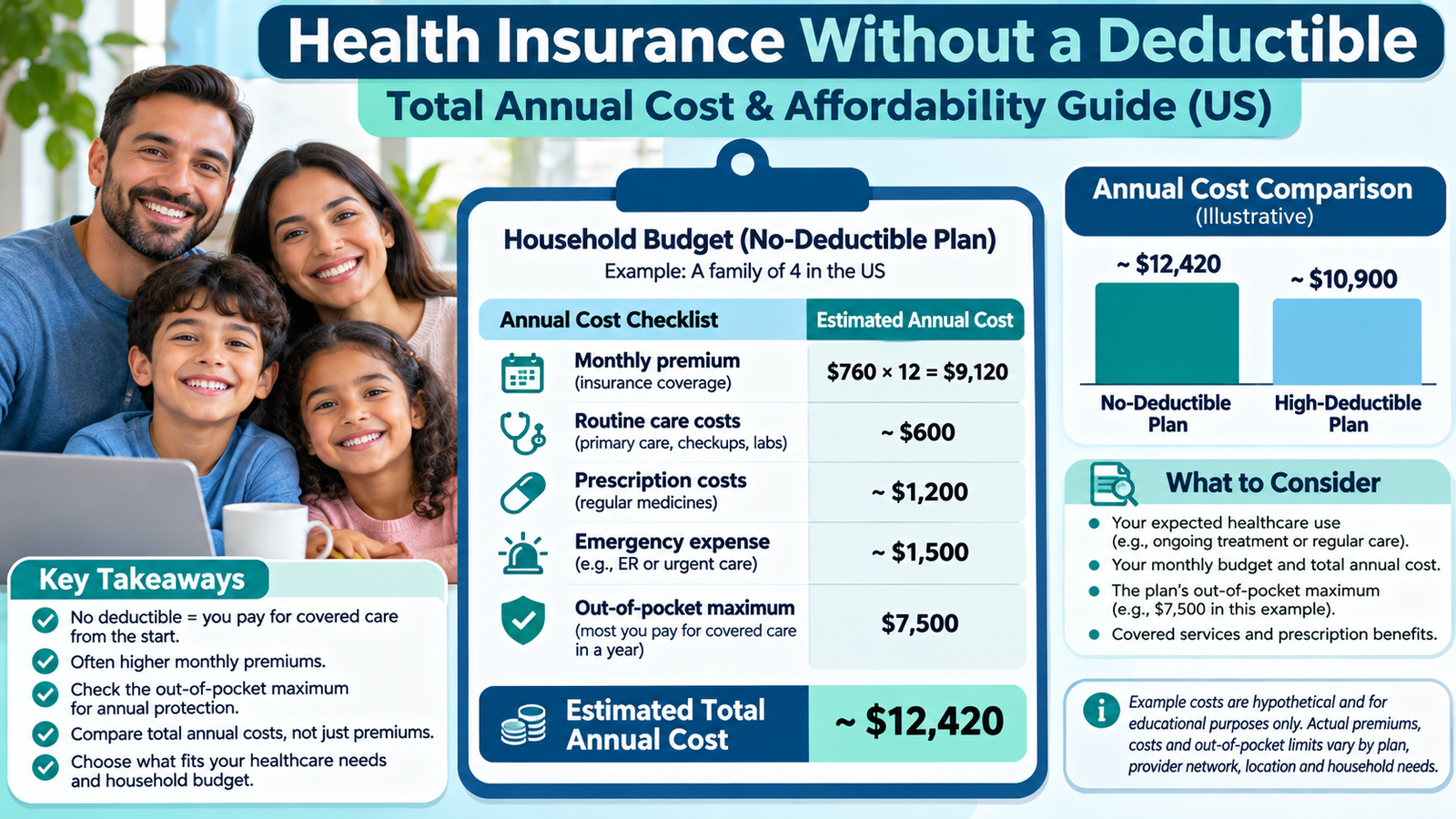
The annual comparison should include twelve months of premiums, anticipated patient charges for covered services and separately estimated excluded expenses. If the policy requires coinsurance, estimate charges using the plan’s allowed amounts where available rather than the provider’s advertised list price. See HealthCare.gov’s total healthcare cost guide.
Zero-deductible versus high-deductible insurance: practical comparison
Imagine two fictional comprehensive policies for one adult. Plan A has no medical deductible, a $450 monthly premium and a $4,000 covered in-network out-of-pocket maximum. Plan B has a $2,500 deductible, a $275 monthly premium and a $6,000 covered in-network out-of-pocket maximum.
In a low-use year, assume Plan A leaves $300 in medical cost sharing, while Plan B leaves $800. The annual expenses are $5,700 for Plan A and $4,100 for Plan B. The higher-deductible policy is less expensive in this hypothetical low-use scenario.
In a moderate-use year, suppose Plan A leaves $1,200 in patient expenses and Plan B leaves $3,500. The respective annual totals are $6,600 and $6,800. The zero-deductible plan now has a modest financial advantage.
In a high-use year when each applicable spending maximum is reached, Plan A totals $9,400 and Plan B totals $9,300. This example illustrates why a zero deductible does not automatically produce the lowest annual cost, even when medical expenses are substantial. These fictional amounts exclude noncovered services, subsidies and tax effects.
2027 out-of-pocket limits and financial protection
The standard 2027 ACA annual cost-sharing ceiling is $12,000 for self-only and $24,000 for other-than-self-only coverage, as described in the May 20, 2026 final rule. The rule also describes special Bronze and Catastrophic cost-sharing provisions whose implementation may be affected by litigation. Confirm current requirements and the actual plan’s limits rather than assuming one ceiling applies to every product. Specific policies can have lower limits. These limits apply to eligible covered in-network spending subject to the applicable rules, not every medical or household expense.
A zero-dollar deductible can coexist with a substantial out-of-pocket maximum because copayments and coinsurance may accumulate throughout the year. Compare both figures. Monthly premiums, noncovered services and many out-of-network expenses are outside this protection. Read the official out-of-pocket maximum guide for the current plan-year information.
Health insurance without a deductible for chronic conditions
People with ongoing healthcare needs may value an arrangement that reduces large upfront expenses. However, a zero medical deductible is useful only when the relevant services are covered and the remaining charges are manageable. Examine the entire treatment plan before deciding.
Diabetes and medical equipment
Check insulin and other prescribed medicines, glucose meters, continuous glucose monitors, test strips and approved suppliers. A device may be handled under a medical equipment benefit or a pharmacy benefit, depending on the policy. Verify which charges apply from the beginning of the coverage year.
BBH’s continuous glucose monitors guide and blood glucose meters guide can help readers identify relevant equipment questions. Review ongoing monitoring needs using our diabetes eye examination guide. A clinical recommendation does not itself guarantee insurance payment.
Mental healthcare and specialist treatment
For recurring psychotherapy, psychiatric appointments or other specialist treatment, compare the cost per covered visit and the anticipated number of appointments. Ask whether laboratory monitoring, medications and telehealth services have separate payment requirements. Read BBH’s diabetes and depression guide for an example of combined physical and mental healthcare needs.
Health insurance without a deductible for families
When comparing family coverage, check both individual and collective deductibles and spending maximums. Confirm whether the zero-dollar deductible applies to all enrolled family members and to all relevant benefits. Separate dental, vision and pharmacy arrangements can have different financial requirements.
Estimate the annual needs of each household member, including routine care, medicines, pediatric services and any anticipated specialist treatment. A family that uses healthcare frequently may prefer a more predictable payment structure, but higher premiums affect the household every month whether or not services are used.

Content gap: predictable expenses versus predictable access
A zero-deductible plan may reduce uncertainty about initial payment requirements without improving access to clinicians. A restricted network can create appointment delays, longer journeys or difficulties maintaining established treatment. Check whether relevant providers participate and whether they are accepting patients.
Likewise, a service with a fixed copayment may require prior authorization or a referral. Ask about the process for planned care, and confirm whether the charge covers both facility and professional services. A predictable office visit fee may not include all investigations performed during that appointment.
Before enrolling, test the plan against realistic situations: a specialist appointment with laboratory work, a prescribed medicine refill, an imaging investigation and an unexpected hospital stay. Ask how each component would be handled. This approach is more informative than simply checking whether the deductible is zero.
BBH day-one benefit audit: four bills, not one deductible
Ask each insurer to estimate the patient share for four realistic events: a specialist visit, a laboratory test ordered during that visit, a recurring prescription and an outpatient imaging procedure. Record the billing setting, network status, applicable copayment or coinsurance and any separate deductible. A fixed visit fee should not be mistaken for a bundled price for everything performed that day.
Compare the same four events across policies using the CMS Summary of Benefits and Coverage guidance. Mark any unresolved price or provider question rather than assigning it a zero. This BBH worksheet-style audit is an educational aid, not a guarantee of benefits.
BBH practical zero-deductible insurance checklist
Obtain the complete benefits summary and current premium quotation. Record the medical and pharmacy deductibles, individual and family spending limits, primary care and specialist copayments, hospital coinsurance, prescription formulary and network restrictions.
Verify your preferred clinicians and facilities. Estimate low, moderate and high healthcare use scenarios. Check eligibility for Marketplace assistance or employer benefits and consider the timing of potential expenses. Ask the insurer to clarify uncertain benefits in writing. Confirm the effective date and required payments before replacing existing coverage.
Related BBH guides and budget worksheet
Compare High-Deductible Health Insurance Plans with this guide and the four chronic-care resources linked above. Explore the Health Insurance and Healthcare Costs support page.
Frequently asked questions
Does zero-deductible insurance pay every medical bill?
No. Other cost sharing, exclusions, network requirements and approval rules may still apply.
Can I have a zero medical deductible and a prescription deductible?
Yes. Review medical and pharmacy benefits separately to determine whether the policy has different thresholds.
Are zero-deductible plans always more expensive?
No. Compare actual premiums after eligible assistance or employer contributions and estimate annual patient expenses.
Can I contribute to an HSA with a zero-deductible plan?
Generally a standard HSA-compatible high-deductible policy must meet deductible requirements, but special statutory rules apply to certain Marketplace plan categories. Verify both the plan’s HSA designation and individual eligibility before contributing.
Is zero-deductible insurance best for diabetes?
Not necessarily. Confirm medications, equipment benefits, provider access, service charges and annual costs based on individual treatment needs.
Conclusion
Health insurance without a deductible can offer greater predictability for some households, but the absence of a deductible does not eliminate healthcare expenses. Compare complete annual costs, prescription and medical benefits, spending maximums and access to care. Use actual plan documents and official eligibility information rather than relying on a promotional description.
Editorial disclosure: HealthCare.gov deductible, cost-sharing reduction and CMS 2027 final rule and benefit summary guidance consulted November 29, 2026. Individual policy terms require confirmation. Educational information only, not individualized medical, financial, tax or insurance advice. Verify current plan terms and eligibility.