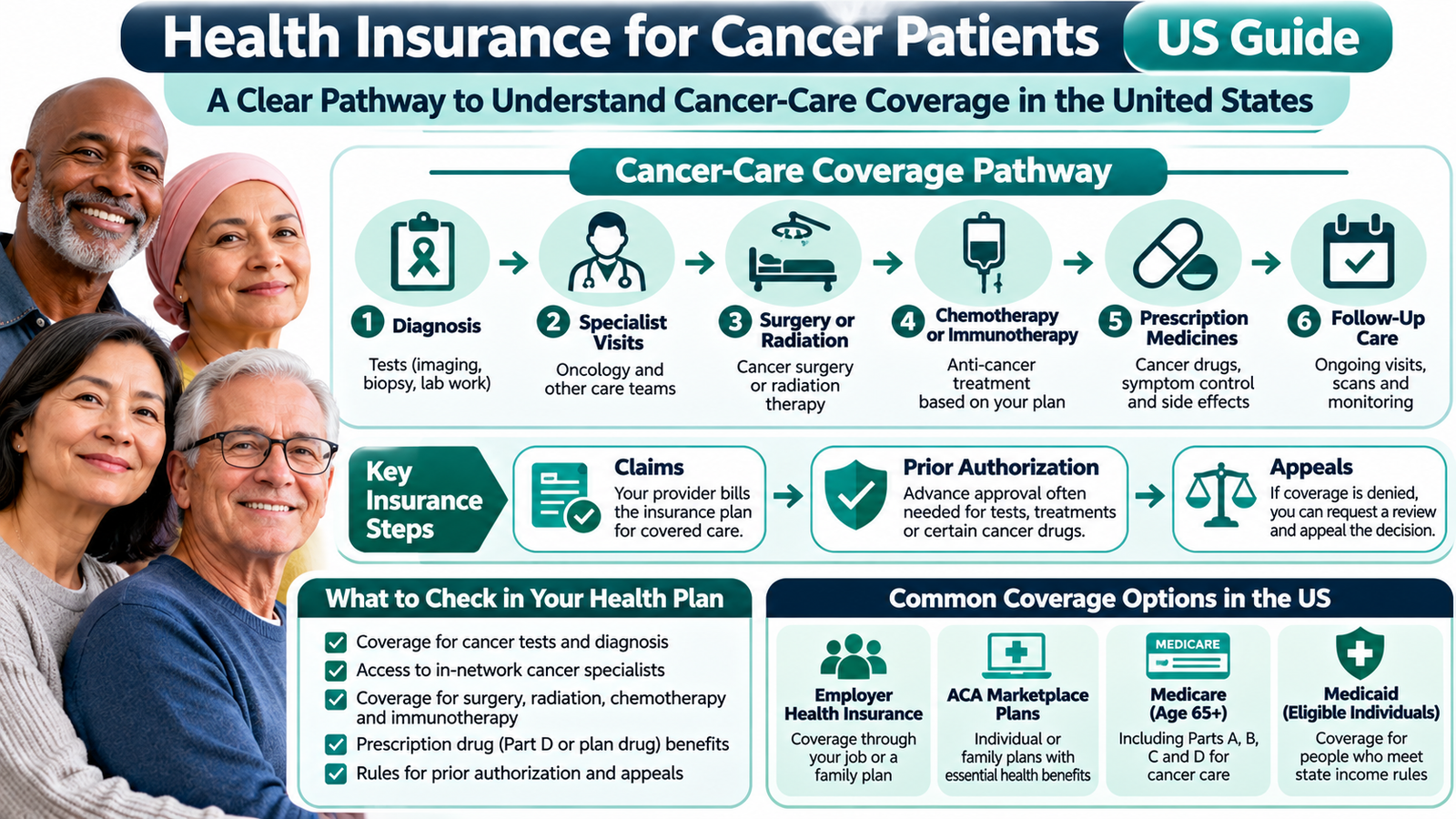
Health Insurance for Cancer Patients: US Guide
Cancer Health Insurance: Coverage and Costs


Health insurance for cancer patients can help protect access to diagnosis, treatment and follow-up care while reducing financial uncertainty. In the United States, an individual receiving cancer treatment may need several specialists, hospital services, laboratory investigations, imaging, medicines and supportive care. Each service can involve a different benefit or billing arrangement. Understanding those arrangements is particularly important when choosing or renewing insurance during treatment.
Thank you for reading this post, don't forget to subscribe!In This Guide: Coverage after diagnosis; cancer treatment benefits; chemotherapy and radiation; oral cancer medicines; Medicare and Medicaid; annual expenses; clinical trials; financial toxicity; insurance denials; changing coverage; survivorship and FAQs.
Health insurance for cancer patients: can you enroll after diagnosis?
Cancer diagnosed before a new policy begins is a pre-existing condition. Under ACA Marketplace protections, an insurer cannot refuse to enroll an eligible person or increase their premium because of that medical history. Essential health benefits cannot be excluded simply because the condition existed before enrollment. See the official Marketplace pre-existing condition guidance.
These protections do not establish a right to purchase coverage on any date. Applicants must still meet the applicable enrollment requirements. A diagnosis by itself does not generally create a federal Marketplace special enrollment opportunity. Loss of qualifying coverage or other qualifying events may provide a different pathway. Medicaid eligibility can generally be assessed throughout the year.
Comprehensive health insurance should also be distinguished from limited-benefit products advertised as cancer insurance. A fixed indemnity or specified-disease policy may pay defined amounts under limited circumstances. It should not be assumed to replace comprehensive medical coverage. Review the actual contract and verify the product with a qualified insurance professional.
Types of health insurance for cancer patients
Employer-sponsored coverage
Request the current benefit summary, prescription formulary and oncology network details from your employer or plan administrator. Compare any available workplace options according to expected care rather than the employee contribution alone. Ask how coverage will continue if treatment requires time away from work.
Marketplace health insurance for cancer patients
Eligible households can investigate available policies and financial assistance using HealthCare.gov or their state’s Marketplace. Check the coverage year, geographic service area, participating cancer centers and expected annual expenses. Do not assume that every plan sold by the same insurer uses the same network.
Medicaid and Medicare
Medicaid may provide a coverage pathway for eligible individuals, with state-specific rules and administration. Medicare has its own eligibility requirements and benefits. People approaching Medicare eligibility during treatment should investigate the transition early and coordinate it with their care team. A change in insurance can require new approvals and suppliers.
Health insurance for cancer patients: treatment benefits
Comprehensive coverage may include medically necessary oncology services such as surgery, hospital treatment, radiation, systemic therapies and diagnostic investigations, subject to the contract and applicable protections. The appropriate treatment is determined by the medical team, not by a general insurance article.
Ask the oncology center for a written description of the planned services, expected treatment setting and relevant billing information. A hospital may bill for facility services separately from physicians, anesthesia, pathology or imaging. Ask about both professional and facility participation and obtain a personalized cost estimate where possible.
Chemotherapy coverage
Chemotherapy may be administered in different settings depending on the treatment. Medicare explains the circumstances under which hospital and outpatient benefits pay for eligible chemotherapy in its chemotherapy coverage guide. Other plans may apply different networks, cost sharing and approval processes.
Verify the exact treatment location and prescribed regimen. Ask whether supportive medicines, laboratory monitoring and infusion-related charges are included in the estimate. The patient should not alter the prescribed treatment schedule in order to accommodate an insurance calculation without discussing the issue with the oncology team.
Radiation therapy and cancer surgery
Radiation treatment may involve planning appointments, imaging and repeated treatment sessions. Surgery may involve hospital charges, professional fees and postoperative care. Request an estimate that identifies major categories of expense rather than a single figure that leaves unclear what is included.
Confirm whether a procedure requires authorization and who is responsible for obtaining it. Ask whether a change in treatment technique or location requires additional approval. A preauthorization is not necessarily a guarantee that every eventual claim will be paid.
Immunotherapy and targeted treatment
Insurance benefits for these treatments depend on the specific medicine, indication and administration method. Some therapies require specialist documentation or additional review. Ask the oncologist and insurer to clarify the relevant coverage requirements. Do not assume that a policy covering one cancer medicine will pay for every other medicine in the same broad category.
Cancer prescription drug coverage: pharmacy versus medical benefits
An important distinction is whether a treatment is processed under the medical benefit or pharmacy benefit. An infused medication may be billed by a treatment facility, while an oral medicine may be supplied through a specialty pharmacy. There are exceptions, including certain outpatient drugs covered under Medicare Part B.
Medicare’s outpatient prescription coverage guide describes circumstances in which Part B covers specified medicines. Part D covers many medicines outside Part B. Check which benefit applies to the exact prescription rather than relying only on whether it is taken orally or administered by injection.
Ask about formulary placement, specialty pharmacy requirements, refill timing, prior authorization and the patient’s estimated cost. Confirm whether supportive medicines such as those prescribed for nausea or pain are covered separately. Discuss any difficulty obtaining treatment promptly with the prescribing team.
How much does health insurance for cancer patients cost?
There is no single reliable monthly premium or universal treatment cost for someone with cancer. Expenses depend on eligibility, location, insurance design, the treatment prescribed and the services actually used. Marketplace premiums cannot be increased on the basis of cancer history, but the cost of receiving care under different policies can still vary.
A useful annual budget includes premiums, expected medical and pharmacy cost sharing, and expenses outside the policy. Review the applicable deductible and out-of-pocket limit using the official total cost comparison guide. Original Medicare alone has no general annual Part A and B spending cap. Premiums and many noncovered or out-of-network services do not count toward that limit. Check whether different benefit arrangements apply to particular prescriptions or equipment.
Consider two fictional plans. Plan A costs $350 per month and leaves $7,000 in eligible annual treatment expenses. The estimated total is $11,200. Plan B costs $550 per month and leaves $3,500 in estimated treatment expenses. Its total is $10,100. These hypothetical figures are a budgeting exercise, not real quotes or a prediction of cancer treatment costs.
How to verify your cancer center and oncology network
Contact the insurer and the treatment facility using the exact policy identifier. Confirm the participation of the oncologist, hospital, infusion center, radiation provider, imaging facility and any other professionals involved in the planned course of care. Ask about referrals, authorization and whether services at a different location will be treated differently.
If a preferred center is outside the network, ask whether your plan offers out-of-network benefits or a case-specific network exception. Such arrangements are not guaranteed. Obtain the relevant approval and expected cost-sharing information in writing before planned care when possible. If treatment is urgent, discuss safe timing with your clinical team.
The oncology practice may have a financial navigator, social worker or insurance coordinator who can assist with questions about coverage and billing. Establish who will obtain authorizations and whom to contact when a claim or medication supply is delayed.
Original BBH cancer treatment continuity map
For each planned treatment, record the prescribing oncologist, exact facility, medicine or procedure, medical or pharmacy benefit, required approval, scheduled date and expected patient payment. Confirm each entry with the insurer and care team; mark uncertain answers as unresolved. A confirmed oncologist alone does not establish coverage for the entire treatment pathway.
Ask who owns each outstanding task and when follow-up is needed. Keep records securely and request written confirmation. Repeat the map when the regimen, insurer or facility changes. This BBH educational workflow is not a validated clinical tool, a guarantee of payment or a substitute for treatment planning.
Clinical trials and cancer insurance coverage
Clinical trial expenses can include routine patient care, research-specific procedures and the investigational treatment itself. Responsibility for these costs may differ. Applicable insurance protections can require coverage of certain routine patient costs for qualifying trials, but not every research expense is necessarily covered.
Before enrolling in a trial, ask the research coordinator for a written explanation of which expenses are paid by the sponsor, which are billed to insurance and which may be the patient’s responsibility. Verify travel expenses and care outside the trial site. The clinical decision to participate should be made with the oncology team after informed discussion.
Financial toxicity: the hidden burden of cancer treatment
The National Cancer Institute identifies cancer-related financial hardship as a significant issue. Medical bills are only part of the problem: time away from employment, travel and other practical expenses may strain household finances. Insurance can reduce some medical costs without eliminating the wider economic impact of illness.
The NCI’s patient information on financial toxicity provides background on these challenges. Discuss cost concerns early with the treatment team. Financial questions are a legitimate part of care planning, and patients should not be expected to solve complicated billing issues alone.
Build a realistic monthly budget that separates recurring household bills, medical expenses and one-time treatment-related costs. Keep a record of insurance statements, payments and outstanding balances. Ask a financial navigator to identify assistance opportunities and help resolve unclear charges. Review NCI’s cancer cost management resources for additional information.
Financial assistance for cancer patients with or without insurance
Ask the hospital or cancer center about its financial assistance policy, payment arrangements and eligibility requirements. Nonprofit hospitals may have assistance policies for eligible patients. Ask whether the policy covers the specific facility and whether independent clinicians bill separately.
Public coverage, charitable programs, transportation assistance and medicine-related support may be available depending on diagnosis, income, residence and other criteria. Funding and eligibility can change, so obtain current confirmation before including assistance in a household budget. Never assume approval from an advertisement or a third-party referral.
The NCI financial hardship research resource describes research into cancer-related financial hardship. Request help identifying legitimate programs rather than paying an unverified service to obtain promised grants. Protect medical and financial information and confirm the identity of anyone requesting it.

What to do if insurance denies cancer treatment
Request the written coverage decision and identify the precise reason for the denial. It may involve missing documentation, a network issue, an authorization requirement, a coding problem or a contractual limitation. Ask your oncology team whether additional clinical information is appropriate.
Record the claim number, date, insurer contact information, relevant benefit documents and submission deadlines. Depending on the plan, an internal appeal and independent external review may be available. Consult the official insurance appeals guide. Ask about expedited review when the clinical situation warrants it. See internal appeal guidance and external review eligibility.
Changing health insurance for cancer patients during treatment
A new policy may use a different oncology network, specialty pharmacy or approval process. Before switching, confirm the effective date and whether existing treatment arrangements can continue. Ask the new insurer about continuity-of-care protections or transitional arrangements that may apply to your circumstances.
If you are leaving employment, investigate continuation coverage and other eligible options promptly. Compare the entire treatment-related expense and provider access, not just the replacement premium. Do not cancel existing insurance before verifying that replacement coverage is active.
Prepare a transition file containing the current treatment plan, prescribing clinician contacts, medication list, relevant authorizations and insurance correspondence. Share sensitive details only with authorized parties. Coordinate the transition with the treating team so that administrative changes do not unnecessarily interrupt care.
Cancer survivorship and continuing healthcare coverage
The end of active treatment does not necessarily eliminate healthcare needs. Follow-up appointments, imaging, rehabilitation, management of late effects and emotional support may remain important. Ask which services are included in the survivorship plan and how insurance handles their costs.
Explore BBH’s cancer awareness and screening guide for general educational background. Screening advice should be individualized after a cancer diagnosis rather than automatically following recommendations for the general population.
People with additional conditions should also plan for continuing care. BBH’s diabetes and depression guide discusses an example of overlapping physical and emotional health needs, while the women’s health guide provides broader information on screening and care.
Related BBH insurance resources and worksheet
Explore Private Health Insurance in the US and Medicare Supplement Plans alongside the three linked health education articles above. Visit the Health Insurance and Healthcare Costs support page.
Frequently asked questions
Is health insurance for cancer patients available after diagnosis?
Yes, eligible applicants can obtain Marketplace coverage without cancer-based rejection or premium increases. Enrollment timing and other eligibility requirements still apply.
Is chemotherapy always fully covered?
No. Coverage depends on the specific service, setting, plan and applicable requirements. Verify cost sharing and authorization.
Can cancer patients change insurers during treatment?
Potentially, when eligible to enroll. Check the treatment network, transition arrangements, approvals and effective date before switching.
Does cancer insurance pay for every treatment expense?
No. Comprehensive medical coverage and specified-disease insurance are different products. Review exclusions, cost-sharing limits and nonmedical expenses.
Who can help with unaffordable cancer care?
Ask the oncology center’s financial navigator or social worker, relevant public insurance programs and verified assistance organizations.
Conclusion
Health insurance for cancer patients should help support continuity of appropriate care and manageable expenses. Compare comprehensive benefits, verify the treatment team and medications, understand appeal rights and seek financial counseling early. Treatment decisions belong with qualified healthcare professionals; insurance education helps patients navigate the financial arrangements.
Editorial disclosure: Core NCI financial toxicity, HealthCare.gov pre-existing condition, costs and appeals guidance, and Medicare chemotherapy and outpatient drug coverage sources checked November 29, 2026. Verify other linked resources and plan-specific terms before use. General educational information, not individualized clinical, financial, legal or insurance advice. Confirm current plan-specific coverage before enrollment or treatment.