Mental Health Insurance Coverage: US Guide
Mental Health Insurance: Therapy and Costs

Mental health insurance coverage in the United States can help people obtain psychotherapy, psychiatric assessments, medication management and more intensive treatment. Yet having insurance does not guarantee an immediate appointment or payment for every service. Understanding your specific plan before starting treatment can reduce uncertainty and help you make informed decisions about care.
Thank you for reading this post, don't forget to subscribe!In This Guide: Mental health benefits; therapy and psychiatry; parity protections; Medicare and Medicaid; treatment programs; costs; online therapy; prescription benefits; network access; claims and appeals; continuity of care; the BBH appointment access test and FAQs.
What is mental health insurance coverage?
Mental health coverage is the portion of a health plan that helps pay for eligible behavioral healthcare. It may support assessment, psychotherapy, medication prescribing and monitoring, crisis stabilization or treatment for substance use disorders. Benefits depend on the specific plan, provider, setting and clinical circumstances.
Coverage is a financial and administrative question, whereas suitability is a clinical question. A qualified mental health professional can help determine appropriate treatment. Your insurer can explain how its contract handles that treatment. Neither a coverage approval nor a denial should be treated as a definitive clinical assessment.
Start with your Summary of Benefits and Coverage and the detailed insurance policy. Record the precise name of the plan, its behavioral health administrator and the member services telephone number. In some arrangements, a separate company administers behavioral health benefits even though your medical insurance card shows another insurer.
Mental health insurance coverage for therapy and psychiatry
Mental health insurance coverage for psychotherapy
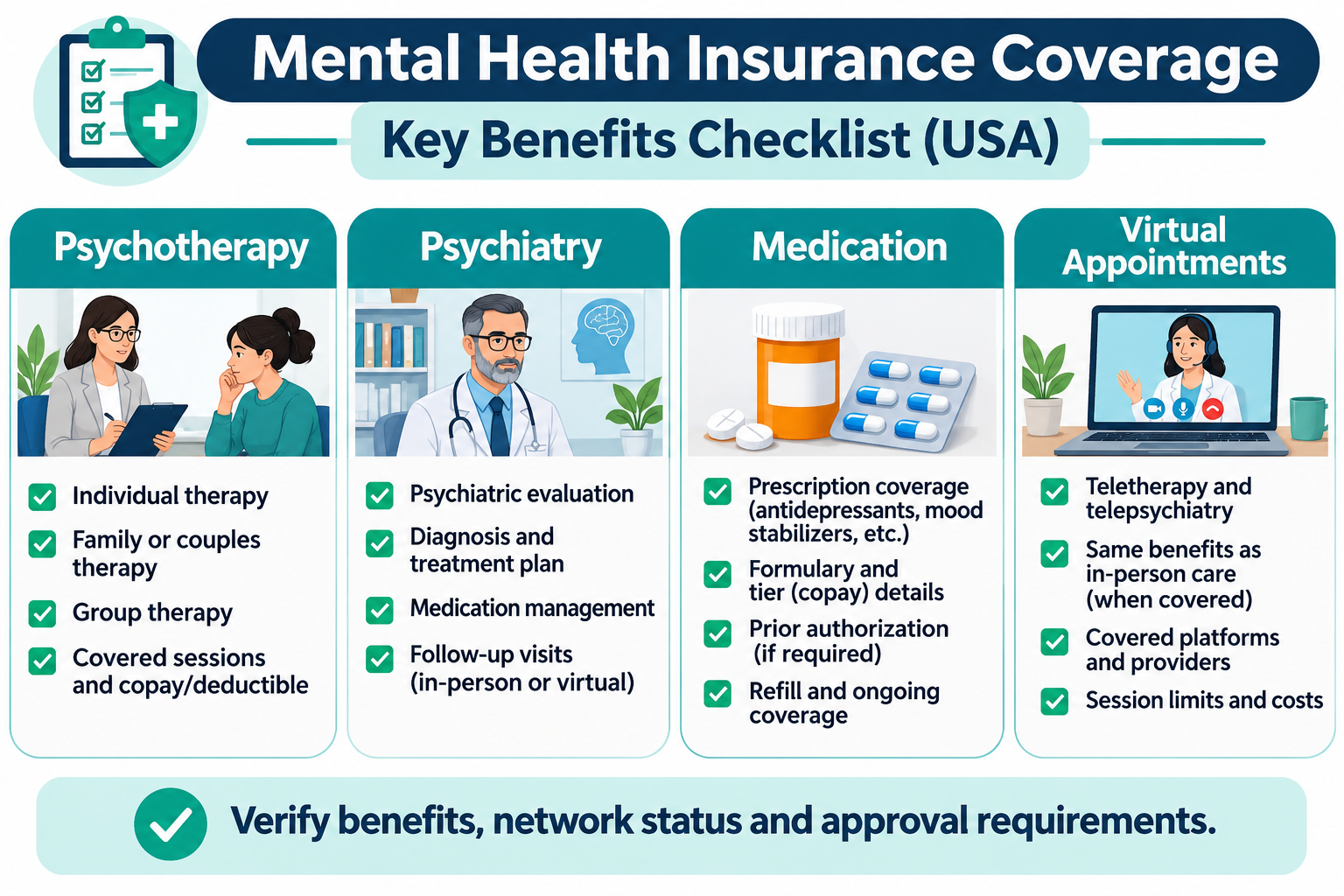
Psychotherapy involves structured work with a trained professional to address emotional, behavioral or psychological difficulties. Ask whether your policy covers individual, group or family sessions when medically appropriate. Coverage for a particular format, frequency or provider is not guaranteed by the general term counseling.
Before making an appointment, obtain the expected charge and confirm the professional’s license, network status and ability to bill your plan. Ask whether the first assessment has a different charge from later appointments. If more than one person participates in treatment, clarify whose coverage will be billed and how the provider handles that arrangement.
Psychiatric assessment and medication management
Psychiatrists are physicians who specialize in mental healthcare. Other appropriately licensed professionals may also prescribe psychiatric medication within their professional and jurisdictional scope. Ask about the costs of an initial evaluation, subsequent monitoring and relevant laboratory tests. A medication management visit may have different billing arrangements from psychotherapy.
A plan may cover psychiatric appointments while placing particular medications in different formulary categories. Review both the medical and pharmacy benefits. If you need multiple specialists, consider how they will communicate and whether your primary care clinician can help coordinate treatment.
Mental health insurance coverage under the Affordable Care Act
The individual Marketplace requires behavioral healthcare benefits that address mental illness and substance use. This includes outpatient treatment and other categories of care described in the policy. Marketplace coverage is also subject to applicable protections for existing health conditions. Read the official behavioral health benefit overview when comparing plans.
Required benefit categories do not mean every therapeutic approach, clinic or medication must be paid for under identical conditions. Review the contract and ask about service-specific limitations. Workplace insurance and other coverage pathways may operate under different requirements.
Mental health parity: protections and practical limitations
Mental health parity concerns differences in how insurers restrict behavioral health benefits compared with medical and surgical care. Depending on the applicable law and plan, protections can address financial requirements, numerical limits and administrative barriers. Parity does not mean that every medical and psychological appointment must have an identical price.
Federal parity law remains relevant, but enforcement of newer regulatory provisions is not identical to enforcement of the underlying statute. As of November 2026, federal implementation and enforcement guidance continues to evolve. The Department of Labor’s September 2026 Field Assistance Bulletin 2026-03 identifies enforcement priorities related to exclusions, medical necessity review and network adequacy. Readers should consult the current parity law and regulation resources rather than assuming every provision of a particular final rule is enforced uniformly.
If your plan appears to impose an unusual restriction on mental healthcare, ask how the requirement was established and whether comparable restrictions apply to medical services. Keep written records. A state insurance department or the appropriate federal benefits agency may help determine the relevant complaint process.
Medicare and Medicaid mental health benefits
Original Medicare
Medicare Part B provides benefits for eligible outpatient behavioral health services, while Part A may help pay for qualifying inpatient hospital treatment. Drug coverage may be available through a separate Part D arrangement. Verify whether the professional accepts Medicare and whether your supplemental or other insurance changes your personal expenses.
The official outpatient mental healthcare page explains covered services and provider requirements. The inpatient coverage page describes the hospital benefit. Medicare Advantage beneficiaries should consult their own plan about networks and authorization.
Medicaid and CHIP
Eligibility and benefit delivery depend on the state and applicable program. Contact the state Medicaid agency or managed care organization to locate participating providers, understand referrals and verify covered services. Children and adults may have different care arrangements. Do not assume that a provider accepting one Medicaid plan accepts every plan in the state.
Coverage for intensive mental health treatment
Some people need more support than occasional outpatient appointments. Intensive outpatient programs and partial hospitalization may involve structured treatment over multiple sessions or days without an overnight hospital stay. Inpatient care provides a different level of supervision and treatment. The correct setting depends on professional assessment and safety needs.
Medicare describes eligibility for intensive outpatient services and partial hospitalization. Other insurance contracts can use different program requirements. Confirm facility participation, professional charges, authorization and expected patient expenses before planned admission when feasible.
Specialist interventions such as electroconvulsive therapy or transcranial magnetic stimulation may require specific clinical indications and documentation. Ask about the coverage policy, approved setting and separate fees. A treatment should not be selected simply because an insurance policy reimburses it.
How much does mental health insurance coverage cost?
Your personal expenses depend on the contract and the services you receive. A premium maintains enrollment, a deductible may apply before some benefits are paid, and copayments or coinsurance determine additional costs for covered services. Some plans cover certain appointments before the deductible is reached; others handle them differently.
Imagine a hypothetical patient who attends 24 therapy visits each year. With a $30 charge per covered appointment, the annual therapy expense would be $720. A different policy might require $75 per visit, producing $1,800 in annual therapy expenses. These fictional charges do not represent market averages or insurance quotations. Premiums, medication, psychiatric visits and other medical needs must be included separately.
Use the Marketplace total cost guide to compare expected expenses. Review both an ordinary treatment year and one requiring more appointments. If a policy has an out-of-pocket maximum, establish which covered expenses count toward it. Premiums and excluded services generally do not count.
Does insurance cover online therapy?
Virtual behavioral healthcare can reduce transportation barriers and make follow-up appointments easier for some people. Coverage may depend on the provider, platform, location, service format and applicable telehealth rules. Verify whether video or telephone appointments are included, whether the clinician may legally treat you in your location and whether your exact insurance policy is accepted.
A subscription service may advertise that it accepts insurance while excluding particular plans or services. Ask for a written breakdown of subscription fees, covered visits, cancellation conditions and any additional prescribing charges. Do not assume a monthly platform fee will count toward your insurance deductible.
Prescription medication and mental health insurance coverage
Prepare a medication list containing the exact prescribed formulation, dose and pharmacy. Review the formulary, refill limits, preferred pharmacy arrangements and approval criteria. Ask whether a new prescription, dosage change or brand substitution would require fresh approval.
Some treatments require laboratory monitoring or follow-up examinations. These expenses may be billed separately from the medication itself. Discuss expected monitoring with your prescriber and ask the plan about participating laboratories.
Never discontinue or adjust psychiatric medication solely because of an insurance difficulty without seeking medical advice. If a refill is delayed or unaffordable, contact your prescriber and pharmacist promptly to arrange a clinically appropriate solution.
Mental and physical health: coordinating insurance benefits
Many people require both behavioral and physical healthcare. A plan that supports coordinated care may be more practical than one that provides limited access to several disconnected providers. Consider how primary care, psychiatric care and other specialists will communicate, with appropriate consent and privacy safeguards.
BBH provides educational resources about diabetes and anxiety, diabetes and depression and diabetes distress. These articles can help readers identify questions to raise during care planning. Explore the wider BBH Mental Health resource hub for additional education.
When mental health insurance coverage does not lead to appointments
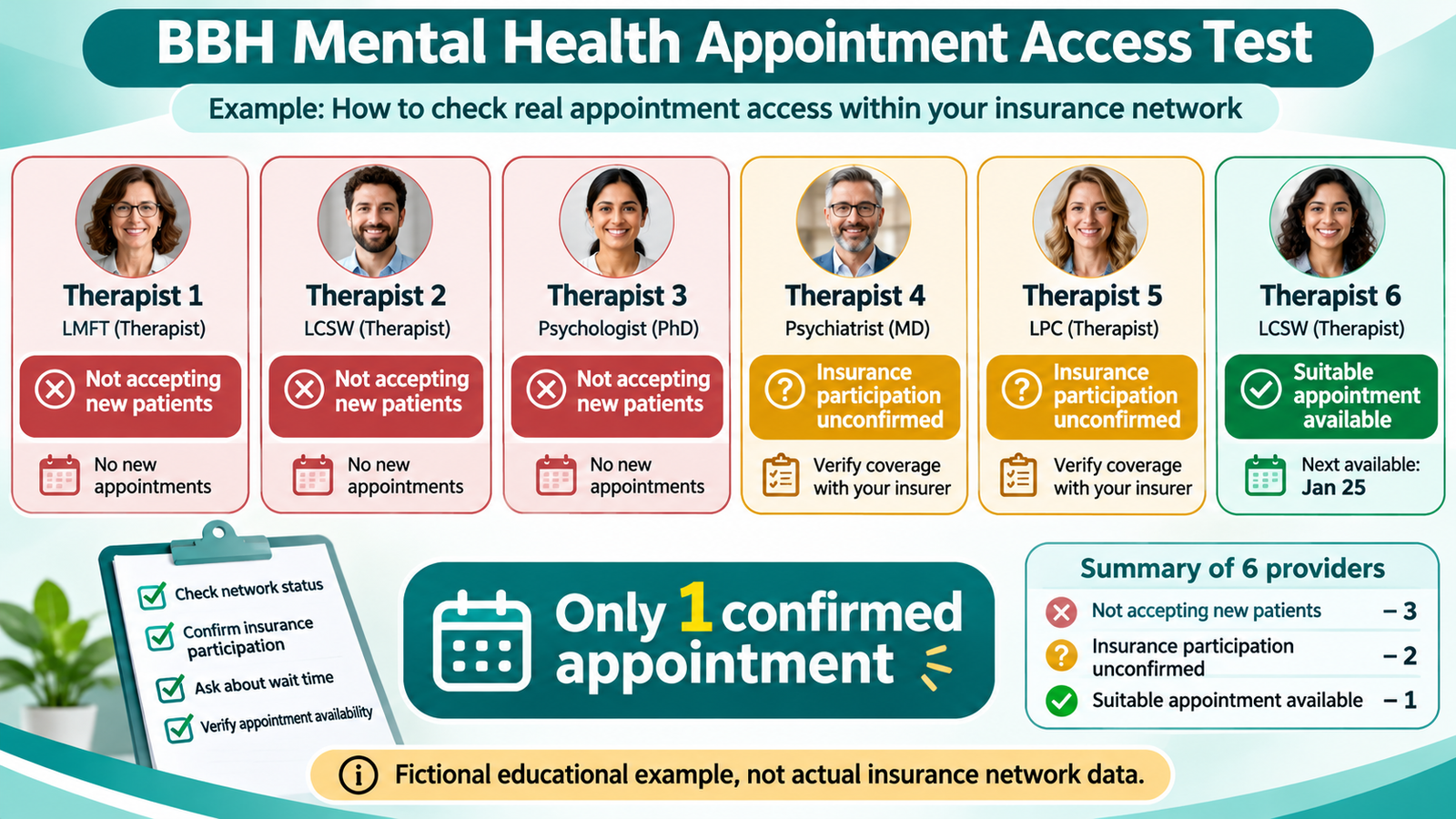
A provider directory may list many practices without establishing that they are accepting new patients. Contact several suitable professionals and record their responses, including waiting times and whether they accept your particular policy. Ask your insurer for assistance finding an appointment within a clinically appropriate timeframe.
If no suitable participating provider is available, ask whether the contract allows a network exception, single-case agreement or another arrangement. Such options are not automatic entitlements under every policy. Obtain the approval and expected payment terms in writing before beginning planned out-of-network care where possible.
For out-of-network appointments, a therapist may provide a detailed receipt sometimes called a superbill. This document does not guarantee reimbursement. Ask about out-of-network benefits, eligible charges, separate deductibles and the claim submission process.
Original BBH appointment access test
Before enrolling or renewing, distinguish a listed provider from a reachable appointment. Choose a few clinically appropriate practices from the directory and record the date contacted, exact plan name, whether new patients are accepted, earliest appointment, telehealth availability and estimated patient cost. Record whether the practice confirmed these details or whether they remain unknown. Do not put sensitive clinical history into a public spreadsheet.
When requesting assistance, provide the dates and outcomes of your attempts and ask for a suitable appointment, a written explanation of available network exceptions, and applicable complaint or appeal instructions. The Department of Labor identifies network admission criteria, reimbursement methodologies and medical necessity review among its current parity enforcement concerns. Difficulty finding a therapist does not by itself prove a legal violation.
What to do when insurance denies mental health treatment
Obtain the denial notice and identify the exact reason. A rejection can involve a billing problem, missing clinical information, network status, an authorization issue or a service exclusion. Ask the insurer for the relevant policy language and appeal instructions.
Work with the treating professional where additional clinical documentation is appropriate. Keep copies of submissions, dates and reference numbers. Depending on the applicable protections, internal review and independent external review may be available. The official insurance appeals guide explains these pathways.
Ask about accelerated review when a delay may seriously affect health. An appeal is not a substitute for crisis care or urgent medical assessment. If the issue concerns workplace coverage, the appropriate federal benefits office may provide assistance; for regulated individual policies, your state insurance department may also be relevant.
BBH mental health coverage comparison worksheet
For every candidate policy, record the monthly premium, behavioral health deductible, expected therapy charges, psychiatric appointment charges, medication expenses, virtual care rules, and the costs of intensive programs when relevant. Write down the names of clinicians you wish to continue seeing.
Confirm the exact plan identifier with each practice. Ask whether new patients can obtain an appointment, whether your treatment requires referrals and how authorization renewals are handled. Save dated confirmations and benefit documents. Protect private medical information and share only what is necessary with verified parties.
Before changing policies, ask about continuity of ongoing treatment and medication refills. Arrange a safe transition with your clinicians. Confirm the new plan’s effective date and payment requirements before ending existing coverage.
Related BBH resources and free budget worksheet
Compare general insurance terminology in Private Health Insurance in the US and retirement coverage in Medicare Supplement Plans. The three diabetes and mental health articles linked earlier provide additional context for coordinated treatment. Visit the Health Insurance and Healthcare Costs support page for related guides.
Frequently asked questions
Can I get Marketplace insurance if I have depression or anxiety?
Yes. Existing mental health diagnoses do not disqualify someone from Marketplace coverage or justify higher premiums based on health status. Ordinary enrollment and eligibility rules still apply.
Does insurance pay for unlimited therapy?
Not necessarily. Check the service criteria and applicable parity protections. Ask for a written explanation of any restriction.
Does a psychiatrist cost more than a therapist?
The answer depends on the appointment, professional, insurance contract and setting. Obtain a specific estimate rather than relying on a general assumption.
Can insurance cover online counseling?
It may. Confirm the provider, service format and location requirements with your exact plan.
What if I cannot afford treatment?
Ask about community mental health services, public coverage eligibility, sliding-scale clinics and available financial assistance. If there is a crisis, seek timely help rather than waiting for financial arrangements.
Conclusion
Mental health insurance coverage is most useful when it provides practical access to qualified professionals and appropriate treatment at manageable cost. Compare plan documents, confirm appointments and medications, understand parity protections and document coverage decisions. The best choice depends on individual needs rather than a universal insurer ranking.
Editorial disclosure: Key HealthCare.gov, Department of Labor and Medicare outpatient and intensive treatment guidance checked November 29, 2026. This article provides general education, not individualized clinical, insurance or legal advice. Confirm current benefits and applicable rules with qualified professionals.